Friday, December 22, 2017

Friday's Forgotten Books: E PLURIBUS UNICORN by Theodore Sturgeon; NINE HORRORS AND A DREAM by Joseph Payne Brennan; (HORROR STORIES FROM) TALES TO BE TOLD IN THE DARK edited by Basil Davenport


FFB bonus: 
Robert Bloch, 1979:
Leigh Brackett, J. Francis McComas and Eric Frank Russell in memoriam


"I have always felt that, at his best, nobody wrote better science fiction and fantasy than Ted Sturgeon." Richard Matheson, newly released 1992 interview with Richard Lupoff and Richard Wolinsky


from the Contento index:
E Pluribus Unicorn Theodore Sturgeon 
(Abelard, 1953, $2.75, 276pp, hc; Ballantine, 1956, pb; 
cover by Richard Powers)

· Essay on Sturgeon · Groff Conklin · in
· The Silken-Swift · nv F&SF Nov ’53
· The Professor’s Teddy-Bear · ss Weird Tales Mar ’48
· Bianca’s Hands · ss Argosy (UK) May ’47
· Saucer of Loneliness · ss Galaxy Feb ’53
· The World Well Lost · ss Universe Jun ’53
· It Wasn’t Syzygy [“The Deadly Ratio”] · nv Weird Tales Jan ’48
· The Music · vi *
· Scars · ss Zane Grey’s Western Magazine May ’49
· Fluffy · ss Weird Tales Mar ’47
· The Sex Opposite · nv Fantastic Fll ’52
· Die, Maestro, Die! · nv Dime Detective Magazine May ’49
· Cellmate · ss Weird Tales Jan ’47
· A Way of Thinking · nv Amazing Oct/Nov ’53

This was only the second collection of Sturgeon's work, and the most eclectic one readers would see at least until the the Dell collections published at the turn of the 1980s...given the mix of western, suspense, horror, fantasy and sf, perhaps not until Paul Williams got The Sturgeon Project and its volumes of his complete short stories under way more than a decade after that. And while the first collection and several to appear shortly afterward snagged such notable stories as "It" and "...And My Fear Is Great...", this is as good a core-sampling of Sturgeon's work as one could ask for. "Bianca's Hands" is the story that Unknown's John W. Campbell was so disturbed by that he sought to convince other editors not to publish it; happily, the editors at Argosy's British edition, slightly more sophisticated than even the good US version of the magazine, decided that it deserved to win a contest they were running...with the runner up being Graham Greene. "A Saucer of Loneliness" is barely an sf story at all, with the alien visitation theme added only when Sturgeon couldn't place the story in paying non-sf markets (and it's an excellent story even with that market improvisation in place). "The Professor's Teddy Bear," "Fluffy" and "Cellmate" are expert horror, as is the even more disturbing "A Way of Thinking" (improbably first appearing in theoretically science-fictional Amazing rather than its fantasy/sf companion Fantastic), which, like "Bianca's Hands," had waited several years for a market willing to take it on. "The World Well Lost" was the first story to be published in the sf magazines to argue for acceptance of homosexuality, and it's a credit to editor Bea Mahaffey as well as to Sturgeon that it appeared in her first issue of Universe Science Fiction. "Scars" is an utterly unfantasticated western, with several sorts of tragic turn running right up to its conclusion. "The Silken Swift" is a fine, gentle fantasy (and the source of the book-title's unicorn); "It Wasn't Syzygy" one of the first works tackling the recurring Sturgeon fascination with synergies of personality and greater forces that might thus be generated...his novel More Than Human would be another example, as is this volume's "The Sex Opposite."

(The Pocket Books reprint I was quite happy to purchase in a supermarket in 1984. You never know where Sturgeon's work would turn up...an sf short story in Sports Illustrated, as the only book reviewer, I suspect, to ply that trade in all four of Venture Science Fiction, National Review, Galaxy and Hustler, in that order...etc....)


from ISFDb:
Nine Horrors and a Dream by Joseph Payne Brennan (Arkham House, 1958; Ballantine 1962); cover by Richard Powers (contents first published in this collection except as noted)

1 • Slime • (1953) • novelette (Weird Tales, March 1953)
33 • Levitation • (1958) • short story
39 • The Calamander Chest • (1954) • short story (Weird Tales, January 1954)
51 • Death in Peru • (1954) • short story (Mystic Magazine, January 1954)
61 • On the Elevator • (1953) • short story (Weird Tales, July 1953)
71 • The Green Parrot • (1952) • short story (Weird Tales, July 1952)
79 • Canavan's Back Yard • [Canavan] • (1958) • short story
95 • I'm Murdering Mr. Massington • short fiction
101 • The Hunt • (1958) • short story
113 • The Mail for Juniper Hill • short fiction

Joseph Payne Brennan was a less fully-realized artist than Sturgeon was, and not as deft nor as careful with his prose (few have been); but nonetheless, Brennan did good work in the field of horror in at least two ways, with the brilliant vignette "Levitation" and such perhaps more-famous stories as "Canavan's Back Yard," "The Calamander Chest" (which Vincent Price would record for a Caedmon LP in the mid '70s) and, most famously, "Slime"...a long story that if it isn't the only parent of the film The Blob, is still the most important one (and rather an improvement on the somewhat cruder similar story in the first issue of Weird Tales from 1923, "Ooze" by Anthony Rud). As one of the last great "discoveries' for the original Weird Tales magazine before it folded in 1954, Brennan's other notable contribution was in publishing the occasional little magazine devoted to horror and related matter, Macabre, in the latter '50s and into the 1970s, by which time several small-press magazines had picked up the torch. As Avram Davidson concluded his positive review of this book in F&SF, "Mr. Brennan is perhaps not M. R. James...but who is?"


courtesy Vault of Evil:
Tales To Be Told in the Dark, edited by Basil Davenport 
(Dodd, Mead 1953; abridged edition, as Horror Stories from..., Ballantine, 1960; cover by Richard Powers)

William Fryer Harvey - The Beast With Five Fingers
Stephen Hall - By One, By Two, By Three
Saki - Sredni Vashtar
Lord Dunsany - The Two Bottles Of Relish
Margaret Irwin - The Book
John Collier - Thus I Refute Beelzy
[James Thurber - The Whip-Poor-Will--omitted in the Ballantine edition]
Arthur Machen - The White People
Lafcadio Hearn - Mujina
Saki - The Open Window
Basil Davenport - Two Anecdotes
Anon - The Closed Cabinet
Basil Davenport - The Closed Cabinet Retold

Critic and historian E. F. Bleiler is quoted in the capsule review at Vault of Evil: 
"Davenport, recognizing that 'The Closed Cabinet' is cumbersome, badly plotted and barely intelligible, has shortened the narrative greatly and reworked the story. It was not worth the effort."


While Davenport was a literary gadabout in the 1950s and up till his death in 1966, and a friend to fantastic fiction, this anthology is a very mixed bag, indeed, despite the excellent stories by John Collier, Lord Dunsany (his already a relish-drenched chestnut by 1953), Harvey and Saki. The anecdotes are mild jokes, the punchline of one being a rather elderly pun: "I was told to always strike a happy medium.") Davenport's instructional tips on how to tell stories are rather good, better the most of the balance of the fiction here ("Mujina" has been improved upon from Hearn's version, though I'm damned if I can remember whose very similar story I was fortunate enough to read not long after first picking up this book). Apparently, the other Ballantine anthologies attributed to Davenport were ghost-edited, but I suspect this one is so idiosyncratic that only Davenport himself would've chosen the contents, since he also annotates them. An interesting curio, and with the third of a trio of rather good Richard Powers covers, from this age of Powers's work appearing on many Ballantine and Berkley items particularly. 


A redux post from 2013.
For more of this week's books, please see Patti Abbott's blog 

Friday, December 15, 2017

Victoria Kemp on Bill Crider

I've never met Bill Crider. I just read his books and then started following him on Facebook. He posted regularly, both as himself on his personal and on his author page. His author page was a fun amalgam of vintage advertisements; songs of the day; announcements about his writing, including his appearances at various mystery cons around the country, not to mention interviews with all his mystery writing buddies. His personal page was a wonderful glimpse into the life of a man who loved his wife (who died too soon) and his cats, the VBKs, Gilligan, Keanu and Ginger Tom. He wrote prolifically, separate series: Sheriff Dan Rhodes; Truman Smith; Carl Burns and Sally Good, not to mention co-authoring books with Willard Scott and several stand-alone westerns. His writing seemed to me to illustrate who he was as a man, plain-spoken and straight-shooting. 

Cancer sucks. It has taken too many people from my life. And, now, I will lose an author whose writing has taken me places I would never go by myself. 

Fuck cancer.

Victoria Kemp

Richard Lupoff on Bill Crider

I can only recall meeting Bill Crider once--at a Bouchercon--but wish I'd got to know him better. In person he was a pleasant person. "Comfortable" strikes me as the appropriate word. He was courteous and relaxed. We also corresponded, and read each other's books. I'm sure it didn't hurt, but he seemed to like mine, and reviewed them on occasion, in a sensitive and positive manner.

His own books reflected his nature: courteous, thoughtful, intelligent. He seemed to be rather like Tony Hillerman. His heroes were rather like him. His killers, like Tony Hillerman's, were more broken and warped individuals rather than human monsters.


He has always been an ornament and an asset to our community. As long as he is with us he will continue to be a shining light.

Dick Lupoff


Richard Lupoff: "Writing Backwards" at Mystery Fanfare 

Richard Lupoff on Sweet Freedom
Pat and Dick Lupoff back when they were helping to found comics fandom and more recently

Karin Montin: Meeting Bill Crider

Meeting Bill Crider
Bill at the 2010 San Francisco Bouchercon

I first heard of Bouchercon, the world’s biggest convention for mystery fans (and authors) through Rara-Avis, an online discussion group devoted to hardboiled and noir writing. Bill Crider was a frequent contributor. I couldn’t miss the 2004 con in Toronto when I live practically next door in Montreal.
A number of us, including Kevin Smith, Marianne Macdonald and Kerry Schooley, attended a face-to-face meet-up organized by Rara-Avis founder Bill Denton. It was a pleasure to meet other members like Brian Thornton, Jim Doherty and Jason Starr at the con, too. 


But it was Bill Crider who made the biggest impression on me. Bill has published over 100 books in several genres, while teaching at a couple of Texas colleges and continuing into retirement. His late wife, Judy, was Bill’s first reader, and he always acknowledged her contribution to his work. Far too few male authors make that a practice. Bill and Judy attended many mystery, western, fantasy and SF book conventions together. I found them to be warm, interesting conversationalists.
 

At other Bouchercons in subsequent years, I crossed paths with Bill and often Judy. I would go to panels where Bill was featured and he was gracious enough to say that he always appreciated seeing familiar faces in the audience. 

Bill collects novels never published in hardcover, mostly mysteries and science fiction. (There are pictures of part of his tremendous collection on the Web.) He generally attended only panels he was on, preferring to browse and schmooze, so he could often be spotted in the booksellers’ room.
 

In Baltimore I ran into him in the book room.
“See anything here you need, Bill?”
“Well, I can’t say that I need any more books, but there’s one over there I’d love – Reform School Girl. It’s a really important paperback original.”
“Why didn’t you snap it up?”
“They’re asking $1,750.”


So there are limits to the madness. Or so I thought at the time. In correspondence Bill later admitted that he wasn’t sure his mania did have a limit.
 

“I keep looking at copies of Reform School Girl with longing. Who knows when I might break down?” 

I wonder if he ever yielded to that temptation.


Unlike many collectors who never even turn the pages of their cellophane-wrapped prizes, Bill is an avid reader. Not only that, he remembers the details, making him an invaluable source of information on pulps and later publications.


In addition to writing books, Bill has always been ready to offer encouragement to aspiring writers. From talking to him, I knew he would be. He’s kept at least two blogs, one on jogging and the other a “Pop Culture Magazine” in which he posts links to humorous and informative articles on a wide variety of topics. It must be said that he has a weakness for certain subjects, like Bigfoot, alligators and crocodiles, “the Thin Mints melee” and related incidents, and for a while, Paris Hilton. 


Several years ago, when Judy was diagnosed with cancer, Bill shared their journey through treatments and relapses up to her death, frankly and unsentimentally, yet lovingly. It was very touching. When he himself became sick, his posts on the subject were far fewer and less detailed, but even his recent announcement that his days are numbered was characteristically frank and unsentimental.

 
I would like to say I’ve read everything he’s written, but I don’t think that will ever be possible. Nonetheless, I have enjoyed every word of the dozen or so books and countless blog and Facebook posts, and generous correspondence I have had the privilege of reading. 


I miss Bill’s daily posts now and will miss him for a long time to come. 


Karin Montin

Karin on Dead to Begin With by Bill Crider

More on Bill Crider

Bill Crider, and some of his work and play, including some short stories: the FFB Crider Celebration Week

The Next Edition Quartet: Bill Crider, Ed Looby, Gary Logsdon and Richard Wolfe: "The Lion Sleeps Tonight"


Bill Crider: How I Became a Mystery Fan

Karin Montin: Meeting Bill Crider

Victoria Kemp on Bill Crider

Richard Lupoff on Bill Crider

Richard Moore on longtime fellow-fandom and Bill's Truman Smith novels

James T. Cameron: We'll Always Have Murder: A Humphrey Bogart Mystery by Bill Crider

Curtis Evans: Romanced to Death by Bill Crider

Todd Mason:
I first "met" Bill Crider virtually, via the discussion groups on the web or which used email to distribute posts to the correspondents (or, eventually, both)...someone, I've managed to forget whom, was running a western-fiction discussion forum, Read the West, on the web, which rather suddenly shut down...but not before I became aware of discussion groups such as WesternPulps, conducted by James Reasoner, and Rara-Avis, conducted by William Denton. Though old friends and fellow crime-fiction fans and/or DAPA-EM contributors such as James and Richard Robinson contributed to the R-A list earlier, Bill's first post I can find on Rara-Avis is this:

Bill Crider [at his Alvin Community College address]
Sat, 26 Sep 1998 08:58:53 -0500


I've been lurking on this list for quite a while now, and I know there's some interest in the books of Robert Skinner. I thought the first two books (BLOOD RED, SKIN DEEP and CAT-EYED TROUBLE) were excellent. I was eagerly looking forward to the third book in the series. But now I may never see it. Kensington had the book set in print, had the cover designed, and even had bound galleys done. But the swine canceled publication! "Not enough advance orders" was the official reason given. If you've ever given thought to boycotting a publisher or writing an irate letter, Kensington is a deserving target. Bill Crider

...Rara-Avis always has encouraged a certain feistiness, as well as a certain likelihood that justice might be called for (and certainly Kensington has had more than a few sins to atone for over the decades). I joined there in the next year, along with FictionMags (where Bill would eventually join us in 2004) and WesternPulps. 

Bill was a consistently gracious and good-humored contributor, as you've probably experienced or very likely read from others if you're reading this when it's posted, on our Friday Books Celebrate Bill day...the late Mario Taboada and I would eventually begin conducting Rara-Avis when Bill Denton wanted to step away, and the flow of discussion there and on WesternPulps has slowed considerably over the years, with occasional flurries of new discussion and no lack of good contributors still subscribing. But, for many of us not excluding Bill most of the discussion started to move onto blogs (and Facebook, though Bill was less engaged there) by the mid 2000s. 

Bill Crider interviewed (via video chat) on Debbi Mack's The Crime Cafe, 2015


Bill was a poet even before a published fiction writer...sometime over the last couple of years, he took down the poetry and life-as-a-runner blogs he had going alongside Bill Crider's Popular Culture Magazine, and I've missed them.  I'm not sure how many of his short stories (a very few, I think) appeared before his first novel, The Coyote Connection (Ace/Charter 1981, with Jack Davis--not the cartoonist, but at the time a carpoolmate) a collaborative entry in the revived Nick Carter series (which had the venerable detective recast as a Men's Adventure Series spy or "Killmaster"). But I thought I'd cast around for a few of his stories for this week's FFB in books I've been meaning to write up for the Friday Books roundelay.

Quite probably the first time I saw Bill's byline was on the story "Wolf Night" in Ed Gorman's anthology, a mix of reprinted and original stories, the latter including Bill's, Westeryear (M. Evans, 1988). I picked up a library discard copy of the large print edition sometime around 1993-4,  Bill gets to have some fun with this historical western, touching on his love of  B and modestly-budgeted A western films, and horror films from the same era and level of studio support, in this tale of a strange menace attacking the women of a small Texas town in the post-Civil War era...but only on the nights with a full moon...and how the European immigrant schoolteacher in the town knows what might explain this, and what might be needed to stop this slaughter. You're likely to guess at least one of the surprises Bill has planted in this story as it reaches its conclusion, but he is having such fun with this, and sharing that fun, that I doubt you'll be too impatient in your anticipation. 

Rosalind and Martin Harry Greenberg and Charles Waugh's 14 Vicious Valentines (Avon, 1988) was an almost all-original anthology of short stories, and Bill's then new "My Heart Cries for You" is a much more thoroughly grim and noirish affair...there's some humor, including a few jokes that I suspect Bill might not've cracked not too long after he wrote this three decades or so ago, but which can be taken in stride when one considers these characters making the joking references are even more pathetic versions of the kind of "mean furniture" John D. MacDonald, and no few of the other writers Bill admired who were most active in the '50s and '60s, would describe.  The attempt at a long con, between a sort of low-rent Lothario and the woman who disgusts him, and her brother who hopes to have the protagonist bump her off, is well-told and has a very deeply felt sort of cosmic justice built into its climax. You might also detect a hint of Dortmunder or Ron Goulart characters in the attempts our anti-hero makes.

Karen and Joe R. Lansdale's Dark at Heart (Dark Harvest, 1992) feature's Bill's "An Evening Out with Karl", a leaner and even more vicious exploration of some of the same motifs at play in "My Heart Cries for You"; Karl is a predator, looking for tonight's woman Who Is Asking For It, It being a brutal rape if Karl can pull it off. So far, he's been able to avoid capture, and nearly half the too-numerous women he's assaulted haven't even reported the attack to the police, as far as he can tell. Karl prefers to do his hunting in small dance clubs, never visiting any two twice, then usually follows his victim home, breaking in while wearing his ski mask. This night, however...things don't go as planned. The sense of rough justice is also on display here, and some of the jokes in "My Heart..." are turned around in this one, literally as well as figuratively. Probably not a story you'd tell your children before bedtime (as this anthology isn't reaching for that sort of story at all), but if one wondered if Bill was sublimating some of his angrier impulses in some of his fiction, particularly these short stories, it wouldn't seem too wild a surmise. 

Jayme Blaschke interviewed folks at the 2016 ArmadilloCon, to help raise the spirits of Bill, who couldn't attend. A number of these brief statements are at this link, and here's Joe R. Lansdale's contribution:


Others are likely to cite Bill's work as a writer of nonfiction about crime fiction and popular culture, and at least one contributor to this blogpile was hoping to write about Bill's blogging work particularly, which leads me to mention one of his last regular deadline-hitting tasks, along with his contributions to Friday's Forgotten Books, the (real soon now) to be revived and regular Tuesday's Overlooked A/V, and Monthly Underappreciated Music roundelays: his continuation of the "Blog Bytes" column Ed Gorman had started in Ellery Queen's Mystery Magazine...which, we hope, might continue...in the current issue, one of Bill's columns is in place, but one suspects that there're not too many more in inventory at this time. Bill has cited most of the blogs he frequents which have some notable amount of attention to crime fiction, including this one, which got Sweet Freedom one of the biggest spikes in its viewership/readership it's had. And that only one of the smaller services Bill has performed for so many of  his friends and acquaintances, and the readers of his fiction and nonfiction and the fiction he's loved. And only a small token of his kindness toward me, and his willingness (as with James Reasoner, John Grant, Patti Abbott and others) to help out librarians and others trying to find "lost" and poorly-remembered items for their patrons and others...something I engage in through several mailing lists I'm still a member of. 

 Among Bill's "Very Bad Kittens"/VBKs videos...a fairly recent one, of them as young adult cats...


Bill is a wonderful man, and an excellent writer, and now a blasted disease is taking him much as it took his beloved wife Judy not so long ago, and leaving his adult kids and siblings...and Bill's cats, a trio of siblings who've become a very popular feature of Bill's Facebook account, and all his good friends and the rest of us that much less excellent company in this life. We hope, if you haven't read his work before, that this set of remembrances might nudge you along. I've met him face to face only once, at the mildly 9/11-haunted 2001 Bouchercon only a few miles from the Pentagon, but he's been a consistently good man to know, and I wish there was more I could do to make things better for him. He's certainly done a lot for a lot of us.


Bill Crider, Angela Crider Neary and Dana Cameron at the 2017 Bouchercon courtesy EQMM
 Angela Crider Neary on attending the 2017 Toronto Bouchercon with Bill.

Bill Crider on Facebook, 15 December 2017: Overwhelmed by kind thoughts and appreciation of me and my work. Wish I could write more. Can't.

For links to, and hosting some of, this week's reviews, remembrance and more, please see Patti Abbott's blog.

Richard Moore on Bill Crider and his Truman Smith novels and crime-fiction fandom

On Bill Crider:
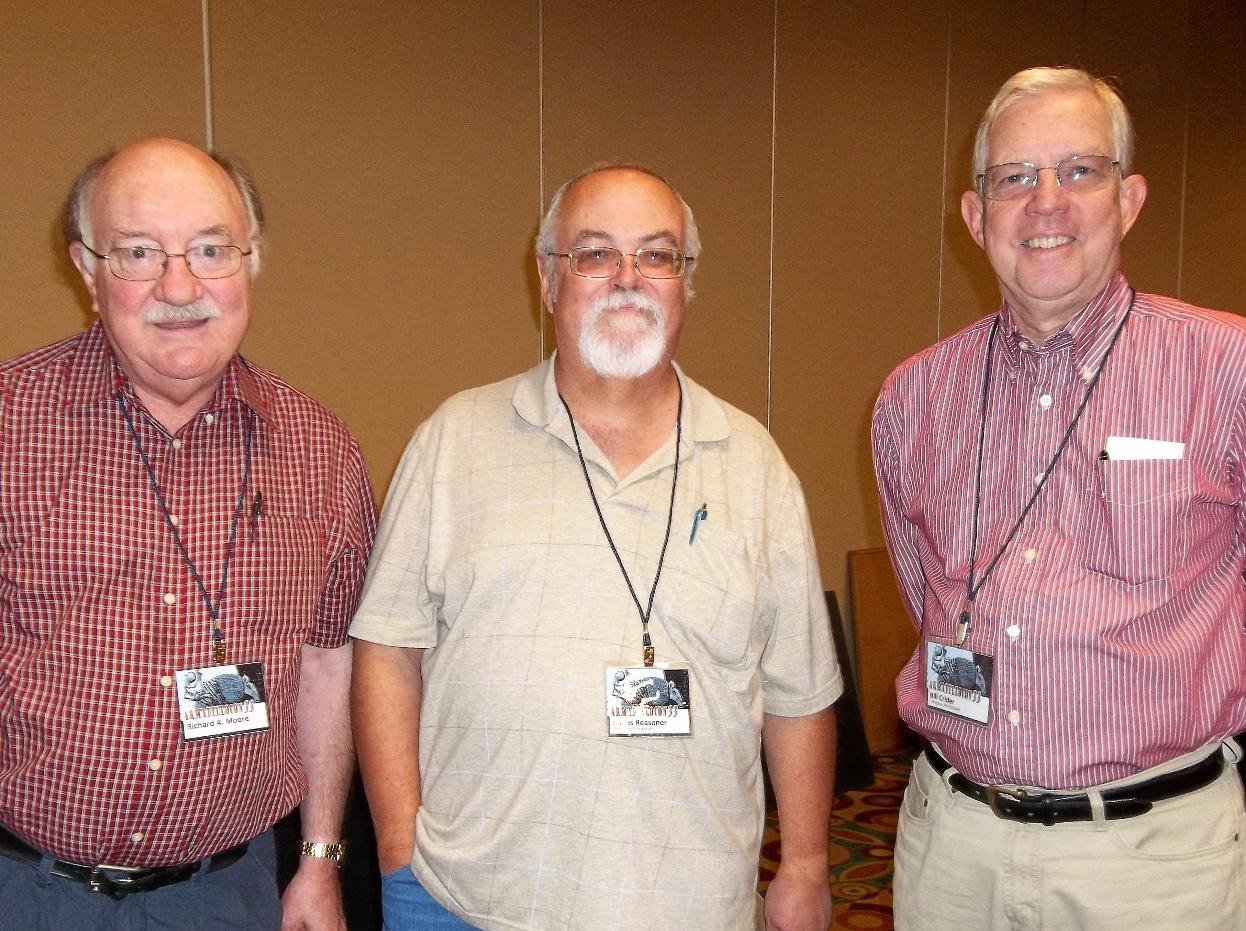
Richard Moore, James Reasoner, Bill Crider
I first got to know Bill Crider in an Amateur Press Association (APA) for mystery fans called Elementary My Dear APA or DAPA-EM. Long before the internet and blogs, groups of fans would do individual “zines” and mail their pages to the Official Editor who would bind them together and send them back out to the members. We were limited to 35 members and the mailings were every other month. As every member would usually comment on each zine, it became 35 individual conversations with weeks of lagtime. We were in DAPA-EM for more than three decades and Bill and I are still in a western APA, Owlhoot.

Decades of mailings become incredibly bulky. Bill has sent all of his to Texas A&M and as a running record of mystery fandom, they certainly have value. Bill began as a fan—when we met, he had one Nick Carter novel credit before finding his voice in mystery, western, horror and other fiction. And Bill does have a distinctive voice—all the great writers do.

It was at conventions that we met in person and over three and a half decades at Bouchercons and regional mystery conventions as well as a few science fiction cons such as ArmadilloCon in Austin. we’d attend panels, roam the dealer’s rooms, stand in line to get favorites to sign books, explore the cities and meet at night to share stories. Bill has one of the great book and paperback collections. I remember standing with him in line at a Bourchercon to get Evan Hunter to sign a few books. He groaned when he saw I had Hunter’s elusive first novel The Evil Sleep (Falcon Books 1952). It was one of the few he didn’t have (he later found a copy).

Bill loved the old paperback original writers such as Harry Whittington, Marv Albert, Peter Rabe. Bill and I always attended the occasional convention appearances of old pulp writers and editors such as Stephen Marlowe (Milton Lesser), Howard Browne, William Campbell Gault and Dwight V. Swain. If I have favorite memories from the dozens of conventions where we gathered they would be the trips to Austin, Texas where Bill and Judy would lead us to some great Tex-Mex food, and then going booking with Crider and Joe Lansdale.

I don’t know about this heaven thing but if I could draw one up it would include a convention with a stocked dealer’s room and a roomy suite with all the old departed gang present: including Barry Gardner, Graeme Flanagan, Bob Briney, Noreen Shaw, Hal Rice, Stan Burns, and with dear Ellen Nehr bellowing at me in a tone worthy of a Wodehouse aunt.

On his Truman Smith novels:

Bill Crider in an afterword to one of his Truman Smith novels wrote: “When I was a child, I thought Galveston was one of the most romantic places in Texas. Many years later, I still do.” That nostalgic atmosphere and love of place runs throughout the series, which was launched in 1991 with Dead on the Island. In that time the glory that was Galveston had faded from the days when it was a wide-open town with gambling, brothels, and nightclubs attracting major acts.
A crusading DA in the late 1950s led a crackdown that closed the dens of iniquity and dumped all the slot machines into the bay. After long decay, some renovations are underway in the historic district during the time in which these novels are set. Today the old Hotel Galvez, built in 1911, has been modernized into a showplace and they still have the Dickens festival in December with various Tiny Tims and Scrooges parading along the Strand.
Truman Smith was a star running back for his Galveston high school and his friend Dino was a linebacker on the same team. Truman ended up at the University of Texas and in his sophomore year blossomed into a major threat. Dino went to Texas Tech was a defensive star.  When the two teams met, a blindside tackle by Dino ended Truman’s football career.
Truman ends up as a private investigator in Dallas but is drawn back to the island to search for his sister who has disappeared.  Despite all his exhaustive work trying to locate her or learn her fate, he fails.   His old friend Dino provides an old house to live in and he scratches out a living taking house painting jobs.  In the opening novel, Dino asks him to locate a different missing girl.  Very reluctantly, Truman takes the case.  
Through the course of this novel (and others in the series), he has to dig through a lot of family histories and Galveston’s past.  In rereading the series, I was reminded of Ross Macdonald’s Lew Archer novels where so many stories involve hidden family secrets.  
Perhaps influenced by Bill's life-long love of private eye novels, Truman Smith is a more robust figure than Sheriff Rhodes, Carl Burns or other Crider mystery heroes. Although still hampered by his balky knee, Truman can hold his own in a barroom brawl and he has a pistol and will shoot someone if he has to. I like the cast of secondary characters such as Miss Sally, the ancient old lady who sips Mogen David wine and knows all the gossip past and present in Galveston. I just plain love this series and all five novels are available in Kindle editions.


Text copyright 2017 by Richard Moore. For more considerations of Bill and his work, please see Patti Abbott's blog...