Details supplied by Steve Scott. Bluebook would become a shadow of itself by the time its '60s revival as Blue Book for Men staggered into the '80s, but in 1952, it was still riding reasonably high as the sibling magazine of Redbook, though it had just lost its most legendary editor, the late Donald Kennicott, and new editor Maxwell Hamilton was making some changes, including more nonfiction in the mix and moving away from some of the devotion to historical fiction and, to a lesser extent, sf and fantasy. This issue includes such old hands at the magazine and in other pulps and digests of the era as Nelson Bond, Robert Bloch, John D. MacDonald, Tom Roan and a relative newcomer as the only female contributor to this issue, Elsie Lee. Another notable byline is that of Ib Melchior, who would gain his greatest infamy in his scripting and other contributions to some of the worst skiffy films at midcentury, certainly least the Danish production Reptilicus, which was notable in several ways, including having its giant monster portrayed by a poorly-designed and -controlled marionette, and causing havoc by spewing acidic mucus, which the monster belches up by having the yellow/green goop drawn on the negative of the film with what looks like ink. The Bloch novella, "Once a Sucker", is a slightly shorter form of Spiderweb, first published in an Ace Double two years later, in 1954, and reprinted in 2006 with another 1950s Bloch short novel, Shooting Star, in a double-volume by Hard Case Crime. An out of work radio announcer/actor in L. A. is sucked into assisting with an elaborate series of cons by a Very Careful megalomaniac and his collaborators, who begin by setting up fake spiritualism rackets and sexual blackmail stings, while the ringleader is beginning to take his potential leadership in a satanic cult very seriously indeed. The reverberations from, among others, the Jack Parsons, et al., involvement in the Aleister Crowley Thelema cult, and Scientology, and anticipation of the likes of "est", are rather deftly employed here, along with laying out some of the various tricks of the "psychic" trade and means of encouraging potential cult members to Get and Stay In Line. Bloch lays the jokey patter on a bit heavily at first, and then gets down to business. It's not quite noirish nor hardboiled, but it's in the neighborhood. The John D. Macdonald vignette "Delivery Boy War" involves the trade-offs military life requires of married couples, in this case the relatively dangerous duty faced by US pilots and crew even in transporting fighter planes from the U.S. to South Korea, during our Police Action of the '50s. Morale and how it can be (barely) maintained is the subject, and it's treated sensibly in the narrative, as was JDM's wont. Elsie Lee's vignette "Ever Since Eve" is a bit of folktale/joke satire of the vicious pomposity of foolish judges, albeit set perhaps unfortunately in historical Arabia. It makes its point. I shall be reading at least the Roan and Bond stories soon. FFB reviews of Spiderweb by Robert Bloch: James Reasoner (and again for the Bloch Centennial) Ed Gorman (and hosted by Patti Abbott) For more of today's stories, please see Patti Abbott's blog. |
Wednesday, March 30, 2022
Short Story Wednesday: BLUEBOOK, August 1952, edited by Maxwell Hamilton (McCall Corp., publishers): a novella by Robert Bloch, short stories by John D. MacDonald, Nelson Bond, Tom Roan, Elsie Lee
Wednesday, March 23, 2022
Short Story Wednesday: BEST DETECTIVE STORIES OF THE YEAR: 17TH ANNUAL COLLECTION (1962) edited by "Brett Halliday" (Davis Dresser)
first edition (Dutton '62) pagination:
7 · Foreword by "Brett Halliday" (Davis Dresser)
11 · Service Call · Bruno Fischer · ss Ed McBain’s Mystery Book [#3, 1961]
28 · Game · Herbert D. Kastle · ss Ed McBain’s Mystery Book [#3, 1961]
41 · For All the Rude People · Jack Ritchie · ss Alfred Hitchcock’s Mystery Magazine [v6 #6, June 1961]
60 · A Home Away from Home · Robert Bloch · ss Alfred Hitchcock’s Mystery Magazine [v6 #6, June 1961]
71 · Drum Beat [Chester Drum] · Stephen Marlowe · ss Ed McBain’s Mystery Book [#2, 1960]
76 · Midnight Blue [Lew Archer] · Ross Macdonald · nv Ed McBain’s Mystery Book [#1, 1960]
115 · I’m Tough · Davis Dresser · vi Mike Shayne Mystery Magazine [v8 #6, May 1961]
119 · For the Love of $10,000,000 · Douglas Farr · ss Alfred Hitchcock’s Mystery Magazine [v6 #5, May 1961]
140 · How Much to Kill? · Michael Zuroy · ss Manhunt [v9 #1, February 1961]
158 · Retribution · Michael Zuroy · ss Manhunt [v9 #2, April 1961]
164 · How to Kill Your Aunty · Theodore Sturgeon · ss Mike Shayne Mystery Magazine [v8 #4, March 1961]
191 · Hard Sell [John J. Malone] · Craig Rice (ghost written by Lawrence Block) · ss Ed McBain’s Mystery Book [#1, 1960]
202 · Second Honeymoon · Richard Deming · ss Mike Shayne Mystery Magazine [v8 #4, March 1961]
210 · The Night Before Christmas · Paul M. Fitzsimmons · ss Ed McBain’s Mystery Book [#2, 1960]
230 · Put Together a Man · Steve O’Connell · ss Alfred Hitchcock’s Mystery Magazine [v6 #5, May 1961]
239 · I’m Better Than You! · Henry Slesar · ss Alfred Hitchcock’s Mystery Magazine [v6 #6, June 1961]
251 · A Death in the Family · Miriam Allen deFord · ss The Dude [November 1961]
267 · Tale from Tangier · Mack Reynolds · ss Mike Shayne Mystery Magazine [v8 #4, March 1961]
What seems immediately notable about the contents of this volume is how few magazine issues they are taken from (and how few...one...of the contributors are women, albeit one was ghosted by a man for a woman who used a male pseudonym). Nonetheless, it is a reasonably good representation of the era, with a selection of some notable stories from some of the more notable authors working short forms at the time; the one n0n-crime-fiction-magazine story, the deFord, was adapted a decade later for the Night Gallery television anthology series.
Notable that the deFord story, among so many writers and stories, was first read by me in this among other Robert Arthur and Harold Q, Masur "Hitchcock" anthologies (and those produced by others, but the RH volumes edited by Arthur and Masur were the cream)...notable that the UK edition, from Rinehart, of this one substituted a US novel for the UK novel in the original...see below...wonder why the Disch, the St. Clair, the "Ellis Peters" and "Adobe James" stories were dropped...
Alfred Hitchcock Presents: Stories That Scared Even Me ed. Alfred Hitchcock (ghost edited by Robert Arthur with assistance from Thomas M. Disch) (Random House LCC# 67-22678, 1967, $6.95, 463pp, hc)
- Derivative anthologies: Alfred Hitchcock Presents: Stories That Scared Even Me (Rinehart 1967), Alfred Hitchcock Presents: Scream Along with Me, Alfred Hitchcock Presents: Slay Ride, and Alfred Hitchcock Presents: Stories That Scared Even Me, Part One (Dell, various dates).
- xiii · Ahem! If I May Have a Moment- · Alfred Hitchcock (presumably ghosted by Robert Arthur) · in
- 3 · Fishhead · Irvin S. Cobb · ss The Cavalier Jan 11 1913
- 13 · Camera Obscura · Basil Copper · nv The Sixth Pan Book of Horror Stories, ed. Herbert van Thal, London: Pan 1965
- 33 · A Death in the Family · Miriam Allen deFord · ss Dude Nov 1961
- 46 · Men Without Bones · Gerald Kersh · ss Esquire Aug 1954
- 55 · Not with a Bang · Damon Knight · ss F&SF Win/Spr 1950
- 61 · Party Games · John Burke · ss The Sixth Pan Book of Horror Stories, ed. Herbert van Thal, London: Pan 1965
- 73 · X Marks the Pedwalk · Fritz Leiber · ss Worlds of Tomorrow Apr 1963
- 79 · Curious Adventure of Mr. Bond · Nugent Barker · nv The Cornhill Magazine Jul 1939
- 102 · Two Spinsters [Nicholas Goade] · E. Phillips Oppenheim · ss The Grand Magazine Jun 1926, as “The Spinsters”
- 114 · The Knife · Robert Arthur · ss The Mysterious Traveler Magazine Nov 1951
- 122 · The Cage · Ray Russell · ss 1959
- 129 · It · Theodore Sturgeon · nv Unknown Aug 1940
- 154 · Casablanca · Thomas M. Disch · nv *original publication here (the only story so published in the Robert Arthur "Hitchcock" volumes)
- 174 · The Road to Mictlantecutli · Adobe James · ss Adam Bedside Reader #20 1965
- 189 · Guide to Doom · Ellis Peters · ss This Week Nov 10 1963
- 195 · The Estuary · Margaret St. Clair · ss Weird Tales May 1950, as “The Last Three Ships”
- 200 · Tough Town · William Sambrot · ss 1957, as “Stranger in Town”
- 207 · The Troll · T. H. White · ss Gone to Ground 1935
- 219 · Evening at the Black House · Robert Somerlott · ss Cosmopolitan Oct 1964
- 230 · One of the Dead · William Wood · nv The Saturday Evening Post Oct 31 1964
- 258 · The Real Thing · Robert Specht · ss Alfred Hitchcock’s Mystery Magazine Apr 1966
- 263 · Journey to Death · Donald E. Westlake · ss Mystery Digest Jun 1959
- 272 · The Master of the Hounds · Algis Budrys · nv The Saturday Evening Post Aug 27 1966
- 301 · The Candidate · Henry Slesar · ss Rogue Aug 1961
- 309 · Out of the Deeps [The Things from the Deep, Everybody’s 1952; The Kraken Wakes, M. Joseph 1953] · John Wyndham · n. Ballantine 1953
- Alfred Hitchcock Presents: Stories That Scared Even Me ed. Alfred Hitchcock (ghost edited by Robert Arthur) (Rinehart, 1967, 20/-, 384pp, hc)
- Ahem! If I May Have a Moment- · Alfred Hitchcock · in
- Fishhead · Irvin S. Cobb · ss The Cavalier Jan 11 1913
- Camera Obscura · Basil Copper · nv The Sixth Pan Book of Horror Stories, ed. Herbert van Thal, London: Pan 1965
- A Death in the Family · Miriam Allen deFord · ss Dude Nov 1961
- Men Without Bones · Gerald Kersh · ss Esquire Aug 1954
- Not with a Bang · Damon Knight · ss F&SF Win/Spr 1950
- Party Games · John Burke · ss The Sixth Pan Book of Horror Stories, ed. Herbert van Thal, London: Pan 1965
- X Marks the Pedwalk · Fritz Leiber · ss Worlds of Tomorrow Apr 1963
- Curious Adventure of Mr. Bond · Nugent Barker · nv The Cornhill Magazine Jul 1939
- Two Spinsters [Nicholas Goade] · E. Phillips Oppenheim · ss The Grand Magazine Jun 1926, as “The Spinsters”
- The Knife · Robert Arthur · ss The Mysterious Traveler Magazine Nov 1951
- The Cage · Ray Russell · ss 1959
- It · Theodore Sturgeon · nv Unknown Aug 1940
- Tough Town · William Sambrot · ss 1957, as “Stranger in Town”
- The Troll · T. H. White · ss Gone to Ground 1935
- Evening at the Black House · Robert Somerlott · ss Cosmopolitan Oct 1964
- One of the Dead · William Wood · nv The Saturday Evening Post Oct 31 1964
- The Master of the Hounds · Algis Budrys · nv The Saturday Evening Post Aug 27 1966
- The Candidate · Henry Slesar · ss Rogue Aug 1961
- The Body Snatchers · Jack Finney · n. Collier’s Dec 10 1954 (+2); Dell 1955
revised from Alfred Hitchcock Presents: Stories That Scared Even Me (Random House 1967)
For more of today's SSW entries, please see Patti Abbott's blog.
Wednesday, March 2, 2022
Short Story Wednesday: Shirley Jackson, Robert Bloch, Alfred Bester, Theodore Sturgeon, Jerome Bixby, Manly Wade Welllman, Ray Bradbury, Gahan Wilson et al: THE MAGAZINE OF FANTASY AND SCIENCE FICTION March 1954 edited by "Anthony Boucher" and J. Francis McComas and FANTASTIC April 1954, edited by Howard Browne
Two issues off the shelf, and I thought I'd mention (in first pass, anyway) the stories I particularly remembered, from collecting and reading these two some years back or from reading beforehand the stories collected elsewhere, contemporary issues (as Fantastic was a bimonthly that year) and both published just over a decade before I was born.
Neither has the best cover that either magazine would sport in their early years, though the F&SF cover did inspire Alfred Bester to write the impressive cover story, my default choice for his best short fiction.
Shirley Jackson's first short story for F&SF, "Bulletin", is a fine jape in the form of a story of apparatus, several fragments or documents returned from a time-traveler's investigation of the U.S. in 2123, including a scrap from the New York Herald-Tribune (well, it Could be possible again, eventually), a US history exam questions sheet from a frosh course in an unnamed college, a letter home from summer camp from a young boy, and a Your Weight and Fortune card...something a bit Retro even in 1954, I think. Jackson has the most fun with the history exam questions, running some jokes by us that could be a bit recondite even for relatively well-informed readers today, seven decades later ("Identify Twelve of the Following:", with the appended list including "Sinclair (Joe) Louis", and "Sergeant Cuff"--the pseudonym once used, adorably, by Saturday Review magazine crime-fiction reviewer John Winterich, after the character in Wilkie Collins's The Moonstone).
"5,271,009" digs a bit deeper, and is just as funny, as Alfred Bester introduces us to a humanoid alien who chooses to aid a human artist whose work he has admired, the latter currently locked up in a psychiatric hospital after some acting out. The mysterious Mr. Solon Aquila, who speaks in a jazzy patois that drops in phrases from various languages and types of English-language slang, forces Jeffrey Halsyon to undergo a series of psychodramas that rather savagely mock a number of childish and adolescent fantasies not altogether uncommon to fantasy readers/fans and rather more conventional people, alike. Bester once had it collected in an early volume as "The Starcomber" (a reference to Aquila, as akin to a beachcomber), but was convinced to revert to the magazine title for subsequent reprints.
"All Summer in a Day" is one of Ray Bradbury's most widely-reprinted stories, set on his fantasy of the planet Venus as an environment of endless rain, albeit at a livable temperature for its largely unprotected human colonists, including a young girl who is locked by her classmates away so that she misses the one afternoon of relatively clear skies and opportunity to romp about in recess one year. A bit heavy-handed, I thought even as I read it for the first time in a 7th-grade reading textbook, but makes its points; Bradbury apparently approved a 2002 sequel story by one Jason Marchi, originally published in Verbicide magazine, and eventually in a chapbook with the Bradbury story and introduction by Bradbury's old friend William F. Nolan.
"Dumb Supper", as Manly Wade Wellman originally called and would again title this John the Balladeer story, in the collection Who Fears the Devil? and subsequently, is a fine entry in this cycle, but I'll have to reread it to recall which events occur in this entry in the series vs. the others. They reward rereading, as prime examples of folk horror and fantasy decades before that term achieved its current fashionable status.
Robert Bloch's "Mr. Steinway", with a handsome, boldly inked illustration by Bill Ashman in this issue of Fantastic, is a fine example of a kind of haunted object story that Bloch executes here (and on most other occasions) with panache, one of the earlier examples of his work in this mode to appear other than in Weird Tales, the magazine which folded for the first long stretch in 1954, and which had helped launch or further the careers of so many of the best fantasy and horror writers of the early 20th century in English.
Jerome Bixby's "The Young One", involving a New Kid in town who definitely seems to have Something Odd going on (as do his parents), is an utterly charming story that I first encountered in one of Robert Arthur's YA "Hitchcock"-branded anthologies published by Random House in the 1960s. Happily, this kid is far less threatening than the protagonist in Bixby's most famous story, "It's a Good Life--"
Gahan Wilson has two of his first professional cartoons in this issue, having sold his very first to Fantastic for publication in the January, 1954 issue, and one can see the seeds of his career in the early examples here, and in the other Fantastic and stablemate Amazing Stories issues of the period...his drawing style not yet as distinctive, but the kind of subject matter he was drawn to already clear. His tenure at the Ziff-Davis magazines not nearly as long as it would be at F&SF during Edward Ferman's editorship; a pity for the ZD magazines and their readers.
Much as with the Wellman story, I know I've read (and enjoyed) the Sturgeon, which I read at least in Sturgeon in Orbit under his preferred title of "Extrapolation", but will have to reread, at least skim, it to help segregate it from other good Sturgeon stories of the era.
Fantastic, April 1954 --can be read here
- Editor: Howard Browne
- Cover: Fantastic, April 1954 by Augusto Marin
- fep/inside front cover • Louis Priscilla: A Portfolio • essay by uncredited
- fep • Louis Priscilla: A Portfolio • interior artwork by Louis Priscilla
- 4 • According to You ... (Fantastic, April 1954) • [According to You (Fantastic)] • letter column by various
- 6 • The Letter • short story by Doris E. Kaye
- 6 • The Letter • interior artwork by Ernest Schroeder
- 23 • Cartoon: no caption • interior artwork by Gahan Wilson
- 25 • Mr. Steinway • short story by Robert Bloch
- 28 • Mr. Steinway • interior artwork by Ashman [as by Bill Ashman]
- 38 • The Young One • novelette by Jerome Bixby
- 38 • The Young One • interior artwork by Sanford Kossin
- 62 • One Foot in Yesterday • essay by William Lindsay Gresham
- 62 • One Foot in Yesterday • interior artwork by Ashman [as by Bill Ashman]
- 68 • Cartoon: no caption • interior artwork by Hanna
- 70 • A Portfolio • interior artwork by Louis Priscilla
- 74 • Beware the Fury • novelette by Theodore Sturgeon (variant of Extrapolation)
- 74 • Beware the Fury • interior artwork by Louis Priscilla
- 79 • Cartoon: "Could you direct me to the Vampire State Building?" • interior artwork by Frosty
- 95 • The Moon and Nonsense • novelette by William P. McGivern
- 97 • The Moon and Nonsense • interior artwork by Louis Priscilla
- 101 • Cartoon: "Sorry, sir--no browsing in the occult section." • interior artwork by Gahan Wilson
- 114 • Cartoon: "No, No, Smithers! I said get me Rosenbaum!" • interior artwork by uncredited
- 116 • Anything to Declare? • interior artwork by uncredited
- 116 • Anything to Declare? • short story by Eric Frank Russell [as by Naille Wilde]
- 127 • Cartoon: "That surrealist stuff bores me." • interior artwork by Carl Geren
- Editors: Anthony Boucher, J. Francis McComas
- Cover: 5, 271,009 by Fred Kirberger
- 3 • 5,271,009 • novelette by Alfred Bester
- 33 • Mrs. Hinck • short story by Miriam Allen deFord
- 39 • Spunk Water • short story by Bill Brown
- 46 • Bulletin • short story by Shirley Jackson
- 49 • The Last Caper • short story by Charles Beaumont
- 58 • Man Friday • novelette by Roger Dee
- 78 • The Firefighter • short story by Robert Abernathy
- 81 • Call Me from the Valley • [John the Balladeer] • short story by Manly Wade Wellman (variant of Dumb Supper)
- 91 • Recommended Reading (F&SF, March 1954) • [Recommended Reading]: "The Best Science-Fantasy Books of 1953" • essay by The Editors;
- among the many sf, fantasy, and associational titles cited:
- 92 • Review: Out of the Deeps by John Wyndham • review by The Editors
- 92 • Review: Expedition to Earth by Arthur C. Clarke • review by The Editors
- 93 • Review: The Lights in the Sky are Stars by Fredric Brown • review by The Editors
- 95 • Sriberdegibit • (1943) • novelette by Anthony Boucher
- 122 • All Summer in a Day • [All Summer in a Day series] • short story by Ray Bradbury
- 127 • Two More Outstanding Writers! (F&SF, March 1954) • house ad by uncredited (touting upcoming stories by "William Tenn" and Marion Zimmer Bradley, among others)
Wednesday, February 16, 2022
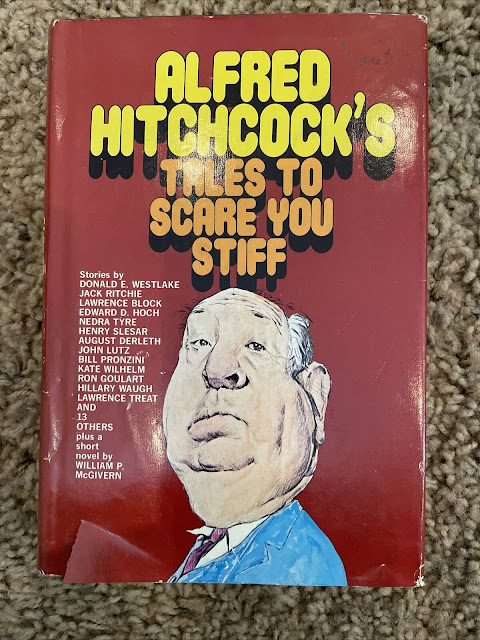
SSW: Eleanor Sullivan, editor: ALFRED HITCHCOCK'S ANTHOLOGY issue 4; Spring/Summer 1979 (Davis Publications)/ALFRED HITCHCOCK'S TALES TO SCARE YOU STIFF (Dial Press 1978) simultaneous Winter '78 publication
It's a magazine, and it's a hardcover...the latter has better paper, but the same typesetting; the covers are comparably uninspiring. Dell, parent company of the Dial Press, all just purchased in 1976 by Doubleday, continues its long history of being in the Hitchcock book business...before eventually purchasing Alfred Hitchcock's Mystery Magazine and its fiction-magazine stablemates from the then-collapsing Davis Publications in the early 1990s. The Dial hardcovers were mostly aimed at the library market, though Doubleday's relatively cheap production methods meant the hardcovers weren't the most durable of volumes--the glued (rather than sewn) first signature of my copy, having already been creased severely by some previous reader (this wasn't a discard, but I did pick it up at a library sale) broke away from the binding as I rather carefully read it...I suspect the magazine form would be hardier.
This issue was also available in hardcover (Dial 1978 as Alfred Hitchcock’s Tales to Scare You Stiff). In the Beginning, or at least in 1945, Dell Books begat the first anthology attributed to then-young-middle-aged film director Alfred Hitchcock, in the Dell MapBack paperback series, Suspense Stories. This also began Dell's rather devious (but hardly unique) practice of obscuring the actual editor of the Hitchcock (or other famous person) volumes, who in this case was probably Dell's own Don Ward, who edited most of the early Dell "Hitchcock" paperbacks, as well as the Dell magazine Zane Grey's Western Magazine (which ran from 1946 to 1954, and which got better and better the less Grey fiction it reprinted). In 1956, HSD Publications was formed to publish Alfred Hitchcock's Mystery Magazine, not at all coincidentally with Alfred Hitchcock Presents: beginning its television career in Fall 1955. Likewise, by 1957, Random House engaged fiction and script-writer and magazine editor Robert Arthur to ghost-edit a series of anthologies also entitled Alfred Hitchcock Presents: [various usually darkly humorous subtitles]; by 1961, these were joined by a young readers' series, with the first volume, Alfred Hitchcock's Haunted Houseful, ghost-edited by YA specialist Muriel Fuller, but subsequent volumes, till his death in 1969, edited along with the adult-AHP: series by Arthur. (Arthur was also called to upon to devise a Hardy Boys/Nancy Drew-style series devoted to Hitchcock and the youthful The Three Investigators, and he wrote the first several volumes and edited the series initially afterward.) Other tv-driven projects included the 1957 Simon & Schuster anthology Stories They Wouldn't Let Me Do on TV, possibly assembled by Arthur but definitely by the network and/or sponsor censors via refusal (and in reprint editions, often intentionally retitled "AH Presents: Stories...") and writer Henry Slesar's first collection, an Avon Books paperback A Bouquet of Clean Crimes and Neat Murders; Slesar had contributed scripts and source stories to the AHP: tv series and Hitchcock branding was much in evidence. Meanwhile, Dell was very much interested in keeping their hand in, by reprinting the older anthologies they had originated and from others, publishing paperback editions of the Random House adult books that mostly split the hardcover contents into two softcover volumes, and, in the early '60s, beginning to publish best-of volumes from AH's Mystery Magazine...all packaged as if Hitchcock was the editor, and all looking rather like one another, whatever their content's source. In the UK in the latter '60s, busy editor Peter Haining would also begin editing "Hitchcock" anthologies, mostly not seen in the US (though Dell would publish the last one, in 1971) for Four Square, then New English Library. HSD would publish the magazine till 1976, selling it in late '75 to Davis Publications, formed in the late '50s when B. G. Davis left Ziff-Davis in part because the house he co-founded was less and less interested in publishing fiction magazines; Davis started his second firm with the purchase of Ellery Queen's Mystery Magazine from Mercury Press, and one of Davis's innovations was to begin publishing as well a reprint magazine called Ellery Queen's Anthology drawing mostly from the back pages of EQMM...by late '76, under B. G.'s son Joel Davis's direction, Alfred Hitchcock's Anthology magazine had joined the stable...and the Dial Press hardcover editions came with them. Davis Publications, having suffered an expensive failure in launching a Sylvia Porter-branded financial-planning magazine, sold its fiction titles (at that point, the sf magazines Analog and Asimov's along with the two crime-fiction titles) to Dell's magazine arm in 1991; the last Anthology issues (including those spun off from the sf magazines) had appeared in 1988 (dated 1989). In 1996, Dell sold its magazine group, by then mostly devoted to crossword/word puzzle and astrology magazines along with the four fiction titles (Dell had briefly published an impressive Louis L'Amour Western Magazine as well in the mid '90s, but that had been folded before the sale and was not revived) to word-game specialist Penny Press, which has been publishing them since, doing business as Crosstown Publications/Dell Magazines. Eleanor Sullivan had been Managing Editor of Ellery Queen's Mystery Magazine from 1970 at least through 1975, and was handed the reins to AHMM when it became a Davis Publication till 1981's penultimate issue; in 1981, after the death of Frederic Dannay, she edited both monthly magazines for about a year, and then handed editorship of Hitchcock's to Cathleen Jordan, a book editor who had been recommended to Joel Davis by Isaac Asimov. Jordan was a less-sure hand at the magazine, but did publish more horror fiction than Sullivan had, so a small favor there. Sullivan also edited, as a consequence, the first ten issues/volumes of Alfred Hitchcock's Anthology magazine, and under their various titles in the Dial Press editions. AHMM, as this anthology-issue might suggest, was often among the best of crime-fiction magazines available during its run, and had certainly drawn fiction from many of the best active cf writers. EQMM had always had a bit more prestige, at least theoretically (and perhaps paid a bit more), though when Avram Davidson lampooned it in one of his fantasy stories as Quentin Queely's Mystery Museum, he wasn't alone in finding it at times a bit fusty; Manhunt and a few of its imitators in the 1950s were briefly providing even better issues, though most had folded by the turn of the '60s and Manhunt was on a severe downward slide that would continue till its folding in '68; The Saint magazine was interesting but erratic, as was the less well-funded but more consistently published Mike Shayne Mystery Magazine, the only primarily hardboiled cf magazine to run from the '50s into the '80s, unless one counted the then-mostly, but not exclusively, noirish AHMM, still published today. "Come Back, Come Back" was the second in the young Donald Westlake's short series of stories about aging, literally as well as a bit figuratively heart-sick police detective Abe Levine; they were collected, with a new story to wrap them up, in a 1984 volume. Westlake wasn't a kid by the time he was writing these, but this one was published before he was thirty; you can see him grappling with big thinks at every opportunity and not self-editing the explication of every character beat, as he would in his work not too long afterward...it probably didn't hurt that Hitchcock's paid by the word, and this story could've been a tighter short story rather than the pretty good novelet that it is (apparently, Westlake notes in the Levine collection that he stopped writing the series of novelets when AHMM rejected the penultimate one--and for decades the last--for not being sufficiently criminous; Mike Shayne Mystery Magazine picked it up for publication a few years after the last AHMM entry, with Shayne a salvage market; the new story was placed with EQMM in '84, presumably just before the book's publication). Westlake's wit and incisiveness are on display...just not his usual later concision. While Kate Wilhelm, also with one of her earlier stories, "A Case of Desperation", has her paring knife firmly in hand, and the casual bullying violence of the protagonist's kidnapper is chilling to read so plainly and concisely detailed. Worse still, for Marge, the experience of being taken at gunpoint from her bank-teller job, as hostage to help him with his robbery, has too many resonances with the rest of her life. Interesting to see the protagonist of Westlake's story and the utter, resentful, careful villain of this one both spout similar notions of How Men Are Kept From Being Men, and Don't you Want a Real Man in Your Life? Defined, apparently, as a benevolent (more or less) dictator. Contrasts slightly with the default shrewish wives and turning-worm husbands of too many of the Alfred Hitchcock Presents: tv episodes. There is a bit of oddly overemphatic foreshadowing in the story's beginning, but otherwise it's about as quietly tough and emotionally complex as one might expect from Wilhelm. More to come. The whole post is in italics because the substandard Acer laptop I'm using at the moment loves to grab not just the selected text but all the text it can just as one hits the italics button, and I'd gone through and corrected for about twenty minutes early this morning when I could've been reading more stories in this collection. So I did the faster version just now. I will soon beat the Acer to shards, or perhaps sanity will prevail. For more of today's short fiction selections, please see Patti Abbott's blog |

.jpeg)

.jpg)