Showing posts with label Kate Wilhelm. Show all posts

Wednesday, March 20, 2024

SSW: "Day of Succession" by Ted Thomas (1959): Short Story Wednesday

(Arguable "spoilers" for the story throughout what's below; one can read it here first, if one chooses.) 


I posted this note to a discussion list not too long ago, since I thought it might be of at least passing interest:

Probably familiar clip to some: Cassie Mackin, Arthur C. Clarke, Rod Serling on THE DICK CAVETT SHOW


12 July 1972: Clarke mentions 1959 ASF Ted Thomas story, "Day of Succession", which (pseudo-sophisticatedly) posits a pacifist US Pres. and VP, and the "necessity" of killing them to allow the Speaker of the House to do Necessary Killing as Head of State. Cavett also suggests a notional skiffy plot, and H. G. Wells is discussed briefly

Fellow panelist Cassie/Catherine Mackin, an NBC and ABC-TV reporter, died of cancer at 43.

--A fellow-member, writer and editor John Boston (see also), took issue with my characterization, which as I admitted in reply was based entirely on Clarke's description of the story (and, further blame all mine, I managed befuddledly to conflate Ted Thomas with the somewhat more knee-jerking Theodore Cogswell in memory as I watched the excerpt and, shortly after, posted the link).  

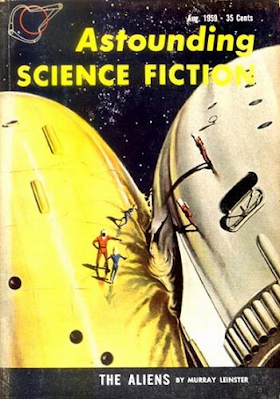
I've now (re)read the story, which, since original publication in Astounding Science Fiction in the August 1959 issue, as far as ISFDB is aware has only been anthologized three times, albeit the three anthologies have been reprinted several times between them: Damon Knight's A Century of Science Fiction (1962),  John F. Carr and Jerry Pournelle's Armageddon!: There Will Be War [series], Volume VIII (1989), and Dennis Pepper's The Young Oxford Book of Aliens (1998; Pepper being an editor who seems to be most interested in sf to the degree that it resembles horror fiction). As John noted,"I thought 'Day of Succession' was about how we get to fascism, which never lets a crisis go to waste."


Well, it is a seemingly double-bottomed story, which has fit comfortably within the world (and beyond)-view of Astounding editor John W. Campbell, Jr., that humans are the Most Dangerous Creatures (he seemed to posit this as a plus, more or less, and preferred fiction where humans were always the superiors of any other sort of sentient creatures they might encounter--as well as avowedly loving to publish stories that would "shake up" readers), and of the militarist editors of the long There Will Be War series, while not actually putting forward any sort of argument for the Destroy the Village in Order to Save It attitude of the not quite protagonist, a highly-placed US Army general, aside from his paranoia in regards to the hostile nature of the alien visitation proving to be apparently correct, as far as we can tell...albeit, that affirmation of their hostility occurs after extreme hostility and destruction, by his command, of the first aliens to arrive, and his claim of the aliens having not being able to make any warning to their fellow-travelers. 

Ted Thomas, who also signed his work Theodore L. Thomas (and wrote, and occasionally co-wrote with Charles Harness a humorous series of patent-related sf stories as by Leonard Lockhart) never published a collection, and his only two novels I'm aware of were in collaboration with Kate Wilhelm, and the first, The Clone, is the best "Blob" story I've read and a fine novel by any standard (it expands a shorter solo story of his). His "The Family Man" (which I read upon publication in The Magazine of Fantasy and Science Fiction, March 1978)  is a story that has stuck with me much more vividly than "Day of Succession", which I first read not long after, in my copy of the Knight anthology...but this vignette makes its points...and lets you sort them out. 

(Thomas's 1962 story "Test" is one which haunted readers for decades...one of the most-remembered stories librarians and booksellers would be queried about by people who couldn't remember the author, title, or both...but the story stuck with them. It can be read, or reread, here.)

Please see Patti Abbott's blog for more of today's short fiction reviews.

Wednesday, September 7, 2022

SSW: Kate Wilhelm, Harlan Ellison, Marion Zimmer Bradley, Gordon Dickson, Edward Wellen, Arthur & Irwin Porges: FANTASTIC, April 1959, edited by Cele Goldsmith (Lalli)

The third in a series of posts about select set of late '50s issues of fantasy and related-fiction magazines: 

The first can be read here: Fantasy/Horror/SF fiction magazine issues from the 1950s fantastica "End of Summer": THE MAGAZINE OF FANTASY AND SCIENCE FICTION April 1958 edited by "Anthony Boucher"; FANTASTIC April 1959 edited by Cele Goldsmith; FANTASTIC UNIVERSE April 1958 edited by Hans Stefan Santesson; TALES OF THE FRIGHTENED August 1957 edited by Lyle Kenyon Engle; SCIENCE FANTASY April 1958 edited by John Carnell (and INSIDE SF's F&SF/Mercury Press parody issue/September 1958, edited by Ron Smith, and MACABRE, Summer 1958, edited by Joseph Payne Brennan)

Not yet reviewed, though described in the first post's overview...and a more eye-catching cover than than the Fantastic sports!

The second, here: Short Story Wednesday: Kit Reed, Margaret St. Clair, William F. Nolan, Avram Davidson, Richard Wilson, and others: April 1958 fantasy (and related) stories from THE MAGAZINE OF FANTASY AND SCIENCE FICTION and FANTASTIC UNIVERSE (part 2)

Can be read here.

The first thing one might note about the April 1959 issue of Fantastic, beyond the notional cover, is that the issue became Even More an all-star issue in time than it was upon release...Arthur Porges (usually without his brother) might be the most obscure of the professional writers assembled here, and he can be remembered for the more clever stories he saw published in fantasy, sf and crime fiction magazines, such as "$1.98" in F&SF in 1954 (Irwin presumably helped develop the gimmick in "A Touch of the Sun", as he never published his own fiction in magazines, though he did publish essays). Kate Wilhelm and Harlan Ellison went on to become major writers in several fields; Wilhelm's first published story, "The Pint-Sized Genie"  had been pulled out of the "slush pile" by Goldsmith during her assistant-editor days and was published in Fantastic, though she had already sold her notable story "The Mile-Long Spaceship" to Astounding SF, it would be published later; I remain somewhat amused that she thus limned small and large, fantasy and sf, in her earliest career; Ellison had, during Goldsmith's predecessor-editor Paul Fairman's term, been one of the writers with a contract to produce a certain amount of fiction each month for a flat fee, and that was that, making for a fair amount of on-the-job training. Edward Wellen was a consistently interesting writer of crime fiction and some speculative fiction (often with a criminous aspect as well), and while Jack Sharkey, who had his first published short story in the previous, March 1959, issue of Fantastic, never wrote too much of lasting value in fantastica, he did go on to become one of the most successful playwrights among those who provided mostly one-act plays for community theater and similar productions, published by Samuel French, Inc. Rog Phillips was, along with William P. McGivern, among the rather good writers who often provided the best copy as regulars in the Ray Palmer years of Fantastic's older siblings Amazing Stories and Fantastic Adventures. And, other cover Names Jack Williamson, Marion Zimmer Bradley, and Gordon R. Dickson had already established their often influential careers, Williamson already one of the grand old writers in the fields, his work first appearing in the 1920s.

Another thing one might note is that while the previously reviewed F&SF and Fantastic Universe 4/58 issues were toward the end of their editors' runs (several issues before Anthony Boucher turned over the magazine to Robert P. Mills, barely more than twice as many issues before FU was abruptly folded in 1960, having published only the first installment of Fredric Brown's novel The Mind Thing), this was only the fifth issue Cele Goldsmith served as editor of...though throughout her run on Fantastic and Amazing, "editorial director" Norman Lobsenz wrote the editorials and blurbs for the magazines (sexism and ageism will out, particularly in the latter '50s and early '60s). Previously, I wondered if Paul Fairman's departure, and the end of  his quota system of gathering staff stories, led to a sudden shortage of fiction and a related dearth of interior illustration, and this issue suggests that might well've been the case...a largish number of Coming Soon stories from major writers mentioned in a house ad in this issue are in fact included in this issue.

The Wilhelm and Ellison stories share a certain sense of their writers still trying to refine their approaches. Ellison's "The Abnormals" ("The Discarded" being his preferred title) has a reasonably good sense of propulsion and demonstrates his concern for outsiders and enjoyment of flashy grotesqueries. It features a fairly easy-to-anticipate twist in the plot. Wilhelm's "The Ecstasy of It" demonstrates her interest from the beginning of her career in grounding her stories in day-to-day realities for her characters, notably in this case an insecure torch singer and a philosophical pianist traveling with a small press corps to interact with a first Mars colony, somewhat improbably all-male, and what befalls them. The title refers mostly to what appears to be an illness that strikes several of the characters in the colony, leaving them temporarily unwilling to do anything but enjoy their sudden esthetic appreciation for things generally. Thus also an early example of Wilhelm's fascination with diseases and similar infections that can leave at least some of the afflicted better off than previously. This, and a consistent general engagement with science that is often expressed in how it affects specific individuals, which will also recur in her work (including some of her crime fiction, such as the impressive Death Qualified).

Fantastic was making one of its occasional moves toward being a Mostly fantasy-fiction magazine at this point (and Norman Lobsenz's typically breezy, shallow editorial is about his mulling what kind of classic monster he would prefer to be, between a ghoul, a vampire or a werewolf, settling on the last), and most of the shorter stories are Goldsmith's favorite sort of fantasy, mildly surreal contemporary fantasy...probably part of he reason her magazines were home to some early "new wave" fiction (though she was also a champion of Fritz Leiber's work, including his high fantasy and more traditional horror, among no few others, in years to come, as well as numbering Ursula K. Le Guin and Thomas M. Disch among her many '60s"discoveries"). Edward Wellen's "Hear a Pin Drop" involves a prisoner seeking to retain his sanity in the face of unceasing solitary confinement and darkness, and how things go very oddly; Gordon Dickson's "After the Funeral" is a horror story involving a mixture of ESP research and a haunting; Marion Zimmer Bradley's "A Dozen of Everything" is a mildly amusing deal-with-djinn tale, fairly typical of her lighter-mode stories, and with just enough twist at the end to not be wholly predictable. While the Porges brothers' story is one of the sf "problem stories" Arthur Porges loved to write, along with the not-dissimilar "locked room"/impossible crimes kinds of mysteries he also published copiously, this one a little less dependent on a high-school physics class gimmick than most problem stories, if also acceptably far-fetched and slightly more devoted than usual to fleshing out its caricature characters...in a sense, it's barely sf, since it could conceivably happen and would be arguably possible with the technology of the time, albeit it's unlikely. I shall catch up with the balance of stories in the three issues so far, including the brilliant Leiber and famous Brian Aldiss story in the F&SF, and the other magazines' contents, Soon!

for more of this week's Short Story Wednesday entries, 
!Miercoles!

Wednesday, February 16, 2022

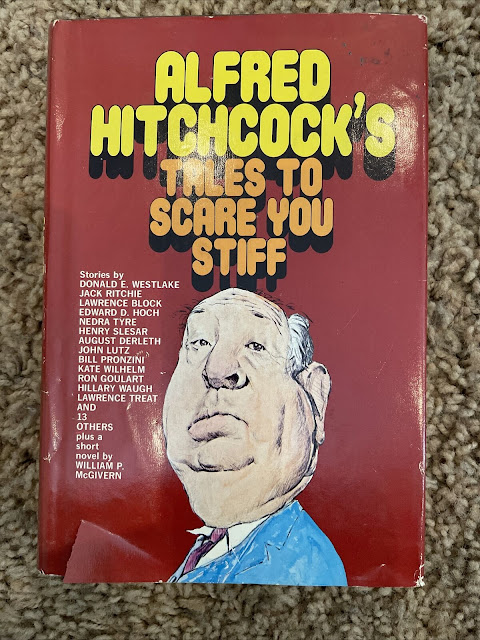
SSW: Eleanor Sullivan, editor: ALFRED HITCHCOCK'S ANTHOLOGY issue 4; Spring/Summer 1979 (Davis Publications)/ALFRED HITCHCOCK'S TALES TO SCARE YOU STIFF (Dial Press 1978) simultaneous Winter '78 publication

It's a magazine, and it's a hardcover...the latter has better paper, but the same typesetting; the covers are comparably uninspiring. Dell, parent company of the Dial Press, all  just purchased in 1976 by Doubleday, continues its long history of being in the Hitchcock book business...before eventually purchasing Alfred Hitchcock's Mystery Magazine and its fiction-magazine stablemates from the then-collapsing Davis Publications in the early 1990s. The Dial hardcovers were mostly aimed at the library market, though Doubleday's relatively cheap production methods meant the hardcovers weren't the most durable of volumes--the glued (rather than sewn) first signature of my copy, having already been creased severely by some previous reader (this wasn't a discard, but I did pick it up at a library sale) broke away from the binding as I rather carefully read it...I suspect the magazine form would be hardier.


In the Beginning, or at least in 1945, Dell Books begat the first anthology attributed to then-young-middle-aged film director Alfred Hitchcock, in the Dell MapBack paperback series, Suspense Stories. This also began Dell's rather devious (but hardly unique) practice of obscuring the actual editor of the Hitchcock (or other famous person) volumes, who in this case was probably Dell's own Don Ward, who edited most of the early Dell "Hitchcock" paperbacks, as well as the Dell magazine Zane Grey's Western Magazine (which ran from 1946 to 1954, and which got better and better the less Grey fiction it reprinted). In 1956, HSD Publications was formed to publish Alfred Hitchcock's Mystery Magazine, not at all coincidentally with Alfred Hitchcock Presents: beginning its television career in Fall 1955. Likewise, by 1957, Random House engaged fiction and script-writer and magazine editor Robert Arthur to ghost-edit a series of anthologies also entitled Alfred Hitchcock Presents: [various usually darkly humorous subtitles]; by 1961, these were joined by a young readers' series, with the first volume, Alfred Hitchcock's Haunted Houseful, ghost-edited by YA specialist Muriel Fuller, but subsequent volumes, till his death in 1969, edited along with the adult-AHP: series by Arthur. (Arthur was also called to upon to devise a Hardy Boys/Nancy Drew-style series devoted to Hitchcock and the youthful The Three Investigators, and he wrote the first several volumes and edited the series initially afterward.) Other tv-driven projects included the 1957 Simon & Schuster anthology Stories They Wouldn't Let Me Do on TV, possibly assembled by Arthur but definitely by the network and/or sponsor censors via refusal (and in reprint editions, often intentionally retitled "AH Presents: Stories...") and writer Henry Slesar's first collection, an Avon Books paperback A Bouquet of Clean Crimes and Neat Murders; Slesar had contributed scripts and source stories to the AHP: tv series and Hitchcock branding was much in evidence. Meanwhile, Dell was very much interested in keeping their hand in, by reprinting the older anthologies they had originated and from others, publishing paperback editions of the Random House adult books that mostly split the hardcover contents into two softcover volumes, and, in the early '60s, beginning to publish best-of volumes from AH's Mystery Magazine...all packaged as if Hitchcock was the editor, and all looking rather like one another, whatever their content's source. In the UK in the latter '60s, busy editor Peter Haining would also begin editing "Hitchcock" anthologies, mostly not seen in the US (though Dell would publish the last one, in 1971) for Four Square, then New English Library.

HSD would publish the magazine till 1976, selling it in late '75 to Davis Publications, formed in the late '50s when B. G. Davis left Ziff-Davis in part because the house he co-founded was less and less interested in publishing fiction magazines; Davis started his second firm with the purchase of Ellery Queen's Mystery Magazine from Mercury Press, and one of Davis's innovations was to begin publishing as well a reprint magazine called Ellery Queen's Anthology drawing mostly from the back pages of EQMM...by late '76, under B. G.'s son Joel Davis's direction, Alfred Hitchcock's Anthology magazine had joined the stable...and the Dial Press hardcover editions came with them. Davis Publications, having suffered an expensive failure in launching a Sylvia Porter-branded financial-planning magazine, sold its fiction titles (at that point, the sf magazines Analog and Asimov's along with the two crime-fiction titles) to Dell's magazine arm in 1991; the last Anthology issues (including those spun off from the sf magazines) had appeared in 1988 (dated 1989). In 1996, Dell sold its magazine group, by then mostly devoted to crossword/word puzzle and astrology magazines along with the four fiction titles (Dell had briefly published an impressive Louis L'Amour Western Magazine as well in the mid '90s, but that had been folded before the sale and was not revived) to word-game specialist Penny Press, which has been publishing them since, doing business as Crosstown Publications/Dell Magazines.

Eleanor Sullivan had been Managing Editor of Ellery Queen's Mystery Magazine from 1970 at least through 1975, and was handed the reins to AHMM when it became a Davis Publication till 1981's penultimate issue; in 1981, after the death of Frederic Dannay, she edited both monthly magazines for about a year, and then handed editorship of Hitchcock's to Cathleen Jordan, a book editor who had been recommended to Joel Davis by Isaac Asimov. Jordan was a less-sure hand at the magazine, but did publish more horror fiction than Sullivan had, so a small favor there. Sullivan also edited, as a consequence, the first ten issues/volumes of Alfred Hitchcock's Anthology magazine, and under their various titles in the Dial Press editions.

AHMM, as this anthology-issue might suggest, was often among the best of crime-fiction magazines available during its run, and had certainly drawn fiction from many of the best active cf writers. EQMM had always had a bit more prestige, at least theoretically (and perhaps paid a bit more), though when Avram Davidson lampooned it in one of his fantasy stories as Quentin Queely's Mystery Museum, he wasn't alone in finding it at times a bit fusty; Manhunt and a few of its imitators in the 1950s were briefly providing even better issues, though most had folded by the turn of the '60s and Manhunt was on a severe downward slide that would continue till its folding in '68; The Saint magazine was interesting but erratic, as was the less well-funded but more consistently published Mike Shayne Mystery Magazine, the only primarily hardboiled cf magazine to run from the '50s into the '80s, unless one counted the then-mostly, but not exclusively, noirish AHMM, still published today. 

"Come Back, Come Back" was the second in the young Donald Westlake's short series of stories about aging, literally as well as a bit figuratively heart-sick police detective Abe Levine; they were collected, with a new story to wrap them up, in a 1984 volume. Westlake wasn't a kid by the time he was writing these, but this one was published before he was thirty; you can see him grappling with big thinks at every opportunity and not self-editing the explication of every character beat, as he would in his work not too long afterward...it probably didn't hurt that Hitchcock's paid by the word, and this story could've been a tighter short story rather than the pretty good novelet that it is (apparently, Westlake notes in the Levine collection that he stopped writing the series of novelets when AHMM rejected the penultimate one--and for decades the last--for not being sufficiently criminous; Mike Shayne Mystery Magazine picked it up for publication a few years after the last AHMM entry, with Shayne a salvage market; the new story was placed with EQMM in '84, presumably just before the book's publication). Westlake's wit and incisiveness are on display...just not his usual later concision.

While Kate Wilhelm, also with one of her earlier stories, "A Case of Desperation", has her paring knife firmly in hand, and the casual bullying violence of the protagonist's kidnapper is chilling to read so plainly and concisely detailed. Worse still, for Marge, the experience of being taken at gunpoint from her bank-teller job, as hostage to help him with his robbery, has too many resonances with the rest of her life. Interesting to see the protagonist of Westlake's story and the utter, resentful, careful villain of this one both spout similar notions of How Men Are Kept From Being Men, and Don't you Want a Real Man in Your Life? Defined, apparently, as a benevolent (more or less) dictator. Contrasts slightly with the default shrewish wives and turning-worm husbands of too many of the Alfred Hitchcock Presents: tv episodes.  There is a bit of oddly overemphatic foreshadowing in the story's beginning, but otherwise it's about as quietly tough and emotionally complex as one might expect from Wilhelm.

More to come. The whole post is in italics because the substandard Acer laptop I'm using at the moment loves to grab not just the selected text but all the text it can just as one hits the italics button, and I'd gone through and corrected for about twenty minutes early this morning when I could've been reading more stories in this collection. So I did the faster version just now. I will soon beat the Acer to shards, or perhaps sanity will prevail.

For more of today's short fiction selections, 


Friday, February 3, 2017

FFB: BETTER THAN ONE by Kate Wilhelm and Damon Knight (MCFI/NESFA Press 1980); BLACK COCKTAIL by Jonathan Carroll (Legend/Century 1990)

"...And you know two heads are better than one..." 
--Annie Ross
Better Than One was the only officially collaborative book that Damon Knight and Kate Wilhelm published during his life and their long marriage; she was one of the most frequent as well as most important of the contributors to Knight's anthology series Orbit, and they are presences in each other's anthologies and nonfiction books, but they never formally collaborated on fiction; Knight refers to one abortive attempt early on, in the prefatory matter in this collection, which was published as a convention commemorative volume for the WorldCon, NorEasCon II in 1980 in Boston, where the couple were the Guests of Honor. (As with the books from Advent: Publishers, only with an even more obvious throughline, the book is now available from the subsequent publishing project NESFA Press.) ISFDB credits D. Christine Benders as editor, though the credit she takes is designer in the volume itself; it does seem likely that Knight and Wilhelm decided what went into the book. There are two introductions, one from each, which serve as brief memoirs of their lives together as partners and artists, followed by three poems by Knight, a prefatory note and the short story "Semper Fi" by Knight, a prefatory note and the short story "Baby, You Were Great" by Wilhelm, and four poems by Wilhelm. The stories deserve to be collected together inasmuch as Knight's story, originally published with some editorial fiddles as "Satisfaction" in Analog for August 1964, inspired Wilhelm to write hers, originally in the second Orbit anthology of original fiction in 1967. Both stories deal with virtual reality in a sense, with Knight's about the opportunities for people to create their own masturbatory playgrounds via a sort of interactive VR drawing on one's own imagination; Wilhelm, rather convinced that the technology that Knight described would probably be put to more social-controlling ends, posits instead a sort of remote experience of the lives of eventually unwilling stars of "reality" VR. Turns out they were both right, to the extent we've achieved a limited form of virtual reality and interactive programming. 

The two stories are not nearly the best single works by either writer, but are both good examples of what they can do, and the introductory matter is insightful and informative, and telling...particularly to the degree to which Knight's comments are more reserved, if clear in his gratitude for the life he has had with Wilhelm and illuminative of his artistic process (as Algis Budrys has noted about other Knight nonfiction, few could tell you more clearly how they go about the actual craft of writing than Knight), while Wilhelm's is more emotionally naked, providing a bit more of the sense of how their partnership worked and how it felt to live together and work separately; they are pretty obviously each other's biggest fans, though no more uncritically than you would expect two artists of their caliber to be.  Wilhelm's poetry gains a bit in comparison by her relative lack of reserve, feeling a bit less like exercises in the form (apparently, one of hers had been published elsewhere previously, though where is not cited; the balance of hers and all of his were apparently first published in the book), though both display their wit and grace.  Wilhelm continues to contribute notably to both fantastic and crime fiction; Knight is not as well-remembered as he should be but even last night, as I write, he was referenced blind on the topical comedy series @Midnight, in a game called "It's a Cookbook" where comedians were encouraged to mock silly or awful  examples of actual cookbooks...a reference to Knight's story "To Serve Man," also not his best but easily his most famous, and a fine more-than-a-joke story, slipped into the cultural surround in part by the adaptation on The Twilight Zone and reference to that episode by The Simpsons, those staples of proto-VR pop culture. 

US edition of the first collection with BC
While it's been collected twice since with short fiction by Jonathan Carroll, Black Cocktail was first published in both the UK and (in 1991) the US on its own, and is (surprisingly to me, considering how long I've had his books in my virtual TBR piles) the first longer fiction I've read by him.  I've had my copy of the St. Martin's Press hardcover of this one for a quarter-century, in fact, almost all of that time in a storage box, and that was my mistake...it's a good read, and I'm even more likely to pick up one of his novels soon. This one begins feeling a bit like Harlan Ellison's "Jeffty is Five"...only with a more sinister, not at all nostalgic mood...and ends with a sense of the same sort of Gestalt personality exploration that fascinated Theodore Sturgeon so fruitfully, and while the story, even given its excellent detail and grace and wit (and good choices of models to draw on...along with F. Scott Fitzgerald, Fritz Leiber, Shirley Jackson and a few other writers working similar territory over the the years) doesn't quite convince, finally, it's a more than game try, and you won't be likely to want to read something else while you're reading this one. The protagonist, mourning the loss of his life-partner, meets up with an enigmatic new man who turns out to have even more enigmatic friends...and an odd connection to people from the protagonist's past as well... Even more than the short stories I've read by Carroll over the years, this reminds me also of William Kotzwinkle's work, and that, too, is high praise. The jacket by Dave McKean is pretty brilliant; the interior illustrations, in black and white, are less effective, if appropriately moody.

The utterly spartan jacket for the first edition.
Peripheral facts: both these books have "officially" 76pp. of formal text (though as the index above notes that leaves out the overall introductions by Wilhelm and Knight); Knight's story appeared in the Analog for my birth-month; Wilhelm had essentially two "first" stories for professional publication--John W. Campbell had purchased Wilhelm's sf story "The Mile Long Spaceship" for Astounding Science Fiction (later known, as of 1960,  as Analog) before assistant editor Cele Goldsmith picked out KW's fantasy "The Pint-Sized Genie" for publication in Fantastic...but Fantastic published its story first...and Wilhelm was also soon selling crime fiction short stories and her first novel, More Bitter than Death, was cf...Knight's first professional publication had been a decade and half earlier, in Fantastic's elder stablemate Amazing, a cartoon (as Knight was initially as much visual as literary artist, but soon determined he was better at the latter...actually, he was better at the former than he gave himself credit for, if still a better writer)...one of the few reasons I was a bit sad to leave New Hampshire behind in 1979 for Hawaii, not quite as acute as leaving my few good friends and some other good people (though also not a few jerks) was that I really wouldn't've minded attending the 1980 WorldCon in Boston. As it was, I didn't get to one till 2001, the one just before 9/11. 

For more of today's books, please see Patti Abbott's blog.

Lucky Cluadia got hers signed...but had to or chose to sell it, or someone did for her...

Saturday, April 2, 2016

Magazine issue review: SCIENCE FICTION STORIES, May 1959

from the FictionMags list, 6 January 2004:

(THE ORIGINAL) SCIENCE FICTION STORIES, May 1959, V. 10 #2. 10 
issues/year (monthly without April or June issues), digest. 132pp 
including covers; 35c ($3/yr). Robert A. W. Lowndes, editor; 
published by Columbia Publications.

Cover features two interior illustrations by Ed Emshwiller and what 
looks like a spot illo of a rocket, uncredited. Cover is in three 
colors, white, purple, and yellow. Readers are asked within if they 
like this new (and presumably economical) sort of cover.

6 * Robert Silverberg * There's No Place Like Space * ss (illus. 
Wallace Wood)(cover has it with exclamation point; title on text, in 
contents and in running heads do not)
24 * Basil Wells * Utility Girl * ss (illus. Ed Emshwiller)
42 * Kate Wilhelm * Android, Kill for Me! * ss (illus. Ed Emshwiller)
49 * Kit Reed * Here, Kitty Kitty * ss
57 * A. L. Caramine * Weapon Master * ss
63 * (Silverberg as) Calvin M. Knox * Readin' and Writhin' * book reviews:
Algis Budrys MAN OF EARTH (Ballantine)
Donald Wollheim, ed MEN ON THE MOON/Murray Leinster CITY ON 
THE MOON (Ace)
C. L. Moore DOOMSDAY MORNING (Doubleday)
Lester del Rey ROBOTS AND CHANGELINGS (Ballantine)
Wilmar H. Shiras CHILDREN OF THE ATOM (Avon)
Leo Margulies, ed. THREE TIMES INFINITY (Fawcett Gold Medal)
69 * Ward Moore and Robert Bradford * CADUCEUS WILD, Conclusion of 
Four Parts * sr (illus. Uncredited, probably reprinted from earlier 
issue)
117 * R. A. W. Lowndes and others * The Last Word and the Reckoning 
* combined editorial, reader poll, and letter column, including 
letters from:
118 * F. M. Busby
119 * Murray King
121 * Alma Hill
124 * J. Martin Graetsz

The three-color cover, with three small illustrations not 
reproducing all that well under those circumstances, probably didn't 
help sales; clearly one gets the sense that Lowndes was being 
instructed not only to economize but to WW Scott-up his magazines, 
at this point..."Eight Crewmen and One UTILITY GIRL," the cover 
teases, and one doubts that "Android, Kill for Me!" was KW's first 
choice of title. (I'll also remind the assembled of James Blish's 
little poke at the magazine's title, labelling SFS as if it was a 
neighborhood bar...not just McGinty's, but the Original McGinty's.)

"There's No Place Like Space" (which sounds like it should be the 
label on an early acetate by the Sun Ra Arkestra) is a smooth, minor 
effort with a reasonably deft handling of the breast-fetish would-be 
eroticism of its story of the colony-planet technician forced by 
those darn bureaucrats into taking a vacation in NYC. Much as Knox 
will later in the issue (justly) complain about MAN OF EARTH, this 
could pretty easily be rewritten to describe the wearying effect of 
NYC's crowding and groupthink in the 1950s as much as the 2650s 
(when $7500--whose dollars not quite specified--is a fine wage), and 
how much more fine a house in Woodstock is. Wood's illustrations 
are very recognizably Woodish, and cartoonishly handsome for it (one 
may make obvious puns); the erotism of this late issue of the 
magazine definitely suggests to me the influence of both MANHUNT and 
VENTURE, going beyond even the somewhat more submerged yearning of 
BEYOND and the other '50s magazines.

"Utility Girl" (Irish ballad, or neo-retro recording by the Roches, 
this one) betrays rather more debilitatingly hidebound thought, or 
lack of it ("It was too bad [Utility Girl] Ellson was a woman. A man 
could be groomed to take [first mate] Alpergen's place. [...] But a 
woman--no!"). However, I like the phrase, "the needle gun was 
sewing" a lot. Wells, to judge by his ISFDb entries, contributed 
most often in the '40s to PLANET and in the '60s to Pohl's magazines 
(and to IF when not the Lowndes magazines in the '50s), and as late 
as the early '90s to SPACE AND TIME. Emsh's illo is appropriately frantic, if not quite representative.

"Bored Faculty Wife with Android" (as might've been Wilhelm's 
working title for this near-vignette) is an early example of KW 
turning women's-magazine-fiction tropes to her own purposes, if only 
just so; a biter-bit plot out of every other contemporaneous episode 
of ALFRED HITCHCOCK PRESENTS and every issue of either MANHUNT or AHMM, to say nothing of the lesser CF magazines then, and some 
nicely turned phrases...and the creepy fun of the lustful robot, 
made slightly more suburban (and telegraphed by Emsh's utterly 
appropriate illustration, well-rendered and the Kind Men Like). A 
bit of genuine melancholy seeps through in that the protag is a 
writer caught in a loveless marriage, I gather not a completely 
alien situation to the author at the time.

The Reed story is cute, almost too cute, and not as redeemed as are 
most of her later humorous stories by what could be called 
Bradburyan detail (and usually less romantic than RB), and it posits 
that no one was getting their cats fixed in 1959. True, that? Fun 
enough.

A. L. Caramine...I knew I'd come across that by-line before, and 
ISFDb reinformed me that it was on a guest editorial in one of Barry's issues of FANTASTIC, which leads me to suspect [incorrectly, as it turned out] that this one is also Robert Silverberg  sorry if no, Mr. S.  A twist ending hard not to see coming, although a point for giving the swindler a slightly more amusingly corrupt reason than usual, even if also a point or two off for his relentless "g"-dropping from gerunds and the utter foolishness of his marks.

I have not yet read the synopsis and conclusion of the serial, 


though it seems to be in the GALAXY tradition, this time with MDs in 
charge of society and just waiting to fall on their own scalpels.  
Apparently, this one may not've gotten a US book publication, at 
least, till a 1978 Pinnacle paperback, so clearly this was not a 
robust moneymaker for Moore nor Bradford; I don't know if the latter 
has done anything else notable in sf or otherwise. Since I like 
Moore, I'll probably read it soonish, and may seek out the Pinnacle edition [or the Armchair reprint pictured above] and hope it isn't too bad a job of republishing.

The most interesting assertion, to me, in Knox's reviews is Silverberg's 

crediting FURY primarily to C. L. Moore. Was there some confusion at that time that has since been resolved toward crediting it mostly or entirely to Kuttner? [Silverberg soon told me he doesn't know why he was so certain of this, though he still suspects Fury was mostly Moore's work.] I idly wonder if Margulies actually edited THREE TIMES INFINITY (since it's comprised of Brackett and Bradbury's "Lorelai of the Red Mist," Sturgeon's "The Golden Helix," and Heinlein's "Destination Moon," it presumably wouldn't take anyone too long to assemble), and am pleased to be pointed toward our much-missed-here Frank Robinson's "The Reluctant Heroes" as the best story in the Wollheim antho. I also wonder how the various reviewers (including Damon Knight) felt about that "Readin' and Writhin'" column-title, and if Silverberg might now be the most frequent column-holder in sf-magazines, with however many of these he did, "The Spectroscope" book reviews in AMAZING in the '60s, the 
"Opinion" columns in AMAZING and ASIMOV'S later, "The Observatory" in 
the last AMAZING inpulpation so far, and possibly others I'm overlooking ...not that Damon Knight wasn't pretty widely-dispersed in this regard, as well...

The ads are a reasonably insane bunch; aside from unsurprising house 

ads for DOUBLE ACTION MYSTERY AND DETECTIVE STORIES (the one led off by Wilhelm's "Murderer's Apprentice" and detailed in the FM Index), and FUTURE SCIENCE FICTION, there are the usual pulp-holdover RUPTURED? ads, offers of "spot-reducing" anti-flab handheld vibrators, BOYS! GIRLS! SPECIAL OFFER TO ZOOM YOUR POPULARITY! through the wonders of personalized stationery, with a menu of suggested self-inflicted nicknames you, too, could have included on your letterhead..."Spook" or "Goldbrick Harry" for boys, "Hep Cat" or "Slick Chick" for the XX chromosome crowd, hoo doggie. Also, an offer for unisex hooded sweatshirts emblazoned "U. S. Drinking Team" just to remind us College Humor was already very much with us by 1959. John Boston's much-beloved "You Traveled Through Time for FORBIDDEN LOVE..." SFBC ad would actually be an improvement, on balance...but perhaps not if it nudged the ILLUSTRATED SEX FACTS ad out. For a magazine printed by the reasonably-rated folk in Holyoke, there's unusually dark ink on the relatively large-charactered, uncrowded pages. I wonder how Lowndes might've done with a budget...but, we can wonder this about 
so many editors, eh?