Showing posts with label Ted Thomas. Show all posts

Wednesday, March 20, 2024

SSW: "Day of Succession" by Ted Thomas (1959): Short Story Wednesday

(Arguable "spoilers" for the story throughout what's below; one can read it here first, if one chooses.) 


I posted this note to a discussion list not too long ago, since I thought it might be of at least passing interest:

Probably familiar clip to some: Cassie Mackin, Arthur C. Clarke, Rod Serling on THE DICK CAVETT SHOW


12 July 1972: Clarke mentions 1959 ASF Ted Thomas story, "Day of Succession", which (pseudo-sophisticatedly) posits a pacifist US Pres. and VP, and the "necessity" of killing them to allow the Speaker of the House to do Necessary Killing as Head of State. Cavett also suggests a notional skiffy plot, and H. G. Wells is discussed briefly

Fellow panelist Cassie/Catherine Mackin, an NBC and ABC-TV reporter, died of cancer at 43.

--A fellow-member, writer and editor John Boston (see also), took issue with my characterization, which as I admitted in reply was based entirely on Clarke's description of the story (and, further blame all mine, I managed befuddledly to conflate Ted Thomas with the somewhat more knee-jerking Theodore Cogswell in memory as I watched the excerpt and, shortly after, posted the link).  

I've now (re)read the story, which, since original publication in Astounding Science Fiction in the August 1959 issue, as far as ISFDB is aware has only been anthologized three times, albeit the three anthologies have been reprinted several times between them: Damon Knight's A Century of Science Fiction (1962),  John F. Carr and Jerry Pournelle's Armageddon!: There Will Be War [series], Volume VIII (1989), and Dennis Pepper's The Young Oxford Book of Aliens (1998; Pepper being an editor who seems to be most interested in sf to the degree that it resembles horror fiction). As John noted,"I thought 'Day of Succession' was about how we get to fascism, which never lets a crisis go to waste."
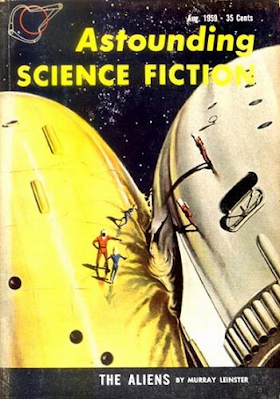

Well, it is a seemingly double-bottomed story, which has fit comfortably within the world (and beyond)-view of Astounding editor John W. Campbell, Jr., that humans are the Most Dangerous Creatures (he seemed to posit this as a plus, more or less, and preferred fiction where humans were always the superiors of any other sort of sentient creatures they might encounter--as well as avowedly loving to publish stories that would "shake up" readers), and of the militarist editors of the long There Will Be War series, while not actually putting forward any sort of argument for the Destroy the Village in Order to Save It attitude of the not quite protagonist, a highly-placed US Army general, aside from his paranoia in regards to the hostile nature of the alien visitation proving to be apparently correct, as far as we can tell...albeit, that affirmation of their hostility occurs after extreme hostility and destruction, by his command, of the first aliens to arrive, and his claim of the aliens having not being able to make any warning to their fellow-travelers. 

Ted Thomas, who also signed his work Theodore L. Thomas (and wrote, and occasionally co-wrote with Charles Harness a humorous series of patent-related sf stories as by Leonard Lockhart) never published a collection, and his only two novels I'm aware of were in collaboration with Kate Wilhelm, and the first, The Clone, is the best "Blob" story I've read and a fine novel by any standard (it expands a shorter solo story of his). His "The Family Man" (which I read upon publication in The Magazine of Fantasy and Science Fiction, March 1978)  is a story that has stuck with me much more vividly than "Day of Succession", which I first read not long after, in my copy of the Knight anthology...but this vignette makes its points...and lets you sort them out. 

(Thomas's 1962 story "Test" is one which haunted readers for decades...one of the most-remembered stories librarians and booksellers would be queried about by people who couldn't remember the author, title, or both...but the story stuck with them. It can be read, or reread, here.)

Please see Patti Abbott's blog for more of today's short fiction reviews.
Friday, April 29, 2011

FFB: Theodore Thomas and Kate Wilhelm: THE CLONE (1965)


Ted Thomas is one of the underappreciated writers in sf, although he's one with a story that's Caught On in such a way that when people approach librarians or booksellers (when they can, in these parlous times, find librarians and particularly booksellers), they often ask about That story, the one about driving tests...and they usually mean Thomas's punchy little vignette "Test." Though he wrote impressively and well in other work, with such as "The Weather Man" and the short form from which this novel was expanded, as well as having a role in a lot of writerly organizing and conferencing in the late '50s and '60s (he's all over PITFCS, the Proceedings of the Institute of Twenty-First Century Studies, the volume collecting this fanzine of professionals' fannishness having been released by Advent in the 1990s--or is he? I suspect I'm having a middle-aged moment of conflation with his colleague Theodore Cogswell, who actually edited and published the newsletter--both Teds were active in the behind the scenes activities), he remains for most the not quite remembered author of "Test."

While Kate Wilhelm broke into professional writing with a good fantasy story, "The Pint-Sized Genie" (1956), which Cele Goldsmith presumably pulled out of the slushpile at Fantastic, in the years in which Goldsmith attempted to actually do her job as editorial assistant even if Paul Fairman saw his as editor as more one of broker for sight-unseen purchases of unsurprisingly usually unimpressive work, famously particularly from a reliable quartet who could and would do better, but would do what was asked of them for now: Robert Silverberg, Harlan Ellison, Randall Garrett, and Milton Lesser (not yet officially Stephen Marlowe). Even as Fairman left to go managingly edit EQMM, when BG Davis quit Ziff-Davis, bought Queen's and took Fairman along, leaving Goldsmith to make Fantastic and its stablemate into real magazines again (and Fantastic would under Goldsmith publish the short form of "The Clone" in 1959), Wilhelm went on to establish her career in both crime fiction and science fiction, publishing early novels and short fiction in both, and never quite abandoning fantasy and horror (which this novel brushes against), which she would turn more energy toward in future decades, and expanding in contemporary mimetic fiction as well...though her third book would be this fine expansion of the Thomas novelet.

This is a blob story, and the best and most intelligent blob story I know of (though Wilhelm's late husband had an excellent near-blob story with "Four in One"). Unlike Joseph Payne Brennan's fine "Slime" (or Anthony Rud's less impressive "Ooze"), it has a reasonably well-worked out scientific basis for its clone (in one of the older senses of that word in biology) to be an all-devouring entity you don't want to meet. The novel version deals in a little more depth with the characters who are in various ways dealing, some very badly, with this blob...as Algis Burdys noted in his review of the book when it was new, at least one character rather convincingly is working out the mechanisms of the creature even as it has trapped him and has begun to consume him. Though a short novel, the panoramic approach so familiar from best-selling bugcrushers, sfnal disaster novels and otherwise, is employed, and deftly...rather memorable multiple characters are heard from, and the book carries a conviction to it rather missing from a certain Steve McQueen film. Even though their next collaborative novel, The Year of the Cloud, wasn't as good, it's notable that both are thoroughly imbued with ecological consciousness, albeit this was post-The Silent Spring, even if some years before Earth Day first was celebrated.

Rick Robinson is riding herd on the Friday Books this week, with Patti Abbott likely back in the links and lists business next week.