Showing posts with label Karl Edward Wagner. Show all posts

Wednesday, December 27, 2023

SSW: Jeff Segal and Todd Mason on David Drake, 24 September 1945-10 December 2023


Todd Mason:

As readers of this blog might've seen before, the fifth volume of The Year's Best Horror Stories: Series V edited by Gerald W. Page, was a kind of revelation to me...evidence that such favorite writers of mine already as Robert Bloch, Fritz Leiber, Manly Wade Wellman, Harlan Ellison and Joseph Payne Brennan were still actively writing new work...and look at all their similarly-active peers, whose work I would read in this volume for the firstime (hell, Tanith Lee, Arthur Byron Cover, H. Warner Munn and Charles Grant had new, previously unpublished stories in the book). And one of the writers new to me, with an elegant dark historical fantasy (reprinted from F&SF), was David Drake...and I would come to welcome his short stories in this mode and related ones over the next decade as I found and read them, in YBHS, in the First World Fantasy Awards volume edited by Gahan Wilson, in Whispers anthologies (and, eventually, in issues of the magazine the anthologies were mostly drawn from--which Drake helped putogether), and in Fantastic and Ramsey Campbell's anthology Superhorror, in Kirby McCauley's anthology Frights...and the only non-fantasy/horror story in the materials I had at hand was a "Hammer's Slammers" story in an issue of Destinies, a paperback magazine edited by James Baen for Ace Books, which was the last sf magazine my father would buy for himself, into early 1979. It didn't make as much of an impression on me. Eventually, I had a secondhand copy of the first Hammer's Slammers anthology, but only read some of it, without getting caught up in it--Jeff Segal had a much more engaged (and sensible) response.

David Drake continued to do interesting work in likely and unlikely places over the next several decades, until recent ill-health kept him from writing fiction any longer, but I had lostrack of his work, while being aware of it being in the marketplace. I should still pick up some of his anthologies along with some of his novels and certainly his collections I let slip by. (I was a bit late on the scene to buy most of his and Karl Wagner's Carcosa collections of Manly Wade Wellman's work and others when they were new.)

Unsurprisingly, he has been remembered as a gracious friend and acquaintance by many, even those who might never, say, take part in, nor read, his collaboration on one book with Newt Gingrich and Marianne Ginther (athe time, still married to Gingrich). And among his fans who goto know him rather better than I did is my old friend Jeff Segal:


Jeff Segal:

An especially important author, and sometimes-editor, in my reading evolution, along with his late friends and associates Karl Edward Wagner and Manly Wade Wellman (though my appreciation of Wellman really kicked-in later, as I matured enough to appreciate the authentically Appalachian settings of a lot of his horror and fantasy fiction).

The first Drakes that ripped into my awareness were: one of his I-was-there Vietnam War-set horrors, the vignette "Best of Luck"; and the historical axe & sorcery (or is it sorcery?) chiller "The Barrow Troll", a tale with one of Drake's bitterly ironic finales.

Drake was a vocal advocate for fantastic fiction, especially pulp magazine-era stories, and both his short fiction and novels often served as tributes to neglected books. Publishers Tor and Baen Books have repackaged his short fiction in many combinations, but also encouraged him to promote and harken back to worthy novels and stories by other hands, which too often had been half-forgotten over the decades. For example, his dark tale "The Automatic Rifleman" was inspired by Fritz Leiber's "The Automatic Pistol", which he also heartily recommended to his readers, and I would finally track it down some years afterward (Leiber's classic Weird Tales story opts for a supernatural premise, rather than the apocalyptic-sf direction Drake employed). 


I wrote to him, and eventually we corresponded about failed military missions; he steered me toward a classic, The March Up Country: A Translation of Xenophon's Anabasis, a primary-source historical and inspirational work (which the multi-lingual Drake likely read in its original Greek), and I dipped into it recently when studying the evolution of Walter Hill's movie The Warriors (1979) (Anabasis inspired both the Sol Yurick source-novel and the film).
My first exposure to the "Hammer's Slammers" mercenary yarns which made Drake famous...or notorious...was in a secondhand copy of the 1979 Ace paperback collection with that title. The stories, reinforced with contextual essays, displayed the universe from the POV of a far-future frontline warfighter. One of them, "Cultural Conflict", reads like a critique of the film Aliens, except it was published half a decade before that movie dominated the 1986 summer boxoffice (I saw it three times in theaters). I read the collection too swiftly and the effect of its concentrated violence was somewhat sickening at first, until I broke down how Drake achieved his effects on a literary level. The Slammers stories, and eventually novels and role-playing games, hammered Drake's name into the world of science fiction, though I'd argue that his finest military-oriented sf novel was the standalone Redliners (1996), which he admitted was a cathartic experience to write, allowing him to expel the toxins of war he hadn't known he still carried. It is also a magnificent achievement in creating, to borrow Harry Harrison's term, a "deathworld".

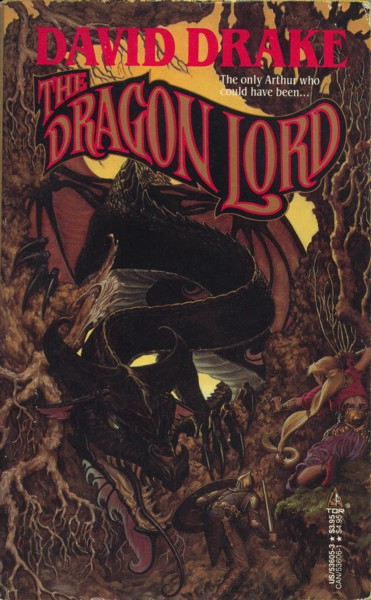
Drake's writing style, distinctly lean and ruthlessly efficient, and his raptor's eye for detail, plus his obsessions and quirks, would often stretch creative muscle over simple or awkward plotting. A case in point is The Dragon Lord, one of my favorite novels of his, a savage take on historical myth with the Camelot crowd, warts and all, serving as supporting players--its wonky back-and-forth traveling plot-structure was more than balanced by the quality of the writing, the research and some engaging characters (traveling and quests are often a part of Drake's longer works regardless of genre; for instance, his Lord of Isles cycle, an epic set almost a 1000 years after a fantasy world's apocalypse, is charmingly told, for all its ambition, in the kind of simple structure that Edgar Rice Burroughs built a successful career around--scatter your protagonists and send them off on separate adventures, while having them attempt to find one another). And The Dragon Lord demonstrated another of the author's talents: the ability to craft credibly menacing creatures with genuine impact and weight; the epic's maturing wyvern, conjured into the world by the scraggly Merlin at the behest of a typically cynical and Drake-esque King Arthur, intended to be employed as a WMD against those pesky Saxons, is used sparingly throughout the book...but it comes across as one helluva intimidating threat by the climax of the story.
Drake was adept in writing horror (primarily in short stories), fantasy (often based in realistically-rendered historical backdrops, though some of his work thus was set in newly-created worlds), and science fiction, the last in harsh military-sf or similarly rugged space opera. He had no qualms about mixing genres. The first and stronger of his two Tom Kelly espionage novels, Skyripper, is as devotedly a Cold War pursuit-thriller as any of its early-Reagan-era ilk, the McGuffin involving a cracked, ingenious Soviet scientist who wants to defect to the US in order to share his conceptual space-warfare plans with Uncle Sam to ward off "an alien invasion" he claims will occur...but there are hints that something is "off" during the brutal multi-threat spy hunt, which results in a hell of an ending, in the tradition of "Just because you're paranoid doesn't mean THEY aren't after you.”
Drake had many interests I share, which would continuously come roaring into his fiction (paleozoology, for instance). History, myth and classical-era literature were integral to much of his bibliography, rather like a bloodthirsty Roger Zelazny (Zelazny's 1969 novel Damnation Alley offered a proto-Drake hardman in a killer vehicle on a nightmare-filled deathworld road-trip). Drake also demonstrated some fascinating contradictions, such as delight in battle-glory action-filled sword & sorcery stories by Robert Howard, and Fritz Leiber (whose Fafhrd and The Gray Mouser bromance tales were repeatedly a big influence on Drake's own characters, fantasy and otherwise) but...Drake's own haunted Vietnam War service acquainted him with the effects of genuine brutality, where there is little glory. [And Leiber, who leaned toward pacifism, was very aware of this in a way that Howard was not. --tm]

Karl Edward Wagner and Drake cowrote a short story that was published in the 1974 first issue of the "little"/"semi-pro" fantasy-fiction magazine Midnight Sun. The tale predated the cult films Without Warning (1980) and Predator (1987) but anticipated something of the alien hunter/predator-on-Earth scenario, though set in ancient Rome. In the '80s, Drake and Wagner nursed the tale into a full-length novel, Killer, which I enjoyed, despite Drake's bad experience with this particular project. The Roman Empire and its frontiers provided a backdrop for his cycle of short bromance historical fantasies featuring the lethal Centurion, Vettius, and his cunning two-fisted merchant pal Dama, as they confront menaces both human and unnatural. Rome also was the setting or inspiration for some of his other short and long fiction. He may have gained a larger audience with the short tale "Ranks of Bronze", which, along with Orson Scott Card's "Ender's Game", I first encountered in the initial volume of Jerry Pournelle's anthology There Will Be War. "Bronze" was expanded into a well-received Bildungsroman novel, which inspired some follow-up books (I first learned about Bildungsromane on his website, an invaluable resource for his fans and scholars).

Not all of Drake's work "popped" for me. For instance, the first and only novel in his proposed "Crystal Walls" series, The Sea Hag, displayed some lively imagination but fell short of the Jack Vance-ian heights he was aiming for. And the follow up to Skyripper seemed to be set in an alternate universe where the conundrum the first book had been building up to was erased. However, a lot of his odd experiments rocked. I warmed up to his "RCN" space-opera series, based, sometimes literally, on Patrick O'Brian's historical Aubrey/Maturin novels. His expansion of Jim Kjelgaard's 1951 paleolithic novel Fire Hunter, The Hunter Returns, enthralled me as much as the original had. His two novels based on Henry Kuttner and C. L. Moore's "Clash By Night", The Jungle and Surface Action, were crammed full of terra-formed Venusian future-naval dreadnaught engagements and horror-choked jungles and seas, another striking deathworld. His take on the Cthulhu Mythos, by way of Joseph Conrad, "Than Curse the Darkness",
was a uniquely feral entry into the pantheon and provided a frightening and absolutely inhuman interpretation of Nyarlathotep, the Dweller in Darkness itself; no chatty Dark Man avatar for this version of the Crawling Chaos (unlike the walking dudes of Robert Bloch's early "The Shadow from the Steeple" and Stephen King's much later The Stand)--Drake's Nyarlathotep was an other-dimensional alien cancer attempting to metastasize throughout our world, summoned to the Congo by those who had been maimed by the Colonials. After humanity has been granted a breather to continue existing, the survivors reflect upon the situation; an American gunslinger, retained as a bodyguard, realizes that he and the singularly unempathic party he is with are the "good guys" and has himself a good laugh. A patented David Drake approach to their victory. That yarn scarred me quite deeply as did a lot of Drake's other efforts.
Finally, he could be quite prescient. His three "Jed Lacey" stories, involving a diagnosed sociopath who is subjected to a behavior-modifying aversion/Ludovico Technique due to his crimes, but who is subsequently "repurposed" as an investigator because he's useful to his AI-governed society, is set in a "Nation without Walls," a near-future United States riddled with omnipresent surveillance technology...a reality accepted by much of the population. When these stories began appearing in the 1970's, a Nation without Walls must have seemed comfortably like fanciful speculative fiction to most readers... 
David Drake and his contributions won't be forgotten by me.

--Jeff Segal

For more of today's short-story posts, please see Patti Abbott's blog.

Friday, January 27, 2017

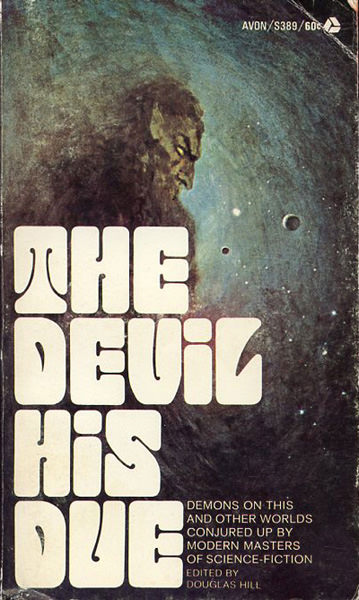
FFB: THE DEVIL HIS DUE edited by Douglas Hill (Hart-Davis 1967; Avon 1969); UNTHREATENED BY THE MORNING LIGHT by Karl Edward Wagner (Pulphouse 1989)


Two sort of hybridized compilations this week, sparked in part by my continuing to unbox my collection of magazines, books, correspondence and other items from storage, and also by the heavy toll this past week has taken on at least the writerly social circles in the UK, with the deaths of writers Hilary Bailey, also an editor of several volumes of the periodical book version of New Worlds, and Emma Tennant, the latter not infrequently a collaborator with Bailey and also the founding editor of the impressive and innovative (and, as the title suggests, hardly stuffy) litmag Bananas. The Karl Edward Wagner is both a magazine issue and a periodical book, which foremost depends on how one chooses to see it (publisher Pulphouse loved to blur those lines with many of its projects), while the older Douglas Hill anthology is one of those which mixes reprinted fiction with new, including first-publication stories by Bailey and some other writers who were, as was Wagner, taken from us prematurely. 

The Wagner collection/issue gathers three dream stories by the often brilliant writer, editor and publisher; the first feels almost like a direct transcription of a dream and as such, a bit slight, if evocative; the second, also a near roman a clef involving correspondents to a writer friend or two of Wagner's and Wagner himself, is a bit meatier and more engaging, as well as giving us a bit of insight on the relation of fantasy writers to organized fandom and reader interaction as well as to the professional grind of publishing and agenting the written work.  Sadly, as Wagner reports in his introduction that his regular habits had him sleeping little more than an hour at a time, and that his death was in part a result of his candle-burning at all points lifestyle, which is reflected in "Neither Brute nor Human" (a Poe reference, as Wagner reminds us in the intro). 

While "The River of Night's Dreaming" is a bit richer yet, building out from a dream of escape via swimming against currents to encompass an extended tribute to Robert Chambers's The King in Yellow...and to rather anticipate some of the nature of the film Sucker Punch...though Wagner's story is far more deft than that clumsy film (one could see Carla Gugino in the cast of a dramatization of this story, however). Wagner's studies as an MD in psychiatry and neurology are not lost in the story as it's told, either...nor is, as Wagner notes (again in his introduction), the "barrier to final comprehension" that Chambers imbued his work with, "the stuff of nightmares"...an influence that extends to much of Wagner's most memorable horror fiction, such as his early award-winner "Sticks"; likewise, the decadence that Chambers enjoyed exploring is replicated here, to such an extent that Charles Grant rejected the story for his Shadows series of anthologies on the grounds it was too sexually explicit. Stuart David Schiff and Whispers were more open to this sort of thing, which is hardly extreme in the context of Chambers pastiche.  (I've yet to read the Chambers, so was mildly amused to learn that one of the key characters in both the novel and the novella is named Camilla, and in the Wagner is described in such a way as to resemble my mother, who shared that name but was a redhead rather than a blonde, however...at first, I suspected a harkening to Le Fanu's lesbian vampire novella "Carmilla" was desired, and perhaps it was, on Chambers's part.) In his last published work, Wagner would increasingly explore "fringe" sexuality in his horror work...and this volume, though not the story in question, was published five years before his death.

I've usually preferred Wagner's sword & sorcery fantasy, dark as it was, to his contemporary horror fiction, but really should read further in his work in this mode, as well (he was one of the most brilliant of s&s writers, certainly of his generation, along with Janet Fox and a few others--I still need to read my copy of his Conan novel, though I suspect it won't be quite up to his Kane stories); he was, of course, also the longest-serving and almost certainly the most influential editor (even given the excellence of his predecessors Richard and Gerald W. Page) of the DAW Books annual The Year's Best Horror Stories, which series died with him.

Author’s Choice Monthly Issue 2: Unthreatened by the Morning Light Karl Edward Wagner (Pulphouse, Oct ’89, $4.95, 101pp, tp) Collection of three stories, with an introduction by the author. Also available in a signed hardcover edition ($25.00). A Signed deluxe leatherbound edition ($50.00) was announced but not seen.
    • 1 · Introduction: Unthreatened by the Morning Light · in
    • 5 · Endless Night · ss The Architecture of Fear, ed. Kathryn Cramer & Peter D. Pautz, Arbor House, 1987
    • 17 · Neither Brute Nor Human · nv World Fantasy Convention Program Book, ed. Robert Weinberg, 1983
    • 53 · The River of Night’s Dreaming · na Whispers III, ed. Stuart David Schiff, Garden City, NY: Doubleday, 1981


Douglas Hill apparently began the 1960s writing nonfiction, including about the history and practice of magic, and by the mid 1960s had begun editing anthologies of fantasy and science fiction, arguing, as he does perhaps most opportunistically in the introduction to this anthology, that SF should stand for "science fantasy" and not be worried about again (a slightly more pat version of how Judith Merril had approached the nomenclature until she decided she preferred her refinement of Robert Heinlein's suggestion of "speculative fiction" to cover all sorts of fantastic fiction)...opportunistically because the conceit of the anthology is supposed to be these are stories about dealing with devils/The Devil in various scientific or at least science-fictional contexts...not really quite true, though, even if the protagonist of Hilary Bailey's fine story is a medical doctor, who finds himself effectively cursed by a local bully with some connection to Satan...and helped by a registered nurse (or the UK equivalent) who has some magical abilities of her own, along with the goodwill of the emigrant community, not at all fond of the bully. The Bailey story might be only the third or fourth I've read by her...she apparently published no collection, and several of her stories, like this one, have only appeared in the site of their original publication...which is a shame, as this is a deft, dryly witty and altogether enjoyable story that might remind you of what Shirley Jackson or Kit Reed (or Avram Davidson, in a restrained mood) might do with a similar notion, had it occurred to them. Hill's choices seem to be rather unsurprising as when he was putting this book together, he was about to become the Assistant Editor of New Worlds, hence was working directly with contributor (and NW editor) Michael Moorcock (at the time, also married to Bailey) and SF Impulse staffer Keith Roberts, contributors to the magazines Thomas Disch and John Sladek, Judith Merril (her story had been reprinted in SF Impulse after appearing in Fantastic), E. C. Tubb (even if he was more likely to have contributed to the pre-Moorcock NW, and had even been the editor of the competing UK magazine Authentic Science Fiction) and John Wyndham; young  American Ramsey Wood had his one fantasy publication here (also never reprinted, as the Disch and Sladek only recently has been); and while Moorcock's Elric story had appeared first in one of  L. Sprague de Camp's genre-shaping sword & sorcery anthologies, there's a good chance it was sold simultaneously to de Camp and Hill for their opposite sides of the Atlantic publications, as Pyramid paperbacks weren't too common in the UK, nor Hart-Davis hardcovers in the New World, I suspect. 

The Disch and Sladek is also wryly witty, and has even less claim to being a Devil in Scientific Context story than the Bailey, even if the protagonist is a grieving atheist (who gets shown what for in a way he hardly suspects, and which former Minnesotans Disch and Sladek almost certainly devised with wide grins and not at all nostalgic shudders).  I'm going through the rest of the stories now, re-reading the Merril after some thirty years. I'll definitely need to read some more Bailey, as well, when I've enjoyed, at least, everything I've seen from her. (Disch and Sladek have been...frequently, at least...more easy to find in bulk, even with their work in shorter lengths.) And the kind of bad luck that has recently caught up with Bailey, or for that matter dogged Disch and Sladek at the ends of their lives, also caught up with Hill...he was hit by a bus at age 72, in 2007. Bolts from the blue can get you just as easily as anything else. (And, for goodness's sakes, Hearsts, you could've sprung for some heavier application of ink in this 1969 Avon paperback...the post-cataract eyes aren't so crazy about gray letters on even reasonably undarkened paper...)

For more of today's books, please see Patti Abbott's blog...

Friday, December 23, 2016

FFB 2: 1989 horror/fantasy anthologies: TALES BY MOONLIGHT II edited by Jessica Amanda Salmonson (Tor Books); BOOK OF THE DEAD edited by John Skipp and Craig Spector (Bantam); THE YEAR'S BEST HORROR STORIES XVI edited by Karl Edward Wagner (DAW), THE YEAR'S BEST FANTASY (AND HORROR), 2nd Annual, edited by Ellen Datlow and Terri Windling (St. Martin's): Friday's Forgotten Reviews from (IN*SIT), January 1990

The following reviews reprinted, with minimal editing, from a longer column of mine in the third, January 1990, issue of the magazine (in*sit), edited and published by Mark Hand, Nancy Ryan, Donna Wilson, Jeri Mason and myself 


Jessica Amanda Salmonson's Tales by Moonlight II is not quite a direct sequel to the original anthology of a few years back; with this volume, she has done the valuable service of surveying and collecting some of the semi-professional or little horror and fantasy press. She offers 37 short stories and poems going back to Daniel Defoe's "The Devil Frolics with a Butler", published originally in pamphlet form by Defoe himself and seen therefore by Salmonson as part of a tradition that is currently represented by dozens of small-circulation magazines and book publishers, among hundreds with wider or different emphases (in her appendix, she lists 37 little-magazine contact addresses; a 38th is that of Janet Fox's small-press market-report guide Scavenger's Newsletter). A new translation of Theophile Gautier is included, and stories from such diverse a set of writers as Ramsey Campbell, John Varley, Nina Kiriki Hoffman, John Domini, Fox and Salmonson herself, along with H. P. Lovecraft (a very enthusiastic small-press person) and "The Eldritch Horror of Oz" by "L. Frank Craftlove" (Phyllis Ann Karr)--truly fierce. Salmonson also offers an historical survey as introduction  and Grue magazine editor Peggy Nadramia offers offers tips on starting a magazine of her own in another appendix). 

Splatterpunks...the name is derived from Gardner Dozois's coinage of "cyberpunks" to describe a group of writers who had begun seeing themselves as somewhat apart from other sf people, more aware of global concerns and the interplay of cultures, particularly on the street level, among people living on one or another edge of ever-more technologically-dependent societies. One of the loudest voices, John Shirley's, among this group of writers insisted they were "culturally on-line," with implications that others were not. Cyberpunk writers, particularly Shirley and the most popular of them, William Gibson, also can be prone to flashy writing, and graphic descriptions of the tougher edges of those societies; hence the newly graphic approaches to horror fiction, often featuring marginalized characters, seemed to have more than a little in common with cyberpunk [and writers as interested in branding themselves to gain a little more attention for themselves and their work]. Hence, David Schow's suggestion, splatterpunk: the work of John Skipp, Craig Spector, Schow, Shirley (the notable mutual member), Joe R. Lansdale [at times, though he hated the label and had no interest in being lumped in with it], Robert McCammon and Clive Barker. And with Book of the Dead, splatter punk has its first (as far as I know) all-original anthology, with Skipp and Spector as editors and stories by Lansdale, Schow, McCammon and such fellow-travelers as Ramsey Campbell and Stephen King. The whole thing [in those pre-ubiquitous zombie days] is a tribute to George Romero's Living Dead films, and all the stories involve zombies. Campbell's story is good, if a bit typical of his more sardonic work; sadly, the King is also typical of the worst of his work: dull, unimaginative, sloppily-written. The King and the one by Glen Vasey were unworthy of my time beyond their first few pages (the Vasey because those first few pages were so utterly vapid). But Schow, Lansdale and pop-culture historian and occasional fiction-writer Les Daniels serve it up just the way Joe Bob likes it: imaginatively and wittily cheesy, and tough. McCammon's story manages to be humorously touching about zombie love, veteran Ed Bryant manages to out-ugly the younger splats, and Douglas Winter's "Less Than Zombie" is devastatingly satirical of a certain work by B. E. Ellis (and by extension of similar efforts by McInerney and Janowitz) and the affectless young moderns celebrated by that work [this was before the no-better American Psycho]. The rest are at least interesting, even if Stephen Boyett's story tries that interest eventually; some of the authors, even given the premise of the anthology, might be too slavishly hewing to Romero's concept of zombies, as well. One of those stories, however, Philip Nutman's "Wet Work" [later the basis of a novel of the same title]  is a great knee-jerk  response story for any anti-establishment readers, as it's all about cannibalistic zombies at a certain Pennsylvania Avenue address...

Another contributor to Book of the Dead, Nicholas Royle, came up with perhaps the most difficult (from the writer's perspective, not the reader's) story there, "Saxophone". He has another good piece, first published in the British anarchosyndicalist magazine Dig, reprinted in Karl Edward Wagner's The Year's Best Horror XVII: "One of Us" is one of two yuppie-horror stories in the Wagner volume, and it involves self-piercing enthusiasts (everyone's favorite marginalized group). The other YUP story, Ian Watson's "Lost Bodies", touches on animal rights; it's also one of four stories shared by the Wagner volume and Ellen Datlow and Terri Windling's Year's Best Fantasy (and Horror, as the subtitle reminds us). With the disappearance of Arthur Saha's Year's Best Fantasy annual series for DAW Books, the Datlow/Windling and the Wagner are the only widely-available annual American multi-source collections to emphasize fantasy and horror [something very much not the case any longer, even if Datlow flies on her own these days and Wagner is alas in what afterlife there might be]; at over 600 and 350 pages respectively, they are taking up the slack well. Wagner reminds us that this is his tenth volume of the series, which began as reprints of a British annual and came under Gerald W. Page's editorship for several years in the 1970s; for Omni fiction editor Datlow,
and Windling, co-editor of the Elsewhere series of anthologies and much else, their second volume compares favorably with their colleague's. The Wagner has stories by Harlan Ellison, Dennis Etchison, Nina Kiriki Hoffman and two each by Charles Grant and Ian Watson, and has more material taken from relatively obscure British sources; the Datlow/Windling features a different Etchison, one of the Watsons (as noted above) and one of the Grants, three stories by Gene Wolfe, and William Kotzwinkle, Daniel Pinkwater, Joan Aiken, Jane Yolen and Thomas Disch, among others, and features more stories from American sources that might be obscure to many fantasy readers.  Aside from "Lost Bodies", both books feature M. John Harrison's "The Great God Pan", Ramsey Campbell's "Playing the Game" and Grant's "Snowman", and all four probably deserve their placement in both volumes. Further, there's enough in both to make the dual purchase worthwhile, despite the Brian Lumley's  slightly stodgy "Fruiting Bodies" leading off the Wagner, and a weak Richard Matheson story and Edward Bryant's rather dispiriting "year in film" article in the other. The Lumley (from Weird Tales) [then newly revived for the fourth time, with that revival--theoretically, at least--still with us after a quarter-century] does feature some imaginative nastiness (Wagner, and Page before him, have shown much good taste in selecting from rather uneven or often bad writers; two of the best Stephen King stories I've read, for example, were among those selected for their annual). As for the Bryant (a brilliant fiction writer if somewhat dicy reviewer and media journalist): I suppose someone had to like the film Child's Play [still not me]. The only sad notes are struck by the obituaries in the Windling/Datlow and the notice in the Wagner that Charles Grant has grown tired of reading bad splatter imitations and so has decided to stop assembling his Shadows and Greystone Bay original-anthologies. In a column full [of also a number of other volumes and magazines than mentioned here], these two annuals might be your best bets--certainly for a broad sense of what horror (and associated fantastic fiction) offers today. 

For more of today's books, and prompter (and fresher!) reviews, please see Patti Abbott's blog; please also see Damien Broderick's guest review of  R. Scott Bakker's Neuropath also posted on this blog, today. 

And happy solstice/new year holidays!


From the Contento/Locus/Galactic Central indices:

Tales by Moonlight II ed. Jessica Amanda Salmonson (Tor 0-812-55371-3, Jul ’89 [Jun ’89], $3.95, 306pp, pb) Anthology of 37 horror stories from small press publications, plus an introduction by Salmonson, a piece on starting small press horror magazines by Peggy Nadramia, and a listing of those currently available.
  • 1 · A Glimpse of Supernatural Literature and the Small Presses · Jessica Amanda Salmonson · in
  • 11 · Proem: The Haunted Street · Marion Zimmer Bradley · pm The Nekromantikon #2 ’50
  • 12 · Dream of a Mannikin, or the Third Person · Thomas Ligotti · ss Eldritch Tales #9 ’83
  • 28 · Marilyn and the King · Ruth Berman · ss Grimoire #4 ’83
  • 33 · The Area · Stefan Grabinski; trans. by Miroslaw Lipinski · ss The Grabinski Reader Sum ’86
  • 45 · The Return of Noire [“They Happened”] · Michael Bullock · ss Sixteen Stories as They Happened, Sono Nis Press, 1987
  • 55 · A Light from Out of Our Heart · Jules Faye · ss Fantasy Macabre #9 ’87
  • 61 · Mr. Templeton’s Toyshop [“Selections from ‘Mr. Templeton’s Toyshop’”] · Thomas Wiloch · ss All the Devils Are Here, ed. David D. Deyo, Jr., Unnameable Press, 1986
  • 69 · The Devil Frolics with a Butler · Daniel Defoe · ss, 1726
  • 73 · The Cats of Ulthar · H. P. Lovecraft · vi The Tryout Nov ’20; Weird Tales Feb ’26
  • 77 · Dead Dogs · Denis Tiani · vi Fantasy and Terror #5 ’85
  • 80 · “W.D.” · David Starkey · ss Grue #2 ’86
  • 85 · The Drabbletails · Stephen Gresham · ss Eldritch Tales #7 ’80
  • 95 · The Gravedigger and Death [Jane Bradshawe] · Mary Ann Allen · ss Ghosts & Scholars #5 ’83
  • 103 · Taking Care of Bertie · Janet Fox · ss Eldritch Tales #11 ’85
  • 110 · Cardinal Napellus · Gustav Meyrink; trans. by Michael Bullock · ss Fantasy Macabre #8 ’86
  • 122 · The Coffeepot [1831] · Théophile Gautier; trans. by Phyllis Ann Karr · ss Fantasy Macabre #5 ’85
  • 130 · Seven · Stephen-Paul Martin · vi Asylum Jun ’87
  • 134 · Chocolate · Wendy Wees · vi Fantasy and Terror #3 ’84
  • 136 · Mousewoman · Wendy Wees · vi Fantasy and Terror #10 ’87
  • 138 · Mother Hag · Steve Rasnic Tem · ss Grue #5 ’87
  • 148 · Good Thoughts · W. Paul Ganley · vi Moonbroth #10 ’73
  • 152 · Shirley Is No Longer with Us · Jody Scott · ss Windhaven #3 ’78
  • 158 · The Ghost of Don Carlos · Michel Tremblay; trans. by Michael Bullock · ss, 1977
  • 167 · Live on Tape · Spider Robinson · ss Stardock Sum ’77
  • 175 · The Head of the Hydra Flower · Carol Reid · ss *
  • 183 · The Manhattan Phone Book (Abridged) · John Varley · ss Westercon Program Book #37 ’84
  • 189 · An Image in Twisted Silver · Charles L. Grant · ss World Fantasy Convention Program Book, 1986; story based on a J.K. Potter illustration.
  • 195 · What Used to Be Audrey · Nina Kiriki Hoffman · ss Arcane #1 ’84
  • 200 · The Day · David Madison · ss, 1969
  • 206 · A Thief in the Night · Jayge Carr · ss Room of One’s Own v6 #1&2 ’81
  • 211 · Silhouette · D. Beckett · ss Paradise Plus: Tales of Another Life, 1985
  • 222 · Laugh Kookaberry, Laugh Kookaberry, Gay Your Life Must Be · John Domini · ss, 1985
  • 242 · Azrael’s Atonement · Archie N. Roy · ss Fantasy Macabre #9 ’87
  • 250 · The Eldritch Horror of Oz [Oz] · L. Frank Craftlove · ss Ozania, 1981
  • 264 · O, Christmas Tree · Jessica Amanda Salmonson & W. H. Pugmire · ss Space & Time Jan ’79
  • 279 · The Pacific High · Grant Fjermedal · ss Fantasy Macabre #10 ’88
  • 293 · Jack in the Box · Ramsey Campbell · ss Dark Horizons #26 ’83
  • 299 · Envoy: The Scythe of Dreams · Joseph Payne Brennan · pm Sixty Selected Poems, The New Establishment Press, 1985
  • 300 · Appendix I: How to Publish Your Own Shoestring Horror Magazine · Peggy Nadramia · ar
  • 303 · Appendix II: Current Small Press Horror Magazines · Misc. · bi

Book of the Dead ed. John M. Skipp & Craig Spector (Bantam 0-553-27998-X, Jul ’89 [Jun ’89], $4.50, 390pp, pb) [Living Dead] Original anthology of 16 zombie stories set in the same universe as George Romero’s Night of the Living Dead.


The Year’s Best Horror Stories: XVII ed. Karl Edward Wagner (DAW 0-88677-381-4, Oct ’89 [Sep ’89], $3.95, 351pp, pb) Anthology of 20 horror stories from 1988, with an introduction by the editor.

  • 11 · Introduction: Ten Years After · Karl Edward Wagner · in
  • 15 · Fruiting Bodies · Brian Lumley · nv Weird Tales Sum ’88
  • 44 · Works of Art · Nina Kiriki Hoffman · ss Pulphouse: The Hardback Magazine: Issue One, ed. Kristine Kathryn Rusch, Pulphouse, 1988
  • 53 · She’s a Young Thing and Cannot Leave Her Mother · Harlan Ellison · ss Pulphouse: The Hardback Magazine: Issue One, ed. Kristine Kathryn Rusch, Pulphouse, 1988
  • 71 · The Resurrection Man · Ian Watson · ss Other Edens II, ed. Christopher Evans & Robert Holdstock, London: Unwin, 1988
  • 88 · Now and Again in Summer · Charles L. Grant · ss Fantasy Tales, v.10 #1, ed. Stephen Jones & David A. Sutton, Robinson, 1988
  • 100 · Call 666 · Dennis Etchison · ss Twilight Zone Feb ’88
  • 113 · The Great God Pan · M. John Harrison · nv Prime Evil, ed. Douglas E. Winter, NAL, 1988
  • 140 · What Dreams May Come · Brad Strickland · ss F&SF Dec ’88
  • 151 · Regression · R. Chetwynd-Hayes · nv The Fourth Book of After Midnight Stories, ed. Amy Myers, London: Kimber, 1988
  • 168 · Souvenirs from a Damnation · Don Webb · ss Pulphouse: The Hardback Magazine: Issue One, ed. Kristine Kathryn Rusch, Pulphouse, 1988
  • 176 · Bleeding Between the Lines [Dennis Cassady] · Wayne Allen Sallee · ss 2AM Win ’88
  • 186 · Playing the Game · Ramsey Campbell · ss Lord John Ten, ed. Dennis Etchison, Northridge, CA: Lord John Press, 1988
  • 201 · Lost Bodies · Ian Watson · ss Interzone #25 ’88
  • 216 · Ours Now · Nicholas Royle · ss Dig Magazine #6 ’88
  • 224 · Prince of Flowers · Elizabeth Hand · ss Twilight Zone Feb ’88
  • 242 · The Daily Chernobyl · Robert Frazier · pm Synergy #2, ed. George Zebrowski, HBJ Harvest, 1988
  • 247 · Snowman · Charles L. Grant · ss Gaslight & Ghosts, ed. Stephen Jones & Jo Fletcher, 1988 World Fantasy Con/Robinson Pub., 1988
  • 258 · Nobody’s Perfect · Thomas F. Monteleone · ss Pulphouse: The Hardback Magazine: Issue One, ed. Kristine Kathryn Rusch, Pulphouse, 1988
  • 276 · Dead Air · Gregory Nicoll · nv Ripper!, ed. Gardner Dozois & Susan Casper, Tor, 1988
  • 301 · Recrudescence · Leonard P. Carpenter · nv Amazing Jan ’88

The Year’s Best Fantasy: Second Annual Collection ed. Ellen Datlow & Terri Windling (St. Martin’s 0-312-03007-X, Jun ’89, $12.95, 579pp, tp) Anthology of 46 horror and fantasy stories, with summaries of the past year in horror by Datlow, fantasy by Windling, and film by Edward Bryant. Also available in hardcover (-03006-1 $24.95).

  • xiii · Summation 1988: Fantasy · Terri Windling · ar
  • xxvi · Summation 1988: Horror · Ellen Datlow · ar
  • xlvii · 1988: Horror and Fantasy on the Screen · Edward Bryant · ar
  • liv · Obituaries · Jim Frenkel · ob
  • 2 · Death Is Different · Lisa Goldstein · ss IASFM Sep ’88
  • 17 · The Tale of the Rose and the Nightingale (And What Came of It) · Gene Wolfe · nv Arabesques, ed. Susan Shwartz, Avon, 1988
  • 39 · It Was the Heat · Pat Cadigan · ss Tropical Chills, ed. Tim Sullivan, Avon, 1988
  • 54 · The Cutter · Edward Bryant · ss Silver Scream, ed. David J. Schow, Arlington Heights, IL: Dark Harvest, 1988
  • 67 · The Freezer Jesus · John DuFresne · vi The Quarterly Fll ’88
  • 71 · Voices of the Kill · Thomas M. Disch · ss Full Spectrum, ed. Lou Aronica & Shawna McCarthy, Bantam, 1988
  • 87 · Secretly · Ruth Roston · pm Pandora #19 ’88
  • 90 · The Devil’s Rose · Tanith Lee · nv Women of Darkness, ed. Kathryn Ptacek, Tor, 1988
  • 111 · Wempires · Daniel M. Pinkwater · vi Omni Oct ’88
  • 115 · Scatter My Ashes · Greg Egan · ss Interzone #23 ’88
  • 126 · Unfinished Portrait of the King of Pain by Van Gogh · Ian McDonald · nv Empire Dreams, Bantam Spectra, 1988
  • 150 · Shoo Fly · Richard Matheson · ss Omni Nov ’88
  • 165 · The Thing Itself · Michael Blumlein · ss Full Spectrum, ed. Lou Aronica & Shawna McCarthy, Bantam, 1988
  • 179 · The Soft Whisper of Midnight Snow · Charles de Lint · ss Pulphouse: The Hardback Magazine: Issue One, ed. Kristine Kathryn Rusch, Pulphouse, 1988
  • 193 · Roman Games · Anne Gay · ss Other Edens II, ed. Christopher Evans & Robert Holdstock, London: Unwin, 1988
  • 201 · The Princess, the Cat, and the Unicorn · Patricia C. Wrede · ss The Unicorn Treasury, ed. Bruce Coville, Garden City, NY: Doubleday, 1988
  • 212 · The Book and Its Contents · Robert Kelly · ss Doctor of Silence, McPherson, 1988
  • 225 · The Great God Pan · M. John Harrison · nv Prime Evil, ed. Douglas E. Winter, NAL, 1988
  • 246 · Lost Bodies · Ian Watson · ss Interzone #25 ’88
  • 256 · Two Minutes Forty-Five Seconds · Dan Simmons · ss Omni Apr ’88
  • 265 · Preflash · John M. Ford · ss Silver Scream, ed. David J. Schow, Arlington Heights, IL: Dark Harvest, 1988
  • 284 · Life of Buddha · Lucius Shepard · ss Omni May ’88
  • 302 · Appointment with Eddie · Charles Beaumont · ss Selected Stories, Arlington Heights, IL: Dark Harvest, 1988
  • 316 · Fragments of Papyrus from the Temple of the Older Gods · William Kotzwinkle · ss Omni Apr ’88
  • 324 · Spillage · Nancy Kress · ss F&SF Apr ’88
  • 335 · Snowman · Charles L. Grant · ss Gaslight & Ghosts, ed. Stephen Jones & Jo Fletcher, 1988 World Fantasy Con/Robinson Pub., 1988
  • 344 · The Scar · Dennis Etchison · ss The Horror Show Win ’87
  • 352 · Laiken Langstrand · Gwyneth Jones · ss Other Edens II, ed. Christopher Evans & Robert Holdstock, London: Unwin, 1988
  • 365 · The Last Poem About the Snow Queen · Sandra M. Gilbert · pm Blood Pressure, W.W. Norton, 1988
  • 367 · Pinocchio · Sandra M. Gilbert · pm Blood Pressure, W.W. Norton, 1988
  • 370 · Game in the Pope’s Head · Gene Wolfe · ss Ripper!, ed. Gardner Dozois & Susan Casper, Tor, 1988
  • 377 · Playing the Game · Ramsey Campbell · ss Lord John Ten, ed. Dennis Etchison, Northridge, CA: Lord John Press, 1988
  • 389 · Faces · F. Paul Wilson · nv Night Visions 6, ed. Anon., Arlington Heights, IL: Dark Harvest, 1988
  • 413 · Snowfall · Jessie Thompson · ss F&SF Sep ’88
  • 418 · Seal-Self · Sara Maitland · ss The Book of Spells, Michael Joseph, 1987
  • 428 · No Hearts, No Flowers · Barry N. Malzberg · ss 14 Vicious Valentines, ed. Rosalind M. Greenberg, Martin H. Greenberg & Charles G. Waugh, Avon, 1988
  • 438 · The Boy Who Drew Unicorns · Jane Yolen · ss The Unicorn Treasury, ed. Bruce Coville, Garden City, NY: Doubleday, 1988
  • 446 · The Darling · Scott Bradfield · nv The Secret Life of Houses, Unwin Hyman, 1988
  • 463 · Night They Missed the Horror Show · Joe R. Lansdale · ss Silver Scream, ed. David J. Schow, Arlington Heights, IL: Dark Harvest, 1988
  • 478 · Your Story · Rick DeMarinis · ss The Coming Triumph of the Free World, Viking, 1988
  • 489 · Winter Solstice, Camelot Station · John M. Ford · pm Invitation to Camelot, ed. Parke Godwin, Ace, 1988
  • 495 · The Boy Who Hooked the Sun · Gene Wolfe · vi Cheap Street; New Castle, VA Dec ’85
  • 499 · Clem’s Dream · Joan Aiken · ss The Last Slice of Rainbow, London: Cape, 1985
  • 506 · Love in Vain · Lewis Shiner · nv Ripper!, ed. Gardner Dozois & Susan Casper, Tor, 1988
  • 525 · In the Darkened Hours · Bruce Boston · pm The Nightmare Collector, 2AM, 1988
  • 529 · A Golden Net for Silver Fishes · Ru Emerson · ss Argos Win ’88
  • 538 · Dancing Among Ghosts · Jim Aikin · nv F&SF Feb ’88
  • 575 · Honorable Mentions: 1988 · Misc. · bi