Showing posts with label R. A. Lafferty. Show all posts

Wednesday, September 6, 2023

SSW: SUPERHORROR (aka THE FAR REACHES OF FEAR) edited by Ramsey Campbell; THE MOON'S WIFE (wt: SIGGY LINDO) by A. A. Attanasio

Mooning covers...


Superhorror, published by W.H. Allen in 1976, as the slim anthology was titled in thaoriginal UK edition and its US reprint (the 1980 UK paperback takes the variant title), includes the following stories, all original to it: (via ISFDB)
I picked up my remaindered copy of the 1977 St. Martin's Press US hardcover, with the Donald Grant cover above carried over from the Allen edition, in 1979 or '80 in one of the Hawaiian chain of department stores, Liberty House.

As the first anthology he would edit, it's an impressive start by any measure...with most of the contributors demonstrating why they were already masters of the form, and the largest flaw being a lack of female contributors, with the welcome exception of Daphne Castell...but the biggest surprises in the book would not be that Leiber or Aickman or Wellman or even the then still relatively young Drake, and Castell and Campbell himself, would provide impressive work, but that Brian Lumley's suspense story, like all his work carrying a touch of the Boy's Adventure Tale about it but also like most of his non-Lovecraftian work far superior to the (sustainedly popular) Necroscope kludges, would be a fine and brutal story of retribution; Joseph Pumilia's rather grimly jokey homage to EC horror comics was an early example of that sort of thing in prose, and a good one; and then there's R. A. Lafferty's story. It was no secret that Lafferty was brilliant and eccentric, and often veered close to out-and-out horror in much of his previous fiction, but only rarely nudged any given work firmly into the field...but "Fog in My Throat" takes on the very soul of horror, the knowledge that we will be extinct and how we cope with this, and succinctly and forcefully tells us how and why we'd best not try to fiddle with our self-delusional defense mechanisms in dealing with that. From a devoutly Catholic man, well along in years and not in the greatest of health at the time, it's a brilliant story that carries every sort of conviction with its wit, invention and compassion, and I've remembered it more clearly than any other in this book over the decades.

And, of course, it's been reprinted exactly once, as far as I can tell, in a 1991 small-press collection of Lafferty's short work.
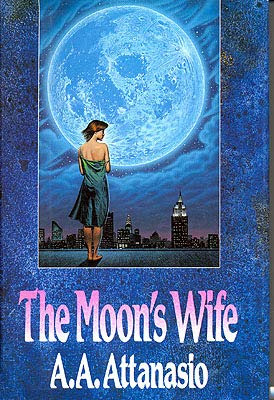

What A. A. Attanasio had been writing for several years under the working title, for his protagonist, Siggy Lindo, was published in a much truncated form as The Moon's Wife, which does describe her predicament, by HarperCollins in 1993. The acquiring editor who'd bought the fat novel, which if Al didn't think of as his magnum opus it was one particularly close to his heart, left HC, and the new editor, as I recall, not only didn't care for Not Invented Here but, I gathered, also chose to be offended that Al as a male writer would dare to write a novel about a female protagonist who could be seen as delusional, and indeed is by other characters in the romantic fantasy about a woman who learns that she is to literally become the Moon's wife, soulmate of its spirit. So, since this was published well after the initial splash of Attanasio's debut novel Radix, a genuinely international bestseller, and before the Arthor series began riding the UK charts, the editor demanded and got a severe edit that reduced the novel to a fraction of its original length. The book when released got zero support, zero attention, nearly zero sales and saw only the original hardcover edition in the States...Al's success in the UK led to a UK paperback reprint. Even truncated, it remains a charming and elegant work, in some ways my favorite of Attanasio's novels and still demonstrative of the joy he took in writing it in its original form, that probably could more easily find an audience today than it could 30 years ago, when publishers weren't too certain how to market Richard Matheson's paranormal romances, either. My copy is one that Al sent along from his stash of HC promotional copies. And in firs
t published form, it's almost a novella...Al has a new edition available, from a small press:


For more of Wednesday's Short Stories, please see Patti Abbott's blog


A redux post, slightly edited/updated, from 2010.

Friday, June 24, 2011

FFB: NEW WORLDS OF FANTASY (1967) and its sequels (1970, 1971), edited by Terry Carr


The first New Worlds of Fantasy was one of the first anthologies Terry Carr would edit on his own, having already become the junior editorial partner for fantastic literature (including gothics and, soon, the significant Ace Specials line) at Ace Books and been paired with boss Donald Wollheim on the World's Best Science Fiction annual; looking back at them now, I'd failed to realize when reading them in the late '70s how much they attempted at least a reasonably focused sampling of the current fantasy fiction, particularly of the kind that has since been tagged as "urban" or contemporary fantasy, which seemed to be flourishing alongside the new emphasis on literary ambition in science fiction in the latter '60s and early '70s. Every volume features a story by Carr himself, which isn't simply egomania, as he was a brilliant and unprolific fantasist, and usually in this mode...his one collection of short fiction missed essentially only one major short work, "Virra," that would be collected in a special convention anthology a few years later. Jorge Luis Borges is in each volume, as are R. A. Lafferty and Avram Davidson (though Davidson is not represented, I'd suggest, by the best possible selections, even stressing their contemporary status), and there's no one in the books who is clearly, utterly out of place, and several you'd be hard-pressed to find too many other places, at least in anthologies of fiction, such as the fannish writer Britt Schweitzer or chess humorist Victor Contoski...I've yet to seek out anything else by Alfred Gillespie, and I suspect that Carr read the Leonid Andreyev in its then-recent Magazine of Horror reprint...happily, there's been at least a little more translated from him. I think Carr might've been the first to reprint Peter Beagle in a fantasy-tagged context, to the benefit of all. And the second volume particularly featured new fiction...even if it's very strange that it took until the third volume for Carr to collect a Fritz Leiber story.

A fine trio of books, and indicative of how Carr would continue his valuable, too short career as an editor, and his too sparse career as a writer of fiction.


from the Contento indices:
New Worlds of Fantasy ed. Terry Carr (Ace A-12, 1967, 75¢, 253pp, pb); In England as Step Outside Your Mind (Dobson 1969).

8 · Introduction · Terry Carr · in
11 · Divine Madness · Roger Zelazny · ss Magazine of Horror Sum ’66
18 · Break the Door of Hell [Traveler in Black] · John Brunner · nv Impulse Apr ’66
52 · The Immortal · Jorge Luís Borges · ss Labyrinths, New Directions, 1962
66 · Narrow Valley · R. A. Lafferty · ss F&SF Sep ’66
80 · Comet Wine · Ray Russell · nv Playboy Mar ’67
97 · The Other · Katherine MacLean · ss New Worlds Jul ’66
101 · A Red Heart and Blue Roses · Mildred Clingerman · ss A Cupful of Space, Ballantine, 1961
118 · Stanley Toothbrush [as by Carl Brandon] · Terry Carr · ss F&SF Jul ’62
133 · The Squirrel Cage · Thomas M. Disch · ss New Worlds Oct ’66
147 · Come Lady Death · Peter S. Beagle · ss Atlantic Monthly Sep ’63
164 · Nackles [as by Curt Clark] · Donald Westlake· ss F&SF Jan ’64
172 · The Lost Leonardo · J. G. Ballard · ss F&SF Mar ’64
190 · Timothy [Anita] · Keith Roberts · ss sf Impulse Sep ’66
203 · Basilisk · Avram Davidson · nv *
228 · The Evil Eye · Alfred Gillespie · nv The Saturday Evening Post Jan 15 ’66

New Worlds of Fantasy No. 2 ed. Terry Carr (Ace 57271, 1970, 75¢, 254pp, pb)

9 · Introduction · Terry Carr · in
13 · The Petrified World · Robert Sheckley · ss If Feb ’68
23 · The Scarlet Lady [as by Alistair Bevan] · Keith Roberts · nv Impulse Aug ’66
63 · They Loved Me in Utica · Avram Davidson · ss *
67 · The Library of Babel [1941] · Jorge Luís Borges · ss Ficciones, Weidenfeld Nicolson, 1962
76 · The Ship of Disaster · Barrington J. Bayley · ss New Worlds Jun ’65
93 · Window Dressing · Joanna Russ · ss *
100 · By the Falls · Harry Harrison · ss If Jan ’70
108 · The Night of the Nickel Beer · Kris Neville · ss Escapade Dec ’67
118 · A Quiet Kind of Madness · David Redd · nv F&SF May ’68
148 · A Museum Piece · Roger Zelazny · ss Fantastic Jun ’63
158 · The Old Man of the Mountains · Terry Carr · ss F&SF Apr ’63
168 · En Passant · Britt Schweitzer · ss Habakkuk Dec ’60
175 · Backward, Turn Backward · Wilmar H. Shiras · nv *
196 · His Own Kind · Thomas M. Disch · ss *
206 · Perchance to Dream · Katherine MacLean · vi *
209 · Lazarus · Leonid Andreyev · ss, 1906; Weird Tales Mar ’27
229 · The Ugly Sea · R. A. Lafferty · ss The Literary Review Fll ’60
243 · The Movie People · Robert Bloch · ss F&SF Oct ’69

New Worlds of Fantasy No. 3 ed. Terry Carr (Ace 57272, 1971, 75¢, 253pp, pb)

9 · Introduction · Terry Carr · in
11 · Farrell and Lila the Werewolf [Sam Farrell] · Peter S. Beagle · nv guabi #1 ’69
39 · Adam Had Three Brothers · R. A. Lafferty · ss New Mexico Quarterly Review Fll ’60
53 · Big Sam · Avram Davidson · ss Alchemy & Academe, ed. Anne McCaffrey, Garden City, NY: Doubleday, 1970
61 · Longtooth · Edgar Pangborn · nv F&SF Jan ’70
107 · The Inner Circles · Fritz Leiber · ss F&SF Oct ’67
125 · Von Goom’s Gambit · Victor Contoski · ss Chess Review Apr ’66; F&SF Dec ’66
133 · Through a Glass—Darkly · Zenna Henderson · nv F&SF Oct ’70
165 · The Stainless Steel Leech [as by Harrison Denmark] · Roger Zelazny · ss Amazing Apr ’63
173 · Sleeping Beauty · Terry Carr · ss F&SF May ’67
187 · The Plot Is the Thing · Robert Bloch · ss F&SF Jul ’66
197 · Funes the Memorious [1941] · Jorge Luís Borges · ss Ficciones, Weidenfeld Nicolson, 1962
207 · Say Goodbye to the Wind [Vermillion Sands] · J. G. Ballard · ss Fantastic Aug ’70
227 · A Message from Charity · William M. Lee · ss F&SF Nov ’67

For more of today's books, please see Patti Abbott's blog (nee Nase, though once that would've been Neis in some circumstances...see the accompanying plate of plate)

Friday, July 23, 2010

Friday's "Forgotten" Books: SUPERHORROR (aka THE FAR REACHES OF FEAR) edited by Ramsey Campbell; THE MOON'S WIFE (wt: SIGGY LINDO) by A. A. Attanasio


Superhorror (published by W.H. Allen in 1976), as the slim anthology was titled in its original UK edition (the 1980 UK paperback takes the other title), includes the following stories, all original to it:

Brian Lumley - The Viaduct
R. A. Lafferty - Fog In My Throat
Daphne Castell - Christina
Joseph F. Pumilia - The Case Of James Elmo Freebish
David Drake - The Hunting Ground
Manley Wade Wellman - The Petey Car
Robert Aickman - Wood
Ramsey Campbell - The Pattern
Fritz Leiber - Dark Wings

I picked up my remaindered copy of the 1977 St. Martin's Press US hardcover, with the Donald Grant cover above carried over from the Allen edition, in 1979 or '80 in one of the Hawaiian chain of department stores, Liberty House.

What Al Attanasio had been writing for several years under the working title, for his protagonist, Siggy Lindo, was published in a much truncated form as The Moon's Wife, which does describe her predicament, by HarperCollins in 1993. The acquiring editor who'd bought the fat novel, which if Al didn't think of as his magnum opus it was one particularly close to his heart, left HC, and the new editor, as I recall from Al's account, not only didn't care for Not Invented Here but, I gathered, also chose to be offended that Al as a male writer would dare to write a novel about a female protagonist who could be seen as delusional, and indeed is by other characters in the romantic fantasy about a woman who learns that she is to literally become the Moon's wife, soulmate of its spirit. So, since this was published well after the initial splash of Attanasio's debut novel Radix, a genuinely international bestseller, and before the Arthor series began riding the UK charts, the editor demanded and got a severe edit that reduced the novel to a fraction of its original length. The book got zero support, zero attention, nearly zero sales and saw only the original hardcover edition in the States...Al's success in the UK led to the paperback reprint pictured above. Even truncated, it remains a charming and elegant work, in some ways my favorite of Attanasio's and still demonstrative of the joy he took in writing it in its original form, that probably could more easily find an audience today than it could seventeen years ago, when publishers weren't too certain how to market Richard Matheson's paranormal romances, either. My copy is the one that Al sent along from his stash of promotional copies.

Meanwhile, the Campbell, the first anthology he would edit, is an impressive start by any measure...with most of the contributors demonstrating why they were already masters of the form, and the major flaw as far as it goes being a lack of female contributors...but the biggest surprises in the book would not be that Leiber or Aickman or Wellman or even the then still relatively young Drake, and Castell and Campbell himself, would provide impressive work, but that Brian Lumley's suspense story, like all his work carrying a touch of the Boy's Adventure Tale about it but also like most of his non-Lovecraftian work far superior to the (sustainedly popular) Necroscope kludges, would be a fine and brutal story of retribution; Joseph Pumilia's rather grimly jokey homage to EC horror comics was an early example of that sort of thing in prose, and a good one; and then there's R. A. Lafferty's story. It was no secret that Lafferty was brilliant and eccentric, and often veered close to out-and-out horror in much of his previous fiction, but only rarely nudged any given work firmly into the field...but "Fog in My Throat" takes on the very soul of horror, the knowledge that we will be extinct and how we cope with this, and succinctly and forefully tells us how and why we'd best not try to fiddle with our self-delusional defense mechanisms in dealing with that. From a devoutly Catholic man, well along in years and not in the greatest of health at the time, it's a brilliant story that carries every sort of conviction with its wit, invention and compassion, and I've remembered it more clearly than any other in this book over the decades.

And, of course, it's been reprinted exactly once, as far as I can tell, in a small-press collection of Lafferty's short work.

For more of Friday's "Forgotten" Books, please see Patti Abbott's blog.