Wednesday, February 16, 2022

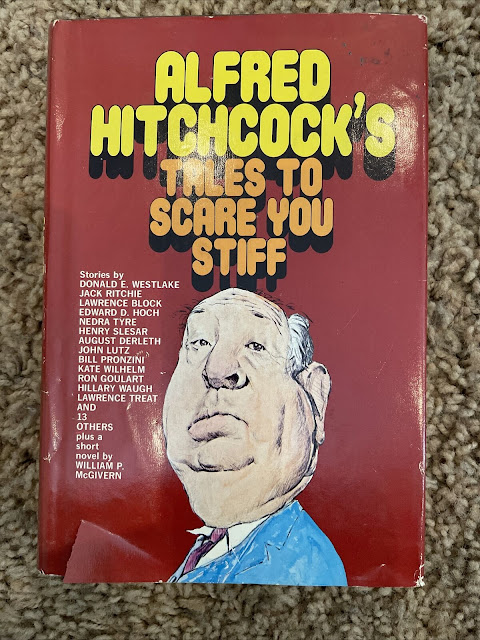
SSW: Eleanor Sullivan, editor: ALFRED HITCHCOCK'S ANTHOLOGY issue 4; Spring/Summer 1979 (Davis Publications)/ALFRED HITCHCOCK'S TALES TO SCARE YOU STIFF (Dial Press 1978) simultaneous Winter '78 publication

It's a magazine, and it's a hardcover...the latter has better paper, but the same typesetting; the covers are comparably uninspiring. Dell, parent company of the Dial Press, all  just purchased in 1976 by Doubleday, continues its long history of being in the Hitchcock book business...before eventually purchasing Alfred Hitchcock's Mystery Magazine and its fiction-magazine stablemates from the then-collapsing Davis Publications in the early 1990s. The Dial hardcovers were mostly aimed at the library market, though Doubleday's relatively cheap production methods meant the hardcovers weren't the most durable of volumes--the glued (rather than sewn) first signature of my copy, having already been creased severely by some previous reader (this wasn't a discard, but I did pick it up at a library sale) broke away from the binding as I rather carefully read it...I suspect the magazine form would be hardier.


In the Beginning, or at least in 1945, Dell Books begat the first anthology attributed to then-young-middle-aged film director Alfred Hitchcock, in the Dell MapBack paperback series, Suspense Stories. This also began Dell's rather devious (but hardly unique) practice of obscuring the actual editor of the Hitchcock (or other famous person) volumes, who in this case was probably Dell's own Don Ward, who edited most of the early Dell "Hitchcock" paperbacks, as well as the Dell magazine Zane Grey's Western Magazine (which ran from 1946 to 1954, and which got better and better the less Grey fiction it reprinted). In 1956, HSD Publications was formed to publish Alfred Hitchcock's Mystery Magazine, not at all coincidentally with Alfred Hitchcock Presents: beginning its television career in Fall 1955. Likewise, by 1957, Random House engaged fiction and script-writer and magazine editor Robert Arthur to ghost-edit a series of anthologies also entitled Alfred Hitchcock Presents: [various usually darkly humorous subtitles]; by 1961, these were joined by a young readers' series, with the first volume, Alfred Hitchcock's Haunted Houseful, ghost-edited by YA specialist Muriel Fuller, but subsequent volumes, till his death in 1969, edited along with the adult-AHP: series by Arthur. (Arthur was also called to upon to devise a Hardy Boys/Nancy Drew-style series devoted to Hitchcock and the youthful The Three Investigators, and he wrote the first several volumes and edited the series initially afterward.) Other tv-driven projects included the 1957 Simon & Schuster anthology Stories They Wouldn't Let Me Do on TV, possibly assembled by Arthur but definitely by the network and/or sponsor censors via refusal (and in reprint editions, often intentionally retitled "AH Presents: Stories...") and writer Henry Slesar's first collection, an Avon Books paperback A Bouquet of Clean Crimes and Neat Murders; Slesar had contributed scripts and source stories to the AHP: tv series and Hitchcock branding was much in evidence. Meanwhile, Dell was very much interested in keeping their hand in, by reprinting the older anthologies they had originated and from others, publishing paperback editions of the Random House adult books that mostly split the hardcover contents into two softcover volumes, and, in the early '60s, beginning to publish best-of volumes from AH's Mystery Magazine...all packaged as if Hitchcock was the editor, and all looking rather like one another, whatever their content's source. In the UK in the latter '60s, busy editor Peter Haining would also begin editing "Hitchcock" anthologies, mostly not seen in the US (though Dell would publish the last one, in 1971) for Four Square, then New English Library.

HSD would publish the magazine till 1976, selling it in late '75 to Davis Publications, formed in the late '50s when B. G. Davis left Ziff-Davis in part because the house he co-founded was less and less interested in publishing fiction magazines; Davis started his second firm with the purchase of Ellery Queen's Mystery Magazine from Mercury Press, and one of Davis's innovations was to begin publishing as well a reprint magazine called Ellery Queen's Anthology drawing mostly from the back pages of EQMM...by late '76, under B. G.'s son Joel Davis's direction, Alfred Hitchcock's Anthology magazine had joined the stable...and the Dial Press hardcover editions came with them. Davis Publications, having suffered an expensive failure in launching a Sylvia Porter-branded financial-planning magazine, sold its fiction titles (at that point, the sf magazines Analog and Asimov's along with the two crime-fiction titles) to Dell's magazine arm in 1991; the last Anthology issues (including those spun off from the sf magazines) had appeared in 1988 (dated 1989). In 1996, Dell sold its magazine group, by then mostly devoted to crossword/word puzzle and astrology magazines along with the four fiction titles (Dell had briefly published an impressive Louis L'Amour Western Magazine as well in the mid '90s, but that had been folded before the sale and was not revived) to word-game specialist Penny Press, which has been publishing them since, doing business as Crosstown Publications/Dell Magazines.

Eleanor Sullivan had been Managing Editor of Ellery Queen's Mystery Magazine from 1970 at least through 1975, and was handed the reins to AHMM when it became a Davis Publication till 1981's penultimate issue; in 1981, after the death of Frederic Dannay, she edited both monthly magazines for about a year, and then handed editorship of Hitchcock's to Cathleen Jordan, a book editor who had been recommended to Joel Davis by Isaac Asimov. Jordan was a less-sure hand at the magazine, but did publish more horror fiction than Sullivan had, so a small favor there. Sullivan also edited, as a consequence, the first ten issues/volumes of Alfred Hitchcock's Anthology magazine, and under their various titles in the Dial Press editions.

AHMM, as this anthology-issue might suggest, was often among the best of crime-fiction magazines available during its run, and had certainly drawn fiction from many of the best active cf writers. EQMM had always had a bit more prestige, at least theoretically (and perhaps paid a bit more), though when Avram Davidson lampooned it in one of his fantasy stories as Quentin Queely's Mystery Museum, he wasn't alone in finding it at times a bit fusty; Manhunt and a few of its imitators in the 1950s were briefly providing even better issues, though most had folded by the turn of the '60s and Manhunt was on a severe downward slide that would continue till its folding in '68; The Saint magazine was interesting but erratic, as was the less well-funded but more consistently published Mike Shayne Mystery Magazine, the only primarily hardboiled cf magazine to run from the '50s into the '80s, unless one counted the then-mostly, but not exclusively, noirish AHMM, still published today. 

"Come Back, Come Back" was the second in the young Donald Westlake's short series of stories about aging, literally as well as a bit figuratively heart-sick police detective Abe Levine; they were collected, with a new story to wrap them up, in a 1984 volume. Westlake wasn't a kid by the time he was writing these, but this one was published before he was thirty; you can see him grappling with big thinks at every opportunity and not self-editing the explication of every character beat, as he would in his work not too long afterward...it probably didn't hurt that Hitchcock's paid by the word, and this story could've been a tighter short story rather than the pretty good novelet that it is (apparently, Westlake notes in the Levine collection that he stopped writing the series of novelets when AHMM rejected the penultimate one--and for decades the last--for not being sufficiently criminous; Mike Shayne Mystery Magazine picked it up for publication a few years after the last AHMM entry, with Shayne a salvage market; the new story was placed with EQMM in '84, presumably just before the book's publication). Westlake's wit and incisiveness are on display...just not his usual later concision.

While Kate Wilhelm, also with one of her earlier stories, "A Case of Desperation", has her paring knife firmly in hand, and the casual bullying violence of the protagonist's kidnapper is chilling to read so plainly and concisely detailed. Worse still, for Marge, the experience of being taken at gunpoint from her bank-teller job, as hostage to help him with his robbery, has too many resonances with the rest of her life. Interesting to see the protagonist of Westlake's story and the utter, resentful, careful villain of this one both spout similar notions of How Men Are Kept From Being Men, and Don't you Want a Real Man in Your Life? Defined, apparently, as a benevolent (more or less) dictator. Contrasts slightly with the default shrewish wives and turning-worm husbands of too many of the Alfred Hitchcock Presents: tv episodes.  There is a bit of oddly overemphatic foreshadowing in the story's beginning, but otherwise it's about as quietly tough and emotionally complex as one might expect from Wilhelm.

More to come. The whole post is in italics because the substandard Acer laptop I'm using at the moment loves to grab not just the selected text but all the text it can just as one hits the italics button, and I'd gone through and corrected for about twenty minutes early this morning when I could've been reading more stories in this collection. So I did the faster version just now. I will soon beat the Acer to shards, or perhaps sanity will prevail.

For more of today's short fiction selections, 


Wednesday, February 2, 2022

Short Story Wednesday: In tribute to Shirley Jackson and Cornell Woolrich: Anthologies of new fiction: WHEN THINGS GET DARK edited by Ellen Datlow (Titan/Penguin 2021); BLACK AS THE NIGHT edited by Maxim Jakubowski (Titan/Penguin 2022)


4 October 2022
Black as the Night: Stories Inspired by Cornell Woolrich 
edited by Maxim Jakubowski * 448 pp.
Introduction/Maxim Jakubowski
Neil Gaiman/A Woolrich Appreciation
Joel Lane/The Black Window (poem)
stories
Joseph S. Walker/A Shade Darker Than Gray
Vaseem Khan/A Thin Slice of Heaven
Charles Ardai/Sleep! Sleep! Beauty Bright
Kim Newman/Black Window
O'Neil De Noux/Blue Moon Over Burgundy
Paul Di Filippo/The Bride Hated Champagne
James Grady/Eyes Without a Face
Donna Moore/First You Dream, Then You Die
M. W. Craven/Institutional Memory
Ana Teresa Pereira/Looking For You Through the Gray Rain
Joe R. Lansdale/Missing Sister
William Boyle/New York Blues Redux
Kristine Kathryn Rusch/Our Opera Singer
Mason Cross/People You May Know
David Quantick/Red
Lavie Tidhar/The Case of Baby X
Tara Moss/The Husband Machine
Warren Moore/The Jacket
A.K. Benedict/The Lake, the Moon, and the Murder
Bill Pronzini/The Long Way Down
Nick Mamatas/The Man in the Sailor Suit
Max Décharné/The Woman at the Late Show
Martin Edwards/The Woman Who Never Was
Samantha Lee Howe/Trophy Wife
Brandon Barrows/Two Wrongs
Maxim Jakubowski/What Happens After the End
Susi Holliday/The Invitation
James Sallis/Parkview
and, in comments, Maxim Jakubowski notes that another story has been added:
Barry N. Malzberg/Phantom Gentleman
...and the further good news that he's contracted with Titan for a tribute anthology in honor of J.G. Ballard to be published in 2023...


• anthology edited by Ellen Datlow
Titan Books, a line from Penguin/Random House, is clearly in the tributes business, and one could only wish these two were published more closely together, as the overlap in audience between those who love the work of Jackson and of Woolrich is not one of unanimity, but it can't be too far from it. Both are best remembered for their work in the outré, suspense and horror and simply charged narratives full of emotion usually in full disarray in Woolrich's fiction, in incompletely controlled cloaking frequently in Jackson's. Even the work they are less well-remembered for, "Jazz Age" stories in The Smart Set for Woolrich and book-length collections of humorous accounts of family life for Jackson, can be seen to have some similar spirit...and similar undertones. 

So, a heads-up for the forthcoming Jakubowski anthology (I suspect [incorrectly...see comments] there are advance readers copies about) and a brief review of some of the stories in the Datlow, a book I've had on hand for on a busy few weeks.

M. Rickert's "Funeral Birds" leads off the fiction, and certainly seeks to fulfill what Datlow describes as called for in her introduction, stories which are not pastiches of Jackson but which incorporate her interest in how the mundane details of daily life and behavior can both mask and drive madness and despair. A thoroughly unlikable home health aide attends the funeral of her recent client, and an after-funeral get-together at her former charge's daughter's house. She finds that perhaps her relation with the departed isn't finished. Rickert does revel in the physical details of the aide's life and eccentric passage through it.

Elizabeth Hand's "For Sale by Owner" digs even more deeply into  Jacksonian exploration of the notion of the invasion of the houses of others, and how the domiciles can return the "favor". Elegant prose, including some that verges on "real-estate porn", as well as an engaging exploration of the friendship of the middle-aged women protagonists, who find over the course of the story a shared attraction to wandering into and through the New England summer houses belonging to others...and what might make that more dangerous than a lark, quite aside from random police checks and the like. How many of us have first read Jackson via "The Summer People", "The Lovely House" or The Haunting of Hill House? Probably relatively few compared to those who first encountered "The Lottery", but I was finding her work in explicitly supernatural horror anthologies first, and "The Lottery" came a year or so later, not too long before such lighter stories as "One Ordinary Day, With Peanuts" in my first Best from [the Magazine of] Fantasy and Science Fiction volume. 

Carmen Maria Machado's "A Hundred Miles and a Mile" is an allusive story about the passing on of what might be secret wisdom, and certainly is at least important...how we can be the bearers of such without fully knowing it, and how carrying it with us doesn't necessarily make our lives easier. 

Joyce Carol Oates's "Take Me, I am Free" is also allusive, but in a more emotionally brutal manner, unrelenting as it limns a certain kind of too-common child abuse as well as drawing in some implications of something beyond that quotidian evil. I suspect Andrew Vachss would've admired if not also loved this one, and he would be correct.

The design of the book as a whole is handsome, and the custom endpapers, fetishizing the style of eyeglass frames Jackson wore in her photographs even more than the jacket/cover art does (as do the story headers), are an amusing touch. Sadly, the copy I first received from a certain Bad Place to Work was rather less-well-"built", as was the replacement I ordered--both had warped boards, and not the firmest binding I've found on a hardcover; I hope a certain source got a bad batch or treated it roughly, rather than all the first printing sharing the same flaws. (In comments below, Ellen Datlow notes she hasn't heard this plaint till now, which I take to be a good sign...and an argument for picking up a copy through an independent or other brick and mortar store, if practical and safe. I do prefer seeing the condition of my copies before I buy them.)

Definitely a book worth having. 

More to come...


For more of today's Short Story Wednesday reviews, 


Wednesday, January 26, 2022

SSW/FFB: First Installment: WESTERYEAR edited by Edward Gorman (M. Evans 1988); THE NEW FRONTIER edited by Joe R. Lansdale (Doubleday 1989); DREAMERS AND DESPERADOES edited by Craig Lesley and Katheryn Stavrakis (Dell 1993)


Some of the titles of the stories collected in these volumes use, for critical purposes, epithets.

WESTERYEAR edited by Edward Gorman (M. Evans 1988; G. K. Hall 1990)
Introduction * Edward Gorman (in) ** (**noting originally published in this volume) --and each item below with a headnote by Gorman
The Sun Stood Still * "Max Brand" (Frederick Faust) (ss) The American Magazine December 1934
Fenimore Cooper’s Literary Offenses * "Mark Twain" (Samuel Clemens) (ar) North American Review July 1895
The Return of a Private * Hamlin Garland (ss) The Arena, V.3 N.1 (January?) 1891
The Idyl of Red Gulch * Bret Harte (ss) Overland Monthly December 1869 
The Lonesome Road * "O. Henry" (William Porter) (ss) Ainslee’s Magazine September 1903
One Dash—Horses (aka Horses) * Stephen Crane (ss) The New Review #81, February 1896 (and newspaper syndication in the U.S. in January of that year)
The Streets of Laredo * "Will Henry" (Henry Allen) (ss) Western Roundup--a WWA anthology editorially attributed to Nelson Nye (Macmillan 1961)
The Hard Way * Elmore Leonard (ss) Zane Grey’s Western Magazine August 1953
Mago's Bride * Loren D. Estleman  ** 
All the Long Years * Bill Pronzini **
The Damned * Greg Tobin **
Wolf Night * Bill Crider **
Liberty * Al Sarrantonio **

Trains Not Taken * Joe R. Lansdale (ss) RE:AL: Regarding Arts & Letters Spring 1987
Whores in the Pulpit * Thomas Sullivan **
Guild and the Indian Woman * Edward Gorman **
A Cowboy for a Madam * Barbara Beman **
One Night at Medicine Tail *  Chad Oliver **
The Time of the Wolves * Marcia Muller **
Hacendado * James M. Reasoner **
The Battle of Reno's Bend * L. J. Washburn **

Index revised and corrected from the WorldCat Index, with links to ISFDB, the FictionMags Index and other databases. Page numbers differ between the two editions.


THE NEW FRONTIER edited by Joe R. Lansdale (Doubleday/Double D 1989)
(Doubleday 0-385-24569-6, May ’89, $12.95, 180pp, hc) Original western anthology of 18 stories and a poem with an introduction by Lansdale and an afterword to a “lost” "Max Brand" (Frederick Faust) story by William F. Nolan. At least four of the stories are also fantasy.
Slightly augmented from the currently offline Locus Index.


DREAMERS AND DESPERADOES edited by Craig Lesley and Katheryn Stavrakis (Dell/Laurel 1993) 

1 * Introduction(s) * Craig Lesley and Katheryn Stavrakis (in)
15 * Sweetheart * Kathleen Alcalá (ex) Mrs. Vargas and the Dead Naturalist Calyx Books 1992
Iliana of the Pleasure Dreams / Rudolfo A. Anaya --
Heartwood / Rick Bass --
The Snowies, the Judiths / Mary Clearman Blew --
Bigfoot Stole My Wife; I am Bigfoot / Ron Carlson --
Paraiso: an Elegy / Rick DeMarinis --
Winter of '19 / Ivan Doig --
Science Meets Prophecy / David James Duncan --
Cry About a Nickel / Percival Everett --
Optimists / Richard Ford --
Girls / Tess Gallagher --
Personal Silence / Molly Gloss --
Nebraska / Ron Hansen --
Friends and Fortunes / Linda Hogan --
A Family Resemblance / James D. Houston --
Rock Garden / Jeanne Wakatsuki Houston --
The Flower Girls / Lawson Fusao Inada --
Death by Browsing / Karen Karbo--
I Could Love You (If I Wanted) / John Keeble --
Why I am a Danger to the Public / Barbara Kingsolver --
Do You Hear Your Mother Talking? / William Kittredge --
Nevada Dreams / David Kranes --
Eggs ; Absences : Cicadas ; Growing Tomatoes / Alex Kuo --
Sleepwalkers / Ursula K. Le Guin --
Mint / Craig Lesley --
The Interior of North Dakota / Barry Lopez --
The Woman Who Would Eat Flowers / Colleen McElroy --
Dropping Anchor / Valerie Miner --
Idaho Man / John Rember --
Slaughterhouse / Greg Sarris --
Whitney and Tracie / Carolyn See --
Emerald City: Third & Pike / Charlotte Watson Sherman --
It's Come to This / Annick Smith --
Sea Animals / Tom Spanbauer --
The Room / Katheryn Stavrakis --
Pragmatists / Robert Stubblefield --
Migrants / Elizabeth Tallent --
Double Face / Amy Tan --
Boat People / Joyce Thompson --
Talking to the Dead / Sylvia A. Watanabe --
The Indian Lawyer / James Welch --
Buried Poems / Terry Tempest Williams

Slightly corrected (and soon to be augmented) from the WorldCat index.


***Stupid publisher tricks: 
Westeryear--the first edition jacket from M. Evans (immediately above); even G. K. Hall's generic large-print-line wrap (at top of post) is a step up.

The New Frontier--jacket copy referring to Neal Barrett, Jr. as "a new discovery" in 1989, a quarter-century or so into his career; also, a jacket at least as generic if not quite as clumsy as the Evans cover for the Gorman book or D-day's package for Lansdale's previous western originals anthology, Best of the West.

Dreamers and Desperadoes--managing to leave co-editor Stavrakis's name off nearly every aspect of the packaging, save the title page, though at least the table of contents does include her introduction. Also not quite stupid but perhaps not the best choice: the reasonably handsome cover for this trade-paperback original apparently doesn't photograph too well, at least on most of the photos and scans I've seen. Hence the current slightly blurry image above...and the cover isn't the easiest to read even in the handheld presence of the potential reader (poor color choices for legibility).

And none of these received the publisher push they deserved by any means, even if the Gorman did get a second edition for large-print readers.

Contents:
Westeryear's stories are, to say the least, an interesting mix of classics and contemporaries of classics, and new fiction from some of the best writers in western fiction (among work in other fields) active at time of assembly...a quality it shares with the Lansdale and Stavrakis/Lesley  volumes...even if each book has its own share of work that might fall on either side of the line established some years back by the Western Writers of America, porously between western fiction and fiction of the west (both of which they embraced). 

And then there's the Twain essay, perhaps the most famous KTF review in at least the US canon, and persuasive enough to me at age nine that I never sought out too much of Cooper's fiction, and what little I did seemed to conform to the Clemens assessment. Twain goes to a few lengths to ensure you can read his survey for humor, but nonetheless it tells, and enrages Cooper fans to this day. Editor Gorman himself isn't beyond pointing out the warts in the older reprints he offers here, or in the other work by their contributors, in his headnotes, but the stories do help add a certain perspective and none of them are difficult reading, and clearly are part of the development of the range of western fiction all the relatively contemporary writers included in all three volumes have drawn upon and reacted to. 

"Max Brand" (Frederick Faust)'s "The Sun Stood Still" is a good example of his graceful, tense writing; Gorman notes that its wit and appreciation of life as it was lived by the everyday people of the old West wasn't as widely shared by his peers (nor some of his successors), giving his work more of a contemporary if not quite timeless quality than that of many who wrote for the pulp magazines and higher-budget and yet still prone to tropism "slick" magazines in the first half of the previous century. For those who want even early western fiction to lack subtlety and a certain dramatic verisimilitude, even when the mythos of western fiction was already being employed (not too much in this decidedly unglamorized account of farmhand life), Brand doesn't help their case too much.

Hamlin Garland made a poor showing for himself (with the help of those hoping to Reach Yet Instruct Our Youth) with such widely-distributed work as his poem "Do You Fear the Force of the Wind?", unless one was looking for simpleminded machismo. But a similar devotion to simpleminded machismo on the part of, say Hemingway or Mailer (and far too many others, even if these two more flagrantly than most) didn't stop them from having a certain dalliance, at least, with social justice causes, and Garland particularly in his early career was throwing in with agrarian socialists, Populists, progressives and other troublemakers, and his fiction about, particularly, the travails of Civil War veterans and others trying to make a life in the hardscrabble, highly Gilded Age-distorted farming country of the Midwest (perhaps a bit too much like today's), struck a chord, and that's on offer with "The Return of a Private"; it's not subtle, but, as Gorman notes, Garland had an excellent eye for the small details and challenges of life.

"The Idyl of Red Gulch", being as it is a Bret Harte story, tries to couch itself as a fable perhaps a bit too much more than is good for it, but nonetheless gets across a fine account of how even in the far western U. S., the unfortunate prejudices can shoot through society once it asserts itself as post-pioneering country. Definitely romanticized, but also making its points. 

"The Lonesome Road", being as It is an "O. Henry" story, is also not quite a fable, but doesn't, unlike the Harte, call attention to its attempt at being of Great Import with every line, but rather more casually and mildly humorously gives the account of two old hell-raising friends, one of whom has now settled into a happy marriage and a more quiet life, finding themselves together having to deal with old adversaries. An interesting weighing of what makes for an actually good life, with a  rather straightforward account of what a chaotic, unromantic thing a gunfight tends to be. Gorman is particularly annoyed in his headnote about how readily Porter's work these years is condescended to as glib and mechanical, and this story helps make his case (and, fwiw, the Doubleday/Anchor folks are still branding their best stories of the year annual in his memory).

More to come. (More distractions as other parts of the ever-collapsing  house and life demand attention, not least the cat. Don't buy a century-old house. Just don't. Unless you have the money, skill or both to keep replacing everything.)


Friday, January 7, 2022

FFMagazines: SPECIAL REPORT: FICTION May-July 1990: "Humor" issue; edited by Keith Bellows: contributions by Harvey Jacobs, Elizabeth Berg, Roy Blount, Jr., et al. (in progress)

Special Report: Fiction, May-July 1990, no volume nor issue numbers, Humor issue. William S. Rukeyser, editor-in-chief; Keith Bellows, editor; Elise Nakhnikian, managing editor (Whittle Communications, $3.50--though not known ever to be distributed to newsstands, individual issues were offered for sale, including postage, for that amount, with a four-issue yearly subscription for $14), 70pp plus covers, 10.5x14" full-color slick with heavier-grade slick paper covers. Cover photograph by Philip Saltonstall; another on the TOC on page 1.

2 * Letters: Ramsey Campbell, complimenting the fantastica issue, August-October 1989/"Another Dimension", which reprinted his story "Little Man" (originally in Night Cry, Winter 1986); also letters from Donna D. Vitucci, Pamela Kennedy, Lillian J. Taylor, Andrea Cirillo, Ann Shields, Lottie T. Caldwell, and Sarah Aronson
5 * In This Issue: What's So Funny? *  The Editors* ed/cs (illus. as a comic strip by Joey Waldon) 
7 * Salvation Sunday * Liz Newall * ss (illus. Laura Levine)
12 * Liz Newall * anon * bi (photo by Brian Dressler)
14 * About Men * Jay Neugeboren * vi (illus. Dudley Reed)
16 * Jay Neugeboren * anon * bi (photo by Chris Wade)
19 * The Poet Lariat * Roy Blount, Jr. * poems about Edna St. Vincent Millay, John Donne, William Blake, Walt Whitman, Jonathan Swift, Stephen King, William Faulkner * gp/hu (illus. Edward Sorel)
23 * Second Thoughts * Elizabeth Berg * ss  (illus. Cary Bartholomew)
31 * Elizabeth Berg * anon * bi  (photo by John Goodman)
33 * 3 Faces of Fiction  (Humor, Mysteries, Romance) * Walter Gurbo * cartoons
34 * Because It Was There * Harvey Jacobs * ss (illus. John Craig)
40 * Harvey Jacobs * anon * bi (photo by Patrick Harbron)
43 * Pequod II * Frank Gannon * hu (illus. Robert de Michiell)
46 * Hotline! * William Price Fox * ss (illus. Karen Kuehn)
55 * William Price Fox * anon * bi (photo by Brian Dressler)
57 * Punch Lines * gp/hu (excerpts) 
57 * Bred Men Don't Wear Checks * P. G. Wodehouse * ex (from The World of Jeeves, Harper & Row 1967) (illus. Tom Bachtell)
57 * Easy Come, Easy Go * Elmore Leonard * ex (from Labrava, Arbor House 1983) 
57 * Dinner's in the Freezer * Calvin Trillin * ex (from "Barnett Frummer Learns to Distinguish Packaged Paprika From the Real Article" The New Yorker 31 March 1967/Barnett Frummer is an Unbloomed Flower E. P. Dutton 1971) (illus. Tim Lewis)
57 * Remedies that Stink * Mark Twain * ex (from "Curing a Cold" The Golden Era 20 September 1863) (illus. Robert Andrew Parker) 
58 * Till Flirting Do Us Part * "Groucho" Marx * ex (from "Private Life" in The Groucho Letters Simon & Schuster 1967) (illus. Robert Andrew Parker)
58 * Shall We Dance? * Dorothy Parker * ex (from "The Waltz" The New Yorker 2 September 1933
58 * Lonely at the Top * Gracie Allen * ex ("If you don't have time to cultivate all your friendships, plow under every fifth one.") from How to Become President Duell, Sloan and Pearce 1940
58 * Children We're Stuck With * Fran Liebowitz * ex (from Metropolitan Life E. P. Dutton 1978) (illus. Tim Lewis)
58 * The Trick to Toy Assembly * S. J. Perelman * ex (from "Insert Flap A and Throw Away" The New Yorker 5 February 1944) (illus. Tom Bachtell)
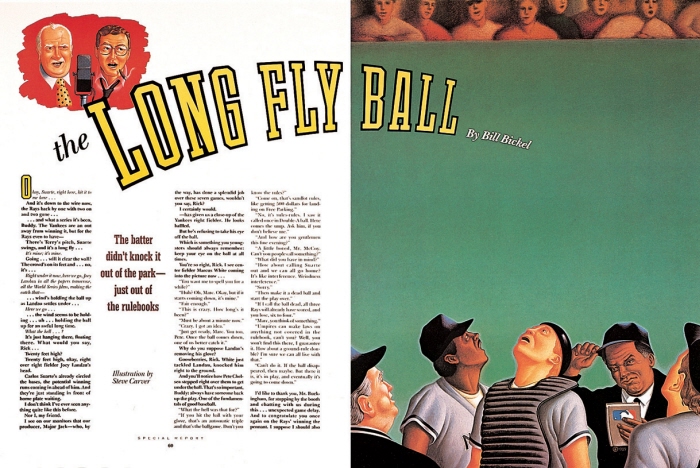
60 * The Long Fly Ball * Bill Bickel * ss (illus. Steve Carver)
65 * Bill Bickel * anon * bi (photo by Joyce Ravid) ("Bickel, now 35, lives in Hillside, NJ"--thus born 1955, NYC, raised in Yonkers and spent most of his adult life in Northern NJ...thanks to Dennis Lien, I've learned he died on 16 September 2020. Obituary/remembrance on his Comics I Don't Understand site)
68 * Elsewhere in Special Reports * house ad for the other Special Report: magazines, about health, sports, etc., part of a line of quarterly magazines sold primarily to and for doctors' offices.
70 * Passages * ex from a story/article in each Special Reports: current issue * house ad

A review of the contents will be posted tomorrow (or, really, later today)...even given the relative difficulty in trying to strike a balance between the types of humorous writing, this issue is reasonably successful, even if the cover was the worst I saw on an issue of Special Report: Fiction during its brief run, if more in concept than execution. The image below is more "bleached" than my copy's front cover. 

Bickel's story is a baseball fantasy; the Jacobs story is a well-turned satire on corporate dissembling; the Newall story a gently funny account of church-based romance. More post-sleep.


images courtesy layout designer William Grimes


Previous index and review here:

Incomplete contents of two previous issues:
Special Report: Fiction November 1989-January 1990: Growing Up Female
A Single Ounce of Good * Kaye Gibbons * ex A Virtuous Woman Algonquin Books 1989
In the Courtyard of the Five Julias * Anna Monardo * ss 
--from references in the letter column detailed above

Special Report: Fiction August-October 1989: Another Dimension
Little Man * Ramsey Campbell * ss  from Night Cry Winter 1986 (as noted above)
I Just Kept Staring at the Rock * Bill Bickel * vi --cited in his bio blurb indexed above; Bickel in ISFDB and in the Fictionmags Index

Publisher Chris Whittle standing in front of first-issue cover images from other Special Report: magazine titles: Health. Living. Family. Whittle had been publisher of Esquire.

Wednesday, January 5, 2022

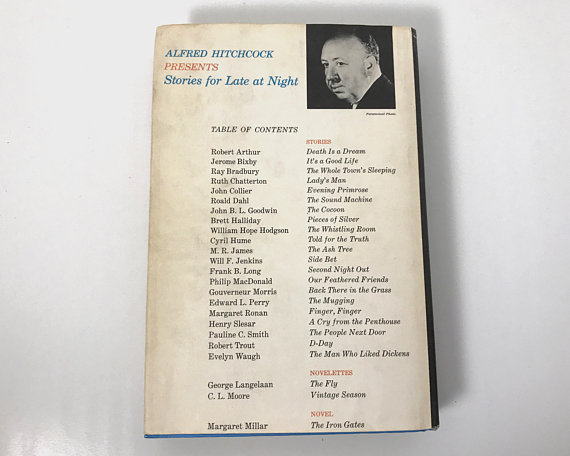
Short Story Wednesday: ALFRED HITCHCOCK PRESENTS: STORIES FOR LATE AT NIGHT Robert Arthur, editor (Random House, 1961); and various paperback abridgments (Dell, Pan)

The degree to which these volumes were Robert Arthur's painless education in the joys of suspense, mystery, horror, fantasy and science fiction would be hard to overestimate, and any time I look upon them it's difficult not to be reminded that these were among the greatest of the "books of gold" in my early literate life, a phrase employed by writer Gene Wolfe in one of his essays to describe  guideposts into the range of literature available but not always accessible, particularly to young readers who might not have first-rate used bookstores nor large libraries available to them. But they might just have a decent-sized public or school library, where the librarians were sensible enough to procure and keep books such as these anthologies on the shelves. Of course, Arthur was kind to his talented friends and old colleagues in the fiction magazines of the 1930s-60s, as well as looking out for #1 (running as he does two of his own stories, one under his Pauline Smith pseudonym--reprinted, as it was, from a magazine he had edited), and there is no lack of chestnuts here--he knew who was likely to be reading these books, young readers (such as myself) or casual ones approaching these fields, or, as the marketing was meant to snare, those who simply enjoyed the television series and hoped for More of Same in prose. Only to be rewarded with a much better selection than even the good choices made for adaptation by producer Joan Harrison and co. And, also to be fair, some of these stories became chestnuts After publication in the various AHP: anthologies...and a few presumably because other editors had them drawn to their attention by Arthur (and his successor in the adult line of Random House anthologies, Harold Q. Masur). And some aren't too well known now, any more than they were then...the Ronan is not the first story one thinks of when one thinks of Unknown: Fantasy Fiction, retitled Unknown Worlds hoping to snag some sf readers as well by the time it published her story. Nor the Long story among Weird Tales reprints, even given he was more a stalwart contributor to that magazine. The Chatterton story being first published in this volume was a rarity in this series--perhaps she was having difficulty placing it elsewhere.

As you glance over the paperback reshuffles of the contents below, you can see how much better the hardcovers were to have--and not solely because the Margaret Miller novel The Iron Garden is missing, presumably because another publisher still had a paperback edition out or at least rights to have one out--often in later volumes, the paperbacks would replace Arthur's novels or long novellas with stories from his YA anthologies from Random House, leading me to wonder if Arthur was given the opportunity to make the reshuffling in the Dell paperbacks himself...or if some functionary at Dell or RH was tasked with this. (Though as noted below, the first edition Dell paperback for the second volume of reprinting Late at Night sports a cover derived from the first RH YA volume in the series, edited by YA specialist Muriel Fuller rather than Arthur, and less successfully than Arthur would approach the same tasks, as a veteran of writing and anthologizing for young readers as well as adults, himself).

The writers this volume would Not have introduced 8- or probably 9yo me to would run only to Arthur himself, Bradbury, Collier, Dahl (running in fine alphabetical sequence--oddly, it seems Arthur was arranging the stories alphabetically by author or pseudonym, except for Millar's novel as last entry as was his custom with the Long Story in his volumes, but for some reason broke his own sequencing with the Moore story), and Bixby and Moore and Jenkins, since I had read their "It's a Good Life--" and "Mimsy were the Borogoves" and "First Contact" in my father's copy of The Science Fiction Hall of Fame, Volume One a few weeks or months before....the others in earlier-discovered kidlit and/or horror anthologies. One thing these anthologies lacked was headnotes for the stories, or similar addenda, so I would, for example, not learn of Robert Trout's work as as a CBS radio and early tv newsman for a couple of decades.
published in the UK under the
Max Reinhardt imprint, 1962


for more Short Story Wednrsday entries,