Showing posts sorted by relevance for query muriel fuller. Sort by date Show all posts

Friday, October 30, 2020

FFB: Robert Arthur's Young Readers' Ghosted Anthologies, Continued: ALFRED HITCHCOCK'S GHOSTLY GALLERY (Random House, 1962) and ALFRED HITCHCOCK'S SPELLBINDERS IN SUSPENSE (RH, 1967): Friday Fright Night

Previous blog entries from the Random House YA anthology series:


Other volumes in the Random House YA series:

Robert Arthur, editor:
Alfred Hitchcock's Sinister Spies (1966)
Alfred Hitchcock's Daring Detectives (1969)

Robert Arthur, author:
Alfred Hitchcock's Solve-Them-Yourself Mysteries (1963)
the initial AH and the Three Investigators novels (beginning 1964)

Henry Veit, editor:
Alfred Hitchcock's Supernatural Tales of Terror and Suspense (1973)


Contents
• Frontispiece blurb by Robert Arthur (as by Alfred Hitchcock): These are mystery-suspense stories. Some will keep you on the edge of your chair with excitement. Others are calculated to draw you along irresistibly to see how the puzzle works out. I have even included a sample or two of stories that are humorous, to show you that humor and mystery can also add up to suspense.

So here you are, with best wishes for hours of good reading.

• The Chinese Puzzle Box by Agatha Christie [Hercule Poirot], (ss) The Sketch Oct 3 1923, as “The Case of the Veiled Lady”
11 • The Most Dangerous Game by Richard Connell (nv) Collier’s Jan 19 1924
65 • Puzzle for Poppy by "Patrick Quentin" (Richard Webb and Hugh Wheeler) (ss) Ellery Queen’s Mystery Magazine Feb 1946
79 • Eyewitness by Robert Arthur (ss) Detective Fiction Weekly Jan 28 1939; as "Eye Witness"
94 • Man from the South by Roald Dahl (ss) Collier’s Sep 4 1948; as "Collector's Item"
105 • Black Magic by Sax Rohmer [Bazarada], (ss) Collier’s Feb 5 1938
119 • Treasure Trove by F. Tennyson Jesse [aka Wynifried Margaret Tennyson Jesse] [Solange Fontaine], (ss) McCall’s Apr 1928
126 • Yours Truly, Jack the Ripper by Robert Bloch (ss) Weird Tales Jul 1943
146 • The Treasure Hunt by Edgar Wallace [J. G. Reeder], (ss) Flynn’s Nov 22 1924
162 • The Man Who Knew How by Dorothy L. Sayers [Pender], (ss) Harper’s Bazaar Feb 1932; also as “The Man Who Knew”
175 • The Dilemma of Grampa Dubois by Clayre Lipman and Michel Lipman (ss) The American Family a 1952 issue
182 • P. Moran, Diamond-Hunter by Percival Wilde [P. Moran], (nv) Ellery Queen’s Mystery Magazine Apr 1946
Robert Arthur, having inherited the editorship of the Random House "Alfred Hitchcock" anthologies aimed at adult readers either with or just after 1959's Alfred Hitchcock Presents: My Favorites in Suspense (in the spot where Arthur would be credited in his later volumes, Patricia Hitchcock under her married name is cited instead), had produced another volume in that series, 1961's AHP: Stories for Late at Night (and might also at least helped put together 1957's AHP: Stories They Wouldn't Let Me Do on TV at Simon & Schuster) before Random House decided they also might have a market for a juvenile-readers' series, and tapped veteran children's editor Muriel Fuller to assemble the nicely illustrated and designed Alfred Hitchcock's Haunted Houseful (1961). However, Fuller's book was somewhat lacking in punch; a quarter of the text was taken up with a long excerpt from The Adventures of Tom Sawyer, excellent material but even better in context and while suspenseful, not exactly the kind of thing kids picking up a Haunted AH book might be looking for. A chestnut of a Doyle Sherlock Holmes story was mixed with stories a bit more on point from some good writers, such as Manly Wade Wellman, but nearly all of those stories were from young readers' magazines Boy's Life and Story Parade. This was the kiddie roller-coaster.
By the time the second AH volume for young readers was released, Arthur had the gig. None of his selections were from magazines aimed at kids, yet all were accessible to young readers. Perhaps the self-indulgence of Fuller in running the Twain excerpt for much of her book was seen as more off-putting than Arthur including three of his own stories, if good ones, as a means of presumably supplementing his take of the editorial budget (or perhaps he sold rights to himself for budget prices to allow for only two stories in the public domain to be included). This was definitely a full-strength anthology for little monster-lovers. While Arthur was never afraid to run a chestnut in his YA books as well (such as "The Upper Berth", certainly, and to a lesser extent the Burrage, Wells and Stevenson stories), he was also offering fairly recent stories for 1962, in the Kuttner and Moore (even if it was dealing in its outre manner with an early postwar situation) and most of the others.
By the time of the 1967 suspense volume, the success of both Random House series was assured, as was that of the third series Arthur had launched with them, the Three Investigators novels. Unfortunately, Arthur's health was beginning to fail by this time, even if his ability to assemble an entertaining anthology was undiminished; the mix of impressive chestnuts young readers might not've yet encountered (such as cover story "The Most Dangerous Game", probably the most plagiarized short story in the 20th Century in English; I find myself disagreeing with Friday Fright Night host Curtis Evans in his relative assessment of the original story and the first film made from it, by largely the same folks behind the first King Kong; I prefer the original text) and even slightly more "edgy" newer stories such as Roald Dahl's "Man from the South". Of course, I'd also take slight issue with the notion that Robert Bloch's "Yours Truly, Jack the Ripper" (another remarkably widely-plagiarized story!) is a realistic mystery/suspense story so much as horror...Daphne Du Maurier's "The Birds" wanders up to the edge of that divide, as well...though including either the Dahl, which had already become one of the most famous of Alfred Hitchcock Presents: tv episodes, nor "The Birds", source story for the inferior 1963 Hitchcock film, probably wasn't too much a matter of controversy around the Random House offices. 
I certainly loved this series of anthologies as a young reader, and inhaled them along with the Random House adult-oriented volumes from about 1974 onward (and the Dell paperbacks taken from them and their similarly-packaged series of best-ofs from Alfred Hitchcock's Mystery Magazine), the RH volumes as edited by Arthur up till his death in 1969, and the adult series continued by Harold Q. Masur from the next volume till the death of Hitchcock himself in 1979; Henry Veit was to produce the two YA anthologies cited above after Arthur's last.
Curtis Evans will have the links for this week's, possibly the last Friday Fright Night this year?, at his blog tonight, and I'll have a fortnight's worth of Friday's "Forgotten" Books at my blog sometime tonight as well, with others added as I find them tomorrow.


Wednesday, January 5, 2022

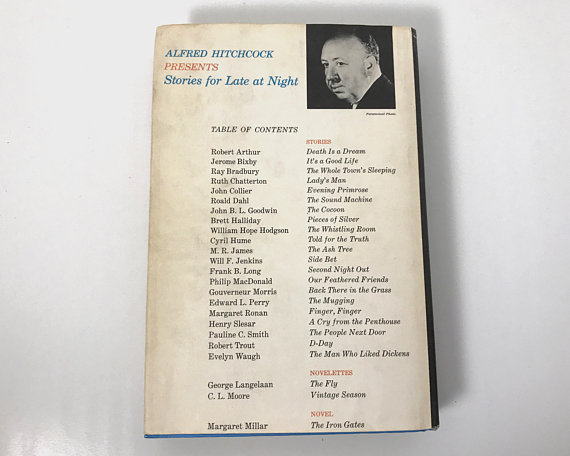
Short Story Wednesday: ALFRED HITCHCOCK PRESENTS: STORIES FOR LATE AT NIGHT Robert Arthur, editor (Random House, 1961); and various paperback abridgments (Dell, Pan)

The degree to which these volumes were Robert Arthur's painless education in the joys of suspense, mystery, horror, fantasy and science fiction would be hard to overestimate, and any time I look upon them it's difficult not to be reminded that these were among the greatest of the "books of gold" in my early literate life, a phrase employed by writer Gene Wolfe in one of his essays to describe  guideposts into the range of literature available but not always accessible, particularly to young readers who might not have first-rate used bookstores nor large libraries available to them. But they might just have a decent-sized public or school library, where the librarians were sensible enough to procure and keep books such as these anthologies on the shelves. Of course, Arthur was kind to his talented friends and old colleagues in the fiction magazines of the 1930s-60s, as well as looking out for #1 (running as he does two of his own stories, one under his Pauline Smith pseudonym--reprinted, as it was, from a magazine he had edited), and there is no lack of chestnuts here--he knew who was likely to be reading these books, young readers (such as myself) or casual ones approaching these fields, or, as the marketing was meant to snare, those who simply enjoyed the television series and hoped for More of Same in prose. Only to be rewarded with a much better selection than even the good choices made for adaptation by producer Joan Harrison and co. And, also to be fair, some of these stories became chestnuts After publication in the various AHP: anthologies...and a few presumably because other editors had them drawn to their attention by Arthur (and his successor in the adult line of Random House anthologies, Harold Q. Masur). And some aren't too well known now, any more than they were then...the Ronan is not the first story one thinks of when one thinks of Unknown: Fantasy Fiction, retitled Unknown Worlds hoping to snag some sf readers as well by the time it published her story. Nor the Long story among Weird Tales reprints, even given he was more a stalwart contributor to that magazine. The Chatterton story being first published in this volume was a rarity in this series--perhaps she was having difficulty placing it elsewhere.

As you glance over the paperback reshuffles of the contents below, you can see how much better the hardcovers were to have--and not solely because the Margaret Miller novel The Iron Garden is missing, presumably because another publisher still had a paperback edition out or at least rights to have one out--often in later volumes, the paperbacks would replace Arthur's novels or long novellas with stories from his YA anthologies from Random House, leading me to wonder if Arthur was given the opportunity to make the reshuffling in the Dell paperbacks himself...or if some functionary at Dell or RH was tasked with this. (Though as noted below, the first edition Dell paperback for the second volume of reprinting Late at Night sports a cover derived from the first RH YA volume in the series, edited by YA specialist Muriel Fuller rather than Arthur, and less successfully than Arthur would approach the same tasks, as a veteran of writing and anthologizing for young readers as well as adults, himself).

The writers this volume would Not have introduced 8- or probably 9yo me to would run only to Arthur himself, Bradbury, Collier, Dahl (running in fine alphabetical sequence--oddly, it seems Arthur was arranging the stories alphabetically by author or pseudonym, except for Millar's novel as last entry as was his custom with the Long Story in his volumes, but for some reason broke his own sequencing with the Moore story), and Bixby and Moore and Jenkins, since I had read their "It's a Good Life--" and "Mimsy were the Borogoves" and "First Contact" in my father's copy of The Science Fiction Hall of Fame, Volume One a few weeks or months before....the others in earlier-discovered kidlit and/or horror anthologies. One thing these anthologies lacked was headnotes for the stories, or similar addenda, so I would, for example, not learn of Robert Trout's work as as a CBS radio and early tv newsman for a couple of decades.
published in the UK under the
Max Reinhardt imprint, 1962


for more Short Story Wednrsday entries, 


Friday, August 11, 2017

FFB: ALFRED HITCHCOCK'S WITCH'S BREW edited by Henry Veit (Random House 1977)...as opposed to ALFRED HITCHCOCK'S WITCHES' BREW edited by uncredited and unidentified folks (Dell Books 1965)


Among the manifold confusions that the branding of "Alfred Hitchcock" anthologies has engendered, between their clutch of publishers (particularly Dell Books, which was in the "Hitchcock" anthology business the longest and mostest--and the books they didn't generate they often reprinted, the long Random House hardcovers frequently broken into two volumes each and sometimes with differing contents from the original anthologies and sometimes with new titles) and ghost-editors (it's not too clear that Hitchcock himself ever did much to edit any of the books credited to him; it's utterly clear that he didn't do much more than sign off in a general way on almost all of them, along with the magazine named for him and other similar products), one of those which can even vex such careful "Hitchcock" readers as Frank Babics and the folks at The Hitchcock Zone, much less all the others more casually engaged (such as ISFDB or GoodReads, and even WorldCat), is the similarity of titles between the last of the young readers' anthologies in the series Random House would publish, Henry Veit's 1977 Alfred Hitchcock's Witch's Brew, and the early (1965) entry in the long series of Dell Books paperback original volumes of stories drawn from the pages of Alfred Hitchcock's Mystery Magazine, Alfred Hitchcock's Witches' Brew, edited anonymously but presumably by the editorial staff at AHMM.  Hell, I tripped up on this when writing to George Kelley, who was trying to figure out the confusion these and other references had presented, in his post on both books a year or so back. 
The known ghost-editors of Hitchcock anthologies include: Don Ward (long-term Dell editor who did "Hitchcock" anthologies from the years before the AH Presents: tv series began and branding went into overdrive, with both the Random House anthologies and AHMM beginning along with the show in 1956; notably, later, Ward edited Zane Grey's Western Magazine for Dell), Patricia Hitchcock aka O'Connell (his daughter), most diversely and importantly Robert Arthur (the one who also wrote radio scripts as well as for a wide range of fiction magazines, and who edited such magazines as The Mysterious Traveler keyed to one of his radio series), Harold Q. Masur (who succeeded Robert Arthur as editor of Random House's anthologies aimed at adults when Arthur died rather young in 1969), Peter Haining (primarily for UK paperback line the New English Library's Four Square imprint), Muriel Fuller (a children's lit specialist who edited the first Random House YA, Alfred Hitchcock's Haunted Houseful, before Arthur took the series over till his death), and for the last two YA volumes, Veit. 

So...I remember reading Alfred Hitchcock's Witch's Brew, already a bit nostalgically as I'd gone through Robert Arthur's YA Hitchcocks several years before, while sitting in detention at what was then Londonderry Junior High School one afternoon. I'd already read through some back issues of AHMM by that time, borrowed from the library or purchased at used book sales, but was a month or so away from buying my first new issue of AHMM (January 1978) and growing as addicted as I've been since to fiction magazines generally. Following the Robert Arthur YA model rather well (though it's arguably a bit less focused an anthology than most of the Arthur YAs, more like the Arthur and Masur Alfred Hitchcock Presents: adult anthologies thus, even given the witchy theme), it's a diverse and good collection of horror, fantasy and related stories mostly by notable writers in these fields, mixed in this case with a novel excerpt (from T. H. White's Arthurian fantasy The Sword in the Stone) and another novelty for the series, an abridged version of a story, this one probably an improvement on the original by the windy Sterling Lanier. 

The contents of Witch's Brew (courtesy ISFDB and corrected with The FictionMags Index, since ISFDB incorrectly assumes several of the newer stories first appeared in the Dell anthology, which it mistakes for the first edition of this book):
Illustration from AH's Witch's Brew by Stephen Marchesi; scan courtesy The Hitchcock Zone.
Meanwhile, here is the Hitchcock Zone table of contents of Alfred Hitchcock's Witches' Brew, the 1965 AHMM best-of, with the pagination of the 1978 edition added by me, and original publication info from the FictionMags Index:

1965 first edition; not solely in paperback
6. Introduction by Alfred Hitchcock (ghost-written)
19. A Shot from the Dark Night by Avram Davidson  Alfred Hitchcock’s Mystery Magazine Feb 1958 (incorrectly cited in the book's acknowledgments as a 1960 story)
31. I Had a Hunch, and... by Talmage Powell (ss) Alfred Hitchcock’s Mystery Magazine May 1959 (incorrectly cited in the book as a 1960 story) (also included in Alfred Hitchcock’s Anthology #18 1984)
43. A Killing in the Market by Robert Bloch Alfred Hitchcock’s Mystery Magazine May 1958 (also included in Alfred Hitchcock’s Anthology #16 1983)
91. The Gentle Miss Bluebeard by Nedra Tyre Alfred Hitchcock’s Mystery Magazine Nov 1959
121. Just for Kicks by Richard Marsten (Evan Hunter) Alfred Hitchcock’s Mystery Magazine Jun 1958
169. When Buying a Fine Murder by Jack Ritchie Alfred Hitchcock’s Mystery Magazine Jun 1960

Richard Decker was the AHMM editor for much of 1964, succeeded by G. F. Foster, so one or the other is probably the editor of this volume unless the Dell Books editor made the selection...or some combination...

Alfred Hitchcock's Anthology #13, a Davis Publications magazine issue, reprinted by the Dial Press (a Dell hardcover imprint) as Alfred Hitchcock's Death-Reach
Alfred Hitchcock's Anthology #18 reprinted by the Dial Press as Alfred Hitchcock's Crimewatch

I don't remember if I picked up my then-new 1978 third edition or the secondhand copy of the 1965 original first, but probably the former...I don't think I have a copy of the 1975 second edition from Dell:


The AHMM best-of is very much comparable, if certainly less diverse, a reading experience to the YA anthology of a dozen years later, with a similar mix of brilliant to decent writers; the classic Robert Bloch story in the Random House volume is certainly better than the good Bloch story in the AHMM book, but that's hardly a fair comparison, as "That Hell-Bound Train" is one of the key stories in Bloch's career. The ghosted introduction to the Dell book is rather funnier, one of the best in that series...one wonders who actually wrote it (perhaps devising editorials for her father was one of Patricia Hitchcock's duties in the office of the magazine). 

For some reason, the Random House paperback editions of the YA volumes would often drop some of the stories, though I don't see that RH even ever offered a paperback reprint of Witch's Brew, though the UK saw both hardcover and paperback editions:


For more of today's books, much more promptly reviewed, 
please see the gracious and patient Patti Abbott's blog.