Wednesday, October 18, 2023

20th Anniversary Issues: THE MAGAZINE OF FANTASY AND SCIENCE FICTION October 1969, edited by Edward Ferman, and FANTASTIC August 1972, edited by Ted White: Short Story Wednesday

Perhaps unsurprisingly for 20th Anniversary issues of fantasy/sf magazines, or for any gathering of fiction, considerations of time (and, often, loss) loom large in the stories in these two issues. Slightly odd that two magazines which have been, at times at least in their previous histories, famous as homes for women writers in fantastica should produce "all-stag" anniversary celebration issues, albeit in the case of Fantastic, Alice (at conventions, going by nickname "Racoona") Sheldon was still hiding behind the "James Tiptree, Jr." pseudonym, and cover artist Jeff Jones was eventually to transition to womanhood and take on the name Jeffrey Catherine Jones in 1998; "Ova Hamlet" as the pseudonym Richard Lupoff used for his parody stories for Fantastic, mostly, was a Very open non-secret (part of the gag was that Lupoff was serving as interlocutor for the eccentric "Hamlet"). 

That said, these are impressive issues, helping to kick off good decades artistically for both magazines, and eventually financially for F&SF, at least.

The best stories in either issue are, I'd say at this hour, Robert Bloch's time-travel (of a sort) and definitely afterlife fantasy "The Movie People", which incorporates his love for film and his experiences as both youthful film fan and eventual professional screenwriter, and Tiptree's "Forever to a Hudson Bay Blanket", very much a time-travel story and yet also deeply encoding some of her lived experience as a young debutante (and, to a much lesser extent, her later life as an OSS/CIA staffer). I haven't yet read the Conan pastiche by de Camp and Carter, nor this part of the eventual Ursus of Ultima Thule by Avram Davidson, but the introduction to the first part of the serial, giving some of the events in the previous segment published as a standalone story in the sf magazine Worlds of If, is indicative of Davidson in one of his favorite modes, writing about the origins of the mythology he's mining for the story, and the sort of thing he eventually would write at length in the essays collected as Adventures in Unhistory...which is highly recommended.

Barry Malzberg, the editor of Fantastic and stablemate Amazing before White, as well as contributor to this issue, would later collect the Tiptree story in his 2003 anthology The Best Time Travel Stories of All Time, as well as it being first collected in Sheldon/Tiptree's first, widely-hailed collection, Ten Thousand Light Years from Home. Bloch's "The Movie People" has also been widely collected, in his The Best of Robert Bloch and many other volumes, in translation as well as the original.

Please see Patti Abbott's blog for more complete considerations of their objects of discussion and review, and a fine new poem she's composed commemorating the birthday of her late husband, the political science professor and historian Philip Abbott (whose favorite short story was E. M. Forster's seminal sf story, "The Machine Stops")...


Thursday, October 5, 2023

SSW/P: New MacArthur Fellow Manuel Muñoz quotes lines from Rita Dove's poem "Fantasy and Science Fiction" (about her early reading of THE MAGAZINE OF F&SF and other things) as epigraph for his story collection THE CONSEQUENCES...

Renee Shea: The epigraph to this collection is five lines from a poem, “Fantasy and Science Fiction,” by Rita Dove, but I’m not sure how they speak to you about what you’re doing in these stories.

Manuel Muñoz: It’s a nod to how I have received stories from my parents, but, I, in turn, have not really shared any of my own. It’s well understood in my family that I’m out, but we don’t talk about it. All of the personal stories of mine about love or rejection or partnership aren’t shared or even asked about. That’s not what the Dove poem is actually about, but the lines struck me: the privacy and intimacy of encountering or experiencing story: “shutting a book . . . you can walk off the back porch / and into the sea—though it’s not the sort of story / you’d tell your mother."


from: https://www.worldliteraturetoday.org/blog/interviews/consequences-story-conversation-manuel-munoz-renee-h-shea

meanwhile: 

Rita Dove:

from https://www.wsfcs.k12.nc.us/site/handlers/filedownload.ashx?moduleinstanceid=93509&dataid=158691&FileName=For%20the%20Love%20of%20Books%20by%20Rita%20Dove.doc

At the same time, my brother, two years my senior, had become a science fiction buff, so I’d read his Analog and Fantasy and Science Fiction magazines after he was finished with them. One story particularly fascinated me: A retarded boy in a small town begins building a sculpture in his backyard, using old and discarded materials—coke bottles, scrap iron, string, and bottle caps. Everyone laughs at him, but he continues building. Then one day he disappears. And when the neighbors investigate, they discover that the sculpture has been dragged onto the back porch and that the screen door is open. Somehow the narrator of the story figures out how to switch on the sculpture: The back door frame begins to glow, and when he steps through it, he’s in an alternate universe, a town the mirror image of his own—even down to the colors, with green roses and an orange sky. And he walks through this town until he comes to the main square, where there is a statue erected to—who else?—the village idiot.

I loved this story, the idea that the dreamy, mild, scatter-brained boy of one world could be the hero of another. And in a way, I identified with that village idiot because in real life I was painfully shy and awkward; the place where I felt most alive was between the pages of a book.


Dove's poem first published in Ploughshares, Spring 1987and included in her Collected Poems 1974–2004 (Norton) and...

in Grace Notes...


(h/to Paul Di Filippo for the IA citation)

Thursday, September 14, 2023

A MYSTERY, CRIME & NOIR NOTEBOOK by Gary Lovisi (Stark House 2023/forthcoming in November)

A collection of short essays from Paperback Parade editor/publisher Gary Lovisi, a companion to his 2022 A Sherlock Holmes Notebook, also from Stark House, in their Reference line. Most of the individual entries run about three pages or so, and when it gets to collecting, Lovisi's lifelong passion, he can get expansive and go for six or more...illustrated with black and white images of book covers and similar items of interest (looking online, or to his video presentations on YouTube, to get the full-color experience won't be too trying). 

This book upon receipt has already proved useful to me, as Steve Oerkfitz and I were sharing our frustration the other day with the ending of the famous French film adaptation of The Wages of Fear--a brilliant film till that point--which attempts profundity by basically tossing off much of what made the film till that point riveting, almost to the point of making an existential joke of it...Steve noted that this irked him sufficiently that he preferred the later US adaptation Sorcerer. One thing I'd never had the wit to do was check the source novel of both films, by "Georges Anaud" (Henri Girard)--not the easiest of tasks, given it apparently hasn't been reprinted in an Anglophone translation since the 1950s, but Gary has a(t least a) copy, and describes the ending (which is much more a furtherance of the terms of the narrative than the Wages film chooses to be), and thus an intellectual itch is scratched...one of the best results in consulting a reference work. 

Essays are reprinted from a wide array of sources, including Paperback Parade and The Armchair Detective and Ed Gorman and Lee Server's The Big Book of Noir, along with others a bit less likely, but no less engaged and enthusiastic. You are likely to find it a fine addition to your reference shelf.

and currently available:


Friday, September 8, 2023

FFB: WORLDS TO COME edited by Damon Knight (Harper & Row 1967); FOURTEEN FOR NOW edited by John Simon (Harper & Row 1969)

 Dutch Uncles: Two Anthologies for Younger Readers:


    Worlds to Come edited by Damon Knight (Harper & Row, LCC# AC 67-10130, 1967, $4.95, xii +337pp, hc)
    • ix · Introduction · Damon Knight · in
    • 1 · The Sentinel · Arthur C. Clarke · ss Ten Story Fantasy Spr 1951, as “Sentinel of Eternity”
    • 17 · Moonwalk · H. B. Fyfe · nv Space Science Fiction Nov 1952
    • 81 · Mars Is Heaven! · Ray Bradbury · ss Planet Stories Fll 1948
    • 109 · The Edge of the Sea · Algis Budrys · ss Venture Mar 1958
    • 141 · The Martian Way · Isaac Asimov · na Galaxy Nov 1952
    • 213 · The Big Contest · John D. MacDonald · ss Worlds Beyond Dec 1950
    • 227 · Ordeal in Space · Robert A. Heinlein · ss Town & Country May 1948
    • 253 · That Share of Glory · C. M. Kornbluth · nv Astounding Jan 1952
    • 303 · Sunken Universe [Lavon] · James Blish · nv Super Science Stories May 1942, as by Arthur Merlyn, see also “Surface Tension”
    • 337 · More Good Reading in Science Fiction · Damon Knight · bi
Fourteen for Now: a collection of contemporary stories edited by John Simon (Harper & Row, OCLC #54245, 1969, $4.95, xvi + 316pp, hc)
ix · Introduction for the Young Reader: Books in an Age of Television / by John Simon  
1 · When the Priest is Not at Home / by B. Traven (ss) The Night Visitor and Other Stories, Hill and Wang 1966
19 · A Good Man is Hard to Find / by Flannery O'Connor (nv) The Avon Book of Modern Writing, ed. William Phillips & Philip Rahv, Avon 1953
44 · Into the Green Night / by Irvin Faust (ss) Roar, Lion, Roar, Random House 1961
60 · The Stone Boy / by Gina Berriault (ss) Mademoiselle Jun 1957
79 · The Games of Night / by Stig Dagerman (translation by Naomi Walford) (ss) Nattens lekar ("Night Games") Norstedts förlag 1947; The Games of  Night, Bodley Head 1959
93 · Nazis / by Ferenc Sánta (translation by John Simon)(ss) Kortárs ("Contemporary"), May 1960; translation in New Hungarian Review
103 · Among the Dangs / by George P. Elliott (nv) Esquire Jun 1958
119 · The Death of Me / by Bernard Malamud (nv) World Review April 1951
151 · Murke's Collected Silences / by Heinrich Böll (translation by Leila Vennewitz) (ss) Esquire Nov 1959
182 · The Hero / by Bruce Jay Friedman (ss) Cavalier 1966
196 · Ceremonies / by Joyce Carol Oates (nv) By the North Gate, Vanguard 1963
227 · As I Was Going Up the Stair / by Alfred Chester (nv) The Sewanee Review 1957
277 · The Day Beaumont Became Acquainted with His Pain / by J.M.G. LeClézio (translation by Daphne Woodward) (nv) Mercure de France 1964; Fever, Hamish Hamilton 1966
313 · Biographical notes / by John Simon


Two anthologies aimed at a teen readership by two famously prickly critics, and writers otherwise (not that Harper & Row, their mutual first publisher, nor certainly the paperback packagers, would mind if adults were willing to partake--one notes the degree to which adult-targeted anthologies could easily feature the same sets of stories). Notable in part for the eclecticism of the choices, in the case of the Knight even to the the degree that all the stories are drawn from different magazines in the sf field (including Worlds Beyond which Knight edited), and that famous speculative fiction title Town and Country (devoted, of course, to fantasies and achieved realities of expensive living). 

Also notable to the degree which the Simon anthology doesn't eschew the fantastic, from the rather thoroughly science-fictional "Among the Dangs" to the various more blatantly metaphorical explorations as the Böll, and those that can be read as certainly akin to the fantastic (or at least as a borderline horror) as the O'Connor; certainly, very few of Simon's writers haven't at least delved notably into the fantastic, even as few of Knight's haven't made at least some notable or interesting contribution to the contemporary/mimetic or other non-fantasticated genres, including Heinlein and Asimov and definitely including Budrys, Kornbluth, Blish, Bradbury and, most obviously, John D. MacDonald, most of whose career was set in other contexts than fantastic fiction. Also, as is common in anthologies aimed at young readers, no fear of gathering chestnuts, mixed in both cases with rather obscure stories...and at the remove of half a century, some once ineluctable stories are now only infrequently seen, if at all...such as "The Stone Boy" or "The Edge of the Sea". 

Knight offers quick headnotes and a brief bibliography of recommended additional reading, Simon musing endnotes to each story, and both manage to provide introductions that are interesting mixes of useful observation and hobbyhorse-riding on their parts...Knight lays out rather well why science fiction is not so much a predictive artform as a speculative one, which can at times predict and at times nudge readers, scientists or technologists or those who are likely to work in those fields eventually, toward development (and notes that Jules Verne enjoyed playing around with exotic but already achieved advances and discoveries, while imbuing them with Gosh-Wow as if they were still basically out of reach)...while providing in his anthology a number of stories with no relation to the stated thesis, as one might take it, of the anthology...since "Mars is Heaven!" and at least a few of the others are more borderline horror and/or of other ambitions altogether (as Algis Budrys noted, in his own hobbyhorse-riding review, one of only two the book received in the sf media, apparently--typically, Budrys does not miss a chance to dismiss his own work as less than fully-realized, while also justly taking on the unearned reputation of Arthur C. Clarke as primarily a hard-science extrapolator so much as frequent mystic). While Simon makes useful argument for what makes good narrative art vs. less good, while mostly pretending that what made so much television drama in the 1960s and previously (he doesn't admit that there are any exceptions) so bland and unenlightening doesn't apply to such arts more dear to his heart as film, stage drama and literature (and where he does admit the latter, it is almost grudgingly and fleetingly).

Good anthologies, some interesting arguments and insights from the editor/annotators, and some work no longer as over-familiar as it once was, and some which never had the chance to become over-familiar...and there are worse fates than reading the Oates or the Kornbluth again. Knight had already published a few younger-skewing anthologies at time of publication, and would publish a few more, though he would produce vastly more aimed at adult audiences; I believe this is Simon's only anthology of fiction, for any audience. And it should be noted that the Blish story in the Knight volume is the predecessor to Blish's most famous single short story, "Surface Tension" (as "Common Time" is becoming more obscure)..."Sunken Universe" was combined with the later story to fashion the novella form of "Surface Tension"...

Worlds to Come can be read here.

Algis Budrys reviews the Knight in Galaxy, October 1967 issue. (P. Schuyler Miller reviewed it for Analog, as well.)
John Leonard reviews the Simon in The New York Times in the 1 March 1970 issue (rather late)(and the scanning in of the article was particularly inept, putting paragraphs out of place; you'll have some puzzle assembly to do while reading Leonard's review of the Simon and The Loners, edited by L. M. Schulman, and George A. Woods's review of a how-to-cartoon book for young readers, admixed.)(Woods mentions in passing how he meant to be reading instead TR and Will by William Manners...one of Manners's popular-history successes after his work as founding editor of Alfred Hitchcock's Mystery Magazine, whom I was asking after just yesterday and the day before.)

For more of today's books (in 2019), please see Patti Abbott's blog.


US first edition:

UK paperback:
a redux post with some slight edits and added links.

Wednesday, September 6, 2023

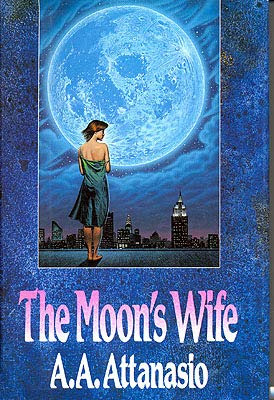
SSW: SUPERHORROR (aka THE FAR REACHES OF FEAR) edited by Ramsey Campbell; THE MOON'S WIFE (wt: SIGGY LINDO) by A. A. Attanasio

Mooning covers...


Superhorror, published by W.H. Allen in 1976, as the slim anthology was titled in thaoriginal UK edition and its US reprint (the 1980 UK paperback takes the variant title), includes the following stories, all original to it: (via ISFDB)
I picked up my remaindered copy of the 1977 St. Martin's Press US hardcover, with the Donald Grant cover above carried over from the Allen edition, in 1979 or '80 in one of the Hawaiian chain of department stores, Liberty House.

As the first anthology he would edit, it's an impressive start by any measure...with most of the contributors demonstrating why they were already masters of the form, and the largest flaw being a lack of female contributors, with the welcome exception of Daphne Castell...but the biggest surprises in the book would not be that Leiber or Aickman or Wellman or even the then still relatively young Drake, and Castell and Campbell himself, would provide impressive work, but that Brian Lumley's suspense story, like all his work carrying a touch of the Boy's Adventure Tale about it but also like most of his non-Lovecraftian work far superior to the (sustainedly popular) Necroscope kludges, would be a fine and brutal story of retribution; Joseph Pumilia's rather grimly jokey homage to EC horror comics was an early example of that sort of thing in prose, and a good one; and then there's R. A. Lafferty's story. It was no secret that Lafferty was brilliant and eccentric, and often veered close to out-and-out horror in much of his previous fiction, but only rarely nudged any given work firmly into the field...but "Fog in My Throat" takes on the very soul of horror, the knowledge that we will be extinct and how we cope with this, and succinctly and forcefully tells us how and why we'd best not try to fiddle with our self-delusional defense mechanisms in dealing with that. From a devoutly Catholic man, well along in years and not in the greatest of health at the time, it's a brilliant story that carries every sort of conviction with its wit, invention and compassion, and I've remembered it more clearly than any other in this book over the decades.

And, of course, it's been reprinted exactly once, as far as I can tell, in a 1991 small-press collection of Lafferty's short work.


What A. A. Attanasio had been writing for several years under the working title, for his protagonist, Siggy Lindo, was published in a much truncated form as The Moon's Wife, which does describe her predicament, by HarperCollins in 1993. The acquiring editor who'd bought the fat novel, which if Al didn't think of as his magnum opus it was one particularly close to his heart, left HC, and the new editor, as I recall, not only didn't care for Not Invented Here but, I gathered, also chose to be offended that Al as a male writer would dare to write a novel about a female protagonist who could be seen as delusional, and indeed is by other characters in the romantic fantasy about a woman who learns that she is to literally become the Moon's wife, soulmate of its spirit. So, since this was published well after the initial splash of Attanasio's debut novel Radix, a genuinely international bestseller, and before the Arthor series began riding the UK charts, the editor demanded and got a severe edit that reduced the novel to a fraction of its original length. The book when released got zero support, zero attention, nearly zero sales and saw only the original hardcover edition in the States...Al's success in the UK led to a UK paperback reprint. Even truncated, it remains a charming and elegant work, in some ways my favorite of Attanasio's novels and still demonstrative of the joy he took in writing it in its original form, that probably could more easily find an audience today than it could 30 years ago, when publishers weren't too certain how to market Richard Matheson's paranormal romances, either. My copy is one that Al sent along from his stash of HC promotional copies. And in firs
t published form, it's almost a novella...Al has a new edition available, from a small press:


For more of Wednesday's Short Stories, please see Patti Abbott's blog


A redux post, slightly edited/updated, from 2010.