Showing posts with label 1950s. Show all posts

Saturday, December 2, 2023

Some 1949-1958 US television Xmas/related programming of sorts!

US commercial television syndicationTHE CHRISTMAS CAROL (sic), as narrated by Vincent Price, and commissioned by television manufacturer Magnavox in 1949 and fed to 22 stations in its first run. One of the earlier US non-network productions to have survived, and apparently the earliest known extant US television adaptation of the Dickens story. The younger Cratchit daughter was played by Jill St. John when she went by Jill Oppenheim, apparently among her first professional credits (at age 9).


ParamounTelevision NetworkTIME FOR BEANY, #421, 11 April 1951 (as you might gather, I haven't found a more Solstice-adjacent episode, but at leasthis episode makes gratuitous reference to Ina Ray Hutton, also [with her Orchestra] on Paramount's never-too-robust early-mid '50s L. A.-based networkBob Clampett, Stan Freberg, Daws Butler, et al.--Albert Einstein and the young Frank Zappa among the devoted fans. Won three Emmy Awards and was nominated for a Peabody Award and thus was the most honored Paramount Network series, and the '60s Beany and Cecil cartoon was a revival). 

DuMont Network: CAVALCADE OF STARS, "A Honeymooners Christmas", 21 December 1951, with Art Carney, Joyce Randolph, Jackie Gleason and Pert Kelton in this pre-Audrey Meadows performance ...when the Honeymooners were a recurring sketch on the variety series...

NBC: YOUR HIT PARADE, Christmas Eve 1955 episode. Absolutely nothing non-pop, even given the #1 song for this episode is "Sixteen Tons", not even performed by Tennessee Ernie Ford much less the Merle Travis original, but by Snooky Lanson. Buthe Xmas music is mostly well-performed...

Canadian Annex: CBC: ON THE  SPOT, "Christmas Comes Twice";  a 1955 episode from OTS 's first season, abouthe seasonal celebrations of Ukrainian-Canadians, and their aspirations for an independent Ukraine.

CBSTHE JACK BENNY PROGRAM, 1957 tv version of "Christmas Shopping"; here's the 1960 version. And the 1961 "Christmas Party" episode.

ABC: AMERICAN BANDSTAND, 18 December 1957, apparently in the first season of national broadcast. Apparently also, a 25 Dec-scheduled episode was recorded (presumably earlier on)...unavailable, as far as I see now.

NTA Film NetworkART FORD'S JAZZ PARTY, "Tribute to Buddy Bolden", the final episode, transmitted 0n WNTA on 25 December 1958 and soft-fed to affiliates (the link includes three not quite complete episodes, including the New Orleans jazz special that was held for the final episode, last of the three). Part of Jazz Party's wide distribution cited during the second episode in the IA queue was due to its clearance on the US Armed Forces television services around the world, and perhaps some local civilian clearance in some countries.

NET (National Educational Television): A LARGE SPECK OF PROGRESS, a short 1958 fantasy parable, not light-handed but certainly earnest and rather cleverly produced on a budget at the Ann Arbor/University of Michigan production studio, presumably for first broadcast on DetroiNET station WTVS (more than a decade before PBS supplanted NET as the primary US national public-broadcasting network).

Happy Solstice/New Year Holidays!

Wednesday, December 29, 2021

Short Story Wednesday: THE SUPERNATURAL READER edited by Lucy and Groff Conklin (Lippincott 1953); ROD SERLING'S DEVILS AND DEMONS edited by Gordon R. Dickson (Bantam 1967)


The Supernatural Reader 

edited by Lucy & Groff Conklin
(Philadelphia: Lippincott, 1953, $3.95, 349pp, hc)

Rod Serling’s Devils and Demons
  
ghost-edited by Gordon R. Dickson 
(Bantam, Feb ’67, 212pp, pb) 
    • vii · Introduction · Rod Serling · in
    • 1 · The Montavarde Camera · Avram Davidson · ss F&SF May 1959
    • 14 · The Coach · Violet Hunt · ss The English Review Mar 1909
    • 31 · Adapted · Carol Emshwiller · ss F&SF May 1961
    • 40 · Death Cannot Wither · Judith Merril · nv F&SF Feb 1959
    • 61 · The Story of the Goblins Who Stole a Sexton · Charles Dickens · ss The Posthumous Papers of the Pickwick Club Jan 1837
    • 72 · Pollock and the Porroh Man · H. G. Wells · ss New Budget May 23 1895
    • 87 · Stars, Won’t You Hide Me? · Ben Bova · ss Worlds of Tomorrow Jan 1966
    • 101 · The Bottle Imp · Robert Louis Stevenson · nv New York Herald Feb 8-Mar 1 1891
    • 129 · The Adventure of the German Student · Washington Irving · ss Tales of a Traveller, John Murray 1824
    • 135 · The Four-Fifteen Express · Amelia B. Edwards · nv Routledge’s Christmas Annual, 1867  1866
    • 160 · The Blue Sphere · Theodore Dreiser · ss The Smart Set Dec 1914
    • 177 · The Bisara of Pooree · Rudyard Kipling · ss The Civil and Military Gazette Mar 4 1887
    • 182 · A Time to Keep · Kate Wilhelm · ss F&SF Jan 1962
    • 197 · Brother Coelestin · Jaroslav Vrchlický  (as by Emil Frida)  · ss  Lumír Jan 20 1878 (trans./ed. Edna Worthley Underwood, from"Flétna", in Short Stories from the Balkans, Marshall Jones Co., 1919)

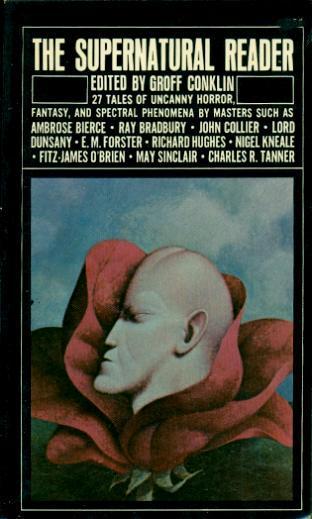
The 1966 paperback edition of the Conklins' anthology, sharing rack space with the 1967 Dickson/ "Serling" volume (and seeing at least four printings over the next several years)...the Collier pb, with more pages (and twice as many stories) on better paper, would set you back 95c, while the Bantam volume was 60c (by the 11th printing in the early '70s, the price would rise to 75c). I have this edition of the Conklins' book (though I find the cover on the first Collier paperback, from 1962, the handsomest of the packages the book has sported). In the wake of the remarkable success of Ira Levin's Rosemary's Baby, the televised horror soap opera Dark Shadows catching fire, and a number of paperback houses discovering that tagging anything remotely relevant as a Gothic was a guaranteed selling-strategy...perhaps that both books saw more reprints in 1967, and just after, than the Reader had had or either would have again is less surprising in retrospect than it might be (the Serling-branded book might've had a bump both from The Twilight Zone's entry into the syndicated television repeats market and from his initial-draft scripting the 1968 film Planet of the Apes). It doesn't hurt that they are both fine collections, even if the lack of concern for detail on Bantam's part (managing to refer Worlds of Tomorrow magazine in the publication credits as "The World of Tomorrow", for example), as well as featuring a slightly larger proportion of (theoretically) public domain stories (if good and mostly not overly familiar ones, in both volumes) than the scrupulously credited Conklins' volume might discourage a few potential readers.


Groff Conklin and Rod Serling were busy, productive, eventually frustrated people, who both chain-smoked their way into early graves. Both had been rather broad-scope in literary and narrative arts in their early careers, and eventually found themselves locked into working in fantastica, which they enjoyed but to some extent wished they didn't have to rely on, particularly as the rewards contracted. Conklin, who as a young man contributed to Poetry magazine, began his anthology-editing career with volumes drawn from The Smart Set and The New Republic, and wrote benchmark guides to home repair which would remain in print for decades, was 63 when he died of emphysema in 1968; Serling, a playwright who began his career in radio, was at least as widely-known for his teleplays Patterns and Requiem for a Heavyweight (and hassles with sponsors and censors) at the height of his career as he was for creating The Twilight Zone and its offshoots; and who found himself as prominent as a voice-over man and narrator as as a writer at the end of his career, was 50 when the third heart attack in a brief period, while he was on the table for open-heart surgery to repair damage from his second, essentially killed him in 1975. Conklin's wife and co-editor on The Supernatural Reader, Lucy Conklin, had died the year after the first edition was published, in 1954, and her husband added a note to reprints of the book stating that she had fully collaborated on the selections and the introduction with him; I have to wonder why her name is missing from the later editions otherwise. Presumably as lazy a marketing strategy as having Gordon Dickson, a talented writer and occasional editor, ghost the "Serling" book (he had also previously ghost-edited Rod Serling's Triple W: Witches, Warlocks and Werewolves for publication in 1963). I suspect Serling did write his two-page introduction... it has his cadences down.

The stories I loved decades before I encountered either volume include, among the Conklins' selections, were Sturgeon's "Shottle Bop", "Saki"'s "Gabriel-Ernest" and Bierce's "The Moonlit Road"; from the Dickson, Davidson's "The Montavarde Camera" and Stevenson's "The Bottle Imp", and I was a late-comer to the Wells, but only as late as reading it some years ago in Fraser and Wise's Great Tales of Terror and the Supernatural. A couple of the others, I liked rather than loved from my early reading, remembering them less well till refreshing my memories. 

Among the stories new to me in our volumes for today:

The Supernatural Reader:
"Pick-up for Olympus" by Edgar Pangborn is the one story original to either volume, a slight but amusing vignette about a 1960s (in this 1953 story) small-town garage mechanic enchanted by the durable but neglected 1930s Chevy truck that rolls into his gas station one day. So taken with the truck, he barely notes the rather unusual owners.

John Collier's "Bird of Prey" is good, mid-level Collier, a writer one can only suspect was high on Patricia Highsmith's inspiration list. And both students of Ambrose Bierce. A very happy couple (with only one notable sore spot between them) and their beloved pet parrot do not have a good time after a certain visitation by Another sort of bird.

Devils and Demons:
Carol Emshwiller's "Adapted" is a typically urgent recounting, not quite stream of consciousness but almost so, of the life of a woman who is of Other folk, at least on her father's side, and how she realizes this only rather late in life, and hopes she hasn't managed to cut this realization off in her quarter-Other daughter.

"A Time to Keep" by Kate Wilhelm is an interesting approach to her protagonist's free-floating anxiety, expressed in sustained hallucinations occasionally triggered by passing through doorways. Not completely successful, but a stepping-stone toward more assured work from later in her career. 


First US edition

First UK hardcover edition

UK paperback edition

For more of today's entries, please see Patti Abbott's blog.