Patti Abbott: Kalena Kai
Bill Crider: The Sons of the Pioneers; Don Gibson
Jerry House: Bessie Smith
Randy Johnson: Jake Holmes, exploited by the Yardbirds (and that minor successor project of Jones and Page)
George Kelley: Some Girls (remastered) by The Rolling Stones
Charlie Ricci: The Turtles
In 2011, we lost two of the great jazz drummers of the post-bop era...major contributors to third stream and other adventurous music of the era: Joe Morello and Paul Motian. Two New England guys, of Southern European extraction at a time when that wasn't always comfortable in America (Morello Italian-American, Motian Armenian-American), about the same age (Motian a few years younger), and both began as string-instrumentalists: Motian was a guitarist, Morello a wunderkind violinist. Instead, they moved over to being among the most impressive and influential of drummers, usually but not exclusively as jazz players, and both thoroughly engaged in musical education (Morello particularly formally, as the creator of texts and a/v materials and as an instructor, Motian often in taking in younger players in his bands). With the loss of Max Roach and Elvin Jones and Art Blakey and Connie Kay and Kenny Clarke and a slew of others over the previous decade or so (of that generation, perhaps the only prominent survivor is Chico Hamilton, but I'm probably being criminally forgetful), it's a Change of the Guard, and not necessarily a welcome one.
I met Morello once, and he suggested that this was among his own favorite performances:
Some further examples:
Of course, Morello wasn't a part of the "original" Dave Brubeck quartet; just the best one.
Paul Motian (has there ever been a better surname for a drummer?), with his first great band:
(the loud hiss is kicked down with the beginning of the music)
With Paul Bley and Gary Peacock:
with the Charles Lloyd Quartet:
Rest in glory.
Showing posts with label Monthly "Forgotten" Music. Show all posts
Showing posts with label Monthly "Forgotten" Music. Show all posts
Thursday, January 26, 2012


Friday, December 30, 2011
December's Underappreciated Music (w/links): RIP: Sam Rivers, and Johnny Cash: DESTINATION VICTORIA STATION (Columbia Special Products, 1975)

It doesn't seem too likely that a promotional item for a gimmicky chain restaurant might be one of the best anthology albums of the career of someone of Johnny Cash's stature, nor the best collection of train songs I've encountered (even when compared to Cash's own early themed album Ride This Train); the Wikipedia entry on the record states that most of the recordings were new for this album (seems possible, though that wasn't the usual procedure for CBS Special Products releases, but this is Cash, and some of his favorite songs). But it's the very fact that this album cherry-picks wisely from the catalog of Cash's recordings for CBS that makes it such great listening, even with the fleshing out by Cash of his Victoria Station jingle into a pleasant, unmemorable "real" song at the tag end.
Look to this selection:
Casey Jones (Johnny Cash) 3:01
Hey Porter (Cash) 2:41
John Henry (Traditional) 2:51
Wabash Cannonball (A.P. Carter) 2:39
City of New Orleans (Steve Goodman) 3:38
Folsom Prison Blues (Cash) 2:45
Crystal Chandeliers and Burgundy (Jack Routh) 2:27
Wreck of the Old 97 (Trad. arr. by Cash, Norman Blake, Bob Johnson) 1:49
Waitin' for a Train (Jimmie Rodgers) 1:46
Orange Blossom Special (Ervin T. Rouse) 3:05
Texas 1947 (Guy Clark) 3:16
Destination Victoria Station (Cash) 2:20
--and you see it's not only a good representation of Cash's career, but a not too terribly unrepresentative slice through the history of country music and the folk music which it came out of. And Cash is, unsurprisingly given that this is a cherry-picking anthology, at his best, with some of his best bands and arrangements, throughout. When I picked up this LP at a rummage sale for 50c, I wasn't aware of the Victoria Station chain of restaurants, and I still haven't been inside of one (if they're even still in operation), but even given the promotional nature of this record, it's still a gift from Cash and his colleagues, and we're lucky to have it as a measure of their legacy.
"John Henry"
An incomplete reading of "City of New Orleans" but a similar if less accompanied version:
"Texas 1947"
"Hey, Porter" (similar vintage, same arrangement)
Scott Parker usually has a list of participating blogs in this monthly meme...but if none arises over the course of the day, I'll probably compile what I see...
...and I've been missing the news a lot of late, so missed till just now the note that the seminal jazz reed-player (primarily a saxophonist, but also flautist and more) Sam Rivers died on 26 December, in an item Bill Crider posted. Rest in glory; two of his tracks for Blue Note albums, when he and Eric Dolphy were the primary free jazz innovators for that label:
"Involution"
"Dance of the Tripedal"
More recent big-band work: "Pulsar"
THE LINKS:
Patti Abbott: Etta James: "At Last"
Yvette Banek: John Williams: Score to Superman (1978)
Sean Coleman: The Flying Burrito Brothers: The Gilded Palace of Sin
Bill Crider: the music of Robert Mitchum
Jerry House: hymns
Randy Johnson: Chuck Mangione: Children of Sanchez
George Kelley: Linda Eder: Now
Kate Laity: The Cundeez
Todd Mason: the music of Sam Rivers; Johnny Cash: Destination Victoria Station
Eric Peterson: Demon Knight (soundtrack album)
Charlie Ricci: Chicago: Hot Streets
Thursday, September 29, 2011
September Music: 3rd Stream Reissues: Brubeck Quartet (+)/The Modern Jazz Quartet/George Russell NY Big Band/Gillespie Orchestra/David Amram &--

I think I've made it clear by now how much I love third stream music...the term Gunther Schuller coined for music which mixes jazz idiom with that of the European court and ceremonial traditions, which almost as soon as it was in print was expanded (certainly in the work of the likes of Randy Weston and Toshiko Akiyoshi) to incorporate other "serious" musics from other ethnic traditions. Third stream music recurs throughout the history of jazz, from the origins involving the "Spanish tinge" (jazz as cousin to tango and, more distantly, milonga and other forms) and classic ragtime even before that (Scott Joplin, James Scott and their colleagues seeking to create a first Truly American classical tradition), and into the New Orleans marching bands and their extensions and Harlem ragtime and its extensions at the turn of the 1900s, through the more ambitious big-band music (Gershwin commissioned, Ellington on his own ticket, and hardly they alone), into the bebop-influenced big bands (the Gillespie Orchestra also cementing Afro-Cuban jazz, the Gil Evans and John Lewis assemblies helping to establish the "cool" approach that owed so much to Beiderbecke and Young but nonetheless, it moved; Dave Brubeck's Octet of jazz-loving classical students among the Left Coast stirrings). George Russell discovering modal improvisation and teaching it to Bill Evans so that he could teach it to the Miles Davis quintet; meanwhile, the free jazz players beginning to find their liberation, and learning (as Ornette Coleman noted) that it was possible to play incorrectly in free jazz...while Sun Ra and company played orchestral R&B in one selection, large-band collective-improvisational free jazz in the next. Ellington most consistently, and probably most ambitiously, pushing his swing orchestra to more and more adventurous music (as well as playing the hits), but from Benny Carter suites for the Count Basie band to Stan Kenton's almost jazzless longform compositions, from the Chico Hamilton and Jimmy Giuffre small groups and the larger ones under the direction of Charles Mingus and eventually John Coltrane, from Max Roach when working in this mode and Lennie Tristano nearly always--and Thelonious Monk nearly always defaulting into this mode by his very nature, there arose the hugely popular quartet, the Dave Brubeck Quartet, and the very popular and even more stable quartet, the Modern Jazz Quartet, and even if there hadn't been support from folks ranging from Eric Dolphy to Ran Blake, from Claude Thornhill to Gerry Mulligan to Cecil Taylor, the two quartets would've made a case for this kind of music to be popular and important (and continued to blaze trails for those who would follow, from Anthony Braxton with his "For Four Orchestras" and Carla Bley to the "chamber jazz" of the '70s). It didn't hurt that Davis wanted to record with the Gil Evans Orchestra, but it might've been even more important that Gillespie wasn't done with his experimentation with jazz orchestral composition, either (and was happy to have his young protege Lalo Schifrin spread his wings), nor was a young magpie classically-trained player, helping to pioneer what was later tagged "world music" as well as working on increasingly adventurous film-soundtrack scoring, David Amram. And George Russell couldn't sit still, composing his own album-length suites and shorter pieces, as organically experimental as Monk and perhaps even more protean.

So, these five albums, not hardly the sum total of the 3rd Stream movement, though one of the best of the Modern Jazz Quartet's albums is Third Stream Music, but these all reissued in the last half-decade or so, or in the case of the Brubeck newly packaged and released this month, the Russell as part of a set devoted to his complete recordings for the 1970s label Black Saint/Soul Note, including no fewer than three albums devoted largely or entirely to Russell's "Electronic Sonata for Souls Loved by Nature," probably still the best composition of its sort (electronic third stream music, of course). Ridiculously, the best of Russell's 1970s albums, Living Time, attributed to featured soloist Bill Evans the way Gil Evans's albums were to Davis, remains out of print...but at least the New York Big Band album features a good, not quite as good, reading of the longest segment of the "Living Time" suite, "Event V" among other works, including a reading of his first professional work, for the Dizzy Gillespie Orchestra of the mid 1940s, "Cubano Be/Cubano Bop"...and a version of Billie Holiday's "God Bless the Child." Though perhaps the new listener should start with the Russell "Smalltet" (with Bill Evans) and their Jazz Workshop album, you can do worse than the NYBB disc. Or almost any of his other albums...but Living Time needs to be back in print.

As noted, Gillespie gave Russell his entre into professional jazz work, and did the same, at least in the States, for Brazilian emigre Lalo Schifrin, not yet a household name for the likes of the theme to Mission: Impossible nor such film soundtracks as that for Bullitt. Schifrin's suite sought to suggest the story of first contact and war and conquest, and the eventual partial (never complete) rapprochement between the nations of the Americas and those who named the continents thus. Shifrin and the orchestra does so brilliantly, and I'm not sure I've heard better playing from Gillespie in any context in that decade (as with the very late Rhymthmstick tour, I think Gillespie always enjoyed being at the head of an orchestra the best, though when playing in a small group, as in the only time I saw him in concert...in a "cutting contest" with David Amram, in part...he was rarely a slouch, either.)

David Amram...whether scoring Pull My Daisy, the Kerouac and other Beats film (looks like the Google video play I embedded some time back has been removed, alas, but I hope the copyright holders are at least getting something out of that) or The Manchurian Candidate (the first film adaptation), whether playing European "classical" music or folk tunes from all over, or jazz or some combination of those and more (in that cutting contest with Gillespie, he played French horn to Gillespie's trumpet, pennywhistles to Gillespie's muted trumpet), he is a force for joy and other passions, as well as for global fellow-feeling. It won't surprise you to learn that in person (as after that first Thelonious Monk Memorial Concert in 1987, or writing to this blog a year or so back), he's an utter gentleman, and an often amused and amusing delight. The compositions on the "genre"-busting manifesto that this album is range widely, but are uniformly engaging, energetic...and great fun. Very little, if anything, of the formalist exercise about them...those practice-room walls, like those between "classical" and jazz and folk, come down as well. Bari saxophonist Pepper Adams, as well as Amram, has rarely been been better than he is here.

The Modern Jazz Quartet (for most of its run John Lewis, piano; Milt Jackson, vibraphone; Percy Heath, bass; Connie Kay, percussion) and the Dave Brubeck Quartet (particularly that, from 1957-1966, made up of Paul Desmond, alto sax; Gene Wright, bass; and Joe Morello, percussion), can't be neatly summed up by any single album, which is why such boxed sets as the Mosaic "complete Atlantic studio" MJQ and the DBQ's For All Time cube are so valuable, but the 1960 European Concert album (much later augmented by further recordings from the same tour released after Kay's death as Dedicated to Connie) gives a core sampling of the band's contribution, in 3S and otherwise, much as the third-stream-heavy picking and choosing through Brubeck's career on Columbia/CBS Records and their successors at Sony, while including earlier and later work than the most popular quartet's and some that is less relevant to "classical"/jazz hybrids (because what Brubeck sampler can escape "Take Five" and why not the one recording with Tony Bennett?), nonetheless these, a reissue of the MJQ's double-album that unfortunately edits out Lewis's introductions to some of the tracks (as audible on the LPs) to help fit everything onto one CD, and a sampler that finally(!) puts the entirety of brother Howard Brubeck's composition "Dialogues for Jazz Combo and Orchestra" (as performed by the DBQ and the New York Philharmonic under the direction of Leonard Bernstein) out on cd (only the last movement had been available previously), but also includes the rather weak tea of the orchestral version of "Brandenburg Gate"...better, particularly in the DBQ's performance, than I remembered from the vinyl, but still essentially a "with strings" recording rather than up to "Dialogues" or "Elementals," the earliest Dave Brubeck large-group composition we hear here (along with a movement from Dave Brubeck's much later work for a large group, "Points on Jazz for Two Pianos and Chamber Orchestra"). From Lewis's tribute "Django" and Brubeck's "The Duke" through such brilliant and often overlooked work as Lewis's "The Cylinder" and Brubeck's "Winter Ballad" to the straight-ahead blowing of Milt Jackson's "Bag's Groove" and Brubeck and Charles Mingus's duo improvisation "Non-Sectarian Blues", these are great starting points, and as someone with dozens of albums by the MJQ, the DBQ and their related projects, I've very glad to have them, as well.
Brubeck Quartet and Orchestra: "Elementals"
since this one's decommissioned:from the European Concert album: The Modern Jazz Quartet: "Django"
Here's the MJQ and the Beaux Arts Trio, from the Third Stream Music album of similar vintage:
Dizzy Gillespie and David Amram, et al., at the Thelonious Monk Memorial Concert
George Russell's band featuring Eric Dolphy: "Round Midnight" (since the NYBB isn't poachable)
For more "forgotten" and rediscovered music selections for this month, please see Scott Parker's blog.
Thursday, August 25, 2011
August's "Forgotten" Music: WHERE THE ACTION IS: Los Angeles Nuggets 1965-1968

I've been flensing the carcass of the most convenient Borders, and just bought this last night for slightly less than you can get it from an Amazon vendor, at least...there aren't Too many collections that range quite as widely over a pop landscape, even given how many of the just-out-of-the-garage bands, when they were, sound alike on disc two. Meanwhile, while it was unnecessary to offer all the recordings in mono (a common complaint about this package), as opposed to most which were recorded only in mono, and the sleeves for the discs are less than optimal for protection, this does give a sense of the "scene" in those years, as well as offering a decent selection of orphaned or otherwise rare items...so, if this music is of interest, here's an opportunity to find The West Coast Pop Art Experimental Band cheek by jowl with the Bobby Fuller Four...and, happily, that's not the 1980s Knack, below. But, yes, that Kim Fowley. (Somehow, I thought Spirit was a San Francisco band...seems more fitting, somehow.) For that matter, it's a pretty rare album which features both Beefheart and the Magic Band and the Mamas and Papas...though the lack of The Mothers of Invention is another flaw (I can only imagine there was some intransigence on the part of the copyright holders)...
Track Listings
Disc: 1
1. Riot On Sunset Strip (The Standells)
2. You Movin' (The Byrds)
3. You I'll Be Following (Love)
4. Dr. Stone (The Leaves)
5. Go And Say Goodbye (Buffalo Springfield)
6. Zig Zag Wanderer (Captain Beefheart & His Magic Band)
7. Gentle As It May Seem (Iron Butterfly)
8. Candy Cane Madness (Lowell George & The Factory)
9. If You Want This Love (The West Coast Pop Art Experimental Band)
10. Baby, My Heart (The Bobby Fuller Four)
11. All Night Long (The Palace Guard)
12. It's Gonna Rain (Sonny & Cher)
13. For My Own (The Guilloteens)
14. Take A Giant Step (The Rising Sons)
15. One Too Many Mornings (The Association)
16. Time Waits For No One (The Knack)
17. Take It As It Comes (The Doors)
18. Pulsating Dream (Kaleidoscope)
19. Tripmaker (The Seeds)
20. The People In Me (The Music Machine)
21. Saturday's Son (The Sons Of Adam)
22. Eventually (The Peanut Butter Conspiracy)
23. Swim (Penny Arkade)
24. The Third Eye (The Joint Effort)
25. Girl In Your Eye (Spirit)
Disc: 2
1. Jump, Jive & Harmonize (Thee Midniters)
2. Back Up (The Light)
3. To Die Alone (The Bush)
4. Get On This Plane (The Premiers)
5. Little Girl, Little Boy (The Odyssey)
6. Hideaway (The Electric Prunes)
7. Listen, Listen! (The Merry-Go-Round)
8. She Done Moved (The Spats)
9. Grim Reaper Of Love (The Turtles)
10. See If I Care (Ken & The Fourth Dimension)
11. He's Not There Anymore (The Chymes)
12. Back Seat '38 Dodge (Opus 1)
13. Eternal Prison (The Humane Society)
14. Revenge (The Others)
15. Come Alive (Things To Come)
16. Acid Head (The Velvet Illusions)
17. Guaranteed Love (Limey & The Yanks)
18. Love's The Thing (The Romancers, aka The Smoke Rings)
19. Underground Lady (Kim Fowley)
20. Pretty Little Thing (The Deepest Blue)
21. You're Wishin' I Was Someone Else (The Whatt Four)
22. Hippy Elevator Operator (The W.C. Fields Memorial Electric String Band)
23. That's For Sure (The Mustangs)
24. Tomorrow's Girl (Fapardokly)(Merrell & The Exiles)
25. Everything's There (The Hysterics)
26. Our Time Is Running Out (The Yellow Payges)
Disc: 3
1. Action, Action, Action (Keith Allison)
2. The Rebel Kind (Dino, Desi & Billy)
3. High On Love (The Knickerbockers)
4. Fan Tan (Jan & Dean)
5. Halloween Mary (P.F. Sloan)
6. Somebody Groovy (The Mamas & The Papas)
7. Daydreaming (Thorinshield)
8. Just Can't Wait (The Full Treatment)
9. Yellow Balloon (The Yellow Balloon)
10. The Times To Come (London Phogg)
11. No More Running Around (The Lamp Of Childhood)
12. Little Girl Lost-And-Found (The Garden Club)
13. Mothers And Fathers (The Moon)
14. My Girlfriend Is A Witch (October Country)
15. Montage Mirror (Roger Nichols Trio)
16. Flower Eyes (Pasternak Progress)
17. Come Down (The Common Cold)
18. Jill (Gary Lewis & The Playboys)
19. Daily Nightly (The Monkees)
20. Night Time Girl (Modern Folk Quintet)
21. Don't Say No (The Oracle)
22. Tin Angel (Will You Ever Come Down) (Hearts And Flowers)
23. Rainbow Woman (Lee Hazlewood)
24. Poor Old Organ Grinder (Pleasure featuring Billy Elder)
25. Baby, Please Don't Go (The Ballroom)
Disc: 4
1. Sit Down I Think I Love You (Stephen Stills & Richie Furay)
2. Splendor In The Grass (Jackie DeShannon with The Byrds)
3. November Night (Peter Fonda)
4. Roses And Rainbows (Danny Hutton)
5. Lemon Chimes (The Dillards)
6. Here's Today (The Rose Garden)
7. I Love How You Love Me (Nino Tempo & April Stevens)
8. Words (Demo) (Tommy Boyce & Bobby Hart)
9. (You Used To) Ride So High (The Motorcycle Abeline)(Warren Zevon & Bones Howe)
10. Life Is A Dream (Noel Harrison)
11. Los Angeles (Gene Clark)
12. Once Upon A Time (Tim Buckley)
13. Darlin' You Can Count On Me (The Everpresent Fullness)
14. I'll Search The Sky (The Nitty Gritty Dirt Band)
15. Come To The Sunshine (Van Dyke Parks)
16. Heroes And Villains (Alternate Take) (The Beach Boys)
17. She Sang Hymns Out Of Tune (Jesse Lee Kincaid)
18. Sister Marie (Nilsson)
19. Last Night I Had A Dream (Single Version) (Randy Newman)
20. I Think I Love You (Del Shannon)
21. Change Is Now (The Byrds)
22. The Truth Is Not Real (Single Version) (Sagittarius)
23. Marshmallow Skies (Rick Nelson)
24. You Set The Scene (Love)
25. Inner-Manipulations (Barry McGuire)
Please see Scott Parker's blog for links to other music choices for this month...though a few need to be focused a bit (you'll have to dig into Bill Crider's busy blog for his entry, for example).
Thursday, July 28, 2011
July's "Forgotten" Music: THE WITCHES OF LUBLIN

The Witches of Lublin is a radio drama with music...mostly klezmer, or proto-klezmer Middle-European Jewish folk/dance music, and a thoroughly enjoyable one. While the writing (by fantasist and radio vet Ellen Kushner, Elizabeth Schwartz and musician Yale Strom) is better than the performances of some of the cast--while Tovah Feldsuh is unsurprisingly the most impressive of the actors, Neil Gaiman as an amateur actor doesn't give the worst performance, but close--the music is consistently good (musicians: Yale Strom, composer/arranger and violin; Elizabeth Schwartz, singer; Alexander Fedoriouk, tsimbl [somewhat similar to a simpler autoharp]; "Sprocket" as bassist; Peter Stan, accordion). The story makes its points, about sexism and other sorts of chauvinism (including, unsurprisingly, Christian hostility to Jews...aspects that reminded me how much better-off we are in many ways over larger chunks of territory in the world than we have been in decades and centuries past...not to suggest that we've achieved paradise by any means, but how far we've come...).
For more of this month's music picks, please see Scott Parker's blog.
Thursday, June 30, 2011
June's Overlooked Music: Aretha Franklin's soul recordings for CBS, before she went to Atlantic
CBS famously attempted to make Aretha Franklin, young gospel powerhouse going secular, into the New Dinah Washington...which was a remarkably stupid idea, even though Franklin could do the Washington-style repertoire impressively...but she did her end of what Ray Charles and not too many others were doing even better yet. People think that she didn't do anything truly of herself before quitting CBS for Atlantic, and recording the likes of "Chain of Fools" and "Respect"...these below, with the exception of "Take It Like You Give It," aren't quite up to the best of her Atlantic records, but had CBS more of a clue, she by evidence of these records might've been blowing the doors off in the early '60s even as she would in the latter '60s...
Aretha Franklin's "Soulville":
And Franklin doing one of those songs that, in a close paraphrase of Joanna Russ, only a woman could record, because men know better about us (Buffy Sainte-Marie was even more ridiculous with "He's a Keeper of the Fire")..."Lee Cross":
Franklin's cover of "Mockingbird":
Franklin's pleasant, if a bit mild, cover of Hays and Seeger's "If I Had a Hammer":
And you can hear a scrap here of the very short, very great "Take It Like You Give It," probably Franklin's best single recording for CBS and fully the equal of anything she recorded for Atlantic or anyone else (and a fragment of the not too shabby "A Little Bit of Soul," too). (Here's a clunky MySpace page where you can, with some effort, hear the entirety of both songs.)
The Zombies couldn't resist "Soulville," but they probably should've...
Please see Scott Parker's blog for the list of the Usual Suspects in the monthly music roundelay...
Thursday, May 26, 2011
May's Forgotten/Overlooked Music (so far)

Paul Bishop: Anna Wilson and Friends: Countrypolitan Duets
Bill Crider: Jimmie Rodgers (the folk-pop one)
Jerry House: Steve Gillette
Randy Johnson: The Animals
George Kelley: Roy Orbison: The Monument Singles Collection
Todd Mason: The Byrds, Hüsker Dü, FLiP
Eric Peterson: Addicted to Bad Ideas: Peter Lorre's Twentieth Century by The World/Inferno Friendship Society
Perplexio: Dragon
Charlie Ricci: Israel Kamakawiwo'ole
FLiP(ping) the Byrds...Hüsker Dü?--May's unForgotten (but unfamiliar?) Music
 FLiP


The Byrds...
Hüsker Dü
(And since Blogger's been such a charmer lately, you might be better off in several ways by double-clicking on the videos below to allow them to open in their own windows...full view of them, and quite probably less stuttering.)
So, the Byrds. Not too forgotten, as probably the most protean and innovative of the sustainedly popular US rock bands of the 1960s...certainly even such rivals as the Beach Boys, Jefferson Airplane, the Band (with or without Dylan), and (the initially anti-popular) the Velvet Underground didn't cover as much territory, explore as many ways of making various sorts of rock music, often at the pioneering edge of such forms as folk-rock, jazz-rock, and country-rock (in the latter-day form, anyway, as opposed to rockabilly).
And no song of theirs is more iconic than Gene Clark and Roger/Jim McGuinn's "Eight Miles High"...a song about their first tour of England, the flight over (and Clark's acrophobia, which alas forced him to quit the band, depriving the Byrds of their best songwriter by any measure), and, as every idiot censor at the end of 1966 Just Knew, getting high. Well, as a sort of pun, anyway...as this was also McGuinn's most thorough expression for free jazz (though the album Fifth Dimension would also feature the similar, nearly as good "I See You"), particularly that of John Coltrane, who knew and was consistently further investigating spiritual highs via music as well. Even the British jazz-loving rock bands, the Zombies and Yardbirds and Animals and all, hadn't quite caught up with what was Happening Now in jazz to the same extent, and while the two songs were early steps, they were assured early steps...and also on the way toward realizing McGuinn's desire to make what he metaphorized as "jet" music, as opposed to older forms. Certainly the jazz fusion bands, coming from the other direction, were mostly several years off, as well.
"Eight Miles High" (remastered)
"Eight Miles High" (alternate take/mix)
"I See You":
The syndicated public broadcasting series Growing Bolder offered its viewers an interesting interview and showcase for McGuinn's home movies of that first British experience for the band, and here it is, with an "Eight Miles High" as soundtrack in the middle, along with snatches of other Byrds and Beatles recordings also heard:
Friday, April 29, 2011
April's Music: 1980s and a few callbacks: unforgotten by me, certainly
It's been a rough 48 hours. My friend Laura suggested I treat myself somehow. This music is by me a treat.
Takes this one a while to get to the music...
Scott Parker has the list of links at his blog...an even better set than usual. And it's usually good.
Takes this one a while to get to the music...
Scott Parker has the list of links at his blog...an even better set than usual. And it's usually good.
Thursday, March 31, 2011
March "Forgotten" Music: Vocal Neighborhoods: Ken Nordine, Urszula Dudziak, David Moss...and an instrumental piece by Halim El-Dabh...
I keep hoping to find a reasonably legit linkable download or video of Halim El-Dabh's fine "Leila and the Poet," but no such luck so far...but here's an instrumental piece in a similar direction...

For more of this month's "forgotten" music, please see Scott Parker's blog.
Thursday, February 24, 2011
February's Forgotten Music: THE WEAVERS: REUNION AT CARNEGIE HALL 1963


In 1963, to mark their 15th anniversary as a performing unit, nearly all the Weavers (and all seven who'd recorded together...one Jackie Gibson had apparently tapped out almost immediately after formation in 1948) came onstage at Carnegie Hall for a second series of concerts, the first after a 1955 reunion concert to spit in the face of a McCarthyite blacklist of the diversely leftist band...after being the biggest hitmakers in the history of pop-folk music from 1948 to 1952, the unabashed Communist affiliation of Pete Seeger and Fred Hellerman was a very useful means of chasing them out of their Decca Records contract, off the charts and off the scene. But reform they did, and began recording for Vanguard Records, to their mutual benefit, both live and studio albums, and then Pete Seeger decided he wanted to leave the band, strike out on his own again...leading to his first replacement, the relatively slick but also rather dull Erik Darling, who would soon leave to be a solo act, then form The Rooftop Singers (their one hit being the bowdlerized "Walk Right In"), then the rather more congenial Frank Hamilton, and then for the final year of band's run, young Bernie Krause came in. The 1963 concert is thus almost the end of the band as a regular working unit as well as We're All Together Again for the First Time, and a fine set of songs it is, except for Darling's fairly dull solo "Train Time" (the man had chops on his instrument, but not a whole lot of charisma nor apparently much sense of the importance of the band he joined...to be fair, to be the New Seeger in the band was probably a bit more daunting than being, say, the New Pete Best). Despite such impressive predecessors as the Almanac Singers (which had included Seeger and Hays at times, along with Woody Guthrie and others), the Weavers basically created the commercial space for folk music in the marketplace, and the folk "revival" and efflorescence of the 1950s and later owes at least some debt at every level to what the Weavers did...
The Weavers in the first flush of their commercial success: the "Around the World" suite:
Also, no film or video footage exists of the 1963 concerts (as far as I know), but one of their best gospel numbers throughout their career is this:
Meanwhile, Pete Seeger, seeing that his old songwriting partner (and occasional Ellery Queen's Mystery Magazine contributor) Lee Hays was going into a final spiral, gathered the original four together again for another reunion concert, an album and film, Wasn't That a Time, which will also be popping up again on PBS stations in early March in the US as a pledge-drive incentive:
Meanwhile, you can do worse than to gather these albums, and the documentary footage...few people, certainly few bands, have had such an epochal influence on those who followed.
For more of this month's "forgotten" music choices, please see Scott Parker's blog.
Thursday, January 27, 2011
"Forgotten" Music: Lambert, Hendricks & Ross (or Bavan)

The problem with doing an entry on Lambert, Hendricks and Ross, the vocal trio which formed in 1957 while Dave Lambert and Jon Hendricks were attempting to record a choral jazz record of Count Basie charts, only to discover that only one singer among those they'd contracted for the date, the Briton Annie Ross, was fully competent as a singer in jazz idiom...the problem is that they were so immediately a hit that they did a lot of tv, for a jazz group (particularly a vocal group), and so there's a lot of raw (sometimes in the uploaded state very raw, or rather chewed over) video footage one can cite for them. It does augur that they are Not forgotten, but as their era's great popularizers of jazz "vocalizing" in the sense of singing instrumental lines, either note for note or in the same sort of improvisational lines, I have been surprised by how many people have yet to hear of them, even if they have heard them or covers of their songs (such as Annie Ross's "Twisted," which she first recorded for a solo album split with King Pleasure, another singer working in the same mode, he best remembered for his vocalized cover of James Moody's improvisation on "I'm in the Mood for Love," "Moody's Mood for Love"). (And, boy, what a plethora of impressionistic amateur animation there is for some of the videos for the trio, up on YouTube particularly.)
Annie Ross showcase: "Twisted"
Twisted--Lambert, Hendricks, & Ross from Laura Cash on Vimeo.

So, after recording the Basie charts album here by themselves with overdubbing and multitracking like crazy, they did some touring and an album with the Basie Orchestra, such as "Every Day I Have the Blues":
Dave Lambert showcase: "Bijou"
Jon Hendricks showcase: "Moanin'"
LH&R as backing singers, for Louis Armstrong: "They Say I Look Like God" (from Iola and Dave Brubeck's suite The Real Ambassadors)
Sadly, in 1962, Annie Ross had to drop out of the trio, due to illness and personal problems...a Canadian, Anne Moss, briefly filled in, then the Sri Lankan Yolande Bavan became the permanent third partner for the next two years:
Lambert, Hendricks & Bavan: "Cousin Mary"
In poorer fidelity (both audio, but particularly video--the initial crackle disippates), but a nice reading of "Come On Home," recorded on their third and last headlining CBS ablum by L, H & R--you might note that Bavan flubs her solo's opening, but still pulls it off (if not quite as brilliantly as Ross did); Jon Hendricks chose to leave the trio in 1964, and so the other two decided to call it a day. Sadly, Lambert was killed in a car crash in '66, while the other three continued as performers and inspirations to, most famously and obviously, the Manhattan Transfer but also to many others:
For a nice range of folk, blues, rock and soundtrack music selections, see Scott Parker's blog for the other entries this month (and feel better, Scott).
Thursday, November 25, 2010
November's "Forgotten" Music: Third Streaming


So, here are four of the best of the many brilliant third stream (jazz/"classical" hybrid) albums I've loved for decades, and all had been essentially out of print, till last month's rerelease of the two Modern Jazz Quartet albums they recorded for Apple Records in the latter '60s, and high time. The Teo Macero tracks on What's New? have been reissued in several Macero compilations over the years, including his own release of The Best of Teo Macero; the George Russell item is barely in print in import status (the Koch disc does include some different bonus tracks than the BMG/RCA Bluebird first cd issue from the 1980s); and the Brubeck Quartet/NY Symphony Orchestra album was repackaged on vinyl, but never actually offered in its entirety on cd...the Bernstein showtune tracks were shunted off onto a showtune compilation disc, and only one movement of four of the Howard Brubeck "Dialogues" has been issued on cd. As in, time for some barking and nipping, and not just of the owners of the RCA masters for Russell.
As with ebooks not exactly solving all our OP books problems, not by a long shot, so too has the failure of mp3 and similar technology to speed certain reissue plows been disenheartening...though thank goodness at least occasional movement in the right direction, such as the Apple remasters, are made. It's a nice reading of "Yesterday" by the MJQ, the bonus track.


Please see Scott Parker's blog for more "forgotten" music, perhaps leaning Xmassy for most (mine will make fine seasonal/solstice gifts...).
Thursday, October 28, 2010
October's "Forgotten" Music: Louisville Symphony First Edtiion/VMM Music from Six Continents Records


The Louisville Symphony Orchestra came up with a wonderful win-win idea, particularly for a professional orchestra in a small city in the 1950s...let's commission new works in the "classical" tradition, and release them on our own label, First Edition Records. And certainly every public library with a decent record collection had to have them (as they were an impressive series, well-reviewed and selling reasonably well, in a subscription series to many). That's where I found them, and through them the work of Lou Harrison, Alan Hovanhess, and a raft of others, many relatively unrecorded by others even yet. They, up through the '70s, had uniform white covers, since they felt that what record-store sales they'd get would be furthered more by being part of the series than by the utter novelty of their content, but for the cd reissues and repackages they've spiffed up the covers a bit...in fact, First Edition was rather slow in moving over to cd issues, and I'm not sure to what extent they are taking advantage of MP3 sales, but I'm glad to find at least a somewhat representative selection available on Amazon, for example.
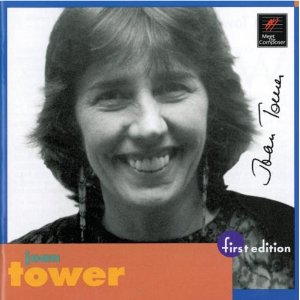

Vienna Modern Masters, headed up by composer Nancy Van de Vate, has been reaching for an intenationalist variation on the First Edition formula since getting going in the 1980s, and their Music from Six Continents series (cruelly snubbing Antarctica, unless of course one faces the fact that Eurasia is one continent) has helped introduce me, at least, to another wide array of composers and impressive performances...I'm particulary prone to return to their Penderecki recordings, and Van de Vate has ensured that she herself is well-represented here...which is fine, as she's not too shabby, herself. (I suspect that it is almost as much a budget as self-promotion measure...she might well be waiving her own royalties, in these tough times.) They were formerly distributed in the US by the fine small label Albany Records, which also distributed the New Albion release of the suite inspired by Rudy Rucker's autobiographical novel All the Visions, Like a Passing River (a partial concert performance of the title song can be heard starting just before the twelth minute of this video), and released on its own ticket at least one opera based on Ray Bradbury's Mexico stories, The Lifework of Juan Diaz...but now seem to be working on their own in US distribution (given the lack of brick and mortar retail outlets, not too surprising...Borders and B&N are probably the biggest surviving record-store chains in the US now). Happily, all the initial VMM discs are still in print, and the latter-day selections I haven't yet picked up look interesting and worth the listen.

For more "forgotten" music, please see Scott Parker's blog.

Thursday, September 30, 2010
September's "Forgotten" Music: RAINY DAY (and, THE BUNCH)

A number of folks in the loose assembly of early 1980s LA-based bands which became known collectively as the "Paisley Underground" got together to record some tracks that were released in 1984 as Rainy Day. This album has not yet been released in any digital format, as far as I know...somewhere, I have a cassette copy, which probably wouldn't sell for the inflated prices that the LP does.
As Amazon.com puts it:
Rainy Day (Self-Titled)
Rainy Day (Author), Susanna Hoffs & Vicki Peterson (Author), David & Steven Roback (Author), Will Glenn (Author), Michael Quercio (Author), Matthew Piucci (Author), Dennis Duck (Author), Kendra Smith (Author), Ethan James (Author), Karl Precoda (Author) | Format: Vinyl
Only three tracks have been posted, and reposted, around the web, that I've found, but they do give a sense of the charm of this collection of covers of folk-rock songs and work that draws on the folk-rock of the '60s, even as such bands as the Bangs/Bangles and the Dream Syndicate did themselves. ***2014 update: here's a full-album post:
As Jenny Woolworth put it in her Women in Punk Blog:
Included here for you today are three songs: ”Flying on the Ground is Wrong” (featuring Kendra Smith on vocals, David Roback on guitar and Susanna Hoffs on backing vocals), “I’ll Be Your Mirror” (featuring Susanna Hoffs on vocals and guitar, David Roback on guitar, bass and tambourine and Kendra Smith on backing vocals) and “I’ll Keep it With Mine” (featuring Susanna Hoffs on lead vocals, David Roback on guitar and tambourine and Will Glenn on violin).
And this kind selection leaves off the fine reading of Alex Chilton's "Holocaust" and a handful of others...to wit, from the Lossless Music site:
Track Listing:
1 I'll Keep It With Mine
2 John Riley
3 Flying on the Ground Is Wrong
4 Sloop John B.
5 Soon Be Home
6 Holocaust
7 On the Way Home
8 I'll Be Your Mirror
9 Rainy Day, Dream Away
1. I'll Keep It With Mine
Written by Bob Dylan; originally recorded by Nico.
Personnel: Susanna Hoffs - lead vocal; David Roback - guitar, tambourine; Will Glenn - violin; Michael Quercio - bass guitar.
2. John Riley
Written by Phil Belmonte, Bob Gibson, Ricky Neff; previously recorded by the Byrds, Joan Baez, Pete Seeger, Judy Collins, and others.
Personnel: Michael Quercio - lead vocal, bass guitar; Matthew Piucci - acoustic 12-string; David Roback - electric 12-string, background vocals; Will Glenn - violin, background vocals; Dennis Duck - drums.
3. Flying on the Ground is Wrong
Written by Neil Young; originally recorded by Buffalo Springfield.
Personnel: Kendra Smith - lead and background vocals; David Roback - guitar; Susanna Hoffs - background vocals.
4. Sloop John B.
Traditional; best known as a Beach Boys hit.
Personnel: Michael Quercio - lead vocal, bass guitar, percussion; Ethan James - keyboards; Dennis Duck - drums; David Roback - guitar, congas.
5. Soon Be Home
Written by Pete Townshend; originally recorded by the Who, as Part V of "A Quick One While He's Away".
Personnel: David Roback - lead vocal, guitars; Michael Quercio - bass guitar, drums; Vicki Peterson - background vocals; Susanna Hoffs - background vocals; Spock - tambourine.
6. Holocaust
Written by Alex Chilton; originally recorded by Big Star.
Personnel: Kendra Smith - lead vocal; Steven Roback - piano; Will Glenn - cello; David Roback - guitar; Ethan James - backwards piano.
7. On the Way Home
Written by Neil Young; originally recorded by Buffalo Springfield.
Personnel: David Roback - vocals, guitar.
8. I'll Be Your Mirror
Written by Lou Reed; originally recorded by the Velvet Underground and Nico.
Personnel: Susanna Hoffs - lead vocal, guitar; David Roback - lead guitar, bass guitar, tambourine; Sue and Kendra - background vocals.
9. Rainy Day, Dream Away
Written by Jimi Hendrix; originally recorded by the Jimi Hendrix Experience.
Personnel: Michael Quercio - lead vocal; Ethan James - bass guitar, keyboard; Dennis Duck - drums; Karl Precoda - guitar; David Roback - congas.
One of the other discussions of this album that I've found on the web noted that it reminded the author of that other collection of covers of older songs by a group of folk-rockers (no bones about it folk-rockers in this case), the album recorded by the largely Fairport Convention-member/ex-member conglomerate and entitled Rock On (and here swiping from Wikipedia):
Sandy Denny lead vocals from Rock On:

Track listing(s)
Original LP album
"Crazy Arms"
"That'll Be the Day"
"Don't Be Cruel"
"The Loco-Motion"
"My Girl the Month of May"
"Love's Made a Fool of You"
"Willie and the Hand Jive"
"Jambalaya (On The Bayou)"
"When Will I Be Loved"
"Nadine"
"Sweet Little Rock 'n' Roller"
"Learning the Game"
Flexi-disc included with original LP
"Let There Be Drums"
Fledg'ling Records FLED 3042 CD bonus tracks
"Let There Be Drums"
"Twenty Flight Rock"
"High School Confidential"
"La Bamba"
Personnel
Gerry Conway - drums and percussion (not the comics/tv Conway)
Tony Cox - piano
Sandy Denny - vocals
Pat Donaldson - bass
Ashley Hutchings - vocals
Trevor Lucas - vocals, 12-string guitar
Dave Mattacks - drums and percussion
Linda Thompson - vocals
Richard Thompson - vocals, guitars
Ian Whiteman - piano
The Dundee Horns - brass
And this one is now an overpriced collectible, too, in its CD release (I have the vinyl from Island). But the (Amazon samples) link above will give you a taste of what they were on about (2014 additional video links)...sadly, events today keep me from writing up the paean to folk-rock and its extensions I hoped to...
Please see Scott Parker's blog for the other "forgotten" music this month...
Friday, August 27, 2010
August "Forgotten" Music/Friday's "Forgotten" Book: BLUE ROSE by Blue Rose (Sugar Hill, 1989); LIFE OF THE PARTY by Mary Fleener (Fantagraphics, 1996)


Life is not cooperative at all at the moment, so I shall have less to say than I'd like about this wonderful book, which collects most of Mary Fleener's most autobiographical comix stories (as of the '96 publication date) and this bluegrass "supergroup" album, I believe the first all-female gathering of veterans, rather than younger folk who came up together in bluegrass (as the Dixie Chicks initially did, or such younger bands as Uncle Earl).
From her middle-class LA early-teen years, through adventures in the bohemian subcultures (including latter-day 1970s hippiedom and the fringes of American punk rock, surf culture and more), the weirdness of the theoretically conventional "straight" life around that and various eerie bits of coincidence that seemingly could verge on the supernatural, Fleener's bold style (given, particularly in portraying incidences of stress or ecstacy, to Cubist abstractions, such as the cover above) is an excellent match with her wit and wry take on the passing show.

Life of the Party is a good introduction to her work, as would be particularly the three issues of Fleener, one of the several shortlived comics titles she's produced on her own or in collaboration (she was one of the most talented of the contributors to the durable Wimmen's Comix and one of the founding group of contributors to its heir, Twisted Sisters. However, Life is, as too many books are, barely in print, from Fantagraphics and others.
Some samples of her b&w work:


Meanwhile, Blue Rose the band: Cathy Fink, Marcy Marxer, Laurie Lewis, Sally Van Meter, and Molly Mason (no relation as far as I know) simply recorded this wonderful album, toured a bit as a group, but didn't find sufficient support to remain a unit, if that was ever the intent, and that's really too bad (as well as a poor commentary on the tough life a bluegrass band could face in the '80s and '90s)...these truncated clips, more at the band link above than I replicate here, will give you a sense of their wonderful sound (though the instrumental solos are often what's truncated, in favor of the lovely vocal harmonies):
1. River of Change
2. Geraldine and Ruthie Mae
3. Blue Love
4. Little Birds
5. Your Friendship Carries Me
6. Sad But True
7. Wild Rose of the Mountain
8. Careless Love
9. Train of Life
10. Time Has Made A Change
--though I'm tempted to simply post them all. You probably need this record. I did.
For more of August's "forgotten" music, please see Scott Parker's blog; for more of this Friday's "forgotten" books, please see Patti Abbott's...
Subscribe to:
Posts (Atom)