YOU'RE ALL ALONE by Fritz Leiber (also published as THE SINFUL ONES) (and a consideration of other 1950 magazine fantastic-fiction)
 You're All Alone is the second of Fritz Leiber's three (essentially) no-bones-about-it horror novels (all of them also noirish novels of social observation with considerable philosophical underpinning and literary innovation running throughout, as these are Fritz Leiber novels with him working at the top of his form, and this one perhaps necessarily the most noirish of the trio); it, in its apparently original form (though it might've been trimmed down to long-novella wordcount), was first published in Fantastic Adventures magazine for July 1950.
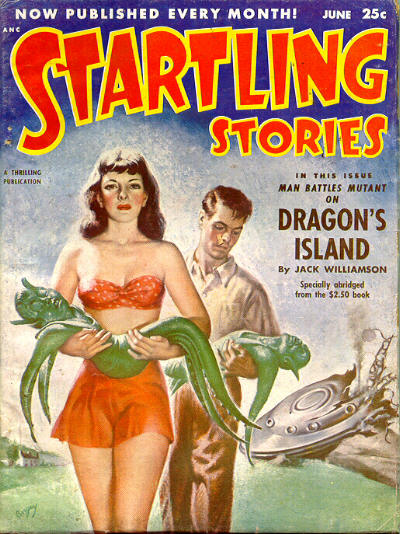
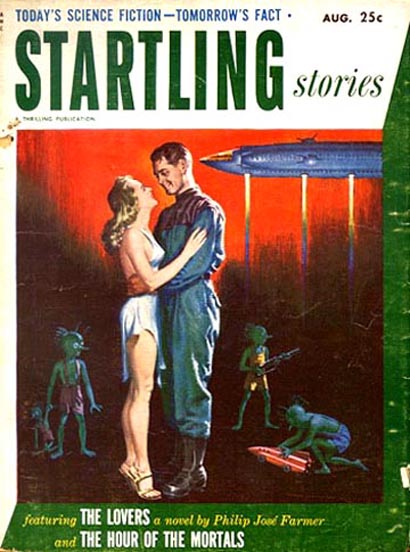
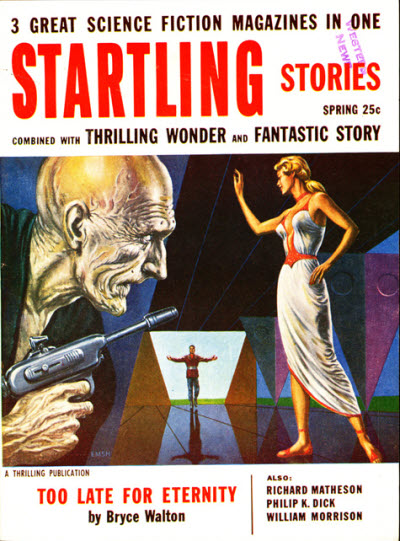
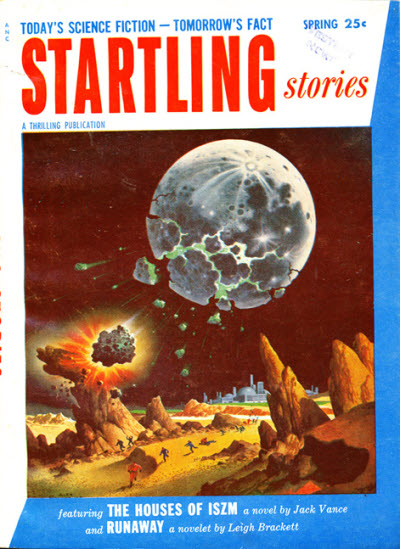
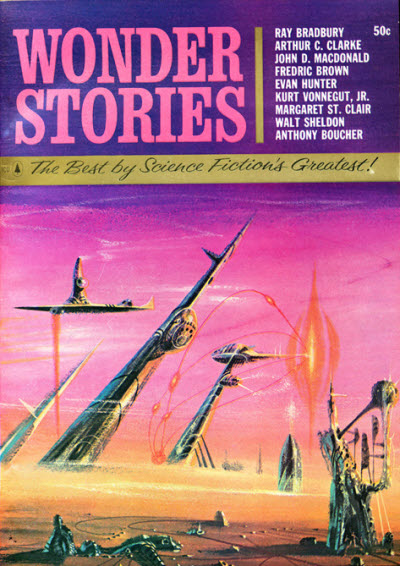
(Very Long Digression: I took a quick spin through the contents of the fantasy/sf/horror-fiction magazines of 1950, after I decided to write about the Leiber, one of a number of fairly to very important novels to be published in the magazines in that year...the year after Street and Smith folded or sold all their fiction magazines except Astounding Science Fiction [and I suspect they kept that one mostly because they wanted to keep its editor around to edit the aviation and technology magazine they kept launching, folding and relaunching in those years to no sustained success], so such major pulp titles as Detective Story, Western Story, Love Story, Doc Savage and The Shadow bit the dust [or at least the pulp-paper confetti, which Kurt Vonnegut compared to dandruff]. Perhaps that contraction of the market, or other factors, not least that nearly all the fantastic-fiction magazines were being edited by reasonably talented to brilliant editors in 1950, meant that every damned magazine extant in the field in that year had some serious bragging rights, from the ridiculously successful Galaxy [in the black financially after three issues, in fact already apparently with the largest circulation in the field, and fiction including Leiber's "Coming Attraction" and Clifford Simak's novel Time and Again, under the magazine's title "Time Quarry," didn't hurt] to the barely-eking-out little magazine Fantasy Book, which offered, in the first of two issues in 1950, a lead story by Isaac Asimov and Frederik Pohl, stories by (promising] Alfred Coppel and [old hand and star of the 1930s] Stanton Coblentz and [reliable pulpster] Basil Wells and, mixed in the middle there, "Scanners Live in Vain" by Cordwainer Smith. John D. MacDonald had stories all over Thrilling Wonder Stories and Startling Stories, including the novel Wine of the Dreamers, along with Arthur C. Clarke, Ray Bradbury, Margaret St. Clair and other major and emerging players...Leigh Brackett and Poul Anderson and Bradbury were featured in Planet Stories [of course] and Bradbury and Robert Bloch and St. Clair and Manly Wade Wellman were prominent in Weird Tales [also of course] and those folks were also in the new Avon Fantasy Reader and/or the newer The Magazine of Fantasy and Science Fiction, in the latter along with some more crime-fiction amphibians such as Elizabeth Sanxay Holding, Miriam Allen de Ford, and Robert Arthur, and this new kid Richard Matheson's first story; an early Matheson story also appeared in Damon Knight's shortlived but impressive 1950 launch Worlds Beyond, despite the stereotype of Knight as a destroyer of Matheson love. L. Ron Hubbard was pretty visible in several magazines, though only Astounding was publishing Dianetics articles by him, while Amazing, now edited by Howard Browne with help from Lila Shaffer and William Hamling, had dumped the comparably enervating "Shaver Mystery" quasi-mystical paranoia fiction--and they moved with former Amazing editor Ray Palmer to his new magazine Other Worlds...but OW also published Gustav Meyrink, Clarke, Bradbury, and others, including the classic Eric Frank Russell (as Richard Moore reminded me) story "Dear Devil". While Amazing remained filled mostly with minor stories, albeit some by Bloch, William McGivern, Simak, and Leiber were better, its companion Fantastic Adventures also featured Theodore Sturgeon's novel The Dreaming Jewels and frequently other more impressive work by Bloch, Simak, McGivern, Philip "William Tenn" Klass and others.
Even the slightest magazines were often readable, and frequently surprising. It's small wonder that the number of titles would briefly but eventually double over the next few years, before the great winnowing by decade's end. And end of digression.)
 You're All Alone was originally meant to follow Leiber's first novel Conjure Wife, and such major short fiction as "Smoke Ghost" and his first published sword & sorcery fiction, into the pages of Unknown Fantasy Fiction magazine, but when that magazine folded in 1943, Leiber set the unfinished manuscript aside. It is a delightfully paranoid story, in which the protagonist finds himself dragged out of the clockwork existence he and the vast majority of people are a part of, through an encounter with a terrified and furtive young woman who is trying her best to avoid the murderous gang of other escapees (not Leiber's term) from the automaton existence who are pursuing her. Certainly The Matrix is only the most obvious later elaboration of a similar trope, only there is no conspiracy of evil computers behind the illusory existence here, nor even the kind of Lovecraftian Old Ones the younger Leiber might've been tempted to employ, but instead simply the cold, empty way of the universe...where those who have broken free from going through the motions of life are a very small group, scattered thinly, indeed, and some are very jealous of that freedom (and their ability to exploit those still trapped in the clockwork). The rest of the novel involves the man and the woman attempting to come to grips with their status in relation to the grand machine of the universe, and to escape the murderous ones. Some of the setpieces in the story, such as the protagonist's attempt to talk to his wife, who quickly reveals herself to be responding in a conversation he might've been having with her if he hadn't been "pulled out" rather than in the increasingly desperate conversation he is actually having with her, are resonant (the alienation metaphor is deftly employed) and memorable. And, of course, noir fans, not only are the villains out to get our heroes, but (of course) the very nature of the world is, as well.
This short novel had to wait several more years before being accepted for publication in book form, and then the offer came from erotica-oriented Beacon Books (unrelated to the later small press Beacon), who had their editor, Ejler Jakobsson--in the early '70s editor of the Galaxy group of magazines, and briefly editor of the earliest '50s brief revival of Super-Science Stories, coincidentally both times following Frederik Pohl's editorship of the magazines-- insert clumsy softcore sex passages and publish it in a "double-novel" as The Sinful Ones with a very forgotten item called Bulls, Blood and Passion. Leiber saw the novella form finally in print from Ace Books in 1972 (in a volume that also included two novelets) and did what he could to rewrite the sexual passages to his taste and republish the longer-form text as The Sinful Ones with Pocket Books in 1980.


While Conjure Wife and his third horror novel Our Lady of Darkness have been reprinted several times, frequently together in an omnibus, You're All Alone has been neglected over the last two decades and more, and that is a pity, given the appeal of its initial conceit and the popularity of similar materials, even when they aren't loosely based on Philip Dick fiction that was probably at least lightly influenced by this.
 Please note the reuse of a certain Victoria Poyser cover painting above at left (Baen Books, 1986) and far above at right (Carroll & Graf, 1990). For more of today's short fiction, please see organizer Patti Abbott's blog.
Below, the 1966 issue of Fantastic which reprints "You're All Alone" from its FA appearance.
THE FANTASTIC PULPS edited by Peter Haining; WHAT DID MISS DARRINGTON SEE? FEMINIST SUPERNATURAL FICTION edited by Jessica Amanda Salmonson


Courtesy ISFDB:
The Fantastic Pulps
Editor: Peter Haining (Gollancz, 1975; St. Martin's Press, 1976; Vintage, 1976--the paperback I have, pictured here)
Contents
11 • Introduction (The Fantastic Pulps) • (1975) • essay by Peter Haining
19 • Manacled • (1900) • shortstory by Stephen Crane
25 • A Thousand Deaths • (1899) • shortstory by Jack London
37 • Author's Adventure • (1897) • shortstory by Upton Sinclair
42 • The Resurrection of Jimber-Jaw • (1937) • novelette by Edgar Rice Burroughs
62 • John Ovington Returns • (1918) • shortstory by Max Brand
79 • The People of the Pit • (1918) • shortstory by A. Merritt
97 • The Man with the Glass Heart • (1911) • shortstory by George Allan England (aka He of the Glass Heart)
110 • The Wolf Woman • [Trumpets from Oblivion] • (1939) • shortstory by H. Bedford-Jones
129 • A Cry from Beyond • (1931) • novelette by Victor Rousseau
149 • Madman's Murder Melody • (1940) • shortstory by Ray Cummings
163 • The Land That Time Forgot • (1975) • interior artwork by Frank Paul
164 • The Moon Pool • (1975) • interior artwork by Graves Gladney
165 • The Indestructible Man • (1975) • interior artwork by John Newton Howett
166 • Full Moon • (1975) • interior artwork by Virgil Finlay
167 • The Rat Racket • (1931) • interior artwork by Leo Morey
168 • Piracy Preferred • (1975) • interior artwork by H. W. Wesso
169 • Vampire Kith and Kin • (1975) • interior artwork by Vincent Napoli
170 • The Devotee of Evil • (1941) • interior artwork by Hannes Bok
171 • Herbert West: Reanimator • (1975) • interior artwork by Damon Knight
172 • The Black Ferris • (1975) • interior artwork by Lee Brown Coye
175 • The Ghost Patrol • (1917) • shortstory by Sinclair Lewis
189 • The Sardonic Star of Tom Doody • (1923) • shortstory by Dashiell Hammett [as by Peter Collinson]
196 • The Second Challenge • (1929) • shortstory by MacKinlay Kantor
209 • Baron Münchhausen's Scientific Adventures • (1916) • shortstory by Hugo Gernsback
221 • A Twentieth Century Homunculus • (1930) • shortstory by David H. Keller, M.D. [as by David H. Keller]
244 • The Man Who Saw the Future • (1930) • shortstory by Edmond Hamilton
260 • Suicide Chapel • [Jules de Grandin] • (1938) • novelette by Seabury Quinn
292 • The Diary of Alonzo Typer • (1938) • novelette by H. P. Lovecraft and William Lumley
315 • The Tree of Life • [Northwest Smith] • (1936) • novelette by C. L. Moore
343 • Iron Mask • (1944) • novelette by Robert Bloch
386 • The Sea Shell • (1944) • shortstory by Ray Bradbury
397 • The Bloody Pulps • (1962) • essay by Charles Beaumont
415 • Poor Amazing Gets It! • (1932) • letter (to Amazing Stories) by Forrest J. Ackerman
417 • The Saint's Here Again • (1939) • letter (to Thrilling Wonder Stories) by Leslie Charteris
419 • Bibliography (The Fantastic Pulps) • (1976) • essay by uncredited (Peter Haining)
again, from ISFDb:
What Did Miss Darrington See?: An Anthology of Feminist Supernatural Fiction
edited by Jessica Amanda Salmonson (Feminist Press, 1989)
Contents
ix • Preface (What Did Miss Darrington See?) • (1989) • essay by Jessica Amanda Salmonson
xv • Introduction (What Did Miss Darrington See?) • (1989) • essay by Rosemary Jackson
xxxvii • Proem: The Immortal • (1908) • poem by Ellen Glasgow
1 • The Long Chamber • (1914) • shortstory by Olivia Howard Dunbar
15 • A Ghost Story • (1858) • shortstory by Ada Trevanion
25 • Luella Miller • (1902) • shortstory by Mary E. Wilkins Freeman
38 • What Did Miss Darrington See? • (1870) • shortstory by Emma B. Cobb
58 • La Femme Noir • (1850) • shortstory by Anna Maria Hall
68 • A Friend in Need • (1981) • shortstory by Lisa Tuttle
79 • Attachment • (1974) • shortstory by Phyllis Eisenstein
90 • Dreaming the Sky Down • (1987) • shortstory by Barbara Burford
101 • The Sixth Canvasser • (1916) • shortstory by Inez Haynes Irwin
114 • An Unborn Visitant • (1932) • shortstory by Vita Sackville-West
124 • Tamar • (1932) • shortstory by Lady Eleanor Smith
135 • There and Here • (1897) • shortstory by Alice Brown
148 • The Substitute • (1914) • shortstory by Georgia Wood Pangborn
158 • The Teacher • (1976) • shortstory by Luisa Valenzuela
164 • The Ghost • (1978) • shortstory by Anne Sexton
170 • Three Dreams in a Desert • (1890) • shortstory by Olive Schreiner
177 • The Fall • (1967) • shortstory by Armonia Somers
188 • Pandora Pandaemonia • (1989) • shortfiction by Jules Faye
192 • The Doll • (1896) • shortstory by Vernon Lee
201 • The Debutante • (1939) • shortfiction by Leonora Carrington
205 • The Readjustment • (1908) • shortstory by Mary Austin (1868)
212 • Clay-Shuttered Doors • (1926) • shortstory by Helen R. Hull
229 • Since I Died • (1873) • shortstory by Elizabeth Stuart Phelps
236 • The Little Dirty Girl • (1982) • shortstory by Joanna Russ
255 • Envoi: For Emily D. • (1989) • poem by uncredited (J. A. Salmonson)
256 • Recommended Reading (What Did Miss Darrington See?) • (1989) • essay by uncredited (J. A. Salmonson)
Two important survey anthologies in my reading, encountered about a decade apart; I would've caught up with the Haining, with its then mildly steep (to me on an allowance) price of $3 (or was it up to $5?) in its "quality paperback" digest-sized form, in 1978, and I picked up the Salmonson at time of publication. Both books good fun to read, the Salmonson averaging better in quality (Haining's anthologies through the decades were often more fun even when not greater than the sum of their parts, and the selection is certainly reasonably representative), but both useful surveys that introduced me to writers I was unlikely to stumble across quickly otherwise (such as Kantor or Quinn, in the Haining, though I had read about Quinn in Les Daniels's history of horror in literature and other arts, Living in Fear).
Perhaps as important as the fiction, in both cases, were the best essays in either book; Rosemary Jackson's introduction to the Salmonson was, by design or happy circumstance, a persuasive counter-argument to Stephen King's rather daft and widely, thoughtlessly assented-to notion, put forth in Danse Macabre, that horror fiction is inherently a politically reactionary form; she deftly demonstrates horror's history and natural utility as radical and progressive critique, not least in pointing out the horrors in society which need to be overcome. In the Haining, he reprints Charles Beaumont's fine essay "The Bloody Pulps" (from an early '60s Playboy), which while not accurate in every detail is a fine, nostalgic gloss on the joys of the pulps of CB's youth...amusing to hear his voice from 1962 sneer just a bit about the slight thing a 1962 Argosy or Amazing: Fact and Science Fiction were compared to what one got in, say, 1946...Argosy by the early '60s had already become a sort of down-market, if slick, Esquire, rather than the leading general-interest/eclectic fiction pulp it had been in the 1940s (and its otherwise unrelated British namesake already a relatively sedate and even more literarily impressive digest), but this contrast between the slim, adventurous digest-sized Amazing, edited by Cele Goldsmith and featuring some of the best fiction in the field, versus the Ray Palmer Amazing Stories of the '40s with some good and a lot of indifferent to bad adventure sf, and a tendency by the end of the '40s to wallow in fringe crackpottery (even as John W. Campbell, Jr. over at Astounding was becoming increasingly willing to do, as well, in his more intellectualized way), is not a terribly strong argument. Except in nostalgic terms, perhaps. (And Amazing's then-recent mockery of Playboy, in a joke story by Isaac Asimov, perhaps had not gone unnoticed in the Hefner Mansion.)
The fiction in both volumes ranges from impressive to readable, with, as noted, the advantage going to the Salmonson, even given the historical importance of nearly everyone in both books (though, obviously, some of the Salmonson picks have become even more obscure over the decades than some of the once-famous and still indirectly influential fictioneers in the Haining); the works by still-major folks in the Haining, ranging from London and Lewis through C. L. Moore and Hammett to Bloch and Bradbury, are represented by stories more rare than representative of what they were capable of, which is less true even of the modern writers in the Salmonson, even as she avoids some obvious choices (and includes such nice surprises as Anne Sexton's prose vignette). A nice bonus in the Haining is a portfolio of pulp illustration, including Damon Knight's work, from before he turned his primary attention to writing, for the Weird Tales publication of the Lovecraft "Herbert West, Reanimator" stories.
The Haining was never too fortunate in cover imagery, but the hardcover has a slightly better cover, a pulp illustration reprint rather than a pastiche (and Haining's later anthology, with actual covers from his collection excerpted on the cover, not surprisingly looks better yet--see above).

The Fantastic Pulps
Editor: Peter Haining (Gollancz, 1975; St. Martin's Press, 1976; Vintage, 1976--the paperback I have, pictured here)
Contents
11 • Introduction (The Fantastic Pulps) • (1975) • essay by Peter Haining
19 • Manacled • (1900) • shortstory by Stephen Crane
25 • A Thousand Deaths • (1899) • shortstory by Jack London
37 • Author's Adventure • (1897) • shortstory by Upton Sinclair
42 • The Resurrection of Jimber-Jaw • (1937) • novelette by Edgar Rice Burroughs
62 • John Ovington Returns • (1918) • shortstory by Max Brand
79 • The People of the Pit • (1918) • shortstory by A. Merritt
97 • The Man with the Glass Heart • (1911) • shortstory by George Allan England (aka He of the Glass Heart)
110 • The Wolf Woman • [Trumpets from Oblivion] • (1939) • shortstory by H. Bedford-Jones
129 • A Cry from Beyond • (1931) • novelette by Victor Rousseau
149 • Madman's Murder Melody • (1940) • shortstory by Ray Cummings
163 • The Land That Time Forgot • (1975) • interior artwork by Frank Paul
164 • The Moon Pool • (1975) • interior artwork by Graves Gladney
165 • The Indestructible Man • (1975) • interior artwork by John Newton Howett
166 • Full Moon • (1975) • interior artwork by Virgil Finlay
167 • The Rat Racket • (1931) • interior artwork by Leo Morey
168 • Piracy Preferred • (1975) • interior artwork by H. W. Wesso
169 • Vampire Kith and Kin • (1975) • interior artwork by Vincent Napoli
170 • The Devotee of Evil • (1941) • interior artwork by Hannes Bok
171 • Herbert West: Reanimator • (1975) • interior artwork by Damon Knight
172 • The Black Ferris • (1975) • interior artwork by Lee Brown Coye
175 • The Ghost Patrol • (1917) • shortstory by Sinclair Lewis
189 • The Sardonic Star of Tom Doody • (1923) • shortstory by Dashiell Hammett [as by Peter Collinson]
196 • The Second Challenge • (1929) • shortstory by MacKinlay Kantor
209 • Baron Münchhausen's Scientific Adventures • (1916) • shortstory by Hugo Gernsback
221 • A Twentieth Century Homunculus • (1930) • shortstory by David H. Keller, M.D. [as by David H. Keller]
244 • The Man Who Saw the Future • (1930) • shortstory by Edmond Hamilton
260 • Suicide Chapel • [Jules de Grandin] • (1938) • novelette by Seabury Quinn
292 • The Diary of Alonzo Typer • (1938) • novelette by H. P. Lovecraft and William Lumley
315 • The Tree of Life • [Northwest Smith] • (1936) • novelette by C. L. Moore
343 • Iron Mask • (1944) • novelette by Robert Bloch
386 • The Sea Shell • (1944) • shortstory by Ray Bradbury
397 • The Bloody Pulps • (1962) • essay by Charles Beaumont
415 • Poor Amazing Gets It! • (1932) • letter (to Amazing Stories) by Forrest J. Ackerman
417 • The Saint's Here Again • (1939) • letter (to Thrilling Wonder Stories) by Leslie Charteris
419 • Bibliography (The Fantastic Pulps) • (1976) • essay by uncredited (Peter Haining)
again, from ISFDb:
What Did Miss Darrington See?: An Anthology of Feminist Supernatural Fiction
edited by Jessica Amanda Salmonson (Feminist Press, 1989)
Contents
ix • Preface (What Did Miss Darrington See?) • (1989) • essay by Jessica Amanda Salmonson
xv • Introduction (What Did Miss Darrington See?) • (1989) • essay by Rosemary Jackson
xxxvii • Proem: The Immortal • (1908) • poem by Ellen Glasgow
1 • The Long Chamber • (1914) • shortstory by Olivia Howard Dunbar
15 • A Ghost Story • (1858) • shortstory by Ada Trevanion
25 • Luella Miller • (1902) • shortstory by Mary E. Wilkins Freeman
38 • What Did Miss Darrington See? • (1870) • shortstory by Emma B. Cobb
58 • La Femme Noir • (1850) • shortstory by Anna Maria Hall
68 • A Friend in Need • (1981) • shortstory by Lisa Tuttle
79 • Attachment • (1974) • shortstory by Phyllis Eisenstein
90 • Dreaming the Sky Down • (1987) • shortstory by Barbara Burford
101 • The Sixth Canvasser • (1916) • shortstory by Inez Haynes Irwin
114 • An Unborn Visitant • (1932) • shortstory by Vita Sackville-West
124 • Tamar • (1932) • shortstory by Lady Eleanor Smith
135 • There and Here • (1897) • shortstory by Alice Brown
148 • The Substitute • (1914) • shortstory by Georgia Wood Pangborn
158 • The Teacher • (1976) • shortstory by Luisa Valenzuela
164 • The Ghost • (1978) • shortstory by Anne Sexton
170 • Three Dreams in a Desert • (1890) • shortstory by Olive Schreiner
177 • The Fall • (1967) • shortstory by Armonia Somers
188 • Pandora Pandaemonia • (1989) • shortfiction by Jules Faye
192 • The Doll • (1896) • shortstory by Vernon Lee
201 • The Debutante • (1939) • shortfiction by Leonora Carrington
205 • The Readjustment • (1908) • shortstory by Mary Austin (1868)
212 • Clay-Shuttered Doors • (1926) • shortstory by Helen R. Hull
229 • Since I Died • (1873) • shortstory by Elizabeth Stuart Phelps
236 • The Little Dirty Girl • (1982) • shortstory by Joanna Russ
255 • Envoi: For Emily D. • (1989) • poem by uncredited (J. A. Salmonson)
256 • Recommended Reading (What Did Miss Darrington See?) • (1989) • essay by uncredited (J. A. Salmonson)
Two important survey anthologies in my reading, encountered about a decade apart; I would've caught up with the Haining, with its then mildly steep (to me on an allowance) price of $3 (or was it up to $5?) in its "quality paperback" digest-sized form, in 1978, and I picked up the Salmonson at time of publication. Both books good fun to read, the Salmonson averaging better in quality (Haining's anthologies through the decades were often more fun even when not greater than the sum of their parts, and the selection is certainly reasonably representative), but both useful surveys that introduced me to writers I was unlikely to stumble across quickly otherwise (such as Kantor or Quinn, in the Haining, though I had read about Quinn in Les Daniels's history of horror in literature and other arts, Living in Fear).
Perhaps as important as the fiction, in both cases, were the best essays in either book; Rosemary Jackson's introduction to the Salmonson was, by design or happy circumstance, a persuasive counter-argument to Stephen King's rather daft and widely, thoughtlessly assented-to notion, put forth in Danse Macabre, that horror fiction is inherently a politically reactionary form; she deftly demonstrates horror's history and natural utility as radical and progressive critique, not least in pointing out the horrors in society which need to be overcome. In the Haining, he reprints Charles Beaumont's fine essay "The Bloody Pulps" (from an early '60s Playboy), which while not accurate in every detail is a fine, nostalgic gloss on the joys of the pulps of CB's youth...amusing to hear his voice from 1962 sneer just a bit about the slight thing a 1962 Argosy or Amazing: Fact and Science Fiction were compared to what one got in, say, 1946...Argosy by the early '60s had already become a sort of down-market, if slick, Esquire, rather than the leading general-interest/eclectic fiction pulp it had been in the 1940s (and its otherwise unrelated British namesake already a relatively sedate and even more literarily impressive digest), but this contrast between the slim, adventurous digest-sized Amazing, edited by Cele Goldsmith and featuring some of the best fiction in the field, versus the Ray Palmer Amazing Stories of the '40s with some good and a lot of indifferent to bad adventure sf, and a tendency by the end of the '40s to wallow in fringe crackpottery (even as John W. Campbell, Jr. over at Astounding was becoming increasingly willing to do, as well, in his more intellectualized way), is not a terribly strong argument. Except in nostalgic terms, perhaps. (And Amazing's then-recent mockery of Playboy, in a joke story by Isaac Asimov, perhaps had not gone unnoticed in the Hefner Mansion.)
The fiction in both volumes ranges from impressive to readable, with, as noted, the advantage going to the Salmonson, even given the historical importance of nearly everyone in both books (though, obviously, some of the Salmonson picks have become even more obscure over the decades than some of the once-famous and still indirectly influential fictioneers in the Haining); the works by still-major folks in the Haining, ranging from London and Lewis through C. L. Moore and Hammett to Bloch and Bradbury, are represented by stories more rare than representative of what they were capable of, which is less true even of the modern writers in the Salmonson, even as she avoids some obvious choices (and includes such nice surprises as Anne Sexton's prose vignette). A nice bonus in the Haining is a portfolio of pulp illustration, including Damon Knight's work, from before he turned his primary attention to writing, for the Weird Tales publication of the Lovecraft "Herbert West, Reanimator" stories.
The Haining was never too fortunate in cover imagery, but the hardcover has a slightly better cover, a pulp illustration reprint rather than a pastiche (and Haining's later anthology, with actual covers from his collection excerpted on the cover, not surprisingly looks better yet--see above).

NEGLECTED VISIONS edited by Barry N. Malzberg, Martin Harry Greenberg and Joseph D. Olander (Doubleday 1979)

Neglected Visions is an interesting anthology in several ways, not least in being a fine collection of short fiction, much of it previously uncollected and all of it out of print at time of publication in 1979; also, it was the first collaborative anthology between prolific anthologists (and frequent collaborators) Barry Malzberg and Martin Harry Greenberg (Barry, whom I've quizzed briefly about this book, remembers Joseph Olander's role as being relatively slight, and that Olander was approaching his retirement from work with Greenberg), as well as being a relatively early book in both their compilation careers. Also unusually, Malzberg and Greenberg/Olander take credit for discrete selections here, with Barry putting in the Mark Clifton, Kris Neville, Peter Phillips, Norman Kagan and F.L. Wallace stories, and his collaborators including the Christopher Anvil, Randall Garrett, Robert Abernathy and Wyman Guin items. Along with getting one more story in, Malzberg also provides a general introduction, and the selectors switch off introducing the stories themselves. Malzberg and Greenberg would do something altogether similar again in Uncollected Stars (Avon, 1986), which I briefly reviewed sometime back, with collaborators Piers Anthony and Charles G. Waugh (in that same review I cited Ramsey Campbell's Fine Frights, which shares the Phillips story with this one...the only story among them I'd read before picking up Neglected Visions).
None of these stories are particularly well-known even among most fantasy and sf "insiders" with the possible exception of Randall Garrett's remarkably thoroughly worked-out "The Hunting Lodge" (a breathless adventure of an assassin's attempt to kill one of the nearly-immortal "senators" who have divvied up North America into personal fiefdoms), a work cited by James Blish as well as the editors here as a jewel, sadly rare in the torrent of facile work he produced to order to fill the pages of Astounding Science Fiction in the latter 1950s and early 1960s, when editor John W. Campbell, Jr. seemed to have grown weary of his task, and was often editing on autopilot (Garrett, by himself and in collaboration particularly with Robert Silverberg or Lawrence Janifer and often under pseudonyms, apparently appeared more times in the magazine than any other contributor of fiction). Garrett would actually try again with his frequently impressive Lord D'Arcy stories in the early '60s and onward (among scattered other examples of solid or better work), but old hacking habits died hard. This cover inspired a lot of machismic discomfort in the sf-fan community at the time, inspiring jokes about, ho ho, the model being John Campbell's "wife"...

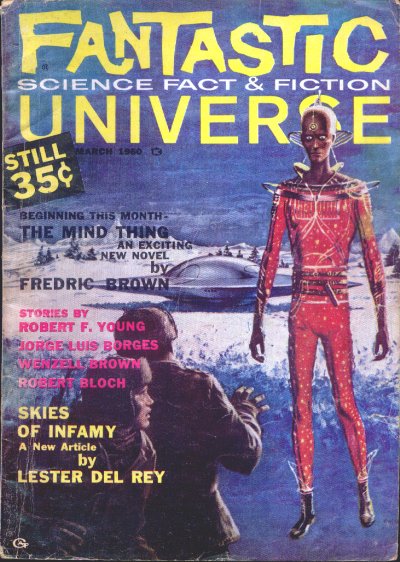
Big Digression: It's little wonder that along with the winnowing of the flood of digest-sized sf and fantasy magazines that popped up in the early 1950s to augment the pulp titles, with opportunist publishers aware of the success of the new Galaxy (particularly), Fantastic and The Magazine of Fantasy and Science Fiction, and the reinvigorated, more mature and briefly more successful than ever Startling Stories and its stablemates, that Earl Kemp's Who Killed Science Fiction? struck such a chord in 1960, as the book publishers were pulling back from their experiments with sf in the early '50s, the potential for ever more mature, well-written and adventurous sf seemed to be disappearing, and as Astounding and Galaxy languished [along with the latter's newly-purchased stablemate, If, treated as a commercial step-sibling] even as they continued to include good and better fiction with the mediocre and worse; F&SF under Robert P. Mills was somewhat less flashy than it had been under "Anthony Boucher", if still good [Mills had done even better at the shortlived companion Venture Science Fiction previously]; and Fantastic and Amazing were only beginning to recover from the utterly disinterested editorship of Paul W. Fairman, under his former assistant, the green but adventurous Cele Goldsmith...and all the other magazines in the field were dead by the end of 1960, H.S. Santesson's Fantastic Universe (the last issue had a garish cover and the beginning of a serialization of The Mind Thing by Fredric Brown and stories by Robert Bloch and Jorge Luis Borges; it was a stablemate of the US edition of The Saint Mystery Magazine, which Santesson also began editing in '59, succeeding Sam Merwin, who had edited Startling and would move on to Mike Shayne Mystery Magazine) and Robert A. W. Lowndes's Science Fiction (the last title of the Columbia pulp and digest chain, publishers of some of the last crime-fiction and western pulps and the last sports-fiction pulp) being the last stragglers to fold. End of digression, pretty much.
 The book begins with a story by retired psychologist Mark Clifton, who turned to sf as a medium for social criticism with vigor, but also (as Malzberg notes) with a keen commercial sense of how to appeal to his primary editor, John Campbell, by writing the kind of stories (about psionic abilities and other ESP-related matters) that JWC was particularly fascinated by in the early to mid 1950s; with "Clerical Error," Clifton was able to strenuously criticize specifically his former profession and the adjoining one of psychiatry, the government cult of classified information, and the tension between actual creative thought and survival in bureaucracy, essentially all matters close to Campbell's heart as well; Barry suspects the rather easy ending was created either in anticipation of Campbell's desire for such, or at his editorial command. The story has not aged badly, as, ridiculously, the degree of these problems hasn't lessened in the slightest since 1956, where it hasn't worsened. Barry has been championing Clifton fairly consistently since the latter 1970s, at least, and has been instrumental in bringing at least some of his work back into print, though the collection (co-edited with Greenberg), The Science Fiction of Mark Clifton (Southern Illinois University Press, 1980), as Barry recalls, sold less than 700 copies--not that SIU Press did much to support it. Clifton's novel with Frank Riley, They'd Rather Be Right, won the second Hugo Award given to a novel, in 1955.
"Christopher Anvil" (Harry Crosby)'s "Mind Partner" is also a story about madness, identity and perception, by another "pet" writer of Campbell's, though perhaps it's notable that this story, which Barry suggests is Anvil's best and it's certainly the best I've read by him, was published in Frederik Pohl's Galaxy instead. This one offers a private investigator trying to help bust an apparent drug ring, who move from mostly well-appointed house to house, but leaving a wake of despondent, psychotic addicts whenever authorities close in but fail to apprehend them. It turns out the pushers can alter perception in remarkably labyrinthine ways, including those of anyone who threatens them; our protagonist goes through a not quite recursive set of experiences as dark (in implication often more than in incident) and as well-told as the best of Philip Dick's similar work, and even though this was not one of Barry's choices, it's certainly akin to Malzberg's work in this mode, as well. Like the Clifton, it has a rather too-neat ending, but remains strange and engaging throughout.

Kris Neville's "Ballenger's People" is the story in the book closest to Malzberg's heart, "the best thing [Neville] has ever written and the best American short story published in its crazy year." as he puts it in the story's headnote; yesterday, he noted in email, "[It] had an enormous influence on my work; I read it at exactly the right time (1967 when published in Galaxy)." It tells the story of a man named Ballenger, whom we discover contains multitudes as well as a pure and abiding love for a percussionist named Angelique and, not irrelevantly, a bone to pick with a Columbia Record Club-style company he had bought his previous love-interest's videotapes from. It is a deft study of not quite functional madness and its affects on those around the madness or treating with their own less obvious sort, akin to both Malzberg's work and Robert Coover's, among others'. And thus, it, too, as is the Garrett which follows, to a great extent another story about identity, perception of identity, and distortion.
 "Lost Memory" continues to be a very grim joke, both the title pun and the story as a whole, losing little of its power on rereading, about well-meaning robots doing their best to return an apparently fallen alien machine to mechanical health...while the human within the damaged spaceship they've found does his best to find a way to help them understand his plight. Malzberg notes that he almost chose Phillips's "Dreams are Sacred" over this one, but noted that what made the choice easier was how many writers had echoed "Dreams" over the years, including Barry himself, while "Lost Memory" seemed to serve as the last word on its theme. "Junior," by Robert Abernathy, which follows, is a much lighter sort of conceptual breakthrough comedy, involving a rebellious young male among a society of sentient and hidebound as well as shellbound mollusk-like creatures. It's a bit cute for my taste, but is pleasant and clever enough. It was a Greenberg/Olander choice and Barry also looks upon it fondly.
"Laugh Along with Franz" by Norman Kagan was another important story in Barry's career, inasmuch as it challenged him to consider writing sf professionally, as well as providing the example that the kind of thing he wanted to write could be published in sf media. Rather in the mode of the film of The Graduate, only more imaginatively and earlier, and even more so in the mode of such satirical writers (at least when in that mood) as Herbert Gold and Herbert Gold and Bruce Jay Friedman or Muriel Spark, only as informed as their fellow-travelers Ray Nelson or (Ms.) Jody Scott (and certainly Malzberg as well) by sf tradition and, of course, by such allied work as Kafka's as well as by the Beat-begetting-Hippie counterculture, the story deals with a young software engineer at IBM (redubbed ICM) coming to some realizations about what really matters in life, and what might just be a tissue of lies, convenient for the powerful.

Wyman Guin, perhaps more exclusively famous (to the extent that he is) for What Is Reality fiction than anyone else in sf, thanks to his once widely-reprinted "Beyond Bedlam" (far superior to Evan Hunter's slightly later drugged society story "Malice in Wonderland," if perhaps missing the snappy ad lines of Huxley's most famous fiction), is instead represented here by a mildly misogynist but otherwise deft fantasy, "My Darling Hecate." Guin didn't quite learn the right lessons from Fritz Leiber's Conjure Wife, in this story of an accidental but nonetheless powerful witch, who has remarkable powers she can barely control, when she puts her mind to it. But, again, it plays out rather cleverly, particularly in the manner in which her subconscious plays havoc with the world around her.

I'd just begun the Wallace story, as I write this, the previous night, and while it starts promisingly, with yet another sort of spy or agent making his way through a dangerous city on a world inhabited by amphibian humanoids, I might or might not get to finish it before revising this later today. Barry is almost as enthusiastic about Wallace's work as he is about Clifton's; he sees Wallace's fiction as similar in approach and in reframing the questions we should be asking in science fiction, though Wallace was writing for (the no less demanding, and in both similar and different ways eccentric) H. L. Gold, founding editor of Galaxy, who grew more removed from his editorial work in later '50s less from simply burning out, as Campbell was, than by the weight of failure to achieve his ambitions with his magazine, and the effects of both WW2-induced agoraphobia and pain meds he took, even before an auto-accident during an attempt to go out nearly killed him; this is why Frederik Pohl was apparently editing Galaxy and If in all but title no later than 1960, and gradually doing more and more of the work for some time before that. That Wallace was so strongly associated with Gold's version of the magazine might've been a contributing factor in Wallace leaving sf in the late '50s, not finding Pohl the same sort of editor; as Malzberg notes, Wallace published some mystery novels and then ceased writing fiction.
And I've finally noted, all these stories come from either Campbell's Astounding (before its retitling as Analog in 1960), or from Gold's Galaxy and Beyond, or Pohl's 1960s Galaxy (and Pohl had been pretty deeply involved with Galaxy as a contributor of fiction and literary agent for a lot of the other contributors from nearly its beginning under Gold).
All told, while this book (more so than the latter Uncollected Stars), has fiction which tends to cluster, as repeatedly noted, around questions of perception and identity, while touching on rather than for the most part dealing directly with other great themes that sf can lend itself to, it's an excellent book to sit and read. And, like the later volume, if not quite to the same extent as the Clifton collection, it was not a commercial success. Like nearly every other book published in the Doubleday Science Fiction imprint, particularly at the production nadir of that line in the late '70s, it's poorly bound (the trade hardcover has a glue binding, not sewn, and in every other way is identical to the probable SF Book Club edition of the time, another arm of Doubleday), given an inept cover (in this case more so than most even for D-day...just look at it), and, as Barry notes, "Doubleday packaged the book contemptuously and dumped it as they dumped all Doubleday sf. Sales were miserable." The Doubleday Science Fiction imprint depended on library sales for nearly all of its income (and was hardly unique in this in hardcover publishing at the time, or for at least a decade or so beforehand and after), and expected those sales to come to a certain amount whether a given book was good, bad or indifferent; no one in Garden City was going to make much effort to help distinguish any given item published thus. The Asimov books would sell better, and Ellison's Dangerous Visions anthology too, or at least sell consistently for longer, but Asimov didn't write much sf any longer, and his sf books from Doubleday were usually about as clumsily-packaged as everyone else's. Everyone else could cry themselves a river. And even as The Silmarillion was setting sales records for hardcover fiction, and the Levin/Tryon/Blatty/King/Rice horror blockbuster trend was starting to become impossible to ignore, no one at D-day was going to try to suggest that a Doubleday Fantasy or Doubleday Horror imprint might be a useful, much less a profitable, idea...nah, those books could continue to be "Doubleday Science Fiction" if they were by some writer a D-day staffer had editorially/promotionally decided wrote sf, five or fifteen years previously...hence, for example, the mislabeling thus of Manly Wade Wellman's John the Balladeer novels in their original editions. (Wellman's historical fantasy novels, too:)

And, frankly, these stories remain (at least) good reading, though they also remain difficult to find without seeking out this long out-of-print volume or their original magazine appearances...but you could do much worse with much more effort. The story headnotes and the pointers to more work by the assembled alone might be worth the few bucks to pick up a library discard like mine, in decent shape (mine from the Public Library of Des Moines).
And many thanks to Barry Malzberg for letting me pepper him with questions.
upgraded slightly from the Contento index:
Neglected Visions ed. Barry N. Malzberg, Martin H. Greenberg & Joseph D. Olander (Doubleday, 1979, hc) 212pp. Each of the stories is followed by a selective bibliography of the author's other short fiction (and the anthologies and collections where they have been reprinted) and novels.
vii · Introduction · Barry N. Malzberg · in
1 · Clerical Error · Mark Clifton · nv Astounding Feb ’56
35 · Mind Partner · Christopher Anvil · nv Galaxy Aug ’60
65 · Ballenger’s People · Kris Neville · ss Galaxy Apr ’67
77 · The Hunting Lodge · Randall Garrett · nv Astounding Jul ’54
109 · Lost Memory · Peter Phillips · ss Galaxy May ’52
122 · Junior · Robert Abernathy · ss Galaxy Jan ’56
130 · Laugh Along with Franz · Norman Kagan · nv Galaxy Dec ’65
153 · My Darling Hecate · Wyman Guin · nv Beyond Fantasy Fiction Nov ’53
171 · Delay in Transit · Floyd L. Wallace · na Galaxy Sep ’52
For more of today's short fiction, please see organizer Patti Abbott's blog.
A redux-post combo!