Showing posts with label overlooked writers and short fiction. Show all posts

Wednesday, July 23, 2025

Short Story Wednesday: the first will be last: "Time Enough at Last" author Ms. Lyn Venable's first published short story (known to indexers), "Homesick", GALAXY SCIENCE FICTION, December 1952

Lyn, short for Marilyn, Venable, some of us have just learned (thanks to a Facebook post by Jessica Amanda Salmonson, which was cited in a discussion group by Gordon Van Gelder), died in March: 3 June 1927 to 31 March 2025, not quite 98 full years. A few years back, I read most of her published stories and wrote a SSW survey review of those I was aware of, but didn't get a chance to also read her first published story, "Homesick", so wrote about her most famous story (mostly due to its The Twilight Zone adaptation starring Burgess Meredith) "Time Enough at Last" and all her other stories known to have been published in fantasy and sf (and adjacent) magazines in the 1950s. I made a point of finally reading "Homesick" last night (as this is published), and it's not bad for a "first story", in Galaxy in 1952, when that magazine had become the best-selling and most influential sf magazine at that time; as it was the property of an Italian magazine publisher trying several new titles in its first attempt to crack the US market, it also appeared in translation in international editions. Venable would've been 25 at time of publication.

SSW: short stories by Lyn Venable (Marilyn A. Venable, 3 June 1927-31 March 2025): "Time Enough at Last" (the Twilight Zone favorite) and others: Short Story Wednesday


It involves a small, relatively elderly crew of US astronauts, caught in a bind once returned to Earth, and coping as best they can with apparently necessary confinement. The story can be read in the Galaxy issue here; it was illustrated (as were several other stories in the issue) by Edmund Emshwiller, and appeared along with the first installment of Clifford Simak's novel Ring Around the Sun; a story by Isaac Asimov, "The Deep", that remained one of his favorites among his own work (it also might be noted that Asimov notes in his memoirs that Simak was probably the most significant non-editorial influence on Asimov's fiction among all writers); another "first" story, by Howard L. Myers, which would remain his only story in a fantastic-fiction magazine (after a nonfiction feature in Astounding SF a few months earlier) till he began publishing again, as "Verge Foray", in 1967, and would continue to publish under both names in a productive if relatively short career; two notable stories by the still very new writer Robert Sheckley, one of them under the pseudonym "Phillips Barbee". The issue is rounded out by the usual columns: H. L. Gold's editorial, Willy Ley's nonfiction science column, and Groff Conklin's book reviews.

Gold was a US World War 2 veteran, who had gone through some awful battlefield experience which left him an agoraphobe for much of the next two decades, very much including his entire tune editing Galaxy; that the Venable story involves the necessary segregation of its astronaut crew, to some extent cut off from the rest of the world, was probably among the aspects that most thoroughly interested Gold about the story. And, like most editors, he was never averse to discovering new talent, with Venable being one of three new writers to have begun publishing in the last year or so in this issue.

A not necessarily fully effective cover, credited to a kind of photo process
--ISFDB credits the cover to Jack and Bob Strimban, and Sam Willig.


For more of today's short fiction, please see Patti Abbott's blog.

Wednesday, May 3, 2023

Short Story Wednesday: Wilma Shore: WW2 stories in McCALL'S: "You Can't Tell Your Mother", "A Woman in Love", "Something of Her Own"

Wilma Shore as a writer has been of continuing interest to me, and the recent citations in the FictionMags Index which included links to the full texts of McCall's magazine, in the Internet Archive, made for a rather good couple of hours' reading. She didn't collect any of these three stories in her one book of fiction, Women Should Be Allowed, but they are nearly as good as those that are, particularly the last of them. I have to wonder if she sent her stories to the Ladies' Home Journal first, on her market list of women's magazines, and if the possible title change of her first story for McCall's (as it would make a bit more sense if titled "You Can't Tell My Mother") or some more conservative tilt in the magazine made it less-favored by Shore for her best work in this wise.


"You Can't Tell Your Mother" is the first and slightest of these three, dating from the May 1942 issue of McCall's, just far enough into US direct combat in the war for a bulletin elsewhere in the issue about how rayon stockings are Almost as good as nylon or silk, but special care must be taken with them. It's a mostly charming, if sad, story about a young girl (a bright 8yo), who confesses to one of her mother's coworkers her own terror of Uboats/submarines generally, as well as other war-driven fear, and how she doesn't dare share these with her mother, despite the protagonist encouraging her to do so, for fear of burdening her mother unduly...which gets the childless protagonist thinking about how very terribly complex as well as terrifying the current crises can only seem to all of us.  I suppose, if the title is Shore's, it was meant to suggest that the girl would advise us thus, but I suspect Shore might've found a more deft way of doing so. 


"A Woman in Love" (from the April 1943 issue) is a much longer and more complex story, focused on the relationship between a married couple of their early middle years, and how they are drawn into direct participation in the war effort, and the stresses this (and external stresses from coping with the demands of wartime activity more generally) places on their relations...told from the wife's point of view, the story is somewhat less thoroughly supportive of her somewhat cooling response to how her husband begins to disappoint her, for the first time in their marriage, in his less than self-sacrificing commitment...without damning her or him from Shore's perspective. But I think Shore wanted us to be a bit disappointed in her for the nature of her disappointment in him. 

While the best of the three is her last in McCall's (ever, as far as the FictionMags Index, or FMI, is aware), from the March 1944 issue, "Something of Her Own", a rather fully-realized account of the somewhat confusing cautious slide into a romantic relationship between two somewhat unconventional young professionals, she working as a stenographer, he as a slightly dissatisfied but obligated junior corporate lawyer, and both always not quite sure of what they genuinely want from life, and never fully at ease with the choices they make or have thrust upon them. It rather expertly deals directly with the complex of emotions wartime separation inflicts on couples, along with the other matters of family, worklife and other pressures that most of us have faced to one degree or another in this country (and most if not all others, in somewhat differing ways) over the last century. 

These are sensitively-written stories, with relatively little if any Forced Uplift (much less Happily Ever After/For Now strictures that are placed on most romance fiction over the decades), and interesting to see in the context of even the sober times they were published in, in a magazine that wasn't (perhaps correctly, but not completely correctly) seen as fully advancing the cause of women as whole persons...but particularly in those days, when they were interested in Wilma Shore contributions, along with those from a relatively few people whose names might strike similar faint bells (such as Rachel Field or Faith Baldwin), doing what they and the magazine staffs (and it's notable how many of the executive editors were men in this decade, and for the next couple of decades at least) felt they could to provide various sorts of service to their readers. (Shore on the new sobriety of the women's magazines and other "slicks" as World War 2 ground on.) 

From the FMI:

For more of today's short stories, please see Patti Abbott's blog.

Wednesday, February 15, 2023

SSW Part 1: Robert Arthur, Robert Bloch, Algis Budrys, "T. P. Caravan" (Charles Carroll Muñoz), Miriam Allen deFord, August Derleth, Shirley Jackson, Henry Kuttner and Catherine L. Moore, Allen Kim Lang, Fritz Leiber, Richard Matheson, Frederik Pohl and Isaac Asimov, Mack Reynolds, Mann Ruben, Margaret St. Clair, Theodore Sturgeon, Jack Vance, Manly Wade Wellman, Cornell Woolrich: 1949-54 magazine short stories--Across Six Aprils (Short Story Wednesday)

Not quite random picks from the US fantasy(+) magazines of that half-decade (subtitle phrase inspired by Irene Hunt).


1949: Fritz Leiber: "The Man Who Never Grew Young" (first mass-market reprinting from original 1947 publication in the Arkham House small-press collection Night's Black Agents); and Robert Bloch: "The Unspeakable Betrothal" Avon Fantasy Reader #9 (February?), edited by Donald A. Wollheim

1950: Mack Reynolds: "Isolationist" Fantastic Adventures April 1950, edited by Howard Browne; Robert Arthur: "The Flying Eye" (reprinted from Argosy 18 May 1940); and Cornell Woolrich: "Speak to Me of Death" (reprinted from Argosy 27 February 1937) Fantasy Fiction May 1950, edited by Curtis Mitchell; Isaac Asimov and Frederik Pohl (as James MacCreigh): "The Little Man on the Subway" Fantasy Book  early/January? 1950, edited by Margaret and William L. Crawford

1951: Margaret St. Clair (as Idris Seabright): "Brightness Falls from the Air"; and Richard Matheson: "Through Channels"; and Manly Wade Wellman: "Larroes Catch Meddlers" The Magazine of Fantasy and Science Fiction April 1951, edited by Anthony Boucher and J. Francis McComas; Allen Kim Lang: "An Eel by the Tail" Imagination April 1951, edited (and packaged almost insanely poorly) by William Hamling; Theodore Sturgeon: "Ghost of a Chance" Suspense Spring 1951, edited by Theodore Irwin (reprinted, for the first time, from Unknown Worlds June 1943, edited by John W. Campbell, where it appeared as "The Green-Eyed Monster"); C. L. Moore and Henry Kuttner (as by "C. H. Liddell"): "Golden Apple" Famous Fantastic Mysteries March 1951, edited by Mary Gnaedinger; Jack Vance: "The New Prime" (as "Brain of the Galaxy") Worlds Beyond February 1951, edited by Damon Knight; Fritz Leiber: "Cry Witch!"; and Kris Neville: "Seeds of Futurity" 10 Story Fantasy Spring 1951, edited by Donald A. Wollheim                                                                                                                  

1952: August Derleth: "The Night Road" Weird Tales May 1952, edited by Dorothy McIlwraith

1953: Shirley Jackson: "Root of Evil" Fantastic April 1953, edited by Howard Browne; Margaret St. Clair: "The Espadrille" Famous Fantastic Mysteries April 1953, edited by Mary Gnaedinger; Algis Budrys: "The Weeblies" Fantasy Fiction (first issue as Fantasy Magazine) June 1953, edited by Lester Del Rey

1954: Miriam Allen deFord: "Gone to the Dogs" (aka "Henry Martindale, Great Dane") Beyond Fantasy Fiction March 1954, edited by H. L. Gold; Charles Carroll Muñoz (as T. P. Caravan): "The Soluble Scientist" Universe Science Fiction March 1954, edited by Bea Mahaffey; Mann Rubin: "The Other Voice" Fantastic Universe March 1954, edited by Beatrice Jones; Robert Bloch: "The Goddess of Wisdom" Fantastic Universe May 1954, edited by Leo Margulies

A small panoply of stories I've been meaning to read or reread or in a couple of instances have stumbled across while looking up the others. Most notable for how little-discussed they are of late...a few understandably, if not necessarily deservedly. All more or less what might've been on newsstands in April of 1949-54, arbitrarily enough.

The 1949 entries, from an issue of Avon Fantasy Reader, include one of Fritz Leiber's best-known early stories and a reasonably well-known item from Robert Bloch's bibliography (the Bloch was bumped from another Donald Wollheim project at Avon, the notable 1949 original-fiction anthology The Girl with the Hungry Eyes and Other Stories, the title story being another major Leiber story). The Reader having been Wollheim's attempt to recreate the flavor of Farnsworth Wright's Weird Tales, as opposed to the less gothic and more modernist approach of Dorothy McIlwraith's issues, the spirit of the Bloch and its Lovecraftian elements made it at least as at home in the magazine. 

"The Man Who Never Grew Young" is a lovely work, as many readers here will already know, that takes the concept of time-regression away from the single-person or similar "small-batch" examples, most famously of  late F. Scott Fitzgerald's "The Curious Case of Benjamin Button", and, in a sense at least, of Nathaniel Hawthorne's "Dr. Heidegger's Experiment", and posits a world in which some sort of barely-remembered (by the protagonist) near-Doomsday weapon has caused, as a result of detonation, the regression of time for everything on the Earth...except, apparently, for the protagonist, who remains pretty much as he has been as those people and other things around him tend to flow backwards, as it grows more difficult to remember just how things once were for him and his world (he is thus a sort of immortal, as he watches his lovers and friends eventually find their mothers and be reabsorbed, and civilizations become less complex over time). The elegiac quality of the story is beautifully maintained. It's sadly less than remarkable that Leiber couldn't find a periodical market for the story, which first appeared in his first collection. 

"The Unspeakable Betrothal" by Robert Bloch is nearly the last of his blatantly Lovecraftian works, before his stated (vain, but knowingly so) hope to put Lovecraftian pastiche to bed permanently with his 1979 novel Strange Eons. (Bloch, as I've noted here on the blog before, was a student and protégé of Lovecraft's, as was, much more briefly, Leiber, and they were the most notable writers to emerge from the Lovecraft Circle of corresponding friends, and did the most to expand and refine Lovecraft's innovations.) It's also, I see on rereading, a harbinger of the increasing turn toward explicitly psychological analysis in his storytelling, while in this case retaining the supernatural element...which would continue, without supernatural elements, through such stories as "Lucy Comes to Stay" and "I Do Not Love Thee, Dr. Fell", both clearly leading up to the novel Psycho, and such other earlier crime fiction as The Scarf and subsequent work such as Firebug and "A Home Away from Home"...

1950: Fantastic Adventures, under the editorship of Howard Browne for three years before it was merged with the new and rather more modish Fantastic, had a brief spell of featuring no little first-rate work (such as Leiber's You're All Alone and Theodore Sturgeon's The Dreaming Jewels), at least some purchased for a mooted 1950 upgrade of companion magazine Amazing Stories, but mostly was treated as a repository of so-so pulp fantasy and sf adventure fiction, much of it published under house names, even if some of it had suggestions of better work to come from such writers as William McGivern and, in this case, the young Mack Reynolds, the son of Verne Reynolds, a presidential candidate for the very doctrinaire Marxist, and first US socialist, political party, the Socialist Labor Party (founder Daniel De Leon had criticized his contemporary Karl Marx for deviation from the latter's own early proposals). Political considerations would find interesting ways to inform nearly if not all of Reynolds's fiction, and "Isolationist", while an early and not completely successful example, is a forerunner building toward such better stories as "Pacifist" and "Compounded Interest"...in this case, a misanthropic farmer has his day, and an acre of good corn, ruined by the unwelcome visit of some condescending aliens, in a spaceship which reminds the protagonist of  children's toys that have led to weapons of mass destruction. (Reynolds has another story in the same issue, "He Took It With Him", under a pseudonym, likewise taking a concept...in this case "You can't take it with you" as in any material wealth into what afterlife there might be...and putting forth a literal reconsideration of the terms in question.)

Reasonably prolific pulp-magazine contributor (largely to aerial-combat fiction titles) Curtis Mitchell's undercapitalized Magabook, Inc. offered two issues only of Fantasy Fiction (the second retitled Fantasy Stories for no obvious reason), and the magazine relied heavily on reprints from the eclectic fiction magazine Argosy and its competitor Adventure (often given new and intentionally crude new titles), interlarding them with short new pieces that often were tagged "true fantasy stories"--about mildly or less mildly bizarre supposed actual occurrences with some sort of uncanny element. My eye was drawn by the first issue containing older stories by Robert Arthur, Richard Sale and Cornell Woolrich I hadn't read.


The Arthur, from Argosy's 18 May 1940 issue, is what I'd call an almost-good example of his work, and I can understand his not rushing it back into print...a camera with an unintentionally-created magical lens which photographs the thoughts of its subjects at the time the shot was taken. It plays out reasonably cleverly, if not too surprisingly. 

To be continued...

for more of today's short fiction reviews, please see Patti Abbott's blog.


Friday, November 11, 2011

FFB: NEGLECTED VISIONS edited by Barry N. Malzberg, Martin Harry Greenberg and Joseph D. Olander (Doubleday 1979)


Neglected Visions is an interesting anthology in several ways, not least in being a fine collection of short fiction, much of it previously uncollected and all of it out of print at time of publication in 1979; also, it was the first collaborative anthology between prolific anthologists (and frequent collaborators) Barry Malzberg and Martin Harry Greenberg (Barry, whom I've quizzed briefly about this book, remembers Joseph Olander's role as being relatively slight, and that Olander was approaching his retirement from work with Greenberg), as well as being a relatively early book in both their compilation careers. Also unusually, Malzberg and Greenberg/Olander take credit for discrete selections here, with Barry putting in the Mark Clifton, Kris Neville, Peter Phillips, Norman Kagan and F.L. Wallace stories, and his collaborators including the Christopher Anvil, Randall Garrett, Robert Abernathy and Wyman Guin items. Along with getting one more story in, Malzberg also provides a general introduction, and the selectors switch off introducing the stories themselves. Malzberg and Greenberg would do something altogether similar again in Uncollected Stars (Avon, 1986), which I briefly reviewed sometime back, with collaborators Piers Anthony and Charles G. Waugh (in that same review I cited Ramsey Campbell's Fine Frights, which shares the Phillips story with this one...the only story among them I'd read before picking up Neglected Visions).

None of these stories are particularly well-known even among most fantasy and sf "insiders" with the possible exception of Randall Garrett's remarkably thoroughly worked-out "The Hunting Lodge" (a breathless adventure of an assassin's attempt to kill one of the nearly-immortal "senators" who have divvied up North America into personal fiefdoms), a work cited by James Blish as well as the editors here as a jewel, sadly rare in the torrent of facile work he produced to order to fill the pages of Astounding Science Fiction in the latter 1950s and early 1960s, when editor John W. Campbell, Jr. seemed to have grown weary of his task, and was often editing on autopilot (Garrett, by himself and in collaboration particularly with Robert Silverberg or Lawrence Janifer and often under pseudonynms, apparently appeared more times in the magazine than any other contributor of fiction). Garrett would actually try again with his frequently impressive Lord D'Arcy stories in the early '60s and onward (among scattered other examples of solid or better work), but old hacking habits died hard. This cover inspired a lot of machismic discomfort in the sf-fan community at the time, inspiring jokes about, ho ho, the model being John Campbell's "wife"...

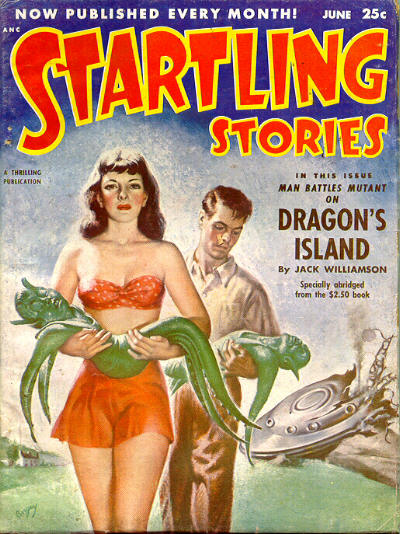
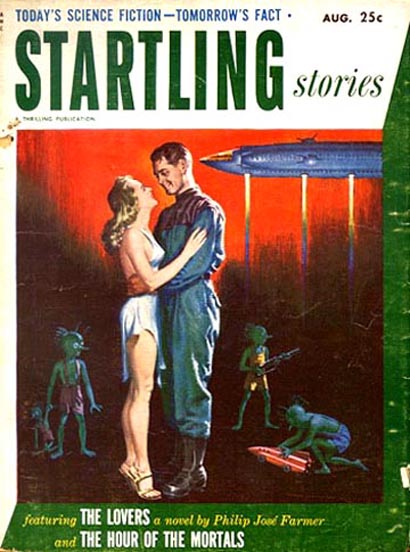
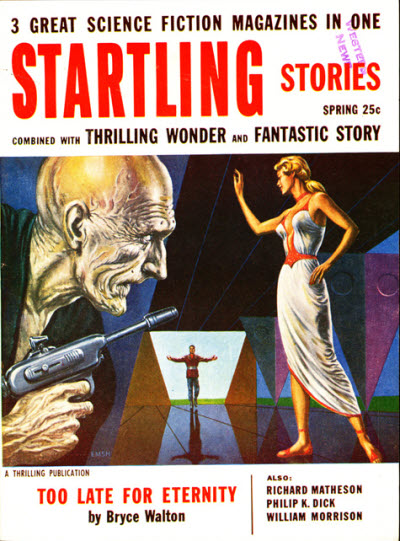
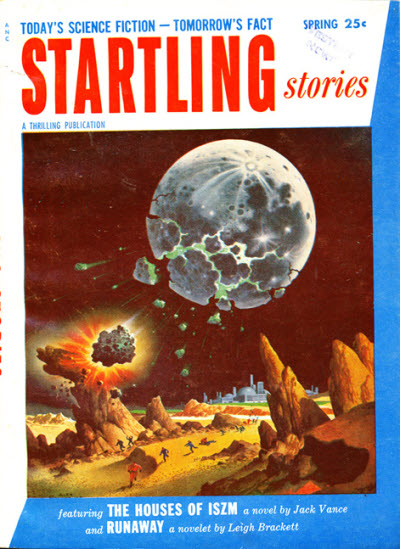
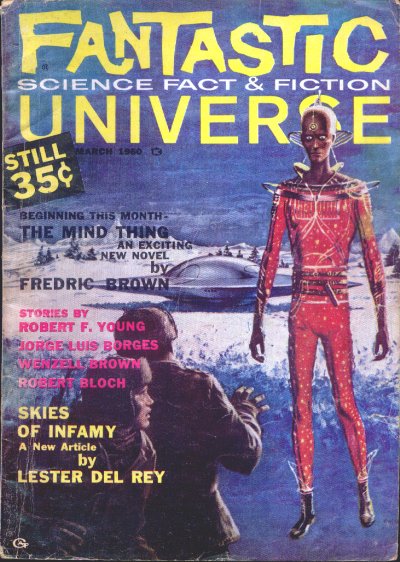
Big Digression: It's little wonder that along with the winnowing of the flood of digest-sized sf and fantasy magazines that popped up in the early 1950s to augment the pulp titles, with opportunist publishers aware of the success of the new Galaxy (particularly), Fantastic and The Magazine of Fantasy and Science Fiction, and the reinvigorated, more mature and briefly more successful than ever Startling Stories and its stablemates, that Earl Kemp's Who Killed Science Fiction? struck such a chord in 1960, as the book publishers were pulling back from their experiments with sf in the early '50s, the potential for ever more mature, well-written and adventurous sf seemed to be disappearing, and as Astounding and Galaxy languished [along with the latter's newly-purchased stablemate, If, treated as a commercial step-sibling] even as they continued to include good and better fiction with the mediocre and worse, F&SF under Robert Mills was the blandest it would be for decades, if still good [Mills had done better at the shortlived companion Venture Science Fiction previously], and Fantastic and Amazing were only beginning to recover from the utterly disinterested editorship of Paul W. Fairman, under his former assistant, the green but adventurous Cele Goldsmith...and all the other magazines in the field were dead by the end of 1960, H.S. Santesson's Fantastic Universe (the last issue had a garish cover and the beginning of a serialization of The Mind Thing by Fredric Brown and stories by Robert Bloch and Jorge Luis Borges; it was a stablemate of the US edition of The Saint Mystery Magazine, which Santesson also began editing in '59, succeeding Sam Merwin, who had edited Startling and would move on to Mike Shayne Mystery Magazine) and Robert A. W. Lowndes's Science Fiction (the last title of the Columbia pulp and digest chain, publishers of some of the last crime-fiction and western pulps and the last sports-fiction pulp) being the last stragglers to fold. End of digression, pretty much.


The book begins with a story by retired psychologist Mark Clifton, who turned to sf as a medium for social criticism with vigor, but also (as Malzberg notes) with a keen commercial sense of how to appeal to his primary editor, John Campbell, by writing the kind of stories (about psionic abilities and other ESP-related matters) that JWC was particularly fascinated by in the early to mid 1950s; with "Clerical Error," Clifton was able to strenuously criticize specifically his former profession and the adjoining one of psychiatry, the government cult of classified information, and the tension between actual creative thought and survival in bureaucracy, essentially all matters close to Campbell's heart as well; Barry suspects the rather easy ending was created either in anticipation of Campbell's desire for such, or at his editorial command. The story has not aged badly, as, ridiculously, the degree of these problems hasn't lessened in the slightest since 1956, where it hasn't worsened. Barry has been championing Clifton fairly consistently since the latter 1970s, at least, and has been instrumental in bringing at least some of his work back into print, though the collection (co-edited with Greenberg), The Science Fiction of Mark Clifton (Southern Illinois University Press, 1980), as Barry recalls, sold less than 700 copies--not that SIU Press did much to support it. Clifton's novel with Frank Riley, They'd Rather Be Right, won the second Hugo Award given to a novel, in 1955.

"Christopher Anvil" (Harry Crosby)'s "Mind Partner" is also a story about madness, identity and perception, by another "pet" writer of Campbell's, though perhaps it's notable that this story, which Barry suggests is Anvil's best and it's certainly the best I've read by him, was published in Frederik Pohl's Galaxy instead. This one offers a private investigator trying to help bust an apparent drug ring, who move from mostly well-appointed house to house, but leaving a wake of despondent, psychotic addicts whenever authorities close in but fail to apprehend them. It turns out the pushers can alter perception in remarkably labyrinthine ways, including those of anyone who threatens them; our protagonist goes through a not quite recursive set of experiences as dark (in implication often more than in incident) and as well-told as the best of Philip Dick's similar work, and even though this was not one of Barry's choices, it's certainly akin to Malzberg's work in this mode, as well. Like the Clifton, it has a rather too-neat ending, but remains strange and engaging throughout.

Kris Neville's "Ballenger's People" is the story in the book closest to Malzberg's heart, "the best thing [Neville] has ever written and the best American short story published in its crazy year." as he puts it in the story's headnote; yesterday, he noted in email, "[It] had an enormous influence on my work; I read it at exactly the right time (1967 when published in Galaxy)." It tells the story of a man named Ballenger, whom we discover contains multitudes as well as a pure and abiding love for a percussionist named Angelique and, not irrelevantly, a bone to pick with a Columbia Record Club-style company he had bought his previous love-interest's videotapes from. It is a deft study of not quite functional madness and its affects on those around the madness or treating with their own less obvious sort, akin to both Malzberg's work and Robert Coover's, among others'. And thus, it, too, as is the Garrett which follows, to a great extent another story about identity, perception of identity, and distortion.

"Lost Memory" continues to be a very grim joke, both the title pun and the story as a whole, losing little of its power on rereading, about well-meaning robots doing their best to return an apparently fallen alien machine to mechanical health...while the human within the damaged spaceship they've found does his best to find a way to help them understand his plight. Malzberg notes that he almost chose Phillips's "Dreams are Sacred" over this one, but noted that what made the choice easier was how many writers had echoed "Dreams" over the years, including Barry himself, while "Lost Memory" seemed to serve as the last word on its theme. "Junior," by Robert Abernathy, which follows, is a much lighter sort of conceptual breakthrough comedy, involving a rebellious young male among a society of sentient and hidebound as well as shellbound mollusc-like creatures. It's a bit cute for my taste, but is pleasant and clever enough. It was a Greenberg/Olander choice and Barry also looks upon it fondly.

"Laugh Along with Franz" by Norman Kagan was another important story in Barry's career, inasmuch as it challenged him to consider writing sf professionally, as well as providing the example that the kind of thing he wanted to write could be published in sf media. Rather in the mode of the film of The Graduate, only more imaginatively and earlier, and even moreso in the mode of such satirical writers (at least when in that mood) as Herbert Gold and Philip Roth and Bruce Jay Friedman or Muriel Spark, only as informed as their fellow-travelers Ray Nelson or (Ms.) Jody Scott (and certainly Malzberg as well) by sf tradition and, of course, by such allied work as Kafka's as well as by the Beat-begetting-Hippie counterculture, the story deals with a young software engineer at IBM (redubbed ICM) coming to some realizations about what really matters in life, and what might just be a tissue of lies, convenient for the powerful.

Wyman Guin, perhaps more exclusively famous (to the extent that he is) for What Is Reality fiction than anyone else in sf, thanks to his once widely-reprinted "Beyond Bedlam" (far superior to Evan Hunter's slightly later drugged society story "Malice in Wonderland," if perhaps missing the snappy ad lines of Huxley's most famous fiction), is instead represented here by a mildly misogynist but otherwise deft fantasy, "My Darling Hecate." Guin didn't quite learn the right lessons from Fritz Leiber's Conjure Wife, in this story of an accidental but nonetheless powerful witch, who has remarkable powers she can barely control, when she puts her mind to it. But, again, it plays out rather cleverly, particularly in the manner in which her subconscious plays havoc with the world around her.

I'd just begun the Wallace story, as I write this, the previous night, and while it starts promisingly, with yet another sort of spy or agent making his way through a dangerous city on a world inhabited by amphibian humanoids, I might or might not get to finish it before revising this later today. Barry is almost as enthusiastic about Wallace's work as he is about Clifton's; he sees Wallace's fiction as similar in approach and in reframing the questions we should be asking in science fiction, though Wallace was writing for (the no less demanding, and in both similar and different ways eccentric) H. L. Gold, founding editor of Galaxy, who grew more removed from his editorial work in later '50s less from simply burning out, as Campbell was, than by the weight of failure to achieve his ambitions with his magazine, and the effects of both WW2-induced agoraphobia and pain meds he took, even before an auto-accident during an attempt to go out nearly killed him; this is why Frederik Pohl was apparently editing Galaxy and If in all but title no later than 1960, and gradually doing more and more of the work for some time before that. That Wallace was so strongly associated with Gold's version of the magazine might've been a contributing factor in Wallace leaving sf in the late '50s, not finding Pohl the same sort of editor; as Malzberg notes, Wallace published some mystery novels and then ceased writing fiction.

And I've finally noted, all these stories come from either Campbell's Astounding (before its retitling as Analog in 1960), or from Gold's Galaxy and Beyond, or Pohl's 1960s Galaxy (and Pohl had been pretty deeply involved with Galaxy as a contributor of fiction and literary agent for a lot of the other contributors from nearly its beginning under Gold).

All told, while this book (moreso than the latter Uncollected Stars), has fiction which tends to cluster, as repeatedly noted, around questions of perception and identity, while touching on rather than for the most part dealing directly with other great themes that sf can lend itself to, it's an excellent book to sit and read. And, like the later volume, if not quite to the same extent as the Clifton collection, it was not a commercial success. Like nearly every other book published in the Doubleday Science Fiction imprint, particularly at the production nadir of that line in the late '70s, it's poorly bound (the trade hardcover has a glue binding, not sewn, and in every other way is identical to the probable SF Book Club edition of the time, another arm of Doubleday), given an inept cover (in this case moreso than most even for D-day...just look at it), and, as Barry notes, "Doubleday packaged the book contemptuously and dumped it as they dumped all Doubleday sf. Sales were miserable." The Doubleday Science Fiction imprint depended on library sales for nearly all of its income (and was hardly unique in this in hardcover publishing at the time, or for at least a decade or so beforehand and after), and expected those sales to come to a certain amount whether a given book was good, bad or indifferent; no one in Garden City was going to make much effort to help distinguish any given item published thus. The Asimov books would sell better, and Ellison's Dangerous Visions anthology too, or at least sell consistently for longer, but Asimov didn't write much sf any longer, and his sf books from Doubleday were usually about as clumsily-packaged as everyone else's. Everyone else could cry themselves a river. And even as The Simarillion was setting sales records for hardcover fiction, and the Levin/Tryon/Blatty/King/Rice horror blockbuster trend was starting to become impossible to ignore, no one at D-day was going to try to suggest that a Doubleday Fantasy or Doubleday Horror imprint might be a useful, much less a profitable, idea...nah, those books could continue to be "Doubleday Science Fiction" if they were by some writer a D-day staffer had editorially/promotionally decided wrote sf, five or fifteen years previously...hence, for example, the mislabeling thus of Manly Wade Wellman's John the Balladeer novels in their original editions. (Wellman's historical fantasy novels, too:)

And, frankly, these stories remain (at least) good reading, though they also remain difficult to find without seeking out this long out-of-print volume or their original magazine appearances...but you could do much worse with much more effort. The story headnotes and the pointers to more work by the assembled alone might be worth the few bucks to pick up a library discard like mine, in decent shape (mine from the Public Library of Des Moines).

And many thanks to Barry Malzberg for letting me pepper him with questions.

upgraded slightly from the Contento index:
Neglected Visions ed. Barry N. Malzberg, Martin H. Greenberg & Joseph D. Olander (Doubleday, 1979, hc) 212pp. Each of the stories is followed by a selective bibliography of the author's other short fiction (and the anthologies and collections where they have been reprinted) and novels.

vii · Introduction · Barry N. Malzberg · in
1 · Clerical Error · Mark Clifton · nv Astounding Feb ’56
35 · Mind Partner · Christopher Anvil · nv Galaxy Aug ’60
65 · Ballenger’s People · Kris Neville · ss Galaxy Apr ’67
77 · The Hunting Lodge · Randall Garrett · nv Astounding Jul ’54
109 · Lost Memory · Peter Phillips · ss Galaxy May ’52
122 · Junior · Robert Abernathy · ss Galaxy Jan ’56
130 · Laugh Along with Franz · Norman Kagan · nv Galaxy Dec ’65
153 · My Darling Hecate · Wyman Guin · nv Beyond Fantasy Fiction Nov ’53
171 · Delay in Transit · Floyd L. Wallace · na Galaxy Sep ’52

For more of today's books, please see organizer Patti Abbott's blog.