Showing posts with label patricia highsmith. Show all posts

Wednesday, October 21, 2020

SHORT STORY WEDNESDAYS: Avram Davidson, Patricia Highsmith, Margaret Millar, Donald Barthelme, T. V. Olsen, David R. Bunch, Barry Malzberg, Jay Kinney

 the October country: three magazine (October) issues and a book, relatively recent purchases, which I delve into in small part.


Avram Davidson's "Revolver" leads off this issue of EQMM, and while it's definitely missed in the crime-fiction retrospective collection The Investigations of Avram Davidson, among the welcome host of stories one does find there, that was in large part because it's one of the least-known stories sapiently gathered in the slightly earlier and rather larger The Avram Davidson Treasury (Bill Pronzini was tapped to write the introduction to the story in that volume). Utterly picaresque black humor as it traces the interlocking lives of several denizens of the slums of New York City on an eventful afternoon...a quickly-stolen pistol, a new purchase by a slumlord named Mason (a sure sign of perfidy) being not the only revolving aspect of the tale.

"The People Across the Canyon" by Margaret Millar is a horror story, or what Frederic Dannay tagged a "tale of the preternatural" in his blurb, which was otherwise mostly devoted to a quoted passage from the story. It's a deft one, as might be expected of Millar, featuring a rather fully realized dysfunctional but operational family of three, two middle-aged parents and their young daughter, and what happens when their exurban home gains some new neighbors...and their daughter gains some new playmates. 

And an old favorite story, if "favorite" is quite the right word, Patricia Highsmith's "The Terrapin" made its debut in this issue, which Dannay refers to as "an odd and thoroughly fascinating story"--true enough, haunting, a sure ringing of changes on the same sort of tale of sustained betrayal of a child as Saki's "Sredni Vashtar", only with even more agonizing detail provided (a certain pair of 1959 novels come to mind as well, though perhaps mostly because the films drawn from them are getting a workout on our movie channels--Psycho and The Haunting of Hill House...
though, of course, parental abuse is slightly less front and center in those). Two years later, the fantasy and sf magazine Gamma would publish "The Snail Watcher", despite it being neither fantasy nor sf--I think the later story has the slight edge, but these two are, I believe, the most widely read of her short stories, and there's little mystery as to why. Almost certainly, it's no accident that Millar, Davidson and Highsmith's names are the first three on the cover array.


The October 1970 issue of Fantastic features as half its text the apparently unreprinted novella "The Crimson Witch", from the period that Dean Koontz was primarily a fantasy and sf writer, rather than, as in more recent decades, more often a suspense and to a lessening degree a horror novelist. David Wright O'Brien, one of the brighter stars of the Ray Palmer era of Fantastic Adventures and Amazing Stories, and one of the relatively few U.S. writers for the sf and fantasy magazines to die in service in World War 2, has the second-longest story in the issue with his 1941 FA reprint, "Spook for Yourself". I've yet to read either of these, but suspect I'll like the O'Brien story better...and the most enthusiastic and knowledgeable Koontz fans I've known, Ed Gorman and Ian Covell, both are no longer in a position to know or speculate why Koontz hasn't done anything more with this long story. Jeff Jones's interior illustrations for the story rather better than Gray Morrow's generic sword and sorcery cover painting, with Caroline Negretti's lettering and design. 

"A Glance at the Past" is also a reprinted story, but this is unacknowledged in the issue, perhaps because editor Ted White and publisher Sol Cohen were unaware of the fact...this relatively early example of David R. Bunch's stories of Moderan (and in this case the neighboring nation of Olderan, where people eschewed replacing as much of their bodies as possible with chrome and plastic cybernetics) was first in Diversion magazine in 1959; Bunch's arch but usually cleverly so stories were a staple of Cele Goldsmith Lalli's and subsequent editors' Fantastic and Amazing, up through White's reign, and tended to vignette length, making their points (whether Moderan stories or otherwise) and bowing out. Dan Adkins's illustration gives away a bit of the punch of this one, but it's a punch that would be most surprising only to those who hadn't ever read a Moderan story before...still, a graceful and amusing exercise. (New York Review Books's classics series reprinted the collection Moderan in 2018.)

Barry Malzberg's "As Between Generations" is closer to metaphor and fable than fantasy as it's usually construed, another tale of the dysfunction between, in this case, son and father, the small resentments unforgotten over the course of years, the damages wrought in both directions by the careless or only incidentally spiteful act or words. Malzberg (whose middle initial, N., is typo'd on the cover), after his short term as editor of the magazines, remained another stalwart contributor to Fantastic and Amazing throughout White's years and beyond. His no bones about it horror story "Prowl" in this magazine eight years later deals with similar matter less head-on.

Fritz Leiber's first books column in several issues appears, as in the interregnum Leiber's wife, Jonquil, had died.

Jay Kinney's "2000 A. D. Man", I believe the first comic (or comix) strip to appear in Fantastic (early issues included some of Gahan Wilson's earliest single-panel cartoons to be professionally published, among less impressive panels) is amiable if slight...Spiro Agnew and Mark Rudd are among the nation's fearless leaders to come between 1970 and 2000...


Donald Barthelme's "Great Days" is a set of interlocking bits of dialog, apparently, which can be interpreted a number of ways, but I suspect we are to understand this is the interior dialog of a man who has collapsed in the street and is being dealt with by first responders, imagining or recalling scattered bits of a conversation or conversations with his womanfriend or wife of long standing. Exactly the kind of story which will, in its resistance to being a coherent and clear narrative, annoy the hell out of some of my acquaintances who are impatient with his more pellucid work. This story lent its title to Barthelme's penultimate collection published during his lifetime, which featured some similar free-associational dialogs among more conventional prose. 


      T. V. Olsen's "The Strange Valley" was the first western short story I read, as anthologized in Nora Kramer's 1972 Scholastic Books anthology The Ghostly Hand and Other Haunting Stories, which I believe to have been the second satisfying horror assembly I was to find, as an 8yo, I believe in the classroom library in my Enfield, CT, elementary school, and the first then-recent one, as I tore through it in 1973. I've finally gotten around to investing in inexpensive copies of that book and the 1968 Scholastic hardcover mostly original-fiction anthology Great Ghost Stories of the Old West, edited by Betty Baker, the Olsen story's first publication site. It's a deftly told but relatively familiar story, for most adult readers who have read much in the way of horror fiction, and only slightly overindulges in having the three young men of the Sioux nation, visiting an odd, desolate spot in a nearby valley, speak without any contractions, or their equivalent in Sioux. As they discuss the odd apparition one saw a couple of nights before, in 1876, it or something like it appears again. And in 1968 or thereabouts, two 18-wheel truck drivers, one the grandson of one of the 1876 Sioux, have their own odd encounter. Western writers are often drawn, when writing crossover western/horror, to mysterious time-displacement stories, and not so very surprisingly. It was certainly the most impressive story in the book to me at the time...Baker was happy with it as well, leading off her volume with it.


    Ellery Queen’s Mystery Magazine [v40 #4, #227, October 1962] ed. Ellery Queen (Davis Publications, Inc., 40¢, 132pp, digest)
    Details supplied by Douglas Greene.
    • 5 · Revolver · Avram Davidson · ss
    • 16 · Murder to the Twist · Pat McGerr · vi
    • 20 · The Talking Tree · George Sumner Albee · ss
    • 32 · The People Across the Canyon · Margaret Millar · ss
    • 45 · Mooney versus Cat · Michael Zuroy · ss
    • 50 · Beyond a Reasonable Doubt · Edgar Pangborn · ss
    • 61 · Best Mysteries of the Month · Anthony Boucher · br
    • Briefly discussed:
    • The Edge of Eden by Dick Pearce
    • The Love Thieves by Peter Packer
    • Lizzie Borden: The Untold Story by Edward D. Radin (nf)
    • The Trial of Dr. Adams by Sybille Bedford (nf)
    • The Will of the Tribe by Arthur W. Upfield
    • Counterweight by Daniel Broun
    • The Crabtree Affair by Michael Innes
    • The Evil Wish by Jean Potts
    • and the then-current Ace Double crime fiction releases en masse
    • 62 · Green Goose Chase · Veronica Parker Johns · ss
    • 72 · The Last Answer · Hal Ellson · ss
    • 76 · The Walewska Cross · Dorothy Fletcher · ss
    • 87 · A Matter of Judgment · K. T. Edwards · ss
    • 90 · Mystery Hardcovers of the Month · [Various] · br
    • 90 · Mystery Paperbacks of the Month · [Various] · br
    • 91 · Any Man’s Death · Paul W. Fairman · ss
    • 99 · The Terrapin · Patricia Highsmith · ss
    • 111 · Murder at Merryoak · Margaret Austin · ss

    Fantastic [v20 #1, October 1970] ed. Ted White (Ultimate Publications, Inc., 60¢, 148pp, digest, cover by Gray Morrow and Caroline Negretti)


For more of today's Short Story Wednesday posts, please see 

Friday, September 27, 2013

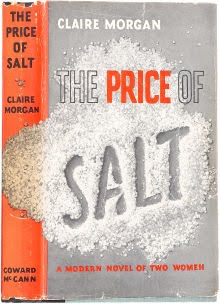
Redux for Highsmith Week: FFB 1952: Marijane Meaker (as Vin Packer): SPRING FIRE (Fawcett Gold Medal); Patricia Highsmith (as Claire Morgan): THE PRICE OF SALT (Coward, McCann)


The first startling thing about these two novels, pioneering lesbian Bildungsromans, first published in the same year, under pseudonyms, by two writers who would go on to have a two-year affair seven years later, is how even more similar they are than this would suggest.

For more of this vintage review, please see here...and for fresher and rather less sloppily-written reviews, try Patti Abbott's page. 

Then there's this!

I'll be back...even if only to remind you of the New Season of Borgen...

Friday, January 28, 2011

FFB 1952: Marijane Meaker (as Vin Packer): SPRING FIRE (Fawcett Gold Medal); Patricia Highsmith (as Claire Morgan): THE PRICE OF SALT (Coward, McCann)


The first startling thing about these two novels, pioneering lesbian Bildungsromans, first published in the same year, under pseudonyms, by two writers who would go on to have a two-year affair seven years later, is how even more similar they are than this would suggest.

Quite amusingly, both novels feature analogs of their authors as their protagonists; the backgrounds and physical descriptions of Salt's 19-year-old Therese and Fire's 17yo Mitch are not too terribly far from those of their authors, particularly at those ages; the cover painting of Mitch (with her paramour Leda) also rather resembles the young Meaker, on staff at Gold Medal when she submitted her first novel (which this was, though it was quickly followed by her second, Dark Intruder [1952]; Salt was Highsmith's second, after Strangers on a Train [1950]). Further, both protagonists fall into mutual love at first sight, or at least something more than simply mutually lustful intrigue, with an older, more high-status woman in the midst of stressful coping with a new, ridiculously artificial environment--Mitch is matriculating at a university and being pledged to a sorority, Therese as a harassed new toy-department clerk at a massive and stuffy department store of the type common in the era. (Of course, this sort of encounter strokes the intended reader in at least two ways--the romance-fiction trope of the immediately-recognized soulmate, and the gaydar click--though different terms would've been used in 1952, such as mutual recognition--of being either two of the only or the only two "deviants" in the social milieu they find themselves in, and the stirring of previously unfulfilled need particularly in our heroines.) Now, we learn this much in the space of the first few pages of both novels; I will now warn you that next paragraph will be filled with "spoiler" citations. After that paragraph, things will get more vague and sweeping, or at least less keyed to the novels' events, again.


There's a bit of a dance, as Therese gingerly pursues department-store customer Carol, after Carol makes at least some kind of interest clear, and Mitch seeks ways to get to know Leda, who in her turn is quite happy to have Mitch room with her in the sorority house; both the older women consistently condescend to their new acquaintances, noting how little of the world they seem to know. Therese has a fiance, Richard, a somewhat spoiled man-boy who is very proud of how patient he's been with Therese, only having had three or so sexual encounters with her, all of them unpleasant for her; Mitch soon attracts the attentions of spoiled frat-boy Bud, who alternately sullenly and unctuously plies her with alcohol, and gropingly molests her on their first date, and rapes her on the second, yet is traumatized himself by her contempt for him after the rape, which he apparently saw as seduction. The older women, Carol being about thirty, Leda being a senior to Mitch's frosh, have steady men in their lives, about whom they have mixed feelings at best--Carol's husband Harge, rather a petty dictator who hopes to control Carol, but can't quite, and Leda's steady, Jake, a somewhat less insane character than Bud, but one who is quite content with a rather blatant sex-buddies relation rather than romance with Leda. Both our protagonists meet initial "other" men who seem at least more helpful at first, but who prove unworthy of friendship; then they both meet relatively sensitive, more romantic men with whom they don't mind the mildest sort of making out (and both these Good Guys are relatively short, stocky, strong, unflashy and self-deprecating men--clearly the kind lesbians like). Both Carol and Leda prove to be difficult and weak, even if their weaknesses can be understood, given that Carol has a daughter with Harge who will become the object of a custody battle as Carol and Harge divorce, and Leda's life at college depends in large part on maintaining a delicate balancing act between the sorority she secretly disdains, the campus status and housing it provides, and her relation with her immature and sexually competitive mother (a bit of an inversion between the two stories). Nonetheless, the young protagonists are stalwart and faithful, though vexed by the dithering and excessive capriciousness of their lovers, even as they are usually ecstatic when engaging them sexually...only usually, since both couples also have somewhat jarring sexual encounters, wherein the self-doubt and uncertainty of the older women leaves the younger partners a bit hurt, put off. Therese and Carol take a roadtrip together, from NYC to the western states, in a journey that in some ways prefigures not only Lolita, as at least one critic has famously noted, but also On the Road, written at about the same time though published years later. Mitch and Leda also contemplate making a long road trip, but ultimately discard that as impractical (perhaps in part because they're already in the Midwest, and the exoticism of further west is less immediately apparent). In another mirror-image inversion rather than congruence, much is made of Carol's car, she being the wealthier of the two in Salt, and likewise Mitch's in Fire, where she comes from money which Leda can't match. Therese and Mitch write rhapsodic love letters to their women, which are eventually used against both couples; Carol and Therese are pursued by an efficient private detective, who gathers recordings of their conversations, while Mitch and Leda are burst in upon by sorority sisters while in flagrante delicto (so passionately so that they almost replicate a passage from J. Sheridan Le Fanu's lesbian vampire classic "Carmilla"). The upshot of the gathering of such evidence against them is the abandonment of the younger woman by the older in both cases; the more brittle Leda attempts to shift all blame for their tryst onto Mitch, while the more morose Carol simply hides from Therese and dithers as to whether Therese should contact her. In the end of Salt, Therese, while toying with the notion of having a fling with a lesbian actress she meets, decides that after all she really wants the resigned Carol, who has been allowed only the most limited access to her daughter, even if Carol did dare to value her daughter over her new lover...this is interpreted by some as a happy ending, although it does suggest a certain lack of freeflowing empathy between the women. Gold Medal editor Richard Carroll warned Meaker that any paperback novel, which would depend on the USPS censors' approval for at least some of its distribution (Gold Medal offered subscriptions to a GM Book Club in those years), would have to not allow the lesbian affair to continue nor end happily, so Leda, in shock after a car accident, reveals directly that she was at least as passionate as Mitch about their affair, and is placed under well-meaning but utterly oppressive psychiatric care, and forced to confront her mother while so hospitalized...and when she reacts with hostility toward her mother, is bound for an asylum. After a tense but gentle confrontation with Leda, in which the hospitalized woman admits how she tried to shift all the onus onto Mitch, Mitch decides she never actually loved Leda. Mitch then cheerfully contemplates an outing with her new roomie, Robin, to whom she is also sexually attracted, and with Robin's boyfriend Tom and Mitch's stocky, goofy male buddy, nicknamed Lucifer. Many choose to see this as an ending which repudiates lesbianism, though I can only see it as a very elegant way to have the potential of a future womanfriend and possibly to eventually eat her, too...Mitch, as noted, was always playfully, never seriously, attracted to "Lucifer," a fitting companion for a practitioner of Mitchcraft. Mitch might also prefer womenfriends in the future who are not willing to flit between utter backstabbing and total emotional collapse--behavior clearly meant to be attributable to Leda's parents' irresponsibility toward her rather than to her lesbianism per se. Meanwhile, the "sensitive" psychiatrist on Leda's case is all too ready to pack his charge off to a sanatorium for Leda's resentment of attempts to remake her into the kind of woman she has pretended to be...while he's tut-tutting about these empathy-free kids these days. A foreshadowing of One Flew Over the Cuckoo's Nest, perhaps, in some small way, only much more subversively so.

(Spoilers End)

While casting their analogs as rather more heroic than their (rather sympathetically portrayed as somewhat beaten-down) paramours, both novels are very well-written, often witty and incisive, and even a bit tricky: Highsmith loves to delay mention of a precipitating event until a paragraph or so into the description of the aftermath, or at least she does several times in the novel; Meaker is contantly shifting point of view between characters, sometimes within one paragraph, but she handles this rather deftly if at times too quickly...Highsmith in her turn remains relentlessly within the psyche of her avatar, albeit Therese is usually not extraordinarily unkind. (Both novels include rather mixed portraits of surrogate-mother dowagers, but mostly pitying where not positive...the actual mothers of key characters in each novel do not come off so well at all.) Having read these two novels in the last week, I am now even more interested in reading the Big Highsmith biography, and in digging out my copy of Meaker's memoir of their life together, both during their affair and in their brief period together as ex-lovers and friends near the end of Highsmith's life, when her irascibility had risen alarmingly. Meaker, who was a guest of the Rara-Avis discussion list some years ago, was utterly gracious, and despite her college friendship with Richard Matheson and rather unconnected career as staffer at and contributor to the same Gold Medal line publishing him, had no more directly intended to be primarily a crime-fiction writer than Highsmith did...and yet the Packer novels (and not a few of Meaker's YA novels as M. E. Kerr) at least touch heavily on CF themes, and Highsmith is mostly remembered for her criminous novels and somewhat more outre short fiction. (Meaker is quoted as noting that Anthony Boucher, under that name in the New York Times and as H. H. Holmes in the New York Herald-Tribune, was the only major-paper reviewer to consistently review paperback originals, so it made sense to write what was in his purview to review; as I remember the account in Highsmith, one of the sources of friction between Meaker and Highsmith was the latter's irritation at Meaker's comparitive wealth as a Gold Medal novelist, versus the relatively small royalties, if "higher prestige," Highsmith earned as a writer primarily for Knopf. Highsmith apparently had earned a considerable part of her income in the latter 1940s writing scripts for comics, including for Fawcett (their stable was toplined by Captain Marvel, the Billy Batson-crying-"Shazam" character sued out of existence and later revived by DC), and hated the work intensely by all accounts, and I wonder if that, along for the hunger to be taken seriously, didn't stop her from placing at least a few manuscripts at her womanfriend's house.

Patti Abbott is on Nixon-by-the-Shore vacation, and Kerrie Smith is this week's host for Friday's "Forgotten" Books links...next week, I'll be hosting the links here, and the week after that, George Kelley will to the honors, and then back to Patti again.