from a 1995 interview with Daniels for Tabula Rasa:
Kyla Ward for TR: Just touching on the other non-fiction book, Fear--
Les Daniels: AKA Living in Fear--
TR: "A History of Horror in the Mass Media."
LD: This followed the first book on comics [Comix, 1971], and once again was based on the fact this was something I was interested in. In a way it's dated and superceded now, there were fairly few books even on horror films back then; but what makes it more unique now is that in addition to discussing most of the significant English-language horror films made up till that time, it also tried to deal with the literature, going back to the Gothic novel and so on. I tried to cover so much ground that there's usually only a couple of sentences about anything that I mentioned, and so much written since that in a way it's superficial.
TR: And it also includes certain stories --
LD: It's partially an anthology.
TR: -- you printed Arthur Machen's "The Novel of the White Powder." Thank you.
LD: Well, it's important to me. At that period, I think the concept of the tradition and what had gone before was almost the basis of horror and was of interest to horror writers and people who made horror films; there has been a tremendous leap, it was almost as though I wrote that book at the appropriate time, because since then there has been a big jump in horror in terms of its wide promulgation and acceptance, and at the same time there has been a tremendous difference in the content.
Living in Fear was the first book about (as well as in small part collecting) horror that I encountered, and as a survey it was an excellent indicator that there was a wide world of material awaiting me of which I had only picked up on a small segment so far...albeit with the anthologies and comics I was reading and the Thriller television series playing in repeats locally in Connecticut (even as repeats of the first The Outer Limits series had brightened noirishly my Saturday afternoons in the Boston suburbs a few years before), and the infrequent good films I could see in theaters (tv averaged better, even with all the damned commercials and the cuts in some of the films, at least as often for more commercials...the rare horror film on the PBS stations were a particular treat), I was already aware of quite a range of work.
Daniels, an independent scholar with a continuing love for horror (and a novelist, beginning in the next decade), didn't produce an impeccably researched book, and even I as a ten year old could spot an error or two (he referred to Gene Roddenberry's nonexistent work on The Outer Limits, for example), but the stories recounted and described (of the development of horror as a field of literature and in related media) and the actual fiction collected in the coffee-table book were often excellent, as well as excellent nudges. As an anthology, others were more important to me, but as a key to the highway...
 |
| Richard Bleiler holding his anthology. |
Certainly Stephen King's Danse Macabre and others which followed Living in Fear never would have such an impact for me, even when written by such well-informed and reflective artists as Ramsey Campbell...even now, very few have attempted to match the scope of this one. (Though, for example, E. F. Bleiler's works, among them the first edition of Supernatural Fiction Writers, are always worth the look...even if a look in son Richard Bleiler's 2002 second edition of that compendium, also a Scribner's book coincidentally, would provide one with, among better and worse contributions, an example of my own bit of survey, on Joyce Carol Oates and, in passing, Kate Wilhelm.)
One can read Living in Fear at the internet Archive here.
Some important horror fiction you can read online, at least at this time:
A few examples of the better horror fiction you can currently read online (no promises that any given item will still be posted tomorrow, but I'm avoiding the more obviously criminal sites on the web, or anything that demands that you download):
Fritz Leiber:
Conjure Wfie (original magazine publication)
"Smoke Ghost"
You're All Alone (original magazine edit)
Theodore Sturgeon:
"It"
"Shottle Bop"
"The Professor's Teddy Bear"
Damon Knight:
"Special Delivery"
Robert Bloch:
"The Weird Tailor"
"The Man Who Collected Poe"
"Enoch"
Ray Bradbury:
"The October Game"
H. Russell Wakefield:
"Ghost Hunt" (if you were wondering about ancestors of The Blair Witch Project)
Saki:
Beasts and Super-Beasts (for a sample, try "Laura," the second story)
Fritz Leiber:
Conjure Wfie (original magazine publication)
"Smoke Ghost"
You're All Alone (original magazine edit)
Theodore Sturgeon:
"It"
"Shottle Bop"
"The Professor's Teddy Bear"
Damon Knight:
"Special Delivery"
Robert Bloch:
"The Weird Tailor"
"The Man Who Collected Poe"
"Enoch"
Ray Bradbury:
"The October Game"
H. Russell Wakefield:
"Ghost Hunt" (if you were wondering about ancestors of The Blair Witch Project)
Saki:
Beasts and Super-Beasts (for a sample, try "Laura," the second story)
The last and the first.

 In 1956, Judith Merril was already a veteran anthologist in the fantastic-fiction arena, her first effort thus a 1950 assembly of sf, fantasy and horror from Bantam entitled Shot in the Dark in part because that's how the publishers looked at the project; you don't see stories by Jack London, Merril's old Futurian Society friend John Michel and Marjorie Allingham in immediate succession in too many books then, or now. She was given, by Dell, the opportunity to edit the second US-based Best of the Year series to focus on short sf and fantasy, stressing the former...she could live with that...S-F in her early volumes officially stood for "science-fantasy" in the broadest sense (later, it abbreviated her revival of Robert Heinlein's suggestion of "speculative fiction"--covering all the fantastic, as Merril used it). Since 1949, there had already been a primarily science fictional BOTY, from the minor but professional hardcover house Frederick Fell, edited by Everett F. Bleiler and Ted Dikty (and George Kelley has been reviewing each in turn); Bleiler tapped out with the 1954 volumes, The Best Science Fiction of the Year and Year's Best Science Fiction Novels (devoted to novelets and novellas), perhaps in part because Fell didn't want to go forward with the longer-story annual, and the remaining volumes combined the shorter and longer stories. Dikty came to depend more and more on unofficial co-editor Earl Kemp, who was also part of the group of s-f/fanzine/convention fans who in 1955 came together to form Advent: Publishers, mostly with the intent of collecting Damon Knight's critical essays and reviews in book form, and In Search of Wonder saw its first edition that year. Advent decided to continue in that mode (publishing books about sf and related matter by James Blish, Robert Bloch and others), and apparently Fell, which began publishing operations in 1949 with, among other books, an artistically wildly uneven and not terribly commercial set of sf releases, and whose sf program shrank almost immediately to their two annuals, decided after the 1956 volume that they didn't want to publish The Best Science Fiction of the Year either, and so there was no 1957 volume...but there was a 1958 volume, published via a partnership between Advent and Doubleday's Science Fiction Book Club: Doubleday printed the copies, including the perhaps thousand or so Advent received for sale to the general and library trade, while the SFBC edition, identical except for the lack of price on the jacket and "Book Club Edition" in its usual place on the front flap, was made available to the membership. The fan-initiated Gnome Press, one of the most prosperous (but apparently not the most ethically-run) of the small houses publishing a lot of sf and fantasy magazine reprint material the larger houses weren't picking up too readily in the early and mid 1950s, got the rights to publish the hardcover editions for the first several volumes from Dell, till Gnome began to completely collapse and Merril and Dell struck up a deal with Simon & Schuster for the hardcover editions with the fourth volume. Meanwhile, the Richard Powers cover for the Dell paperback and the Edward Emshwiller design for the Gnome hardcover jacket were both typically impressive...one wonders who misspelled Avram Davidson's name below, however--and left off Shirley Jackson's name altogether!

SF: The Year’s Greatest Science Fiction and Fantasy ed. Judith Merril (Gnome, 1956, $3.50, 352pp, hc)

The Best Science Fiction Stories and Novels: 9th Series ed. T. E. Dikty and Earl Kemp (Advent:Publishers; Doubleday SFBC, 1958, hc; 258 + vi pp)
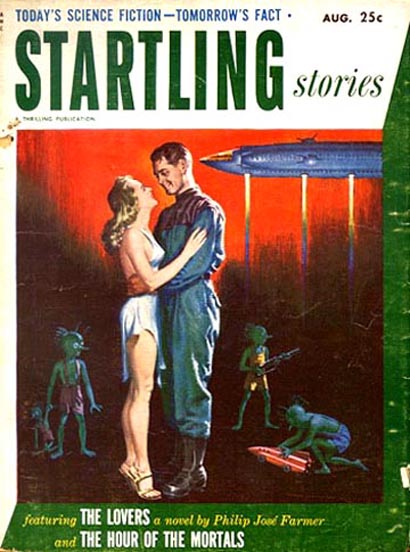
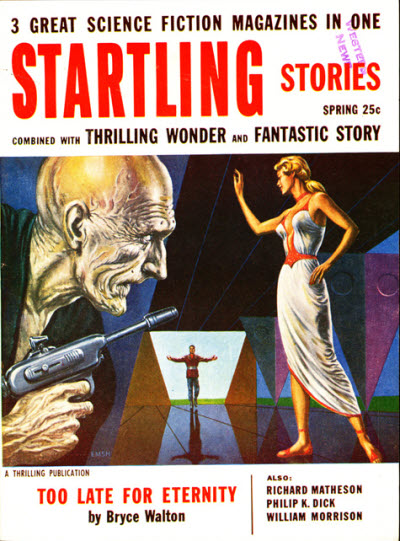
The Merril book begins with Orson Welles's account of his wife Paola Mori and a publisher friend going and buying the actor/director a gift of a shelf-full of sf and similar novels, and how little he enjoyed most of them...in the course of making a pitch for the short fiction in the field, which was less likely to be written by an opportunistic veteran or tyro writer, either sort frequently not up to speed with the best of sf, as the novels often were in 1955. Not that there was any lack of hackwork in the magazines, particularly the lesser ones, which were undergoing the first thinning out, after a boom in the early 1950s in the wake of the insurgent successes of the new Galaxy and the improved, more mature Startling Stories, and the continuing good profitability of Astounding SF, as the American News Company, the distributor which handled perhaps half or more of the magazine traffic in the States, was beginning to lose some of its major clients before the company was sold off piecemeal in 1957 for its real estate and other assets, more valuable by some distance in total than its stock price had been. The glut of magazines had made it possible for a half-competent writer to place any given half-competent story Somewhere in the field, but this also didn't do any favors for the magazines as a whole, since it meant casual or first-time sf/fantasy magazine readers often were as likely to find a mediocre experience at best in their purchase as a good or better one. But, nonetheless, the magazines did tend to have editors more knowledgeable about sf, fantasy and horror than the paperback or hardcover book houses did, with some few exceptions...and even the lower-budgeted magazines often featured work less spavined than too many of the novels, whether new books or primitive or otherwise unworthy reprints. It might also be noted that Dell was fond of getting some sort of Name associated with their magazines and paperback anthologies in those years, not infrequently a Hollywood celebrity such as Welles or Alfred Hitchcock.
 Merril's first-volume preface is brief, and agrees with Welles's notion that sf and fantasy are the Fables of Today in 1956. And then leads off the fiction in her first volume with a relatively clumsy "first story", R. R. Merliss's "The Stutterer", which would turn out to be its young medical-doctor/writer's only story (at very least under his own name) in the sf/fantasy media; he would write two novels with medical themes, one an historical novel set during the Black Plague years, and the other a contemporary novel about life as a med student and intern, published in the 1960s, as by Reuben Merliss. The story, given it was published in Astounding, is remarkably clumsy not only in its literary qualities (often overlooked in that magazine) but also in some of its technological aspects, as it posits android soldiers built from an alloy so hard that an atomic blast at ground zero will do no more to it than crystallize a thin outer layer of it, without bothering to explain how such a material might be shaped or otherwise worked with in manufacture. Merliss also frequently jumps from
 one character to another in terms of point of view in a scene to no good purpose, and explains every action of his characters at times in such a way that should've been pruned, but this was the beginning of the Tin Age at John Campbell's Astounding, where his attention was beginning to be concentrated in fringe "science" and the political content of his editorials, and such miserable writers as E. B. Cole and the blandest sort of yard-goods writing by those who could do better, such as the young Robert Silverberg and Randall Garrett, began to be staples of the magazine. Not a terrible story, but probably the worst in the book, and a very poor choice to start with.
The next, much better story is also about an android, one of Avram Davidson's most famous, if a bit heavy on the fan service and easy schtick, "The Golem"...an elderly couple, the Gumbeiners, are visited one afternoon by a lumbering, gray-complected fellow who invites himself up onto their front porch, and begins to lecture them about how there is clearly an innate emnity between humanity and androids such as itself. The Gumbeiners are unimpressed.
Humor, a bit more labored, continues with Robert Abernathy's "Junior", involving sentient polypoid sea creatures including an innovative young male who manages to upset tradition. A lot of fan service in this one, though with a cute notion to end with.
James Gunn's "The Cave of Night" is, like the Davidson, his earliest widely-cited story, an account of the first human astronaut, launched in military secrecy and on a budget mission...and apparently through misadventure stranded in his disabled space capsule in Earth orbit, making broadcasts to the Earth below over shortwave as he awaits probably unlikely rescue or for his oxygen to run out in about a month's time. The pompous tone which runs through the piece is not completely excused by it being told by an old newspaper-reporter friend of the broadcasting astronaut. Nicely encapsulates the notion of three-stage rocketry for Earth-based space exploration, and deftly describes the impressive vistas from an orbiting craft, though.


 In 1956, Judith Merril was already a veteran anthologist in the fantastic-fiction arena, her first effort thus a 1950 assembly of sf, fantasy and horror from Bantam entitled Shot in the Dark in part because that's how the publishers looked at the project; you don't see stories by Jack London, Merril's old Futurian Society friend John Michel and Marjorie Allingham in immediate succession in too many books then, or now. She was given, by Dell, the opportunity to edit the second US-based Best of the Year series to focus on short sf and fantasy, stressing the former...she could live with that...S-F in her early volumes officially stood for "science-fantasy" in the broadest sense (later, it abbreviated her revival of Robert Heinlein's suggestion of "speculative fiction"--covering all the fantastic, as Merril used it). Since 1949, there had already been a primarily science fictional BOTY, from the minor but professional hardcover house Frederick Fell, edited by Everett F. Bleiler and Ted Dikty (and George Kelley has been reviewing each in turn); Bleiler tapped out with the 1954 volumes, The Best Science Fiction of the Year and Year's Best Science Fiction Novels (devoted to novelets and novellas), perhaps in part because Fell didn't want to go forward with the longer-story annual, and the remaining volumes combined the shorter and longer stories. Dikty came to depend more and more on unofficial co-editor Earl Kemp, who was also part of the group of s-f/fanzine/convention fans who in 1955 came together to form Advent: Publishers, mostly with the intent of collecting Damon Knight's critical essays and reviews in book form, and In Search of Wonder saw its first edition that year. Advent decided to continue in that mode (publishing books about sf and related matter by James Blish, Robert Bloch and others), and apparently Fell, which began publishing operations in 1949 with, among other books, an artistically wildly uneven and not terribly commercial set of sf releases, and whose sf program shrank almost immediately to their two annuals, decided after the 1956 volume that they didn't want to publish The Best Science Fiction of the Year either, and so there was no 1957 volume...but there was a 1958 volume, published via a partnership between Advent and Doubleday's Science Fiction Book Club: Doubleday printed the copies, including the perhaps thousand or so Advent received for sale to the general and library trade, while the SFBC edition, identical except for the lack of price on the jacket and "Book Club Edition" in its usual place on the front flap, was made available to the membership. The fan-initiated Gnome Press, one of the most prosperous (but apparently not the most ethically-run) of the small houses publishing a lot of sf and fantasy magazine reprint material the larger houses weren't picking up too readily in the early and mid 1950s, got the rights to publish the hardcover editions for the first several volumes from Dell, till Gnome began to completely collapse and Merril and Dell struck up a deal with Simon & Schuster for the hardcover editions with the fourth volume. Meanwhile, the Richard Powers cover for the Dell paperback and the Edward Emshwiller design for the Gnome hardcover jacket were both typically impressive...one wonders who misspelled Avram Davidson's name below, however--and left off Shirley Jackson's name altogether!
SF: The Year’s Greatest Science Fiction and Fantasy ed. Judith Merril (Gnome, 1956, $3.50, 352pp, hc)
- Introduction · Orson Welles · in
- Preface · Judith Merril · pr
- The Stutterer · R. R. Merliss · nv Astounding Apr 1955
- The Golem · Avram Davidson · ss F&SF Mar 1955
- Junior · Robert Abernathy · ss Galaxy Jan 1956
- The Cave of Night · James E. Gunn · ss Galaxy Feb 1955
- The Hoofer · Walter M. Miller, Jr. · ss Fantastic Universe Sep 1955
- Bulkhead · Theodore Sturgeon · nv Galaxy Mar 1955, as “Who?”
- Sense from Thought Divide [Ralph Kennedy] · Mark Clifton · nv Astounding Mar 1955
- Pottage [People] · Zenna Henderson · nv F&SF Sep 1955
- Nobody Bothers Gus · Algis Budrys · ss Astounding Nov 1955, as by Paul Janvier
- The Last Day of Summer · E. C. Tubb · ss Science-Fantasy #12 1955
- One Ordinary Day, with Peanuts · Shirley Jackson · ss F&SF Jan 1955
- The Ethicators · Willard Marsh · ss If Aug 1955
- Birds Can’t Count · Mildred Clingerman · ss F&SF Feb 1955
- Of Missing Persons · Jack Finney · ss Good Housekeeping Mar 1955
- Dreaming Is a Private Thing · Isaac Asimov · ss F&SF Dec 1955
- The Country of the Kind · Damon Knight · ss F&SF Feb 1956
- The Public Hating · Steve Allen · ss Bluebook Jan 1955
- Home There’s No Returning · Henry Kuttner & C. L. Moore · nv No Boundaries, Ballantine 1955
- The Year’s S-F, Summation and Honorable Mentions · Judith Merril · ms
While writer Julian May (Dikty)'s clip art-style and basic typography cover for the Advent/SFBC final volume was certainly functional (she was far better known for her story "Dune Roller"--which she also illustrated for its magazine appearance--and would return to writing sf after a long hiatus with a series of novels, and also short movie novelizations as by "Ian Thorne", in the early 1980s).

The Best Science Fiction Stories and Novels: 9th Series ed. T. E. Dikty and Earl Kemp (Advent:Publishers; Doubleday SFBC, 1958, hc; 258 + vi pp)
- 1 · The Science-Fiction Year · T. E. Dikty · ar
- 14 · 2066: Election Day · Michael Shaara · ss Astounding Dec 1956
- 28 · The Mile-Long Spaceship · Kate Wilhelm · ss Astounding Apr 1957
- 37 · The Last Victory · Tom Godwin · ss If Aug 1957
- 53 · Call Me Joe · Poul Anderson · nv Astounding Apr 1957
- 85 · Didn’t He Ramble · Chad Oliver · ss F&SF Apr 1957
- 97 · The Queen’s Messenger · John J. McGuire · nv Astounding May 1957
- 119 · The Other People · Leigh Brackett · nv Venture Mar 1957, as “The Queer Ones”
- 155 · Into Your Tent I’ll Creep · Eric Frank Russell · ss Astounding Sep 1957
- 164 · Nor Dust Corrupt · James V. McConnell · ss If Feb 1957
- 178 · Nightsound · Algis Budrys · ss Satellite Science Fiction Feb 1957, as “The Attic Voice”
- 189 · The Tunesmith · Lloyd Biggle, Jr. · nv If Aug 1957
- 226 · Hunting Machine · Carol Emshwiller · ss Science Fiction Stories May 1957
- 233 · The Science-Fiction Book Index · Earl Kemp · ix
One notes both anthologies hew pretty closely to the sf and fantasy magazines for their selections, with the Merril showing a slightly greater eclecticism in sources, if not to nearly the same degree she would later, with stories from a paperback collection and Bluebook and Good Housekeeping, the latter by fantastic specialist Jack Finney. Both mix new and veteran writers, and both limit the contributions by women writers to three each...if rather stellar trios: Shirley Jackson, Mildred Clingerman and Zenna Henderson in the Merril, Leigh Brackett, Kate Wilhelm and Carol Emshwiller in the Dikty/Kemp. Only Jackson and Brackett could be considered true veterans at time of inclusion, though Clingerman, Henderson and Emshwiller were a few years into their careers.
 Merril's first-volume preface is brief, and agrees with Welles's notion that sf and fantasy are the Fables of Today in 1956. And then leads off the fiction in her first volume with a relatively clumsy "first story", R. R. Merliss's "The Stutterer", which would turn out to be its young medical-doctor/writer's only story (at very least under his own name) in the sf/fantasy media; he would write two novels with medical themes, one an historical novel set during the Black Plague years, and the other a contemporary novel about life as a med student and intern, published in the 1960s, as by Reuben Merliss. The story, given it was published in Astounding, is remarkably clumsy not only in its literary qualities (often overlooked in that magazine) but also in some of its technological aspects, as it posits android soldiers built from an alloy so hard that an atomic blast at ground zero will do no more to it than crystallize a thin outer layer of it, without bothering to explain how such a material might be shaped or otherwise worked with in manufacture. Merliss also frequently jumps from
The next, much better story is also about an android, one of Avram Davidson's most famous, if a bit heavy on the fan service and easy schtick, "The Golem"...an elderly couple, the Gumbeiners, are visited one afternoon by a lumbering, gray-complected fellow who invites himself up onto their front porch, and begins to lecture them about how there is clearly an innate emnity between humanity and androids such as itself. The Gumbeiners are unimpressed.
Humor, a bit more labored, continues with Robert Abernathy's "Junior", involving sentient polypoid sea creatures including an innovative young male who manages to upset tradition. A lot of fan service in this one, though with a cute notion to end with.
James Gunn's "The Cave of Night" is, like the Davidson, his earliest widely-cited story, an account of the first human astronaut, launched in military secrecy and on a budget mission...and apparently through misadventure stranded in his disabled space capsule in Earth orbit, making broadcasts to the Earth below over shortwave as he awaits probably unlikely rescue or for his oxygen to run out in about a month's time. The pompous tone which runs through the piece is not completely excused by it being told by an old newspaper-reporter friend of the broadcasting astronaut. Nicely encapsulates the notion of three-stage rocketry for Earth-based space exploration, and deftly describes the impressive vistas from an orbiting craft, though.