As I've noted elsewhere, yesterday:
In a US Thanksgiving that has been particularly hard on the crime-fiction community, including yesterday's death of Stu Shiffman, a loss this morning hits close to home here...Judy Crider, Bill Crider's wife.
http://billcrider.blogspot.com/2014/11/judy-crider-r-i-p.html
http://billcrider.blogspot.com/2014/11/judy-crider-r-i-p.html
http://billcrider.blogspot.com/2014/11/thanks-to-all.html
and further condolence to family, friends and fans of Janet LaPierre and P. D. James.
and further condolence to family, friends and fans of Janet LaPierre and P. D. James.
***Todd Mason:--from the FictionMags discussion list, 14 May 2000:

STREET & SMITH'S DETECTIVE STORY MAGAZINE, September 1946 (Volume 172, Number 5). Legendary editor: Daisy Bacon. Monthly. 15c ($1.50/year in US/$1.75 Pan American Union/$2.25 elsewhere; no Canadian subscriptions accepted [Can edition?]).
Ads for Calvert Whiskey, Listerine Antiseptic mouthwash, Pepsi-Cola, Ray-o-Vac batteries, Olin Bond flashlights and batteries, Gillette razor blades, Ballco Vacutex blackhead extractor.
Digest, 130 pp. Cover photograph by Ardean Miller, III.
from one of my contributions to the FictionMags Index, or FMI:
Street & Smith’s Detective Story Magazine [v172 #5, September 1946] ed. Daisy Bacon (Street & Smith, 15¢, 130pp, digest, cover by Ardean Miller, III, photo) [TM]
|

Ads for the Detective Book Club and an Inner Sanctum Mystery/Simon & Schuster (LAY THAT PISTOL DOWN by Richard Powell).
Digest, 128 pp. Cover painting by George Salter.
one of Douglas Greene's FMI contributions:
Ellery Queen’s Mystery Magazine [v 6 #24, September 1945] ed. Ellery Queen (American Mercury, 25¢, 128pp, digest s/s, cover by George Salter) managing editor Mildred Falk. [DG]
|
While published about a year apart, unlike the last two fiction-magazine issues I've
reviewed here [on the discussion list], a few of my beloved parallels obtain, even when
in reverse. Aside from both issues being very pleasant reading
experiences overall (and neither being much sought after on the
collectors market--purchase of the DETECTIVE STORY cost me more in
postage than in eBay bid price of $2, the EQMM was a buck in a comics
store; while both are no better than good reading copies, try getting
a merely complete PLANET STORIES for that price), one of the most
striking things about them was how forgotten the DSM writers mostly
are, and how many familiar names (perhaps some more remembered than
read) are in the EQ. The only definitely familiar name to me in the
S&S item is William Campbell Gault, and perhaps unsurprisingly his
"They'd Die for Linda" is the best story in that issue; possibly I'd
heard of Roy Lopez before, whose "You'll Be the Death of Me" is, like
most of the other DETECTIVE stories, what could be called "fake
hardboiled": wisecracking 'tecs of various sorts in stories with
the trappings of classic BLACK MASK and post-diaspora DIME DETECTIVE
fiction, without the bracing sense of hard living or worldly
cynicism of Hammett or Chandler. Odder is the issue's 33-page
"complete novel," "The Screaming Rock" by John H. Knox (whether a
close relation to Calvin M. Knox [Robert Silverberg's most famous pseudonym]
in spirit, I'm not sure), which is nothing so much as a weird-menace/shudder pulp story with most of the torture taken out, more wisecracks and politics inserted. The McGuffin
is a series of experiments in cryogenics, not so named, that serve as
obfuscation for murders at a remote psychiatric clinic, one not too
different from the one in FAREWELL, MY LOVELY. William Honest (good
old Honest Bill?) offers a reasonably affecting frame for his
impossible murder story, "Murder Is Where You Dig It"; Dorothy Dunn's
"A Photo Finish" (the cover story) reads like a slightly more
wholesome and ultimately upbeat version of a Jim Thompson desperate
loser story (before Thompson, at least, was publishing them); "Oswald
Has His Night" by Ronald Henderson is an interesting twist on a theme
AHMM (to say nothing of ALFRED HITCHCOCK PRESENTS the tv series) would
eventually beat to death; in this case the henpecked husband is
framed for a murder he didn't commit by a third party and has to solve the
mystery before his wife returns from a visit as well as before being
collared by the police; "Blood Red Rubies" by Roland Phillips is
imitation THE THIN MAN, but not too shabby an example. What the
magazine reads like, in its mostly noirish feel but not quite
full-fledged hopeless existentialism (or MANHUNT brutality), is AHMM
in its first decades, even down to the mediocre uncredited line-drawing illustrations.
Gault's use of multiple viewpoints/narrators is the major deviation
from basically serious plain tales wisecrackingly told, and his and
perhaps Dunn's are the stories that most deserve to survive this
issue's shelf life, but one common feature here is in fine pulp
tradition: attention-getting, even when cliched, opening lines:
Lopez: "He was a little guy, wearing a checked suit. He was
bald-headed. And he was scared green."
Honest: "You felt like front table at El Morocco when Marie came in.
Nobody expected her to sing, but it wouldn't have been surprising.
Tycoons like Roger Tillman could afford such a wife."
Dunn: "Tommy Murphy tore up his losing ticket after the eighth race
and left the grandstand. His hopes fluttered down to the cold cement
flooring with the pieces of cardboard. And he felt cold and grey
inside, drained of his laughter and his luck."
Knox: "Plain Sid Wilson felt the sickening pause as the wheels of
his coupe lost their grip on the icy slope."
Unlike [fellow Street & Smith fiction magazines] ASTOUNDING or UNKNOWN, but like WILD WEST, DETECTIVE STORY here restricts Ms. Bacon's editorial comment to teaser blurbs, and offers a couple of examples of rather sentimental doggerel as space-filling
tags (the better one by Edgar Daniel Kramer, the other by L[ight?]. Breeze).
No such restriction applies to Fred Dannay, of course, whose
introductory essays several times threaten to exceed the length of
the stories blurbed. Fully half the contributions to this issue of EQMM
are reprints, and only one of the originals is bylined unfamiliarly
(as far as I can recall): James Yaffe's "The Problem of the
Emperor's Mushrooms," aside from being a short, decent alternate-to-Graves
modern retelling of the intrigues in the Roman court of Claudius, is
a piss-poor example of a crime story, albeit with another draft it
could've been a better one; Dannay flagellates himself in the intro
over Yaffe's previous EQMM story, because it never occurred to either
author nor editor that a toy balloon blown up by a person wouldn't
levitate in normal atmosphere, apparently a crucial plot point (the
flaw in the story at hand is more in telegraphing and awkwardness in
dialog, but, as Dannay notes, it was rushed into print to prove Yaffe
not an idiot).
More experienced hands than Yaffe's are tapping in Morse in this
issue. Agatha Christie's "The Case of the Vulture Women" (a reprint
from a 1939 THIS WEEK magazine [wasn't this a PARADE-like newspaper
insert?][yes, it was--the later me]), is a Hercule Poirot puzzle that probably could've been
solved in a few minutes cogitation by Dr. Watson or even Mike Hammer;
it was certainly pretty obvious to me, albeit AC's digs at the
English's depredations upon other languages ring true with anyone
who's ever heard what too many Britons do to Spanish words. The other puzzle
stories in this issue are less straightforward, if too often too
easily soluble: John Dickson Carr's quasi-impossible crime tale,
"Will You Walk into My Parlor?", is actually a radio script, previously
broadcast as part of the SUSPENSE series; G. K. Chesterton's "Dr.
Hyde, Detective, and The White Pillars Murder" (ENGLISH LIFE, January
1925) is not atypically as much philosophical rumination as puzzle,
and somewhat guessable in its "surprise"; Lillian de la Torre's
original Samuel Johnson/James Boswell historical mystery, "The
Wax-Work Cadaver," gets only slightly bogged in its attempts at
period color. James M. Cain's non-puzzle, "Pastorale" (AMERICAN MERCURY,
1928), is a minor murder tale with a not particularly deft use of
vaudeville "countrified" dialect (but a cheap inhouse reprint from a
name, and certainly hardboiled enough; inadvertantly Tuckerizing
opening lines: "Well, it looks like Burbie was going to get hung.
And if he does, what he can lay it on is, he always figured he was so dam
smart."). Things look up with Ben Hecht's brief parody, "The
Whistling Corpse," an original (intentionally) as turgid as the "had I but
known" (as Dannay calls them) once and future Gothics (as I tag them)
within the cf tradition, and worth a chuckle; far funnier and more
devastating is H. F. Heard's original Mr. Mycroft (as in Holmes
pastiche) tale, "Adventure of Mr. Montalba, Obsequist," which, in
addition to goosing Doyle a bit, prefigures Waugh's THE LOVED ONE in
most of the latter's best dimensions (this one's use of cutting-edge taxidermy/undertaking
practices and arguable positing of long-term self-induced suspended
animation sparks an argument--fantasy or no?--between Heard and
Dannay which is dutifully detailed in an endnote, and makes for a weak
parallel with Knox's proto-cryogenics story in DSM). Philip Wylie's
original "Perkins' 'First Case'" is an amiable mix of NYC
slice-of-life and offbeat detection, far less sententious (as I guess
it would have to be) than what SF by him I've tried (WHEN WORLDS
COLLIDE with Balmer and THE DISAPPEARANCE); anyone read his Crunch
and Des stories? Vying with the Heard for second-best in the issue is
Damon Runyon's "What, No Butler?" (from COLLIER'S in 1933 and the 1944 collection BLUE
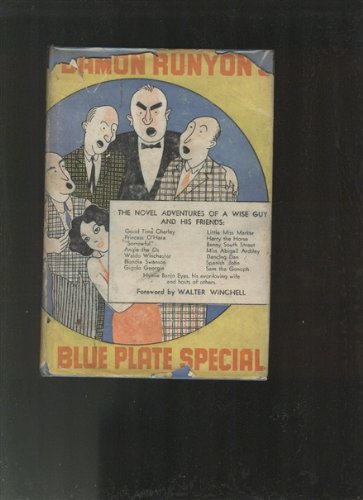
than any of the other stories in either issue (the Gault and the
Runyon come the closest, but it's not that close) gives the sense of life as it is actually lived by adults. And tells a fine, understated story.
(And one wonders if Daisy Bacon and Dannay, both on his own ticket and because he seemed to frequently work with women editors, had for obvious reasons less truck with the misogyny several here have mentioned as impediments to reprinting MANHUNT and at least some BLACK MASK stories....)


