Showing posts with label Bill Crider. Show all posts

Saturday, August 23, 2025

Friday's "Forgotten" Books: the links to the reviews and more: 22 August 2025

Patti Abbott: The Dramatist by Ken Bruen

Tony Baer: Lady Sings the Blues by Billie Holiday (with William Duffy)

Frank Babics: Paingod and Other Delusions by Harlan Ellison

grouped presentations (audio links): Pacificon II, September, 1964:"Anthony Boucher" (William White): "Use of Crime and Suspense Fiction Ideas in Science Fiction"; Karen Anderson, Poul Anderson, Bruce Pelz, Dian Pelz, George Scithers: "The World of Sword and Sorcery"; Richard Lupoff, Ron Ellik, Wally Weber, Arthur Thomson, Joe Gibson: "Ideas and Imagination in Fanzines"

Ben Boulden: The Wolf in the Clouds by Ron Faust

Randal S. Brandt: Plunder of the Sun by David Dodge, and the film adapted from it

Brian Busby: A Japanese Nightingale by "Onoto Watanna" [Winnifred Eaton]


Bill Crider: Among the Gently Mad by Nicholas Basbanes

"DforDoom": Murder on the Way! by Theodore Roscoe

Martin Edwards: Dream of Fair Women by Charlotte Armstrong

Will Errickson: Moths by Rosalind Ashe

Curtis Evans: The Cavalier's Cup by "Carter Dickson"/John Dickson Carr

Jose Ignacio Escribano Garcia-Bosque: Murder, M.D. by John Street

Aubrey Hamilton: The Tunnel Mystery by J. Lenehan

Bev Hankins: Murder in the Caravan and Murder in the Grave by Irina Shapiro

grouped reviews: Maureen Hogan: Hour of the Horde by Gordon Dickson; Victoria Silverwolf: Gateway to Hell by Dennis Wheatley; Amber Dubin: The Star Virus by Barrington J. Bayley and Mask of Chaos by John Jakes

Lesa Holstine: Of All Sad Words by Bill Crider

Rich Horton: Hidden Folk by Eleanor Arnason


Jerry House: Cadaver in Chief: A Special Report from the Dawn of the Zombie Apocalypse by Steve Hockensmith

Kate Jackson: Death of a Stray Cat by Jean Potts; my top 5 mysteries of the 1920s

Tracy K: Death by Accident by Bill Crider

Kaggsy: The Reader and the Writer by Christa Wolf

George Kelley: Space Ships! Ray Guns! Martian Octopods!: Interviews with Science Fiction Legends transcribed and edited by Richard Wolinsky

B. V. Lawson: Murder Among Friends by Elizabeth Ferrars

Steve Lewis: The House of Blue Lights by Robert J. Bowman

Todd Mason: You're All Alone (and variant version, The Sinful Ones) by Fritz Leiber (and some other 1950 fantasy-magazine fiction)

Marcia Muller: The Case of the Moth-Eaten Mink by Erle Stanley Gardner

Neeru: Frame-Up by Andrew Garve


J. F. Norris: The Croaking Raven by Gladys Mitchell

Jim Noy: Sorceror's House by Gerald Verner

"Paperback Warrior": the Mac Bolan series, created by Don Pendleton

"Puzzle Doctor": The Judas Window by "Carter Dickson" (John Dickson Carr)

James Reasoner: The Fast Buck by Ross Laurence

Kevin Tipple: At What Cost by James L'Etoile
--TM

Friday, January 19, 2024

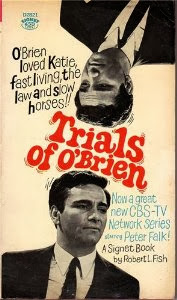
FFB: Randy Johnson on THE TRIALS OF O'BRIEN by Robert L. Fish (Rediscovered)

And, unsurprisingly, Randy also put this review up


Reviewed in the United States on January 9, 2014

I was completely unfamiliar with this series. Understandable. 
I was fifteen at the time it aired and mostly watched and read 
science fiction. It only ran for one season and I read elsewhere 
that Peter Falk said he thought more of it than he did his signature 
show Columbo. Daniel J. O'Brien is a lawyer that likes to play the
horses and throw the dice, gamble in general, and is not very 
successful at any of them. He owes everybody, has an ex-wife that 
constantly carps about late alimony in the form of bounced checks, 
and a secretary he's always borrowing money from and is behind 
on her salary. Fortunately for him, he seems to bring out the soft 
spot in women and stays on their good side. Just barely.

O'Brien gets unwittingly involved in a scheme by an old client of his. 
Benny Kalen is a three time loser. That he only got a few years on 
his last conviction instead of a dozen makes no impression. O'Brien 
should have got him off, therefore he didn't deserve to get paid.

O'Brien gets suckered by Benny's wife into being at a bar late one 
night while Benny and a confederate are pulling a stick-up job on 
a finance company that had just opened next door.

Thinks go wrong and there's a dead body. Benny's parole officer had 
warned O'Brien that he heard his name mentioned and believes he's 
in on the job.

Our lawyer is forced to defend his former client, who swears the man 
was already dead and the safe broken into when he entered the office, 
in order to clear his name.

Robert L. Fish wrote this one and is the reason I gave it a try. 
His novel Mute Witness became the Steve McQueen movie Bullitt.

Friday, December 15, 2017

Victoria Kemp on Bill Crider

I've never met Bill Crider. I just read his books and then started following him on Facebook. He posted regularly, both as himself on his personal and on his author page. His author page was a fun amalgam of vintage advertisements; songs of the day; announcements about his writing, including his appearances at various mystery cons around the country, not to mention interviews with all his mystery writing buddies. His personal page was a wonderful glimpse into the life of a man who loved his wife (who died too soon) and his cats, the VBKs, Gilligan, Keanu and Ginger Tom. He wrote prolifically, separate series: Sheriff Dan Rhodes; Truman Smith; Carl Burns and Sally Good, not to mention co-authoring books with Willard Scott and several stand-alone westerns. His writing seemed to me to illustrate who he was as a man, plain-spoken and straight-shooting. 

Cancer sucks. It has taken too many people from my life. And, now, I will lose an author whose writing has taken me places I would never go by myself. 

Fuck cancer.

Victoria Kemp

Richard Lupoff on Bill Crider

I can only recall meeting Bill Crider once--at a Bouchercon--but wish I'd got to know him better. In person he was a pleasant person. "Comfortable" strikes me as the appropriate word. He was courteous and relaxed. We also corresponded, and read each other's books. I'm sure it didn't hurt, but he seemed to like mine, and reviewed them on occasion, in a sensitive and positive manner.

His own books reflected his nature: courteous, thoughtful, intelligent. He seemed to be rather like Tony Hillerman. His heroes were rather like him. His killers, like Tony Hillerman's, were more broken and warped individuals rather than human monsters.


He has always been an ornament and an asset to our community. As long as he is with us he will continue to be a shining light.

Dick Lupoff


Richard Lupoff: "Writing Backwards" at Mystery Fanfare 

Richard Lupoff on Sweet Freedom
Pat and Dick Lupoff back when they were helping to found comics fandom and more recently

Karin Montin: Meeting Bill Crider

Meeting Bill Crider
Bill at the 2010 San Francisco Bouchercon

I first heard of Bouchercon, the world’s biggest convention for mystery fans (and authors) through Rara-Avis, an online discussion group devoted to hardboiled and noir writing. Bill Crider was a frequent contributor. I couldn’t miss the 2004 con in Toronto when I live practically next door in Montreal.
A number of us, including Kevin Smith, Marianne Macdonald and Kerry Schooley, attended a face-to-face meet-up organized by Rara-Avis founder Bill Denton. It was a pleasure to meet other members like Brian Thornton, Jim Doherty and Jason Starr at the con, too. 


But it was Bill Crider who made the biggest impression on me. Bill has published over 100 books in several genres, while teaching at a couple of Texas colleges and continuing into retirement. His late wife, Judy, was Bill’s first reader, and he always acknowledged her contribution to his work. Far too few male authors make that a practice. Bill and Judy attended many mystery, western, fantasy and SF book conventions together. I found them to be warm, interesting conversationalists.
 

At other Bouchercons in subsequent years, I crossed paths with Bill and often Judy. I would go to panels where Bill was featured and he was gracious enough to say that he always appreciated seeing familiar faces in the audience. 

Bill collects novels never published in hardcover, mostly mysteries and science fiction. (There are pictures of part of his tremendous collection on the Web.) He generally attended only panels he was on, preferring to browse and schmooze, so he could often be spotted in the booksellers’ room.
 

In Baltimore I ran into him in the book room.
“See anything here you need, Bill?”
“Well, I can’t say that I need any more books, but there’s one over there I’d love – Reform School Girl. It’s a really important paperback original.”
“Why didn’t you snap it up?”
“They’re asking $1,750.”


So there are limits to the madness. Or so I thought at the time. In correspondence Bill later admitted that he wasn’t sure his mania did have a limit.
 

“I keep looking at copies of Reform School Girl with longing. Who knows when I might break down?” 

I wonder if he ever yielded to that temptation.


Unlike many collectors who never even turn the pages of their cellophane-wrapped prizes, Bill is an avid reader. Not only that, he remembers the details, making him an invaluable source of information on pulps and later publications.


In addition to writing books, Bill has always been ready to offer encouragement to aspiring writers. From talking to him, I knew he would be. He’s kept at least two blogs, one on jogging and the other a “Pop Culture Magazine” in which he posts links to humorous and informative articles on a wide variety of topics. It must be said that he has a weakness for certain subjects, like Bigfoot, alligators and crocodiles, “the Thin Mints melee” and related incidents, and for a while, Paris Hilton. 


Several years ago, when Judy was diagnosed with cancer, Bill shared their journey through treatments and relapses up to her death, frankly and unsentimentally, yet lovingly. It was very touching. When he himself became sick, his posts on the subject were far fewer and less detailed, but even his recent announcement that his days are numbered was characteristically frank and unsentimental.

 
I would like to say I’ve read everything he’s written, but I don’t think that will ever be possible. Nonetheless, I have enjoyed every word of the dozen or so books and countless blog and Facebook posts, and generous correspondence I have had the privilege of reading. 


I miss Bill’s daily posts now and will miss him for a long time to come. 


Karin Montin

Karin on Dead to Begin With by Bill Crider

More on Bill Crider

Bill Crider, and some of his work and play, including some short stories: the FFB Crider Celebration Week

The Next Edition Quartet: Bill Crider, Ed Looby, Gary Logsdon and Richard Wolfe: "The Lion Sleeps Tonight"


Bill Crider: How I Became a Mystery Fan

Karin Montin: Meeting Bill Crider

Victoria Kemp on Bill Crider

Richard Lupoff on Bill Crider

Richard Moore on longtime fellow-fandom and Bill's Truman Smith novels

James T. Cameron: We'll Always Have Murder: A Humphrey Bogart Mystery by Bill Crider

Curtis Evans: Romanced to Death by Bill Crider

Todd Mason:
I first "met" Bill Crider virtually, via the discussion groups on the web or which used email to distribute posts to the correspondents (or, eventually, both)...someone, I've managed to forget whom, was running a western-fiction discussion forum, Read the West, on the web, which rather suddenly shut down...but not before I became aware of discussion groups such as WesternPulps, conducted by James Reasoner, and Rara-Avis, conducted by William Denton. Though old friends and fellow crime-fiction fans and/or DAPA-EM contributors such as James and Richard Robinson contributed to the R-A list earlier, Bill's first post I can find on Rara-Avis is this:

Bill Crider [at his Alvin Community College address]
Sat, 26 Sep 1998 08:58:53 -0500


I've been lurking on this list for quite a while now, and I know there's some interest in the books of Robert Skinner. I thought the first two books (BLOOD RED, SKIN DEEP and CAT-EYED TROUBLE) were excellent. I was eagerly looking forward to the third book in the series. But now I may never see it. Kensington had the book set in print, had the cover designed, and even had bound galleys done. But the swine canceled publication! "Not enough advance orders" was the official reason given. If you've ever given thought to boycotting a publisher or writing an irate letter, Kensington is a deserving target. Bill Crider

...Rara-Avis always has encouraged a certain feistiness, as well as a certain likelihood that justice might be called for (and certainly Kensington has had more than a few sins to atone for over the decades). I joined there in the next year, along with FictionMags (where Bill would eventually join us in 2004) and WesternPulps. 

Bill was a consistently gracious and good-humored contributor, as you've probably experienced or very likely read from others if you're reading this when it's posted, on our Friday Books Celebrate Bill day...the late Mario Taboada and I would eventually begin conducting Rara-Avis when Bill Denton wanted to step away, and the flow of discussion there and on WesternPulps has slowed considerably over the years, with occasional flurries of new discussion and no lack of good contributors still subscribing. But, for many of us not excluding Bill most of the discussion started to move onto blogs (and Facebook, though Bill was less engaged there) by the mid 2000s. 

Bill Crider interviewed (via video chat) on Debbi Mack's The Crime Cafe, 2015


Bill was a poet even before a published fiction writer...sometime over the last couple of years, he took down the poetry and life-as-a-runner blogs he had going alongside Bill Crider's Popular Culture Magazine, and I've missed them.  I'm not sure how many of his short stories (a very few, I think) appeared before his first novel, The Coyote Connection (Ace/Charter 1981, with Jack Davis--not the cartoonist, but at the time a carpoolmate) a collaborative entry in the revived Nick Carter series (which had the venerable detective recast as a Men's Adventure Series spy or "Killmaster"). But I thought I'd cast around for a few of his stories for this week's FFB in books I've been meaning to write up for the Friday Books roundelay.

Quite probably the first time I saw Bill's byline was on the story "Wolf Night" in Ed Gorman's anthology, a mix of reprinted and original stories, the latter including Bill's, Westeryear (M. Evans, 1988). I picked up a library discard copy of the large print edition sometime around 1993-4,  Bill gets to have some fun with this historical western, touching on his love of  B and modestly-budgeted A western films, and horror films from the same era and level of studio support, in this tale of a strange menace attacking the women of a small Texas town in the post-Civil War era...but only on the nights with a full moon...and how the European immigrant schoolteacher in the town knows what might explain this, and what might be needed to stop this slaughter. You're likely to guess at least one of the surprises Bill has planted in this story as it reaches its conclusion, but he is having such fun with this, and sharing that fun, that I doubt you'll be too impatient in your anticipation. 

Rosalind and Martin Harry Greenberg and Charles Waugh's 14 Vicious Valentines (Avon, 1988) was an almost all-original anthology of short stories, and Bill's then new "My Heart Cries for You" is a much more thoroughly grim and noirish affair...there's some humor, including a few jokes that I suspect Bill might not've cracked not too long after he wrote this three decades or so ago, but which can be taken in stride when one considers these characters making the joking references are even more pathetic versions of the kind of "mean furniture" John D. MacDonald, and no few of the other writers Bill admired who were most active in the '50s and '60s, would describe.  The attempt at a long con, between a sort of low-rent Lothario and the woman who disgusts him, and her brother who hopes to have the protagonist bump her off, is well-told and has a very deeply felt sort of cosmic justice built into its climax. You might also detect a hint of Dortmunder or Ron Goulart characters in the attempts our anti-hero makes.

Karen and Joe R. Lansdale's Dark at Heart (Dark Harvest, 1992) feature's Bill's "An Evening Out with Karl", a leaner and even more vicious exploration of some of the same motifs at play in "My Heart Cries for You"; Karl is a predator, looking for tonight's woman Who Is Asking For It, It being a brutal rape if Karl can pull it off. So far, he's been able to avoid capture, and nearly half the too-numerous women he's assaulted haven't even reported the attack to the police, as far as he can tell. Karl prefers to do his hunting in small dance clubs, never visiting any two twice, then usually follows his victim home, breaking in while wearing his ski mask. This night, however...things don't go as planned. The sense of rough justice is also on display here, and some of the jokes in "My Heart..." are turned around in this one, literally as well as figuratively. Probably not a story you'd tell your children before bedtime (as this anthology isn't reaching for that sort of story at all), but if one wondered if Bill was sublimating some of his angrier impulses in some of his fiction, particularly these short stories, it wouldn't seem too wild a surmise. 

Jayme Blaschke interviewed folks at the 2016 ArmadilloCon, to help raise the spirits of Bill, who couldn't attend. A number of these brief statements are at this link, and here's Joe R. Lansdale's contribution:


Others are likely to cite Bill's work as a writer of nonfiction about crime fiction and popular culture, and at least one contributor to this blogpile was hoping to write about Bill's blogging work particularly, which leads me to mention one of his last regular deadline-hitting tasks, along with his contributions to Friday's Forgotten Books, the (real soon now) to be revived and regular Tuesday's Overlooked A/V, and Monthly Underappreciated Music roundelays: his continuation of the "Blog Bytes" column Ed Gorman had started in Ellery Queen's Mystery Magazine...which, we hope, might continue...in the current issue, one of Bill's columns is in place, but one suspects that there're not too many more in inventory at this time. Bill has cited most of the blogs he frequents which have some notable amount of attention to crime fiction, including this one, which got Sweet Freedom one of the biggest spikes in its viewership/readership it's had. And that only one of the smaller services Bill has performed for so many of  his friends and acquaintances, and the readers of his fiction and nonfiction and the fiction he's loved. And only a small token of his kindness toward me, and his willingness (as with James Reasoner, John Grant, Patti Abbott and others) to help out librarians and others trying to find "lost" and poorly-remembered items for their patrons and others...something I engage in through several mailing lists I'm still a member of. 

 Among Bill's "Very Bad Kittens"/VBKs videos...a fairly recent one, of them as young adult cats...


Bill is a wonderful man, and an excellent writer, and now a blasted disease is taking him much as it took his beloved wife Judy not so long ago, and leaving his adult kids and siblings...and Bill's cats, a trio of siblings who've become a very popular feature of Bill's Facebook account, and all his good friends and the rest of us that much less excellent company in this life. We hope, if you haven't read his work before, that this set of remembrances might nudge you along. I've met him face to face only once, at the mildly 9/11-haunted 2001 Bouchercon only a few miles from the Pentagon, but he's been a consistently good man to know, and I wish there was more I could do to make things better for him. He's certainly done a lot for a lot of us.


Bill Crider, Angela Crider Neary and Dana Cameron at the 2017 Bouchercon courtesy EQMM
 Angela Crider Neary on attending the 2017 Toronto Bouchercon with Bill.

Bill Crider on Facebook, 15 December 2017: Overwhelmed by kind thoughts and appreciation of me and my work. Wish I could write more. Can't.

For links to, and hosting some of, this week's reviews, remembrance and more, please see Patti Abbott's blog.

Richard Moore on Bill Crider and his Truman Smith novels and crime-fiction fandom

On Bill Crider:
Richard Moore, James Reasoner, Bill Crider
I first got to know Bill Crider in an Amateur Press Association (APA) for mystery fans called Elementary My Dear APA or DAPA-EM. Long before the internet and blogs, groups of fans would do individual “zines” and mail their pages to the Official Editor who would bind them together and send them back out to the members. We were limited to 35 members and the mailings were every other month. As every member would usually comment on each zine, it became 35 individual conversations with weeks of lagtime. We were in DAPA-EM for more than three decades and Bill and I are still in a western APA, Owlhoot.

Decades of mailings become incredibly bulky. Bill has sent all of his to Texas A&M and as a running record of mystery fandom, they certainly have value. Bill began as a fan—when we met, he had one Nick Carter novel credit before finding his voice in mystery, western, horror and other fiction. And Bill does have a distinctive voice—all the great writers do.

It was at conventions that we met in person and over three and a half decades at Bouchercons and regional mystery conventions as well as a few science fiction cons such as ArmadilloCon in Austin. we’d attend panels, roam the dealer’s rooms, stand in line to get favorites to sign books, explore the cities and meet at night to share stories. Bill has one of the great book and paperback collections. I remember standing with him in line at a Bourchercon to get Evan Hunter to sign a few books. He groaned when he saw I had Hunter’s elusive first novel The Evil Sleep (Falcon Books 1952). It was one of the few he didn’t have (he later found a copy).

Bill loved the old paperback original writers such as Harry Whittington, Marv Albert, Peter Rabe. Bill and I always attended the occasional convention appearances of old pulp writers and editors such as Stephen Marlowe (Milton Lesser), Howard Browne, William Campbell Gault and Dwight V. Swain. If I have favorite memories from the dozens of conventions where we gathered they would be the trips to Austin, Texas where Bill and Judy would lead us to some great Tex-Mex food, and then going booking with Crider and Joe Lansdale.

I don’t know about this heaven thing but if I could draw one up it would include a convention with a stocked dealer’s room and a roomy suite with all the old departed gang present: including Barry Gardner, Graeme Flanagan, Bob Briney, Noreen Shaw, Hal Rice, Stan Burns, and with dear Ellen Nehr bellowing at me in a tone worthy of a Wodehouse aunt.

On his Truman Smith novels:

Bill Crider in an afterword to one of his Truman Smith novels wrote: “When I was a child, I thought Galveston was one of the most romantic places in Texas. Many years later, I still do.” That nostalgic atmosphere and love of place runs throughout the series, which was launched in 1991 with Dead on the Island. In that time the glory that was Galveston had faded from the days when it was a wide-open town with gambling, brothels, and nightclubs attracting major acts.
A crusading DA in the late 1950s led a crackdown that closed the dens of iniquity and dumped all the slot machines into the bay. After long decay, some renovations are underway in the historic district during the time in which these novels are set. Today the old Hotel Galvez, built in 1911, has been modernized into a showplace and they still have the Dickens festival in December with various Tiny Tims and Scrooges parading along the Strand.
Truman Smith was a star running back for his Galveston high school and his friend Dino was a linebacker on the same team. Truman ended up at the University of Texas and in his sophomore year blossomed into a major threat. Dino went to Texas Tech was a defensive star.  When the two teams met, a blindside tackle by Dino ended Truman’s football career.
Truman ends up as a private investigator in Dallas but is drawn back to the island to search for his sister who has disappeared.  Despite all his exhaustive work trying to locate her or learn her fate, he fails.   His old friend Dino provides an old house to live in and he scratches out a living taking house painting jobs.  In the opening novel, Dino asks him to locate a different missing girl.  Very reluctantly, Truman takes the case.  
Through the course of this novel (and others in the series), he has to dig through a lot of family histories and Galveston’s past.  In rereading the series, I was reminded of Ross Macdonald’s Lew Archer novels where so many stories involve hidden family secrets.  
Perhaps influenced by Bill's life-long love of private eye novels, Truman Smith is a more robust figure than Sheriff Rhodes, Carl Burns or other Crider mystery heroes. Although still hampered by his balky knee, Truman can hold his own in a barroom brawl and he has a pistol and will shoot someone if he has to. I like the cast of secondary characters such as Miss Sally, the ancient old lady who sips Mogen David wine and knows all the gossip past and present in Galveston. I just plain love this series and all five novels are available in Kindle editions.


Text copyright 2017 by Richard Moore. For more considerations of Bill and his work, please see Patti Abbott's blog...

Friday, May 15, 2015

FFB redux: BEST SF '71 ed. by Harry Harrison & Brian Aldiss (Berkley 1972); YEAR'S FINEST FANTASY ed. by Terry Carr (Berkley 1978)

Redux, due to attendance to a funeral and prepping the house for guests, at this link. Back with new next Friday.

Please see Patti Abbott's list of old and mostly new FFB reviews here.

Friday's "Forgotten" Books: BEST SF '71 ed. by Harry Harrison & Brian Aldiss (Berkley 1972); YEAR'S FINEST FANTASY ed. by Terry Carr (Berkley 1978)


Friday, November 28, 2014

FFM: STREET & SMITH'S DETECTIVE STORY MAGAZINE, September 1946, edited by Daisy Bacon; ELLERY QUEEN'S MYSTERY MAGAZINE, September 1945, edited by Frederic Dannay...redux for a very black Friday

Evan Lewis has the reviews links this week...I hope all the readers here have had a good Thanksgiving, and sparing a thought for those who have not.

As I've noted elsewhere, yesterday:
In a US Thanksgiving that has been particularly hard on the crime-fiction community, including yesterday's death of Stu Shiffman, a loss this morning hits close to home here...Judy Crider, Bill Crider's wife.

http://billcrider.blogspot.com/2014/11/judy-crider-r-i-p.html
http://billcrider.blogspot.com/2014/11/thanks-to-all.html

and further condolence to family, friends and fans of Janet LaPierre and P. D. James.


***Todd Mason:--from the FictionMags discussion list, 14 May 2000:


STREET & SMITH'S DETECTIVE STORY MAGAZINE, September 1946 (Volume 172, Number 5). Legendary editor: Daisy Bacon. Monthly. 15c ($1.50/year in US/$1.75 Pan American Union/$2.25 elsewhere; no Canadian subscriptions accepted [Can edition?]). 

Ads for Calvert Whiskey, Listerine Antiseptic mouthwash, Pepsi-Cola, Ray-o-Vac batteries, Olin Bond flashlights and batteries, Gillette razor blades, Ballco Vacutex blackhead extractor. 

Digest, 130 pp. Cover photograph by Ardean Miller, III.

from one of my contributions to the FictionMags Index, or FMI:
Street & Smith’s Detective Story Magazine [v172 #5, September 1946] ed. Daisy Bacon (Street & Smith, 15¢, 130pp, digest, cover by Ardean Miller, III, photo) [TM]
ELLERY QUEEN'S MYSTERY MAGAZINE, September 1945 (Volume 6, issue number 24). Legendary editor: Frederic Dannay; Mildred Falk, Mng. Ed.; Charlotte Spivak, Ass. Ed. Bimonthly. 25c ($1.50/year US and Pan American Union/$1.75 Canada/$2 elsewhere).


Ads for the Detective Book Club and an Inner Sanctum Mystery/Simon & Schuster (LAY THAT PISTOL DOWN by Richard Powell). 

Digest, 128 pp. Cover painting by George Salter.

one of Douglas Greene's FMI contributions:  
Ellery Queen’s Mystery Magazine [v 6 #24, September 1945] ed. Ellery Queen (American Mercury, 25¢, 128pp, digest s/s, cover by George Salter)  managing editor Mildred Falk. [DG]

While published about a year apart, unlike the last two fiction-magazine issues I've
reviewed here [on the discussion list], a few of my beloved parallels obtain, even when
in reverse. Aside from both issues being very pleasant reading
experiences overall (and neither being much sought after on the
collectors market--purchase of the DETECTIVE STORY cost me more in
postage than in eBay bid price of $2, the EQMM was a buck in a comics
store; while both are no better than good reading copies, try getting
a merely complete PLANET STORIES for that price), one of the most
striking things about them was how forgotten the DSM writers mostly
are, and how many familiar names (perhaps some more remembered than
read) are in the EQ. The only definitely familiar name to me in the
S&S item is William Campbell Gault, and perhaps unsurprisingly his
"They'd Die for Linda" is the best story in that issue; possibly I'd
heard of Roy Lopez before, whose "You'll Be the Death of Me" is, like
most of the other DETECTIVE stories, what could be called "fake
hardboiled": wisecracking 'tecs of various sorts in stories with
the trappings of classic BLACK MASK and post-diaspora DIME DETECTIVE
fiction, without the bracing sense of hard living or worldly
cynicism of Hammett or Chandler. Odder is the issue's 33-page
"complete novel," "The Screaming Rock" by John H. Knox (whether a
close relation to Calvin M. Knox [Robert Silverberg's most famous pseudonym]

 in spirit, I'm not sure), which is nothing so much as a weird-menace/shudder pulp story with most of the torture taken out, more wisecracks and politics inserted. The McGuffin
is a series of experiments in cryogenics, not so named, that serve as 
obfuscation for murders at a remote psychiatric clinic, one not too
different from the one in FAREWELL, MY LOVELY. William Honest (good
old Honest Bill?) offers a reasonably affecting frame for his
impossible murder story, "Murder Is Where You Dig It"; Dorothy Dunn's
"A Photo Finish" (the cover story) reads like a slightly more
wholesome and ultimately upbeat version of a Jim Thompson desperate
loser story (before Thompson, at least, was publishing them); "Oswald
Has His Night" by Ronald Henderson is an interesting twist on a theme
AHMM (to say nothing of ALFRED HITCHCOCK PRESENTS the tv series) would
eventually beat to death; in this case the henpecked husband is
framed for a murder he didn't commit by a third party and has to solve the
mystery before his wife returns from a visit as well as before being
collared by the police; "Blood Red Rubies" by Roland Phillips is
imitation THE THIN MAN, but not too shabby an example. What the
magazine reads like, in its mostly noirish feel but not quite
full-fledged hopeless existentialism (or MANHUNT brutality), is AHMM
in its first decades, even down to the mediocre uncredited line-drawing illustrations.
Gault's use of multiple viewpoints/narrators is the major deviation
from basically serious plain tales wisecrackingly told, and his and
perhaps Dunn's are the stories that most deserve to survive this
issue's shelf life, but one common feature here is in fine pulp
tradition: attention-getting, even when cliched, opening lines:

Lopez: "He was a little guy, wearing a checked suit. He was
bald-headed. And he was scared green."

Honest: "You felt like front table at El Morocco when Marie came in.
Nobody expected her to sing, but it wouldn't have been surprising.
Tycoons like Roger Tillman could afford such a wife."

Dunn: "Tommy Murphy tore up his losing ticket after the eighth race
and left the grandstand. His hopes fluttered down to the cold cement
flooring with the pieces of cardboard. And he felt cold and grey
inside, drained of his laughter and his luck."

Knox: "Plain Sid Wilson felt the sickening pause as the wheels of
his coupe lost their grip on the icy slope."

Unlike [fellow Street & Smith fiction magazines] ASTOUNDING or UNKNOWN, but like WILD WEST, DETECTIVE STORY here restricts Ms. Bacon's editorial comment to teaser blurbs, and offers a couple of examples of rather sentimental doggerel as space-filling
tags (the better one by Edgar Daniel Kramer, the other by L[ight?]. Breeze).

No such restriction applies to Fred Dannay, of course, whose
introductory essays several times threaten to exceed the length of
the stories blurbed. Fully half the contributions to this issue of EQMM
are reprints, and only one of the originals is bylined unfamiliarly
(as far as I can recall): James Yaffe's "The Problem of the
Emperor's Mushrooms," aside from being a short, decent alternate-to-Graves
modern retelling of the intrigues in the Roman court of Claudius, is
a piss-poor example of a crime story, albeit with another draft it
could've been a better one; Dannay flagellates himself in the intro
over Yaffe's previous EQMM story, because it never occurred to either
author nor editor that a toy balloon blown up by a person wouldn't
levitate in normal atmosphere, apparently a crucial plot point (the
flaw in the story at hand is more in telegraphing and awkwardness in
dialog, but, as Dannay notes, it was rushed into print to prove Yaffe
not an idiot).

More experienced hands than Yaffe's are tapping in Morse in this
issue. Agatha Christie's "The Case of the Vulture Women" (a reprint
from a 1939 THIS WEEK magazine [wasn't this a PARADE-like newspaper
insert?][yes, it was--the later me]), is a Hercule Poirot puzzle that probably could've been
solved in a few minutes cogitation by Dr. Watson or even Mike Hammer;
it was certainly pretty obvious to me, albeit AC's digs at the
English's depredations upon other languages ring true with anyone
who's ever heard what too many Britons do to Spanish words. The other puzzle
stories in this issue are less straightforward, if too often too
easily soluble: John Dickson Carr's quasi-impossible crime tale,
"Will You Walk into My Parlor?", is actually a radio script, previously
broadcast as part of the SUSPENSE series; G. K. Chesterton's "Dr.
Hyde, Detective, and The White Pillars Murder" (ENGLISH LIFE, January
1925) is not atypically as much philosophical rumination as puzzle,
and somewhat guessable in its "surprise"; Lillian de la Torre's
original Samuel Johnson/James Boswell historical mystery, "The
Wax-Work Cadaver," gets only slightly bogged in its attempts at
period color. James M. Cain's non-puzzle, "Pastorale" (AMERICAN MERCURY,
1928), is a minor murder tale with a not particularly deft use of
vaudeville "countrified" dialect (but a cheap inhouse reprint from a
name, and certainly hardboiled enough; inadvertantly Tuckerizing
opening lines: "Well, it looks like Burbie was going to get hung.
And if he does, what he can lay it on is, he always figured he was so dam
smart."). Things look up with Ben Hecht's brief parody, "The
Whistling Corpse," an original (intentionally) as turgid as the "had I but
known" (as Dannay calls them) once and future Gothics (as I tag them)
within the cf tradition, and worth a chuckle; far funnier and more
devastating is H. F. Heard's original Mr. Mycroft (as in Holmes
pastiche) tale, "Adventure of Mr. Montalba, Obsequist," which, in
addition to goosing Doyle a bit, prefigures Waugh's THE LOVED ONE in
most of the latter's best dimensions (this one's use of cutting-edge taxidermy/undertaking
practices and arguable positing of long-term self-induced suspended
animation sparks an argument--fantasy or no?--between Heard and
Dannay which is dutifully detailed in an endnote, and makes for a weak
parallel with Knox's proto-cryogenics story in DSM). Philip Wylie's
original "Perkins' 'First Case'" is an amiable mix of NYC
slice-of-life and offbeat detection, far less sententious (as I guess
it would have to be) than what SF by him I've tried (WHEN WORLDS
COLLIDE with Balmer and THE DISAPPEARANCE); anyone read his Crunch
and Des stories? Vying with the Heard for second-best in the issue is
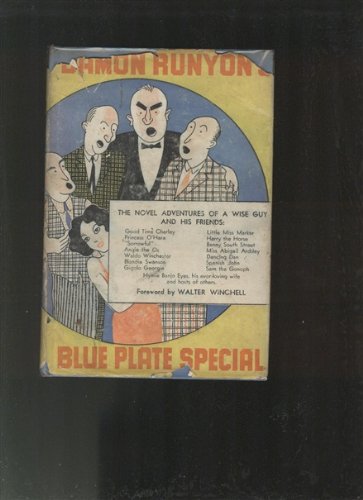
Damon Runyon's "What, No Butler?" (from COLLIER'S in 1933 and  the 1944 collection BLUE

PLATE SPECIAL), like most of theDETECTIVE STORY offerings a basically serious story dressed up with humor, this time from the master of present-tense slang. The best story is unsurprisingly Dashiell Hammett's "Two Sharp Knives" (COLLIER'S MAGAZINE, 1942), which more
than any of the other stories in either issue (the Gault and the
Runyon come the closest, but it's not that close) gives the sense of life as it is actually lived by adults. And tells a fine, understated story.

(And one wonders if Daisy Bacon and Dannay, both on his own ticket and because he seemed to frequently work with women editors, had for obvious reasons less truck with the misogyny several here have mentioned as impediments to reprinting MANHUNT and at least some BLACK MASK stories....)