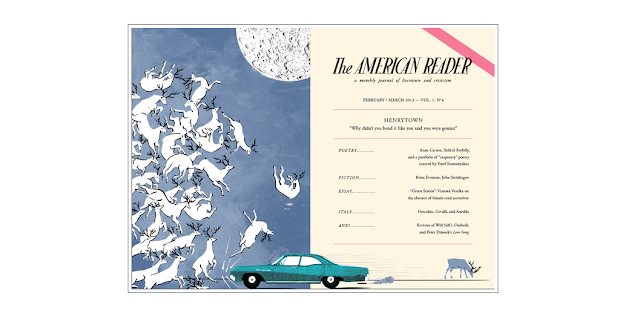
The American Reader was an ambitious project, perhaps even the equivalent of post-grad work for its principals, very much including the founding editor-in-chief and chief public face of the magazine, the (at founding) 25-year-old Ms. Uzoamaka "Max" Maduka, a Nigerian-American who was interested in demonstrating that there was a market among her generation of readers for relatively sophisticated literary work, but not afraid of a sales pitch leaning into would-be glamor, perhaps a fair amount of the latter driven by fund-raising necessity but perhaps also due to the desire to be On the Scene in NYC-based publishing and overlapping communities...the kind of social whirl around magazines ranging from The Paris Review to National Review (only presumably without the CIA connections and/or funding both of those had early on), and seeking the kind of stability that, say, Harper's had achieved through its institutional heir publisher. The subtitle on the cover of the first year+'s issues was "A Monthly Journal of Literature and Criticism"--it managed two monthly issues in its slightly longer than two-year run; it went to "A Bimonthly Journal...", also a schedule they couldn't maintain. But, then, essentially no one has been able to jump into the market in the last half-century or so with a monthly literary magazine...even the hardiest examples have tended to start with quarterly or bimonthly publication, and presumably with more capital on hand in most cases (and this includes the theoretically "more commercial" fiction magazines in fantastic fiction and crime fiction, where the long-running titles are mostly bimonthly these years and often were introduced, even back in the 1940s as well as in the '70s, as quarterlies). And the issues I've seen were ad-free, except for a very few house ads (touting subscriptions and their website, which featured some extra content at times).
I picked up at least a couple/few issues of the magazine during its run. I never saw the first issue, the only one in saddle-stapled format--see photo of the stack below--and with a cover stock that was easily crumpled; the balance of issues were "perfect-bound" (with glued signatures) and with a heavier stock; the new cover format was patterned (notes Amy O'Leary in New York Times coverage linked at the bottom of the post) after a French political journal, Le Contrat Social, with illustrations soon added with the flavor of another 1950s inspiration, the work of art director George Salter at the Mercury Press magazines such as The American Mercury, Ellery Queen's Mystery Magazine, The Magazine of Fantasy and Science Fiction and their Mercury Mystery and other newsstand periodical book lines, packaged and sold similarly to their magazines.
The one issue I've recently turned up in my reorganization of my library is the May/June 2013 issue (still in the "monthly" subtitle era!), so I'll provide an index and links to the American Reader web archive of those contents as I find them (the site Really Could use a search function, at least).
Maduka, upon the folding of her magazine, had already joined the board of Lapham's Quarterly, and subscription fulfillment for her magazine was offered with issues of that magazine, which (as it happens) officially folded late last year.
What remains of the TAR website; TAR's pretty good Facebook "wall"...which has been abandoned, and thus has some porn spam in comments on late posts, but still has many interesting links--and is the closest thing to an index the site has.
Karen Joy Fowler interviewed by Carmen Maria Machado
 |
The first issue, October-November 2012
|


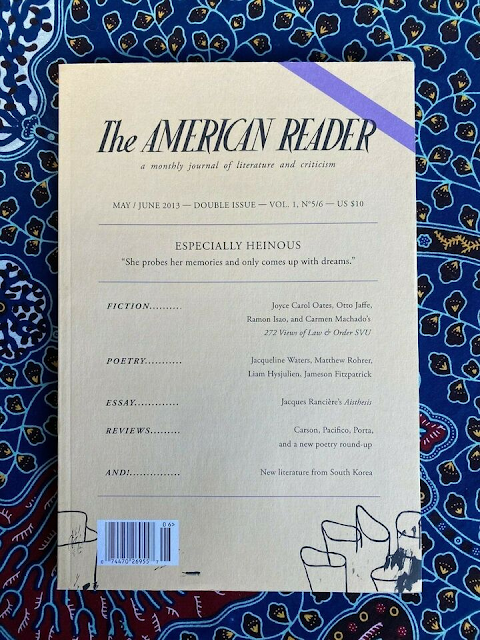
The American Reader, May-June 2013, V 1 No 5/6, edited by Uzoamaka Maduka. 172pp plus covers, $10. Irregular publication intervals, not quite bimonthly throughout its run.
3 * Anonymous/uncredited * Contributors * biographic blurbs
6 * Jacqueline Waters * Candor * poem
11 * Matthew Rohrer * The Photographs of Allen Ginsberg at the Grey Gallery, NYC * pm
12 * Matthew Rohrer * Hide in the Clouds * pm
13 * Matthew Rohrer * Two Poems for Issa * pm
14 * Matthew Rohrer * Dark Inside, Bright Outside: A Magritte * pm
15 * Matthew Rohrer * Bullshark * pm
16 * Liam Hysjulien * Stone, Deep, Mountains * pm
17 * Liam Hysjulien * The South * pm
18 * Liam Hysjulien * Teachers * pm
19 * Jameson Fitzpatrick * Adolescence * pm
20 * Jameson Fitzpatrick * Apart * pm
22 * Otto Jaffe * The South of France * ss
27 * Joyce Carol Oates * Sex with Camel * ss
40 * Ramon Isao * Feats * ss
55 * Carmen Maria Machado * Especially Heinous: 272 Views of Law and Order: SVU * novelet
92 * Jonathon Kyle Sturgeon * Scenes of Emancipation: On Jacques Rancière 's Aisthesis * essay
96 * Jacques Rancière * The Cruel Radiance of What It Is: Hale County, 1936-New York, 1941 * excerpt, Aisthesis, translated by Zakir Paul, translation Verso, 2013
111 * South Korea * group/translations
112 * Jenny Wang Medina* Introduction * in
115 * Hwang Byeong-Seung * First * pm, translated by Chae-Pyong Song and Darcy L. Brandel
116 * Moon Tae-Jun * A Brief Nap * pm, translated by Chae-Pyong Song and Darcy L. Brandel
117 * Moon Tae-Jun * The Ibis * pm, translated by Chae-Pyong Song and Darcy L. Brandel
118 * Moon Tae-Jun * A Pair of Shoes in the Yard * pm, translated by Chae-Pyong Song and Darcy L. Brandel
119 * Park Min-Gyu * Castella * ss, translated by Sora Kim-Russell
129 * Kim Aeran * Flugdatenschreiber * ss, translated by Jamie Chang
145 * Book Reviews (illustrated with uncredited spot/clip art)
146 * Jonathon Kyle Sturgeon * Francesco Pacifico's The Story of My Purity (FS&G 2013) * br
151 * Drew Calvert *Anne Carson's Red Dog (Knopf 2013) * br
156 * Eli S. Evans * A. G. Porta's The No World Concerto (Dalkey Archive Press 2013) * br
160 * Reed Cooley * New Poetry Roundup: Ray Amorosi's Lazarus (Lost Horse Press 2013), Charles Bernstein's Recalculating (University of Chicago Press 2013), Nicholas Hundley's The Revolver in the Hive (Fordham University Press 2013)
168 * Uzoamaka Maduka * Editorial Epilogue: A Woman in Love, In Love, In Love * ed
back cover: painting by Andrew Kim (a detail from which is on the front cover)
Press Coverage, beginning and end:
"Literary magazine The American Reader to shutter" by Kelsey Sutton, Politico 9/23/15 3:53 PM ET
And I hope everyone has had a good Martin Luther King, Jr. Day, even given most of the weather in the U.S....


