Showing posts with label Joyce Carol Oates. Show all posts

Wednesday, March 26, 2025

SSW: "The Frenzy" by Joyce Carol Oates, THE NEW YORKER, 24 March 2025; "The Crack of Doom" by Bill Pronzini and Barry N. Malzberg, ALFRED HITCHCOCK'S MYSTERY MAGAZINE, October 2016: Short Story Wednesday

"The Frenzy" can be read online here.


"The Crack of Doom" was reprinted in Pronzini's collection Small Felonies 2, which can be had in print form from publishers Stark House for $7 a copy. (George Kelley reviewed the collection here.)


Two accounts of aging men, more sinning than sinned against, albeit one is more obliviously culpable than the other.

The recent Joyce Carol Oates story is the account of a late middle-aged man taking his still, if just barely, teen-aged mistress (he is careful to refer to her in his running interior monologue as very nearly 20yo) on a weekend getaway in Cape May, NJ. The somewhat older Malzberg/Pronzini  story is an account of a man perhaps a few years older, trying to make sense of his predicament as he awaits his orders to commit mayhem in NYC from an amorphous but deadly conspiracy that has him under their collective thumb. Malzberg's ultraviolet sense of humor, as frequently in their collaborations, is only augmented by Pronzini's contribution.

Both men mistake themselves for essentially benevolent, even if potential agent of chaos Elias is less certain of this than is philanderer Cassidy. 

Both have wives and children that they have grown somewhat estranged from, albeit their wives are still present in their lives and can be seen as trying to help both protagonists, however insufficiently from the point of view of both men. Oates's Cassidy first met his young mistress Brianna when she performed in the same high school Palestrina choral concert as Cassidy's daughter, who remains three years younger than his paramour. Brianna for her part is somewhat flighty and lost, floating through life haphazardly (as her affair might suggest), but still full of vigor that Cassidy draws on and enjoys controlling as best (or worst) he might.

Both stories are good examples of what their authors have been capable of. The collaboration cites the Rene Magritte painting that presumably served as partial inspiration; the Oates doesn't overplay the kind of smug self-justification its Cassidy wallows in, even as he feels a distant sense of shame for some, but by no means all, of his behavior. 

I'd been meaning to read the Oates for a week or so, since it was released on-line...I'd misplaced the book I was going to review along with the New Yorker story, but the long-buried AHMM issue had just been disinterred, so it makes an interesting counterpoint in paranoia of a different flavor...as I'd put the issue away almost a decade ago before I had a chance to read it.

For more of today's short stories (and another take on the Oates!), please see Patti Abbott's blog.


Wednesday, January 29, 2025

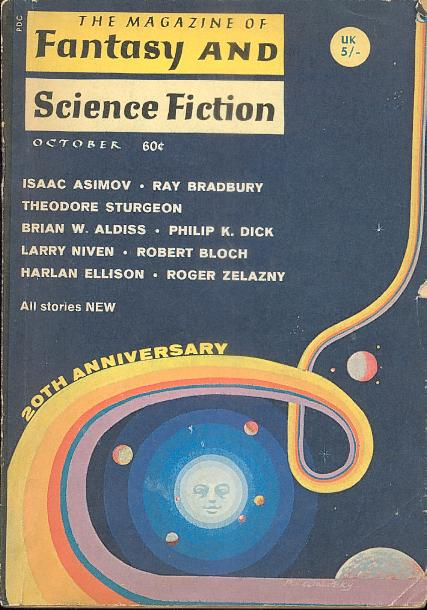
SSW: Robert Bloch: "The Movie People" THE MAGAZINE OF FANTASY AND SCIENCE FICTION, (F&SF), October 1969, edited by Edward Ferman; Jorge Luis Borges: "The Gospel According to Mark" in translation in THE NEW YORKER, 23 October 1971, edited by William Shawn; Marcelle Dubé: "Sky Lanterns" THE SATURDAY EVENING POST, November/December 2024, edited by Patrick Perry; Carl Jacobi: "Phantom Brass" RAILROAD STORIES, August 1934 (editor uncredited); Joyce Carol Oates: "The Maker of Parables" KENYON REVIEW, Spring 1990, edited by David H. Lynn; Wilma Shore: "A Bulletin from the Trustees of the Institute for Advanced Research at Marmouth, Massachusetts" F&SF, August 1964, edited by Avram Davidson: Short Story Wednesday

Bloch: can be read gratis from the paperback edition of his collection Cold Chills at this site.

Borges: can be read gratis at this teacher's aid site, from the US Bantam paperback edition of the Borges collection Dr. Brodie's Report (as translated by Norman Thomas di Giovanni in consultation with Borges); originally in the newspaper La Nación, 2 August 1970

Dubé; can be read gratis at The Saturday Evening Post site.

Jacobi: can be read gratis online in his collection Revelations in Black at this link.

Oates: can be read online at the Kenyon Review site (free account access).

Shore: can be read gratis from the online posting of Robert Silverberg's anthology Voyagers in Time


Robert Bloch's "The Movie People" (first published in the issue above and very widely reprinted) is one of his best-remembered late '60s stories, and with good reason...Bloch, who was a film fan from his childhood in the silent era, who grew up to be the man who wrote the novel Psycho among much else in prose (including a nonfiction account of "H. H. Holmes"/"Herman W. Mudgett" decades before The Devil in the White City), as well as becoming a notable screenwriter and, before that, a radio scripter, posits a sort of afterlife in film, in a charming manner that I think I remember being filmed, but I don't see noted here. 


One of the better later Borges stories, and better read this way than in the clumsy translations by Andrew Hurley that are foisted on us these years by Penguin Books, an ironic not-quite-uncanny tale of perhaps too much piety, "The Gospel According to St. Mark" is a well-turned kind of philosophical crime fiction. one of the kinds of work, along with straightforward if cosmic fantasies and mythic gaucho westerns, that Borges loved to write. 


Marcelle Dubé is one of only two living writers cited in this week's installment, with a story, "Sky Lanterns" in a recent issue of The Saturday Evening Post, not hardly weekly any longer, but too easy to forget as a source of magazine fiction (and income for writers). A deft tale of regret and lifelong debt, by a writer who usually publishes more straightforward fantasy and crime fiction


Carl Jacobi is best-remembered these years for his contributions to Weird Tales, the hugely influential horror and fantasy fiction magazine, but he was a veteran writer before he started publishing there, and inspiring younger writers, such as Bloch. This one, "Phantom Brass" is a bit of historical horror, set in the pre-radio days when railroads depended on telegraph operators for traffic control warnings. I hadn't reread Jacobi for decades, before George Kelley's recent piece on his most famous collection.

The other writer still with us is Joyce Carol Oates, whose highlighted contribution is a vignette verging on a parable, a fantasy that reminds me far too much of me, if I had achieved a bit more in these directions...I suspect it reminds Oates of herself in some senses as well: "The Maker of Parables"

While our last selection for this week is by Wilma Shore, of whom I've written before here, with her first story of two for F&SF, toward the end of an impressive and diverse career writing in a number of venues, not least the slick women's magazines of the '40s through the '60s, as well as leftist magazines and more than one volume of Best American Short Stories and the O. Henry Awards annuals...this was the first and for many years the last story by her I was to read, a charming and funny time travel tale of sorts. I read it when I was very young, in a battered copy of Robert Silverberg's anthology for young readers, Voyagers in Time--a copy my father might've picked up out of a shady bookdealer's collection of stripped paperbacks (their front covers sent back for store credit) in Boston, where he picked up a number of earliest '70s paperbacks for a dime each on his way home from the office...this one definitely caught my eye, and I've been able to thank Silverberg for this collection (though I'm not sure if I've ever mentioned to him that his fine time travel novel Hawksbill Station was the first adult sf novel I read by a living writer--as opposed to H. G. Wells, Mary Shelley or Edward Bellamy).


Wednesday, November 27, 2024

"Thanksgiving" by Joyce Carol Oates (OMNI, November 1993, fiction editor Ellen Datlow, editor Keith Ferrell): Short Story Wednesday

"Thanksgiving" by Joyce Carol Oates, as reprinted in her collection Haunted: Tales of the Grotesque (Dutton 1994) and newly offered in her Substack blog, "Joyce Carol Oates: A Writer's Journal" (the story can be read here).

A bit of dystopian near-future fiction for us all in this holiday, given the promise of the dystopian near future shaping up in the nation; a young woman and her father go foraging for what they can find in the remains of the local A&P (already an anachronism, as even the diminished SuperFresh chain version of the former A&P supermarket giant is now long gone...I might miss their not-bad sugarless cream soda, reasonably priced, the most), in a rural area not altogether unlike the one in New York where Oates grew up, only with everyone feeling more acutely the straitened circumstances of some sort of postwar It's Run Down chaos.

So, a fine way to celebrate the holiday, and a good story. As someone who's published about Oates, and coincidentally written this kind of story for Patricia Abbott and Steve Weddle's anthology Discount Noir, it's worth the look if you're feeling up for it for this particular season.

Please see Patti Abbott's blog for more of this week's short fiction.


Wednesday, January 17, 2024

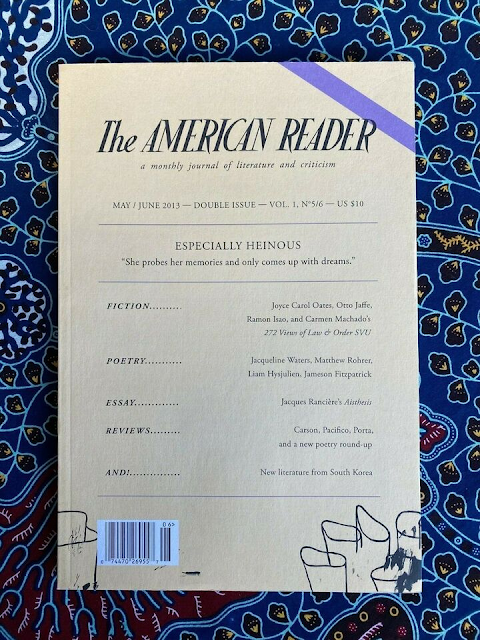
SSW: Joyce Carol Oates: "Sex with Camel"; Carmen Maria Machado: "Especially Heinous: 272 Views of LAW AND ORDER: SVU": THE AMERICAN READER, May/June 2013, edited by Uzoamaka Maduka: Short Story Wednesday


Two stories, a short story by J. C. Oates and a novelet (the magazine dubs it a novella, and it's close to being an either-way call) by Carmen Machado, the two biggest names (in terms of literary careers in the U.S.) a decade+ after this issue's appearance as they were (or in Machado's case, was becoming) at time of publication.

Joyce Carol Oates's story is a fairly straightforward account of what's running through the minds of a grandmother and her adolescent grandson, as she goes through some workups and examinations during cancer treatment and he comes along with her to the labyrinthine hospital; the title is a reference to one of the jokes the teen tells her as she drives them to the appointments, after she asks him to tell her something amusing. It gives impressions of how things work in U. S. medicine these years (a decade ago, much as now), and is otherwise impressionistic,  recounting the grandson's peregrinations around the hospital, including into the adjoining eating disorders suite, while his gran goes through her examinations...a conversation he has, for example, with an apparently to him beautiful teen girl a few years older than he, even given her starvation, who's disinhibited and slightly abrasive in her conversational style by one of the meds she's been given. The views and concerns the boy and the woman have of and for each other are explored.  It's a bit "looser" than many Oates stories, but has the earmarks of her work, and is a solid example thus.

Carmen Maria Machado's story is a metafiction which uses as its skeleton the episode titles of each of the episodes of Law and Order: SVU broadcast up to the time of the story's composition (if she was writing it today, it might have to be at least a short novel, if following its current format), and using the relationship and basic situations between the primary characters Benson and Stabler (in the early seasons of the series) as a springboard for ruminations on how they might find themselves growing increasingly divorced from even their portrayed reality, their lives and jobs, as they navigate the sequence of sex-related and child-abuse-related crimes they are tasked with investigating, detailed by vignettes inspired more by the titles of the episodes of the series than by their plots. It's a clever and often funny approach, even given the seriousness at its heart, which the subject matter of both story and series requires, even as the series can and does manage to traduce that requirement at times via a certain mechanical quality in its scripting...one of the aspects the story gets at, as it also introduces elements such as doppelgangers of the principals, named Hensen and Abler, who seem to be more efficient usurpers of the protagonists' lives and careers. It makes its points, beyond the obvious stunt value of its premise.

For more of today's stories, please see Patti Abbott's blog.

Monday, January 15, 2024

THE AMERICAN READER: 2012-2015 (10 issues) and some web content: edited by Uzoamaka Maduka; Monday Fiction Magazine #1

The American Reader was an ambitious project, perhaps even the equivalent of post-grad work for its principals, very much including the founding editor-in-chief and chief public face of the magazine, the (at founding) 25-year-old Ms. Uzoamaka "Max" Maduka, a Nigerian-American who was interested in demonstrating that there was a market among her generation of readers for relatively sophisticated literary work, but not afraid of a sales pitch leaning into would-be glamor, perhaps a fair amount of the latter driven by fund-raising necessity but perhaps also due to the desire to be On the Scene in NYC-based publishing and overlapping communities...the kind of social whirl around magazines ranging from The Paris Review to National Review (only presumably without the CIA connections and/or funding both of those had early on), and seeking the kind of stability that, say, Harper's had achieved through its institutional heir publisher. The subtitle on the cover of the first year+'s issues was "A Monthly Journal of Literature and Criticism"--it managed two monthly issues in its slightly longer than two-year run; it went to "A Bimonthly Journal...", also a schedule they couldn't maintain. But, then, essentially no one has been able to jump into the market in the last half-century or so with a monthly literary magazine...even the hardiest examples have tended to start with quarterly or bimonthly publication, and presumably with more capital on hand in most cases (and this includes the theoretically "more commercial" fiction magazines in fantastic fiction and crime fiction, where the long-running titles are mostly bimonthly these years and often were introduced, even back in the 1940s as well as in the '70s, as quarterlies). And the issues I've seen were ad-free, except for a very few house ads (touting subscriptions and their website, which featured some extra content at times).

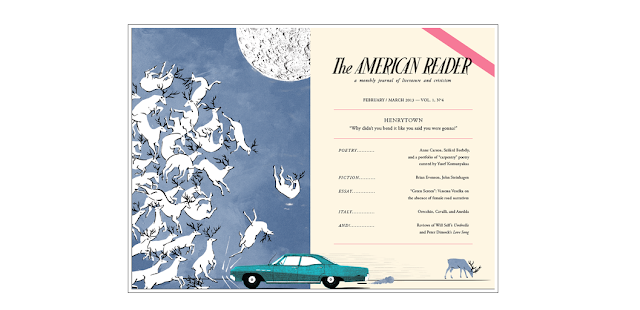
I picked up at least a couple/few issues of the magazine during its run. I never saw the first issue, the only one in saddle-stapled format--see photo of the stack below--and with a cover stock that was easily crumpled; the balance of issues were "perfect-bound" (with glued signatures) and with a heavier stock; the new cover format was patterned (notes Amy O'Leary in New York Times coverage linked at the bottom of the post) after a French political journal, Le Contrat Social, with illustrations soon added with the flavor of another 1950s inspiration, the work of art director George Salter at the Mercury Press magazines such as The American Mercury, Ellery Queen's Mystery Magazine, The Magazine of Fantasy and Science Fiction and their Mercury Mystery and other newsstand periodical book lines, packaged and sold similarly to their magazines. 

The one issue I've recently turned up in my reorganization of my library is the May/June 2013 issue (still in the "monthly" subtitle era!), so I'll provide an index and links to the American Reader web archive of those contents as I find them (the site Really Could use a search function, at least).

Maduka, upon the folding of her magazine, had already joined the board of Lapham's Quarterly, and subscription fulfillment for her magazine was offered with issues of that magazine, which (as it happens) officially folded late last year.

What remains of the TAR website;  TAR's pretty good Facebook "wall"...which has been abandoned, and thus has some porn spam in comments on late posts, but still has many interesting links--and is the closest thing to an index the site has.

Karen Joy Fowler interviewed by Carmen Maria Machado

The first issue, October-November 2012


The American Reader, May-June 2013, V 1 No 5/6, edited by Uzoamaka Maduka. 172pp plus covers, $10. Irregular publication intervals, not quite bimonthly throughout its run.

3 * Anonymous/uncredited * Contributors * biographic blurbs
6 * Jacqueline Waters * Candor * poem
11 * Matthew Rohrer * The Photographs of Allen Ginsberg at the Grey Gallery, NYC * pm
12 * Matthew Rohrer * Hide in the Clouds * pm
13 * Matthew Rohrer * Two Poems for Issa * pm
14 * Matthew Rohrer * Dark Inside, Bright Outside: A Magritte * pm
15 * Matthew Rohrer * Bullshark * pm
16 * Liam Hysjulien * Stone, Deep, Mountains * pm
17 * Liam Hysjulien * The South * pm
18 * Liam Hysjulien * Teachers * pm
19 * Jameson Fitzpatrick * Adolescence * pm
20 * Jameson Fitzpatrick * Apart * pm
22 * Otto Jaffe * The South of France * ss
27 * Joyce Carol Oates * Sex with Camel * ss
40 * Ramon Isao * Feats * ss
55 * Carmen Maria Machado * Especially Heinous: 272 Views of Law and Order: SVU * novelet
92 * Jonathon Kyle Sturgeon * Scenes of Emancipation: On Jacques Rancière 's Aisthesis * essay
96 * Jacques Rancière * The Cruel Radiance of What It Is: Hale County, 1936-New York, 1941 * excerpt, Aisthesis, translated by Zakir Paul, translation Verso, 2013
111 * South Korea * group/translations
112 * Jenny Wang Medina* Introduction * in
115 * Hwang Byeong-Seung * First * pm, translated by Chae-Pyong Song and  Darcy L. Brandel
116 * Moon Tae-Jun * A Brief Nap * pm, translated by Chae-Pyong Song and  Darcy L. Brandel
117 * Moon Tae-Jun * The Ibis * pm, translated by Chae-Pyong Song and  Darcy L. Brandel
118 * Moon Tae-Jun * A Pair of Shoes in the Yard * pm, translated by Chae-Pyong Song and  Darcy L. Brandel
119 *  Park Min-Gyu * Castella * ss, translated by Sora Kim-Russell
129 * Kim Aeran * Flugdatenschreiber * ss, translated by Jamie Chang
145 * Book Reviews (illustrated with uncredited spot/clip art)
146 * Jonathon Kyle Sturgeon * Francesco Pacifico's The Story of My Purity (FS&G 2013) * br
151 * Drew Calvert *Anne Carson's Red Dog (Knopf 2013) * br
156 * Eli S. Evans * A. G. Porta's The No World Concerto (Dalkey Archive Press 2013) * br
160 * Reed Cooley * New Poetry Roundup: Ray Amorosi's Lazarus (Lost Horse Press 2013), Charles Bernstein's Recalculating (University of Chicago Press 2013), Nicholas Hundley's The Revolver in the Hive (Fordham University Press 2013)
168 * Uzoamaka Maduka * Editorial Epilogue: A Woman in Love, In Love, In Love * ed
back cover: painting by Andrew Kim (a detail from which is on the front cover)


Press Coverage, beginning and end: 


"Literary magazine The American Reader to shutter" by Kelsey Sutton, Politico 9/23/15 3:53 PM ET

And I hope everyone has had a good Martin Luther King, Jr. Day, even given most of the weather in the U.S....

Wednesday, January 10, 2024

SSW: MIDNIGHT GRAFFITI edited by Jessica Horsting and James Van Hise (Warner Books 1992); THE WAYS WE LIVE NOW: CONTEMPORARY SHORT FICTION FROM THE ONTARIO REVIEW edited by Raymond J. Smith (Ontario Review Press 1986): Short Story Wednesday


Executive summary:

Anthologies from two of the more notable little magazines of their era; OR having lasted a third of a century, and this, the only anthology from it so far, drawing on its first dozen years, the magazine ending with the death of its editor and co-publisher Raymond Smith, as cofounder and widow Joyce Carol Oates chose not to continue it. MG having been more of a mayfly in the horror small press, but having gathered an impressive roster of contributors, with the editors and publisher continuing their writing careers afterward, if perhaps not robustly (not sure if their romantic/domestic partnership continues, another parallel); the book apparently includes reprints from the magazine and fiction perhaps 
still in inventory after the last issue of the initial run was published in 1992, or solicited for the book--with one story already a reprint when published in the magazine, and another possibly resold to Pulphouse after MG's long delays in publishing (two more issues, one a 1994 "special" and the 1997 other one apparently mostly nonfiction, sporadically followed the book's publication); for i
ts partthe OR book includes a Margaret Drabble story (and not a hundred-word vignette) published two years before in the UK edition of Cosmopolitan, but not previously in North America. Both books rather neglected, even at time of release, with only two editions each...hardcover and apparently trade paperback editions of the Smith volume released by OR Press, and a mass market paperback original release from Warner Books and a Doubleday Book Clubs edition in hardcover for the MG volume. In their introductions, Raymond J. Smith and Jessica Horsting go out of their way to note how very much concerned with the world of today the fiction in their magazines has tended to be, perhaps even more so than that of most comparable magazines in the eclectic literary magazine and the horror and suspense fields (both magazines with dollops of satirical and other sorts of fantasy included), with these selections perhaps highlighting that tendency, which might even be why they seemed a good pair for an essay about just that (Raymond Smith even revising Trollope's novel's title to fit his anthology's tendencies); it's not as if, say, Conjunctions nor Whispers was oblivious to such concerns, but perhaps not quite as intent on being attuned to them. Also notable is the degree to which talented writers, from those who never need worry where their next meal was coming from to rather new and usually promising professionals, would place work with the magazines which presumably paid modestly if at a reasonable going rate. Smith is relatively restrained in presentation, running the stories alphabetically by author, and offering only brief contributor notes in the last pages, including the datum that Oates "helps edit" OR; Horsting is more intent on curation, breaking stories into themed batches, each with a brief introduction by her; each story also has an uncredited headnote, where perhaps an invisible hand of Van Hise is felt. Also notable is how starkly textual how both books feel, compared to the imagery, illustration, photography or otherwise, their magazines featured in each issue.

Both magazines leaned toward shorter fiction, rather than novellas or serialized or even excerpted novels; when one removes the dust jackets from both the hardcover volumes, one finds that the OR volume is red with black lettering on the spine, the MG black with red lettering, making for a sort of visual harkening to Stendhal jointly and severally. Unsurprisingly, Ways is a better-built volume, sewn in cloth-covered boards on better paper but with slightly less easy-to-read typesetting;  the book club edition of the other has a then-typical D-day glue binding on less sturdy boards containing slightly cheaper paper, but also depends on the more thoroughly professional typeface choices in play at Warner Books, and with fewer words per page, probably has about as much content as the thinner volume.

Neither book was too thoroughly reviewed, as far as I can tell, at time of release...the OR volume seems not to have been reviewed in such a way that I've found indexes for those reviews at all, while MG received a number of mostly unimpressive Goodreads responses and not too much more, though Will Errickson's womanfriend Ashley Louise did guest-review it for his blog in 2010.


Midnight Graffiti

edited by Raymond J. Smith (Ontario Review Press, 1986; 0-86538-054-6, x+301pp, hc; 978-0865380554 tp)
        Details supplied by Dennis Lien, augmented by TM.
    • ix · Preface · Raymond J. Smith
    • 1 · Molly’s Dog · Alice Adams · ss The Ontario Review 21, Fall 1984/Winter 1985
    • 12 · The Man from Mars · Margaret Atwood · ss The Ontario Review 6, Spring/Summer 1977
    • 29 · Saving the Boat People · Joe David Bellamy · ss The Ontario Review 21, Fall 1984/Winter 1985
    • 45 · Town Smokes · Pinckney Benedict · ss The Ontario Review 25, Fall 1986/Winter 1987
    • 58 · My Life as a West African Gray Parrot · Leigh Buchanan Bienen · ss The Ontario Review 15, Fall 1981/Winter 1982
    • 69 · At the Krungthep Plaza · Paul Bowles · ss The Ontario Review 13, Fall 1980/Winter 1981
    • 74 · The Black Queen · Barry Callaghan · ss The Ontario Review 13, Fall 1980/Winter 1981
    • 77 · Homework · Margaret Drabble · ss Cosmopolitan (UK) November 1975; The Ontario Review 7, Fall 1977/Winter 1978
    • 84 · Death’s Midwives · Margareta Ekström · ss; translated by Linda Schenck, The Ontario Review 20, Spring/Summer 1984
    • 93 · Fruit of the Month · Abby Frucht · ss The Ontario Review 20, Spring/Summer 1984
    • 102 · A Pure Soul · Carlos Fuentes · ss; translated by Margaret S. Peden, The Ontario Review 12, Spring/Summer 1980 
    • 116 · The Harvest · Tess Gallagher · ss The Ontario Review 19, Fall 1983/Winter 1984
    • 129 · Some Gifts · Reginald Gibbons · ss The Ontario Review 5, Fall 1976
    • 137 · Black Cotton · William Goyen · ss The Ontario Review 17, Fall 1982/Winter 1983
    • 144 · Any Sport · William Heyen · ss The Ontario Review 24, Spring/Summer 1986
    • 152 · The Mango Community · Josephine Jacobsen · ss The Ontario Review 20, Spring/Summer 1984
    • 168 · A Metamorphosis · Greg Johnson · ss The Ontario Review 8, Spring/Summer 1978
    • 178 · On This Short Day of Frost and Sun · Maxine Kumin · ss The Ontario Review 5, 1976
    • 185 · Baby · Joyce Carol Oates · ss The Ontario Review 23, Fall 1986/Winter 1987
    • 199 · Confessions of a Bad Girl · Bette Pesetsky · ss The Ontario Review 23, Spring/Summer 1985
    • 209 · Tea Party · Sarah Rossiter · ss The Ontario Review 15, Fall 1981/Winter 1982
    • 221 · Shadow Bands · Jeanne Schinto · ss The Ontario Review 23, Fall 1985/Winter 1986
    • 235 · Rough Strife · Lynne Sharon Schwartz · ss The Ontario Review 7, Fall 1977/Winter 1978
    • 252 · The Girl Who Loved Horses · Elizabeth Spencer · ss The Ontario Review 10, Spring/Summer 1979
    • 267 · The Interpretation of Dreams by Sigmund Freud: A Story · Daniel Stern · ss The Ontario Review 24, Spring/Summer 1986
    • 273 · Mourning · Robert Taylor, Jr. · ss The Ontario Review 14, Spring/Summer 1981
    • 281 · Interviews with Insufficiently Famous Americans · John Updike · vi series 
    •     281 · The Counselor · vi The Ontario Review 12,  Spring/ Summer 1980
    •     283 · The Widow · vi The Ontario Review 16, Spring/Summer 1982
    •     285 · The Undertaker · vi The Ontario Review 15, Fall 1981/ Winter 1982
    • 287 · A Lesson in the Classics · Gloria Whelan · ss The Ontario Review 18, Spring/Summer 1983
    • 299 · Contributors · Anon · bi

  • The stories: as too often, life has been less cooperative than I'd like in rereading the stories in either volume over the last week, but among those I refreshed my memory of, it's amusing to compare the fantasy stories "My Life as a West African Gray Parrot" by Leigh Buchanan Bienen and "Bob the Dinosaur Goes to Disneyland" by Joe Lansdale (the book never gives him his middle initial); the Buchanan Bienen, by a writer who had been and remains primarily a lawyer (particularly involved with women's rights cases, which informs the story), professor and author of legal volumes, as well as contributor of short fiction and critical essays to little magazines, involves said parrot, being as many non-human animals in the story a karmic? reincarnation of a human, recounting her less that joyous life with a human married couple who looked upon their purchased bird as  more conversation piece and investment than pet; all the reincarnated animals in the story, such as her keepers' tomcat, can converse with each other (somehow), but apparently another non-human animal she interacts with has not been blessed with reincarnation from human form nor a common language. While the Lansdale involves a present of a wife to a husband of an inflatable T. rex toy, which upon inflation begins to act like a young child, not altogether like Pinocchio, but unsurprising in this to its new "parents"...the plastic dinosaur quickly becomes obsessed with the prospect of going to the original Disney theme park and meeting the cartoon characters and the like, an excursion Bob's parents enable with perhaps surprising results. Animal/toy fantasy, a bird with an old soul awaiting its next incarnation and an artificial youngster recapitulating human childhood and adolescence. The Lansdale is funnier, if slighter, and has been reprinted more often; the Buchanan Bienen was included in the O. Henry Prize Stories volume for 1983, and both are a bit eccentric even for their first publication sites. 

Both books have a triptych of short fictions, the OR example by John Updike (arguably the "biggest name" in the Smith volume--though Oates, Margaret Atwood and Carlos Fuentes are among the many potential challengers there, particularly in 2024) and the MG being three of four stories by R. V. Branham, not quite a "discovery" of the horror/dark fantasy magazine (he'd gone through the Writers of the Future program and had sold several stories to Gardner Dozois's editorship of Asimov's Science Fiction), but the only fiction contributor to have two distinct entries in the Horsting/Van Hise volume. Not even Neil Gaiman, much less at time of the anthology's publication Lansdale, was as close as they are now to being nearly as prominent as Stephen King among the MG volume's contributors, which does have a rather lopsided representation of male to female contributors, vs. that of the OR.

  • Jessica Horsting


James Van Hise


Raymond Smith and Joyce Carol Oates


To read some individual issues and contents of those issues, please see
and

For more of today's Short Story reviews, please see Patti Abbott's blog.


Wednesday, December 20, 2023

SSW: stories by Joyce Carol Oates, A. M. Homes, Richard Matheson, John Varley, Ambrose Bierce, Al Franken (among others) from THIS IS MY BEST edited by Kathy Kiernan and Retha Powers (QPB 2004) and FLIGHT OR FRIGHT edited by Stephen King and Bev Vincent (Cemetery Dance 2018)

A pair of anthologies from the "turned up in my resettling the flooding/roof collapse survivors" setthe vast majority of my library, and as one bedroom used mostly for storage becomes Alice's office.  I suspecthe Stephen King and his associate, (Mr.) Bev Vincent might've here produced the least widely-sold volume credited to King, among those not produced exclusively by a small press (even as there was a Cemetery Dance edition of this anthology which apparently preceded its corporate publishers' versions) nor suppressed by author's inclination (the "Richard Bachman" novel Rage)...even with original short fiction included from King and his son, "Joe Hill".  While the Kiernan and Powers bug-crusher, also offered by Chronicle Books in an eventual "illustrated edition" I've not seen (inasmuch as the Quality Paperback Club original includes comics and near-comics work by Gary Trudeau, Mark Alan Stamaty and Scott Adams [a man whose work would be less likely to be included in the years since 2004, and who has not yet stopped digging his own hole], it, too, is Illustrated to at leasthat extent. I wonder if the Chronicle edition includes the original Esquire magazine illustrations for this Nth reprint of Gay Talese's "Frank Sinatra Has a Cold" [which famously involves writer Harlan Ellison being harassed by Sinatra and his flunkies, and notruckling to the latter's bored distaste]). As in previous We Ask Writers For Their Favorite Among Their Own Work volumes (such as two I've offered here previously)This Is My Best is aware of its predecessors in such compilations, and specifically harkens back to Whit Burnett's 1942 original by thatitle (though they seem unaware of Burnett's 1970 sequel volume).

The Oates story was offered by her as a relatively pure example of the kind of tale she's accused, not quite correctly, of  repeatedly writing, those that detail horrible crimes against young women. As she notes, despite the unflinching detail she brings to her accounts of such abuse, she is in nearly all those stories more interested in the aftermath in the lives of the survivors, whether the protagonists or their families and other loved ones. But in the case of  "The Girl with the Blackened Eye", Oates grants thathis story keeps its focus almost entirely on the events of the protagonist's ordeal, which involves the ordeals of others...intense thus even by Oates's standards. But I'd still put forth the default, early choice of her short fiction, "Where Are You Going, Where Have You Been?" as an even more intense example of her continuing concern ("Girl" apparently takes as its springboard an actual abduction which a relative of Oates survived; that Oates herself survived a childhood attempt at gang-assault by similarly young boys would tend to help make consideration of such matters of in one's fiction at least likely).

The A. M. Homes story, "The Former First Lady and the Football Hero", is an account of Nancy and Ronald Reagan (Sr.)'s lives as he slips ever more deeply into senile dementia, and she does what she can to cope with his crisis and with her own in trying her besto keep it from the public. Homes notes in her introduction that in being so intrusive as to write such a story about people actually suffering thus that she had to make it more than a mere lampoon of their travail...and she does so, resulting in a black comedy of sorts that reasonably speculates and demonstrates how such things go (though the notion thathe addled former president would manage to get past his detail of Secret Service agents seems less likely than it is portrayed). Small details are filled in with empathy, otherwise...as someone who saw both parents succumb to varying sorts of dementia in their last years, it reads as a moving account.

Along with the Adams strip (makes its point, and its point is a bit more genuinely populist than his latter-day tRumpeting) and the Trudeau strips and the excerpt from Stamaty's heavily illustrated beginning-reader book, among the humorous bits which rely on trans-text is the fake NYT book review attributed to Jeanne Kirkpatrick (and the "outraged" "responses" from Al Franken, Jeanne Kirkpatrick and the paper's editors), all taken from Franken's most famous text, Rush Limbaugh is a Big Fat Idiot and Other Observations. I'd say Franken's done better (and, in at least one other famous attempt at pranking, worse), but for what they are, they're fine.

Among the stories I've not previously read in Flight or Fright, the most famous is almost certainly Richard Matheson's "Nightmare at 20,000 Feet"...I have seen the two Twilight Zone-branded adaptations decades back, and the story is better, but at first (and a bit repetitiously) it seems as if it might not be, while Matheson sketches in the details of his protagonist's lack of joy in his life; the ending was changed for both adaptations, making them slightly less realistic (it's quite possible to read the short story as non-fantasy as it's usually understood) and thus more rewarding to a less-experienced audience. Nonetheless, not nearly Matheson's best work, I'd suggest, and perhaps unsurprising it first appeared in an anthology edited by Matheson's agent rather than in any of the magazines he might've contributed to at the time.

While I did read John Varley's "Air Raid" not too long after it was published (in the first issue of what's now called Asimov's Science Fiction, in 1977), in 1978 when I was trying to read all the Varley fiction I could find. I liked it but didn't love it, which has put me at odds with a number of fellow admirers of Varley's work...I preferred Varley's other story in that first Asimov's issue, for example. It was expanded to novel length after a grueling process of adapting it for filming over more than a decade, the film and the novel both titled Millennium, and neither did as much for Varley as the amount of time and effort they wasted. "Air Raid" has excellent detail and scene-setting, and quite aside from being more consistently grim than the majority of Varley's early work (not too sure that put me off, as I was certainly reading a fair amount of Pohl, Kornbluth, Malzberg, Kafka, et al. at the time, and still very much a reader of horror fiction), it also deals in a future for humanity that is capable of time and long-distance space travel but cannot handle genetic drift in various forms at all...which struck me as unlikely at the time, though Varley manages deftly enough to avoid dealing with that, and much of the story is ingenious. So, definitely read "Air Raid" before any of his early novels, but perhaps after the other stories in his first three collections, at least. (Revisiting "The Persistence of Vision" as an adult left me with a larger sense of discomfort than I felt when reading it as a 13yo, as it was first published, but even that one might remain a better story in every way.)

Ambrose Bierce's "The Flying-Machine" (first collected in his Fantastic Fables, 1899) remains as very good and pointed a joke-anecdote today as it was in 1891.


This Is My Best: Acclaimed QPB Authors Share Their Favorite Work 
QPB edition published 2004 and can be read athe link; a Chronicle Books trade edition (with slightly amended subtitle) followed for non-QPB members in 2005edited by Kathy Kiernan and Retha Powersthe contributors provide headnotes to their entries.

ix * Introduction  * Retha Powers and Kathy Kiernan * in
1 * Dilbert, October 8, 2001 *  Scott Adams * cs Andrews McMeel Syndication
3 * "Jimmy Hoffa's Odyssey" * Ai * pm Agni #28, 1989
7 * From Before We Were Freethe chapter "Freedom Cry" * Julia Alvarez * novel excerpt, Knopf 2002
21 * "Confessions of a Lonely Atheist" * Natalie Angier * es The New York Times Magazine 14 January 2001
34 * From Timbuktu *  Paul Auster * novel excerpt, Henry Holt 1999
42 * "Filthy with Things" * T. Coraghessan Boyle * The New Yorker 15 February 1993
From Sweet Summer / Bebe Moore Campbell
"What to Do" / Hayden Carruth
From Caramelo / Sandra Cisneros
"Mrs. Dutta Writes a Letter" / Chitra Banerjee Divakaruni
"A Short Story" / Emma Donoghue
"Her Island" / Rita Dove
From "Tiger-Frame Glasses" / Carolyn Ferrell
"Dumped!" / Helen Fisher
From Rush Limbaugh is a Big Fat Idiot / Al Franken
"Surprise" / Martin Gardner
"A Hidden Killer in Cajun Country" / Laurie Garret
From Migrations of the Heart / Marita Golden
The Former First Lady and the Football Hero, A. M.  Homes (ss)  Zoetrope: All-Story Fall 2002
From Fanatics and Fools / Arianna Huffington
From Taste for Death / P.D. James
"Who's Irish?" / Gish Jen
From Cherry / Mary Karr
From The Poisonwood Bible / Barbara Kingsolver
From China Men / Maxine Hong Kingston
"A Gaggle of Saints" / Neil LaBute
From Under My Skin / Doris Lessing
From The Fortress of Solitude / Jonathan Lethem
"My Father with Cigarette Twelve Years Before the Nazis Could Break His Heart" / Philip Levine
"The Mappist" / Barry Lopez
From "The Facts Behind the Helsinki Roccamatios" / Yann Martel
From Property / Valerie Martin
From Salesman in Beijing / Arthur Miller
"From Mao to America: a Writer's Remarkable Journey" / Anchee Min
From Farewell the Trumpets / Jan Morris
From The Wind Up Bird Chronicle / Haruki Murakami
"The Wedding at the Courthouse" / Kathleen Norris
From Intimate Apparel / Lynn Nottage
The Girl with the Blackened Eye * Joyce Carol Oates (ss) Witness v14 #2, 2000
"Impossible to Tell" / Robert Pinsky
From The Botany of Desire / Michael Pollan
"America: The Multi-National Society" / Ishmael Reed
"The Queen of Mold" / Ruth Reichl
From Anthropology: "normal," "pieces," "Madrid," "trick," "dust," "beauty," and "lesbian" / Dan Rhodes
From Fierce Invalids Home from Hot Climates / Tom Robbins
"Sand" / Richard Rodriguez
"Getting Away from It All" / Witold Rybczynski
"Repeat after Me" / David Sedaris
"Flakes of Fire, Handfuls of Light" / Huston Smith
From Who Needs Donuts? / Mark Alan Stamaty
"Frank Sinatra Has a Cold" / Gay Talese
Doonesbury: "The Golden Hour" / Garry Trudeau
From The Laws of Our Fathers / Scott Turow
From Dinner at the Homesick Restaurant / Anne Tyler
"Your Lover Just Called" / John Updike
"Son in the Afternoon" / John A. Williams