Showing posts with label Wilma Shore. Show all posts

Wednesday, January 29, 2025

SSW: Robert Bloch: "The Movie People" THE MAGAZINE OF FANTASY AND SCIENCE FICTION, (F&SF), October 1969, edited by Edward Ferman; Jorge Luis Borges: "The Gospel According to Mark" in translation in THE NEW YORKER, 23 October 1971, edited by William Shawn; Marcelle Dubé: "Sky Lanterns" THE SATURDAY EVENING POST, November/December 2024, edited by Patrick Perry; Carl Jacobi: "Phantom Brass" RAILROAD STORIES, August 1934 (editor uncredited); Joyce Carol Oates: "The Maker of Parables" KENYON REVIEW, Spring 1990, edited by David H. Lynn; Wilma Shore: "A Bulletin from the Trustees of the Institute for Advanced Research at Marmouth, Massachusetts" F&SF, August 1964, edited by Avram Davidson: Short Story Wednesday

Bloch: can be read gratis from the paperback edition of his collection Cold Chills at this site.

Borges: can be read gratis at this teacher's aid site, from the US Bantam paperback edition of the Borges collection Dr. Brodie's Report (as translated by Norman Thomas di Giovanni in consultation with Borges); originally in the newspaper La Nación, 2 August 1970

Dubé; can be read gratis at The Saturday Evening Post site.

Jacobi: can be read gratis online in his collection Revelations in Black at this link.

Oates: can be read online at the Kenyon Review site (free account access).

Shore: can be read gratis from the online posting of Robert Silverberg's anthology Voyagers in Time


Robert Bloch's "The Movie People" (first published in the issue above and very widely reprinted) is one of his best-remembered late '60s stories, and with good reason...Bloch, who was a film fan from his childhood in the silent era, who grew up to be the man who wrote the novel Psycho among much else in prose (including a nonfiction account of "H. H. Holmes"/"Herman W. Mudgett" decades before The Devil in the White City), as well as becoming a notable screenwriter and, before that, a radio scripter, posits a sort of afterlife in film, in a charming manner that I think I remember being filmed, but I don't see noted here. 


One of the better later Borges stories, and better read this way than in the clumsy translations by Andrew Hurley that are foisted on us these years by Penguin Books, an ironic not-quite-uncanny tale of perhaps too much piety, "The Gospel According to St. Mark" is a well-turned kind of philosophical crime fiction. one of the kinds of work, along with straightforward if cosmic fantasies and mythic gaucho westerns, that Borges loved to write. 


Marcelle Dubé is one of only two living writers cited in this week's installment, with a story, "Sky Lanterns" in a recent issue of The Saturday Evening Post, not hardly weekly any longer, but too easy to forget as a source of magazine fiction (and income for writers). A deft tale of regret and lifelong debt, by a writer who usually publishes more straightforward fantasy and crime fiction


Carl Jacobi is best-remembered these years for his contributions to Weird Tales, the hugely influential horror and fantasy fiction magazine, but he was a veteran writer before he started publishing there, and inspiring younger writers, such as Bloch. This one, "Phantom Brass" is a bit of historical horror, set in the pre-radio days when railroads depended on telegraph operators for traffic control warnings. I hadn't reread Jacobi for decades, before George Kelley's recent piece on his most famous collection.

The other writer still with us is Joyce Carol Oates, whose highlighted contribution is a vignette verging on a parable, a fantasy that reminds me far too much of me, if I had achieved a bit more in these directions...I suspect it reminds Oates of herself in some senses as well: "The Maker of Parables"

While our last selection for this week is by Wilma Shore, of whom I've written before here, with her first story of two for F&SF, toward the end of an impressive and diverse career writing in a number of venues, not least the slick women's magazines of the '40s through the '60s, as well as leftist magazines and more than one volume of Best American Short Stories and the O. Henry Awards annuals...this was the first and for many years the last story by her I was to read, a charming and funny time travel tale of sorts. I read it when I was very young, in a battered copy of Robert Silverberg's anthology for young readers, Voyagers in Time--a copy my father might've picked up out of a shady bookdealer's collection of stripped paperbacks (their front covers sent back for store credit) in Boston, where he picked up a number of earliest '70s paperbacks for a dime each on his way home from the office...this one definitely caught my eye, and I've been able to thank Silverberg for this collection (though I'm not sure if I've ever mentioned to him that his fine time travel novel Hawksbill Station was the first adult sf novel I read by a living writer--as opposed to H. G. Wells, Mary Shelley or Edward Bellamy).


Wednesday, May 3, 2023

Short Story Wednesday: Wilma Shore: WW2 stories in McCALL'S: "You Can't Tell Your Mother", "A Woman in Love", "Something of Her Own"

Wilma Shore as a writer has been of continuing interest to me, and the recent citations in the FictionMags Index which included links to the full texts of McCall's magazine, in the Internet Archive, made for a rather good couple of hours' reading. She didn't collect any of these three stories in her one book of fiction, Women Should Be Allowed, but they are nearly as good as those that are, particularly the last of them. I have to wonder if she sent her stories to the Ladies' Home Journal first, on her market list of women's magazines, and if the possible title change of her first story for McCall's (as it would make a bit more sense if titled "You Can't Tell My Mother") or some more conservative tilt in the magazine made it less-favored by Shore for her best work in this wise.

"You Can't Tell Your Mother" is the first and slightest of these three, dating from the May 1942 issue of McCall's, just far enough into US direct combat in the war for a bulletin elsewhere in the issue about how rayon stockings are Almost as good as nylon or silk, but special care must be taken with them. It's a mostly charming, if sad, story about a young girl (a bright 8yo), who confesses to one of her mother's coworkers her own terror of Uboats/submarines generally, as well as other war-driven fear, and how she doesn't dare share these with her mother, despite the protagonist encouraging her to do so, for fear of burdening her mother unduly...which gets the childless protagonist thinking about how very terribly complex as well as terrifying the current crises can only seem to all of us.  I suppose, if the title is Shore's, it was meant to suggest that the girl would advise us thus, but I suspect Shore might've found a more deft way of doing so. 

"A Woman in Love" (from the April 1943 issue) is a much longer and more complex story, focused on the relationship between a married couple of their early middle years, and how they are drawn into direct participation in the war effort, and the stresses this (and external stresses from coping with the demands of wartime activity more generally) places on their relations...told from the wife's point of view, the story is somewhat less thoroughly supportive of her somewhat cooling response to how her husband begins to disappoint her, for the first time in their marriage, in his less than self-sacrificing commitment...without damning her or him from Shore's perspective. But I think Shore wanted us to be a bit disappointed in her for the nature of her disappointment in him. 

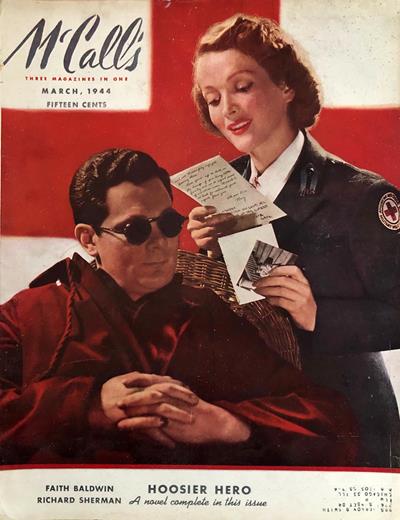
While the best of the three is her last in McCall's (ever, as far as the FictionMags Index, or FMI, is aware), from the March 1944 issue, "Something of Her Own", a rather fully-realized account of the somewhat confusing cautious slide into a romantic relationship between two somewhat unconventional young professionals, she working as a stenographer, he as a slightly dissatisfied but obligated junior corporate lawyer, and both always not quite sure of what they genuinely want from life, and never fully at ease with the choices they make or have thrust upon them. It rather expertly deals directly with the complex of emotions wartime separation inflicts on couples, along with the other matters of family, worklife and other pressures that most of us have faced to one degree or another in this country (and most if not all others, in somewhat differing ways) over the last century. 

These are sensitively-written stories, with relatively little if any Forced Uplift (much less Happily Ever After/For Now strictures that are placed on most romance fiction over the decades), and interesting to see in the context of even the sober times they were published in, in a magazine that wasn't (perhaps correctly, but not completely correctly) seen as fully advancing the cause of women as whole persons...but particularly in those days, when they were interested in Wilma Shore contributions, along with those from a relatively few people whose names might strike similar faint bells (such as Rachel Field or Faith Baldwin), doing what they and the magazine staffs (and it's notable how many of the executive editors were men in this decade, and for the next couple of decades at least) felt they could to provide various sorts of service to their readers. (Shore on the new sobriety of the women's magazines and other "slicks" as World War 2 ground on.) 

From the FMI:

For more of today's short stories, please see Patti Abbott's blog.

Friday, February 8, 2019

Friday's too-Forgotten Stories: Wilma Shore: further short fiction and more from STORY, THE NEW YORKER, and THE MAGAZINE OF FANTASY AND SCIENCE FICTION, et al.


On Wilma Shore on Sweet Freedom.

Wilma Shore: 

The following four short stories (and a very brief "casual") can be read online, but behind a paywall, at The New Yorker Online:

80 * The Curving Road (ss) The New Yorker, June 12, 1948

26 *  and The New Yorker, December 4, 1948: 
The Talk of the Town: "West Coast Intelligence: A nursery school has opened in Los Angeles, called the Tot-orium." * jk/cl


and...free of charge...

80 * Dress from Bergdorf’s (Shore's preferred title: "All Sales Final" --see the review of her collection Women Should Be Allowed here) (ss) Cosmopolitan Jun 1959, which can be read online here

May Your Days Be Merry and Bright, (ss) The Saturday Evening Post Dec 21/28 1963 (which can be read online here)

A Bulletin from the Trustees of the Institute for Advanced Research at Marmouth, Mass., (ss) The Magazine of Fantasy and Science Fiction Aug 1964 (which can be read online here)
The Podiatrist’s Tale, (ss) The Magazine of Fantasy and Science Fiction Apr 1977 (which can be read online here)
...and some nonfiction, from The Writer's Handbook, 1974 edition (online here) "The Hand is Quicker Than the I" (Shore on the uses of first-person narrative form, among an appropriately star-studded cast in the how-to essay anthology.)

Encouraging the reading of Wilma Shore's frequently brilliant fiction (among other writing) is an ongoing concern of this blog, and in the pursuit of that goal, I finally purchased a discounted six week subscription trial to The New Yorker (50% discount code, courtesy of Jackie Kashian's podcast The Dork Forest, is "DORK") so as to allow me online access to the four TNY stories grouped above, while also refreshing my memory of the two latter-day The Magazine of Fantasy and Science Fiction stories (I can only assume that Edward Ferman at F&SF was offered the viciously unnerving "Goodbye, Amanda Jean" but for whatever foolish reason didn't accept it, so that it appeared in Ejler Jakobsson's Galaxy instead). 

"The Butcher" (in Story magazine in 1940) was Shore's second published story, but the first one she liked, as did the editor of Best Stories annual (soon to become, and remain today, The Best American Short Stories series), which demonstrates the early and continuing concern Shore had with the constrictions of traditional roles on men and particularly women; her idealistic and very competent young office worker is as certain she's ready to be an ideal wife as she is an utterly competent and conscientious stenographer, for all practical purposes the only profession a woman can expect to have in New York City in 1940 aside from teaching school. But, somehow, even with an appreciative and reasonably sensitive husband...domestic work at home isn't quite what she hoped it might be. And she couldn't tell you why. As the daughter of an accomplished writer, who dropped out of a California high school to study painting in France and be praised as a budding genius in that field by Gertrude Stein's brother, and then putting aside painting to be the wife of a failing actor, and mother of their child while still very young...one can see where the story might have some autobiographical resonance. 

Eight years later, when the first of Shore's New Yorker stories is published, she has a firmer grip on her tools, can work in the disparities of class as well as the hemming in of sexual assignments in detailing a reunion between a young woman and her former family maid, once a friend as well as servant, now far enough removed from her former ward's life that the latter, also, can't quite put her finger on why their last encounter feels hollow in comparison to their easy interaction when the elder woman worked for the young woman's family...at least not at the time, but, as the former Miss looks back on it a few more years later, she understands better. 
"The Ostrich Farm" deals with family dynamics of a rather more heated sort, as a boundary-free mother and her overdependent daughter don't realize there's any other way to act in regard to each other and their respective husbands. This one, and the two later stories sold to Harold Ross's magazine, are notable compared to Shore's women's and little/radical magazine stories in the degree to which the men are far more in the foreground of the stories...for TNY is about Important Matters, the kind that feature Men, doncha know, in these early but still pretty influential issues of the magazine, where the at times apparently bumptious Ross could express utter confusion in most dealings with women (his successor in the chair would famously hide from everyone). 

But "The Moon Belongs to Everyone", while written from the viewpoint of a male protagonist, still manages to have a gentler if no less wrenching emotional underpinning, where it's less the assignment of roles by society that can be constricting so much as those driven by tragedy...as when a young family, with an infant and a boy on the cusp of adolescence, loses their wife and mother suddenly. And the sense of compromises acquiesced to in the face of tragedy and need, and difficulties in fully overcoming those challenges, taking their toll. 

And by "Lock, Stock and Barrel", the wry sense of humor Shore brings to her best work is in full flower, while no less deftly drawing the predicament of the man who can't quite understand how or why his marriage has failed, and how he tries to come to grips with that fact...or, perhaps more accurately, tries very hard not to. 

These are all good stories, if not quite up to those Shore would collect from her slightly later writing for Women Should Be Allowed, her only published collection...and presumably one delivered to her book publisher about the same time as she contributed to Avram Davidson's Fantasy & Science Fiction "A Bulletin from the Trustees...", her first overt sf story, or at very least her first story for the speculative fiction magazines, and discussed in the earlier posts. Following the savage satire of "Goodbye, Amanda Jean", "Is It the End of the World?" is only a bit less (obviously) apocalyptic, dealing as it does with environmental (mostly atmospheric) degradation so profound that it might well kill us all at any time during the events of the story, but that doesn't mean that the small power-struggles and mutual dependences of family life are any less distracting from that greater danger, and how people will tolerate and adapt to almost any threat in the face of the "need" to simply get to where they want to meet, for one small purpose or another, and on time.

And while "Amanda Jean" and "End" certainly could qualify this post for consideration as entries in the February is Women in Horror Fiction Month observations, "The Podiatrist's Tale", a grimly amusing ghost story, helps clinch the deal...this might not be the last short story Shore published, but I'm not yet aware of another after 1977, and it deals with how the vicissitudes of aging might not be relieved even after death...

Even as we lost another writer not too unlike Wilma Shore in her sensitivity, craft, insight and wit, and bubbling-under influence, Carol Emshwiller, this past Saturday at age 97, with her daughter Susan and son Peter/"Stoney" announcing the fact on Tuesday. Emshwiller, who also had a not to too dissimilar life from Shore's beyond their literary work in some ways, not least in terms of engagement with the community of the avant garde in several artforms, followed such other recently-lost peers as Ursula Le Guin, Kit Reed, Grania Davis and Kate Wilhelm...and inasmuch as I attempted to write up her brilliant first collection Joy in Our Cause a few years back while staying in a hotel in Barre, Vermont, with wonky computer access and there to attend the memorial service for one of the last of my aunts, my father's sister Shirley, it might be past time for a better try. For Emshwiller, too, is perhaps not fully appreciated enough for what she contributed, sometimes obliquely, to modern horror, as well...while writing primarily surreal or satirical or metafictional work, in the modes of contemporary/mimetic fiction, science fiction and fantasy, and even in two innovative western novels.

Please see Patti Abbott's blog for more of today's reviews.


Friday, November 30, 2018

FFB: WOMEN SHOULD BE ALLOWED by WIlma Shore (Dutton 1965), among her other writing


It took a while to find an image online for the cover of Women Should Be Allowed, the only collection of Wilma Shore's short fiction to be published during her life (or, ever)(on 28 November 2016, I finally found one, along with a picture apparently of Shore with her husband Louis Solomon...see the latter below. The jacket is a bit more cute than the fiction deserves, I'd suggest, and probably didn't help sales nor reception). My own second-(or third-)hand copy is missing its dust jacket, and there was no paperback edition, as far as I can tell. As the biography at the Jewish Women's Archive notes, she in 1929 as a 16yo left the US (having been born in NYC and spent high school years in California) and went to Paris to study painting, and "Leo Stein, Gertrude Stein’s brother, declared her a leading talent of her generation." However, as noted there, what she became, as a professional artist, was a writer.

'Shore’s second story "The Butcher" was included in The Best Short Stories of 1941 [with the next year's volume to take on the title-form it still has, Best American Short Stories], and she continued to receive their honor call [sic--honor roll] mention in subsequent years. Shore published widely in magazines, including The New YorkerCosmopolitanStory Magazine, The Saturday Evening Post, The Writer, Ladies’ Home Journal, The Antioch Review, McCall's and The Nation. In 1950 [sic: it was the 1958 O. Henry volume], her story “The Cow on the Roof” was included in the O. Henry Awards Prize Stories.'

Contents of the 1941 volume, courtesy WorldCat:
Shadow of a Girl / E.B. Ashton --
All Around the Town / Stephen Vincent Benet --
Handy / Erskine Caldwell --
Big Jules / Morley Callaghan --
The Net / Robert M. Coates --
Mamma Is a Lady / David Cornel DeJong --
To the Least ... / Henry Exall --
A Nun No More / John Fante --
Gold Is Not Always / William Faulkner --
'Color Trouble' / Harold Garfinkel --
The Magic Wire / Felicia Gizycka --
Smile for the Man, Dear / Justin Herman --
The Life of the Mind / Weldon Kees --
The White Bull / Mary King --
Some People Are Just Plumb Crazy / Arthur Kober -
Scorn and Comfort / Christopher La Farge --
The System Was Doomed / Meyer Levin --
Don't Get Me Wrong / Roderick Lull --
Sunday Morning on Twentieth Street / Albert Malz --
Ill-Winds From the Wide World / Peter Neagoe --
The Three Swimmers and the Educated Grocer / William Saroyan --
Triumph of Justice / Irwin Shaw --
The Butcher / Wilma Shore --
Goin' to Town / Wallace Stegner --
Love / Jesse Stuart --
The Psychologist / Benedict Thielen --
Houdini / Jerome Weidman --
Strip-Tease / George Weller --
Almos' a Man / Richard Wright.


Contents of the 1958 volume, courtesy WorldCat:

In sickness as in health / Martha Gellhorn --
What a thing, to keep a wolf in a cage! / Hortense Calisher --
The deeps of the sea / George Steiner --
My blithe, sad bird / Jean Stafford --
The stone boy / Gina Berriault --
The eclipse / Elizabeth Enright --
The making of a clerk / Leo Litwak --
A summer shower / Walter Clemons --
The long night / Lowell D. Blanton --
A slow boat to China / Nancy Hale --
A drink of water / T.K. Brown III --
A cow on the roof / Wilma Shore --
First voice / Robin White --
The ambassador / Edward Newhouse --
The passion for Silver's arm / Herbert Wilner --
My apples / Robert Granat --
Travelin' Man / Peter Matthiessen.

She and Solomon continued to write for electronic media, and he became a producer...in fact, as the JWA text continues, "Shore also wrote for television, was commissioned to write a song for Carol Channing, and had stories included in the anthology series The Best From Fantasy and Science Fiction in 1965 and 1973. She also published autobiographical pieces in the New York Times Sunday Magazine and the Women’s Studies Quarterly.

"A dedicated teacher, Shore taught at the League of American Writers' School from 1942 to 1944 and at the People’s Education Center until its dissolution. She then taught from her home.


"Shore’s involvement with these schools, her work on the editorial board of the California Quarterly, a politically progressive publication, and other left-wing political activity caused her and her husband to be blacklisted during the House Committee on Un-American Activities hearings." Like most of the blacklisted, Shore and Solomon turned to other work, and also continued to work under other names in the blacklist-sensitive industries...Solomon was eventually a producer on The Great American Dream Machine for PBS.


Skipping ahead: a paid note in the New York Times, published May 12, 2006:


SOLOMON--Wilma Shore, 92. Writer, painter, wit and friend; wife of the late Lou Solomon; mother of Hilary Bendich, Berkeley, CA. and Dinah Stevenson, Hoboken, N.J; grandmother of Nora, Jonathan and Bridget; great grandmother of five; great great-grandmother of one. We welcome donations in her name to feminist, humane, or environmental organizations or those actively opposed to the Bush administration. A Memorial Gathering will be planned.


And, dated with the month of my birth, that first contribution to F&SF, the brilliant and gently caustic, if such a thing is possible, "Bulletin from the Trustees...", a story I first read ca. 1972 in my father's battered copy of Robert Silverberg's anthology Voyagers in Time. Meanwhile, note below the contents of that issue of F&SF, which include Shore's story as the lead, Fritz Leiber's important "When the Change Winds Blow" as the cover story, and early stories by Joanna Russ (her own gently caustic parody of Lovecraft) and Dennis Etchison (just after the start of his impressive career) and Thomas Disch (likewise). And editor Avram Davidson, noting the passing of artist and writer Hannes Bok, and otherwise brilliantly curating the issue (along with being my favorite writer on many days, his F&SF remains my favorite period of the magazine's long, impressive history).


The Magazine of Fantasy and Science Fiction, August 1964:


4 • Editorial (F&SF, August 1964) • [Editorial (F&SF)] • essay by Avram Davidson
5 • A Bulletin from the Trustees of the Institute for Advanced Research at Marmouth, Mass. • short story by Wilma Shore
12 • "I Had Vacantly Crumpled It into My Pocket . . . But By God, Eliot, It Was a Photograph from Life!" • [Cthulhu Mythos] • short story by Joanna Russ
22 • Books (F&SF, August 1964) • [Books (F&SF)] • essay by Avram Davidson
27 • Poor Planet • novelette by J. T. McIntosh
54 • Nada • short story by Thomas M. Disch
71 • Hannes Bok (Obit) • essay by Avram Davidson
72 • The Red Cells • [The Science Springboard] • essay by Theodore L. Thomas
73 • Epitaph for the Future • poem by Ethan Ayer
74 • A Nice, Shady Place • (1963) • short story by Dennis Etchison (Originally published in Associated Students, L.A. State College)
87 • Redman • short story by Robert Lipsyte and Thomas Rogers [as by Robert M. Lipsyte and Thomas Rogers]
95 • The Days of Our Years • [Asimov's Essays: F&SF] • essay by Isaac Asimov
105 • When the Change-Winds Blow • short story by Fritz Leiber
113 • In the Calendar of Saints • short story by Leonard Tushnet

You can now read several short stories, the cited radio play (or listen to it), and a couple of articles (so far) at a new post here, and reprinted below in this redux compilation post.

The next year, E. P. Dutton published Women Should Be Allowed, which includes the following stories, each with a long introduction in which Shore archly, wittily highlights a point or three the following story might support, mostly feminist points in those months after The Female Mystique and the Civil Rights Act and the ferment around the liberation movements of the previous decade-plus had no doubt given Shore at least some new hope, thus:


"A Mammal in a Black Crepe Dress" (published as "The Point of No Return of Gloria MacAdoo" in Good Housekeeping in 1957)

"All Sales Final" (as "The Dress from Bergdorf’s" (ss) Cosmopolitan Jun 1959)
"By the Still Waters of Ethel Wilkie" (as "Do You Take This Man?" GH 1955)
"Go and Catch a Falling Star" (Good Housekeeping Aug 1949)
"The Psychopathology of Everyday Life" (apparently first published in this collection)
"Some Kind of Lousy Cinderella" (as "It Was Different with Cinderella" (ss) The Saturday Evening Post Aug 24 1963)
"Good-bye Charlie" (as "What's Happened to Charlie?" GH, 1957)
"Yours Very Truly, (Miss) Leona Freemantle" (Antioch Review, 1960)
"I Can Get Along Fine" (as "I'll Get Along Fine" GH 1946)
"A Reasonable Facsimile" (as "Marry Me a Million" (ss) Cosmopolitan Feb 1949)
"May Your Days Be Merry and Bright" (The Saturday Evening Post Dec 21 1963)
"The Whole World Takes Off Its Hat to Sheree Wallach" (Ladies Home Journal May 1961)

--as the book's subtitle might suggest, the collection stands in at least partial refutation of the likes of James Thurber (and what might be called default attitude at The New Yorker and around the popular culture), and these stories, with their feminist messages unblunted by their titles being fiddled with by the women's magazines they were published in (when not the Saturday Evening Post or a little magazine), often cheek by jowl with their era's equivalents of today's "service" articles "How to Suppress Everything About Yourself to Snare That Man!" and "Why You Should Give In, For the Sake of the Marriage" and "How to Subvert the Fool without Him Catching On..." as well as more openly or tacitly feminist items, feature in most cases not so very enlightened young women learning better...about their current conditions, about the loutish swains they have been putting up with (and the often just as loutish if more polished men they aspire to) and their own often corrosively unsupportive families; about what really matters as opposed to Why It's Important to Be Married by 25 (though her characters almost to a woman do bristle, however subconsciously in some cases, at the notion that they need to be Safely Ensconced in marriage before they have had much chance to figure out what they need for themselves, while their potential mates have at least a decade or so more to come to some similar conclusions). A few stories deviate from this pattern, such as "May Your Days Be Merry and Bright," from the perspective of an empathetic woman in a retirement hotel, comparable to the upscale condo communities of today, watching the interactions of her colleagues and their families, the little power-plays and jostling for prestige--or the most savagely critical piece here of its female protagonist, "The Psychopathology of Everyday Life," about a boundary-free monster of ego and how she blithely "improves" the lives of her husband, son, and everyone else around her. Even the canniest of young women protagonists here, that of "A Reasonable Facsimile," finds her utter pragmatism in the face of Women's Estate in midcentury NYC shaken, probably if unsettlingly for the better, by the end of her story.


Wilma Shore was a hell of a writer, and her work richly rewards your attention. I probably should add to this critique, but I've my own pragmatic quotidian matters to attend to...though another, comparable writer I've not written well or enough about previously, Carol Emshwiller, is treated a bit more elegantly by James Sallis here.


Meanwhile, going to the FM Index at the link below and clicking through to the magazine issue contents, often seeing the context in which these satiric feminist stories were published (and often how much other fiction was published, even rather recently but not recently enough, by the women's magazines particularly, with Shore sharing space thus with John D. MacDonald and Daphne Du Maurier and A. A. Milne and Hughes Rudd and Hugh B. Cave, is another reminder of Times Changing).


from the FictionMags Index

SHORE, WILMA (1913- ) (chron.)

* The Butcher, (ss) Story Nov/Dec 1940

* Dress from Bergdorf’s, (ss) Cosmopolitan Jun 1959
* Go and Catch a Falling Star, (ss) Good Housekeeping Aug 1949
* It Was Different with Cinderella, (ss) The Saturday Evening Post Aug 24 1963
* Lock Stock and Barrel, (ss) Short Story Magazine #78 1951
* Marry Me a Million, (ss) Cosmopolitan Feb 1949
* May Your Days Be Merry and Bright, (ss) The Saturday Evening Post Dec 21 1963
* The Moon Belongs to Everyone, (ss) Short Story Magazine #70 1950
* The Ostrich Farm, (ss) Short Story Magazine #71 1950
* Someday I Have to Buy a Hat, (ss) Good Housekeeping Nov 1942
* Something of Her Own, (ss) McCall’s Mar 1944
* The Whole World Takes Off Its Hat to Sheree Wallach, (ss) Ladies Home Journal May 1961

From ISFDb:

Legal Name: Solomon, Wilma Shore
Birthplace: New York City, New York, USA
Birthdate: 12 October 1913
Deathdate: May 2006
Webpage: http://jwa.org/encyclopedia/article/shore-wilma

Short fiction (in sf/fantasy magazines):

A Bulletin from the Trustees of the Institute for Advanced Research at Marmouth, Mass. (1964) (F&SF, 8/64)
Goodbye Amanda Jean (1970) (Galaxy, 7/70)
Is It the End of the World? (1972) (F&SF, 3/72)
The Podiatrist's Tale (1977) (F&SF, 4/77)

For more of today's books, please see Patti Abbott's blog.


Wilma Shore contributions to The New Yorker (unless you're a subscriber, they want to charge you extra).


Wilma Shore and Louis Solomon in foreground,  at a banquet, ca. 1950

Three blogposts in total over the last half-decade isn't Too much to devote to the late, brilliant Wilma Shore, whose career is briefly limned here [as combined above and below]...along with links to the un-"protected" online archives of the magazines that ran these items (and a couple of posts offering both the script and the recording of the playlet she wrote with her husband for Orson Welles's CBS radio series).  An amusing set of magazines, too...there are a few other writers, but no too many, who might tie together the folded but extremely influential sf magazine Galaxy (which published among so much else Damon Knight's "To Serve Man", the first form of Ray Bradbury's Fahrenheit 451, Frank Herbert's Dune Messiah and Ursula K. Le Guin's "The Day Before the Revolution"--Galaxy in its first decade particularly was the home of the kind of satire Kingsley Amis dubbed the "comic inferno"--eventual editor Frederik Pohl was Amis's choice as the best of 1950s sf writers), Good Housekeeping (now ever more a "service" magazine at well over a century of publishing), and the Communist-sponsored quasi-revival of the more broadly radical and also hugely influential magazine The Masses, retitled for the new decade The New Masses.  All of these stories are worth reading, the essays as well, and the playlet just a bit slight and humorously sentimental, but not extraordinarily so (and probably pitched just so to Welles or at least at his request). 
"Goodbye Amanda Jean" is a savage bit of satire, set in a version of 1970 U.S. that allows hunting humans for meat, but where killing just for sport is frowned upon, to say the least (and shooting a teenage girl pedestrian from a moving car, rather than from a stopped one or on one's own feet, is utterly illegal if possibly not prosecuted); Shore barely allows the reader time to gather much at all before Amanda Jean's father has failed to shield his daughter from a crosstown neighbor of sorts, and has, still stunned, accepted a side of the kill for dressing and refrigeration. The loss and injustice of it all still rankles him, and it might just be time to take retribution into his own hands...while staying more inarguably within the law. Bloodsport was in the air at the turn of the '70s, and Shore's story is unrelenting and as plausible as sending National Guard units onto various state university campuses and pointlessly dragging out a war in Vietnam while expanding it to neighboring countries. More startling to me is how much this story, which after appearance in Galaxy has only been reprinted in Robert Silverberg's anthology Alpha 2, and which I've read for the first time this week, prefigures the nature and the method of the satire I applied in one of my better stories, "Bonobos," published a decade back in Claude Lalumiere's webzine Lost Pages...my story, as human/bonobo behavioral crosses might suggest, is as drenched in sex as this one is in violence, and is by intention funnier than Shore's story, but Shore's is the better story, and the laughter here is meant to have what Avram Davidson once referred to as a big bubble of blood in it, in describing a similarly incisive satire. A number of people to whom I've recently mentioned the Shore story remember it well, from reading it decades back. 
The newer of the two stories from The New Masses, "The Story of Dorothy Anstable", is a much more muted affair, but has an early example of the kind of overbearing stage mother, living through her family, who will recur in some of Shore's other stories; Dorothy also is fortunate enough to have her story retold by her rather slow-witted elder brother, so by the end, we're (or at least I'm) not exactly sure of all the details of how thoroughly her mother's obsession with the daughter's reliable promptness and attendance record, and the minor but Official recognition of it and the petty fame that has accrued with that, has derailed her daughter's life, but we have some sense of it. The least of these stories, but it still has a bit of a chill to it. Speaking of a bit of a chill, the story is immediately followed by an example of historical blank verse, about George Custer and Crazy Horse and their encounter, by none other than the relatively young Joseph Payne Brennan...never much of a poet, and sometimes a rather clumsy constructor of prose but not by any means always, and clearly like his Arkham House editor and publisher August Derleth at least an occasional contributor to the politically radical press. Wilma Shore and Joseph Payne Brennan, both praised by Avram Davidson, though AD liked Shore's work better.

"Some Day I Have to Buy a Hat" is a much more probable item to have sold to Good Housekeeping, the account of an obstetric nurse doing a favor for a young patient of her boss's private practice, during World War II, in the face of the disruption the war was causing. A far more humane tale than the first two, albeit by necessity just as cognizant of the ugly realities of its times, if also noting that some tragedy can be ameliorated, to some extent, by the kindness of relative strangers. (Shore's essay "What Happened to the Slicks?" notes that this kind of story, not at all shying away from what was happening in a world at war, was now something found in women's magazines that might previously have preferred more purely escapist, if also feminism-tinged, fare. ) It's notable that her story is the first piece of fiction one finds in the GH issue, blurbed by them "A story on the hard-boiled side, but there's a fair chance you'll like it." Shore later stories would get cover credits at the magazine.


"Decision" is the oldest of these stories, and much more deftly and complexly deals with racism, classism, sexism and the exigencies of Getting By under unfeeling bureaucracy and general inequity than something like the fairly recent film The Help, not too tough for a good short story written by an observer as sharp as Wilma Shore was when this was published in 1941, when the clumsy US bureaucracies were still coping as they did with the leftovers of the Great Depression, not quite yet also coping with US involvement with the war.  The last lines are almost inexorable, and still sting today. 

You can do much worse than visit with these stories and more, and the occasionally reprinted stories and memoirs, in one anthology or occasionally several, including the O. Henry Award Prize Stories, Best American Short Stories and the Best from Fantasy and Science Fiction's volumes over the decades, that await you from Ms. Shore's not so small set of contributions, along with those behind paywalls and the like from The New YorkerCosmopolitan, The NationThe Antioch Review, Women's Studies Quarterly, The Ladies Home Journal, The Saturday Evening Post and other magazines, or seeking out her two books, the short story collection Women Should Be Allowed and the apparently charming, Edward Lear-ish children's picture story Who in the Zoo? Perhaps I'll need to do more than I have so far to advocate and excavate here. 


The following links are to facsimile PDFs of stories and articles I've found so far, without need of a JSTOR, ProQuest or other membership, which latter will allow much greater access to a variety of her other stories and essays...as noted in my earlier post on Shore, one can read a handful of short stories and  a "casual" essay if you have a New Yorker subscription.

"Goodbye Amanda Jean"
from Galaxy, July 1970

"Go and Catch a Falling Star"*
from Good Housekeeping, August 1949

"The Story of Dorothy Anstable"
from The New Masses, 15 July 1947

"I Can Get Along Fine"*
magazine title: "I'll Get Along Fine"
from Good Housekeeping, January 1946

"Some Day I Have to Buy a Hat" 
from Good Housekeeping, November 1942

"Decision"
from The New Masses, 13 May 1941

*included in the collection Women Should Be Allowed (E. P. Dutton, 1965), Shore's only volume of short stories published so far, and as far as I can tell one of only two books with her 1976 children's picture book Who in the Zoo?...though she helped produce The California Quarterly at the turn of the 1950s as well...

radio playlet:
"Something's Going to Happen to Henry"
by Wilma Shore and Louis Solomon
for The Orson Welles Almanac, 1 December 1941 episode, with Janet Gaynor, Joseph Cotten, Ray Collins, Glenn Anders.
paired in the episode below with "Wilbur Brown, Habitat: Brooklyn," by Arthur Stander,  with Orson Welles, Ray Collins, Glenn Anders

The radio episode archived here.


Amusing that the Galaxy story is in the same issue as the first part of one of Heinlein's, shall we put it, more controversial, particularly among feminists and sympathizers, (and Not Greatest) novels...

nonfiction:
"What Happened to the Slicks?" (on the improvement in slick-magazine fiction during World War II), The New Masses, 12 September 1944
"Young America Paints" (a review of a show of children's paintings at the NYC Museum of Natural History) The New Masses, 14 May 1940

JWA: Jewish Women's Archive
ISFDB
WorldCat
FictionMags Index
IMDb
The late Robert Vaughn cited her in his blacklist history/PhD dissertation, Only Victims.