Showing posts with label Edward Ferman. Show all posts

Thursday, November 7, 2024

Wednesday Short Stories (on Thursday, due to recounts): Avram Davidson, Harlan Ellison, Thom Jones, John Sladek, Gahan Wilson, Isaac Asimov, et al: THE MAGAZINE OF FANTASY AND SCIENCE FICTION, March 1973, edited by Edward L. Ferman

A redux post from 31 July 2009. Comments can be seen here.

Cover painting by Leo and Diane Dillon. This issue can be read here.

From the F&SF index--not a perfect tool, as one of the mistakes in Ellison's citations refers to the misbegotten television series The Starlost, which abused Ellison's "bible" and groundwork, as The Starcrossed, also correctly noted as Ellison collaborator Ben Bova's parodic novel about the travesty:

Dean McLaughlin, The Trouble With Project Slickenside nv
Avram Davidson. Books, reviewing:
Donald A. Wollheim (ed): The 1972 Annual World's Best SF; Terry Carr (ed) The Best Science Fiction of the Year; Robin Scott Wilson (ed): Clarion II; Lester del Rey (ed): Best Science Fiction Stories of the Year
Gahan Wilson, Cartoon ct
Thom Jones. Brother Dodo's Revenge ss
Edward Wellen, Chalk Talk vi
Baird Searles, Films: Return to Cobra Island
reviews Cobra Woman (1944), starring Maria Montez; The Undead (1957)
Chris G. Butler, A Coffin in Egypt ss
Gahan Wilson, The Zombie Butler vi; 6th story in Moral Vignettes series;
Waldo Carlton Wright, Spirit of the White Deer ss
John Sladek, Solar Shoe-Salesman by Ph*l*p K. D*ck ss
andrew j. offutt, Sareva: In Memoriam ss
Isaac Asimov, Science: Down From the Amoeba essay
Michael G. Coney, The Manya ss; 1st story in Finistelle series
Walter H. Kerr, poem
Harlan Ellison, The Deathbird nv (Winner-1974 Hugo, Jupiter, Locus Awards; Nominee-1973 Nebula award)

From ISFDB:
I'd picked this issue up off a stack and browsed the Table of Contents, and realized I couldn't remember reading the Avram Davidson book review column...Davidson, the brilliant fiction writer and former F&SF editor, would occasionally drop back in during the 1970s to offer a book column, one which otherwise would be conducted in those years by a rotating group including James Blish till his final illness, Algis Budrys with ever-greater frequency in the latter '70s, Joanna Russ, Barry Malzberg, and others from time to time (the best lineup any fantastic-fiction magazine has ever had in this wise, F&SF in the 1970s, even if Damon Knight didn't publish reviews again in F&SF after 1960, and Fritz Leiber in the 1970s published most of his in longterm "rival" magazine Fantasticinstead). Sadly, this consideration of three of the Best of the Year annuals and a Clarion writing workshop anthology is unusually slight and terse for a Davidson review, if gracious and witty. Oddly enough, one of Harlan Ellison's few book-review essays for F&SF, a year before, was also a rundown of the available BOTYs, and a very good one.

But, quite aside from offering a gorgeous wraparound cover by Leo and Diane Dillon, one of the best the magazine has published (and it's a pity the Dillons and Ellison don't seem to work together any longer [by the 2000s]--a falling out, or is it simply that the Dillons are too expensive for most of Ellison's publishers these days?), for the best Harlan Ellison story I've read so far (both in terms of its power and breadth and even its flaws being so much of the Ellison geist)...quite aside from that, this issue also contains the one Thom Jones contribution to F&SF, a story which The Pugilist at Rest writer might've been ashamed of (or he might've feared that being associated with fantastic fiction or the magazine might tar him somehow, the Vonnegut Perplex or the Hortense Calisher flitter). As it is, it is a reasonably deftly-written if rather heavy-handed Orwellian animal fantasy; rather than Lenin and Trotsky with trotters, we have a convocation of Black Panthers and the American Indian Movement and the Young Lords as a Pogo-esque mixture of human-hating animals, including insects and an ill-fated "Tomming" martyr to the Revolution in the form of a cow, sacrificed not altogether accidentally to further the cause (which is greater than the fate of any one constituent, doncha know). Like myself, only fifteen years or so earlier, Thom Jones was a University of Hawaii dropout who took his degree elsewhere.

Ed Ferman's editorship was at least as notable as those around his for the occasional contributions from fiction writers better known for work in other modes...the first F&SF I ever perused, but decided against buying since I had only so many quarters on hand and the magazine was a buck, was the Janauary, 1976 issue...led off by and perhaps best remembered for Joanna Russ's "My Boat," but also featuring Stuart Dybek's disturbing "Horror Movie." Ellen Gilchrist would place her "The Green Tent" with F&SF a decade later.

Some quick notes: Edward Wellen's vignette is one of the few linguistics fantasies, Chomskyite deep structure and all, that I've come across. Wellen, much like such others as Henry Slesar, Fredric Brown, and Miriam Allen de Ford, was a crime fiction/fantastic fiction amphibian, and like them a multiple-story contributor to F&SF and its short-lived sibling magazine Venture Science Fiction. In fact, he was enough of a favorite with Edward Ferman, editor of both magazines from the mid '60s to the turn of the '90s (well, the Venture revival lasted only a year or so at the turn of the '70s), so that Ferman took Wellen's long novella/short novel Goldbrick and ran it, despite it having essentially no sf nor fantasy content, in the November, 1978 issue...it was more a crime fiction, but the only cf magazine running any long stories at this point was Mike Shayne Mystery Magazine, and the only long-form fiction it wanted to run were the ghosted Shayne novellas.

John Sladek's Dick parody was one of a series of short lampoons that Sladek was publishing in those years...I don't have the issue at hand at this moment, but it's a rich and dense parody, and if there's an indispensable line in it, it would be (paraphrased from memory, to be corrected later): "This was the end of existence, they all agreed."

Gahan Wilson contributed a cartoon to every issue of F&SF for 17 years, from Edward Ferman's first issue till Ferman and Wilson had a falling out...a loss all around, particularly since Wilson's occasional fine fiction for the magazine also ceased.

andrew j. offutt often made a point of using all miniscules in his signatures in those years, and his story is almost a parody of Fritz Leiber's Conjure Wife at the point where I've broken off (I will slog through soon). offutt is probably best known these days for the rather bad relation he's had with his writer son Chris Offutt (who likes capitals). (The whole story is about how much less your kids like you than your spouse does, as well as pulling in some heavy winks toward Bewitched the television series.)

Baird Searles was the film, television, and general A/V club reviewer for F&SF from 1969 till moving over to be the book reviewer in Asimov's after the recently late Charles Brown left, in the early '80s. He and his life partner Martin Last ran The Science Fiction Shop in NYC in the '70s, as well. Searles had been preceded in the late 1950s by Charles Beaumont as film reviewer (with William Morrison also submitting at least one stage review), and was succeeded by Harlan Ellison, Kathi Maio, Lucius Shepard and the recently-late David J. Skal.

Dean McLaughlin was one of the folks who did usually good work for various magazines starting around the turn of the '60s...the last time Davidson, Ellison, and McLaughlin had been in the same issue was a decade before, when Davidson had been editing.

Walter Kerr the poet eventually started adding his middle initial to his F&SF contributions to stave off confusion with the NYC stage critic. F&SF contributor Paul Darcy Bowles felt a similar responsibility.

Isaac Asimov eventually wrote 399 monthly pop-science essays (a few touched only peripherally on science) for F&SF, and credited that series, and the predecessor column in the short first run of stablemate Venture Science Fiction, with inspiring his most prominent public career, as a popular-science writer. The Intelligent Man's Guide to Science, later revised as Asimov's Guide to Science, was his first borderline bestseller, and his royalties allowed him to give up his full-time university position and become a full-time freelance writer.


Wednesday, June 28, 2023

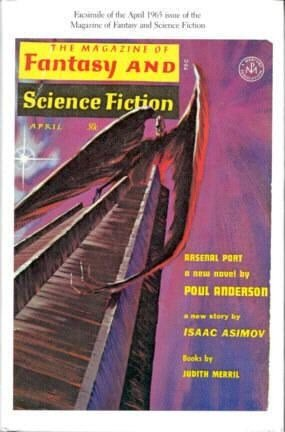
SSW: The Annotated Facsimile of THE MAGAZINE OF FANTASY AND SCIENCE FICTION, April 1965, edited by Edward Ferman (with an introduction by Ferman and memoirs by most of the contributors to the issue, edited by Ferman and Martin H. Greenberg), Southern Illinois University Press, 1981


This was one of a series of books the Southern Illinois University Press issued in their "Alternatives" line, devoted to fantasy and sf, which published a number of volumes from 1990, including collections of Cornell Woolrich's fantasticated fiction (which can be read here), with essays by Francis Nevins and Barry Malzberg, and the first collection of Algis Budrys's book-review essays, for Galaxy magazine, Benchmarks: Galaxy Bookshelf, in 1985 (and similar collections of his later work have been published by Ansible Editions). The Science Fiction of Mark Clifton (1980), edited by Malzberg and Greenberg (with an introduction by Judith Merril), which can be read here, was one of a number of similar books SIU Press was publishing in the same years that were, for no obvious reason, not under the "Alternatives" aegis. Another, less improbably segregated from the "Alternatives" label, was 
Exeunt Murderers: The Best Mystery Stories of Anthony Boucher (1983), edited by Nevins and Greenberg.

They issued only two facsimile issues of fiction magazines during the run, in hardcover editions, one devoted to one of the most promising, as it was laden by current and future stars of the magazine and sf, issues of Astounding Science Fiction, July 1939, and this one, devoted to the first issue Edward Ferman would consider as one he fully edited, as he was the editor succeeding Avram Davidson, who had been editing remotely from Mexico for his last year or so, and his father, the publisher of F&SF, Joseph Ferman, wasn't at all sure it would make for a Good Look to install his young son, four years out of college, as the editor at once, so called himself "editor" as well as publisher during the transition--with Ted White, later to edit Fantastic and Amazing for a decade, continuing as Assistant Editor and Robert P. Mills, editor of Mercury Mystery, Bestseller Mystery, Venture Science Fiction, and of F&SF just before Davidson (and having been managing editor of Ellery Queen's Mystery Magazine while that was still a Mercury Press  property) as staff advisor, younger Ferman was able to make his mark, as the various memoirs as well as the evidence of his issues, and longest term of anyone as editor (and eventually publisher) of the magazine, has made clear.

This issue was a good one, and Ferman can be reasonably proud of it, as he was, as he settled into the full role beyond the "Managing Editor" credit he took for this and previous issues, as they worked through most of the Davidson-selected inventory. (In this issue, at least the M. J. Engh story, her second and last to be published as by "Jane Beauclerk", of a loose and widely-spaced trilogy of stories; "Lord Moon" having been a story eventually bought by the departing Davidson, and, probably only coincidentally, her last F&SF story--she's not been hugely prolific. Engh is probably best-known for her first novel, Arslan, published in the UK as A Wind from Bukhara, which I couldn't help but be reminded of during the recent fracas in Russia, when the mercenary army Putin has been employing for various ugly business around the world briefly threatened to attack him,) Also notable, Gerald Jonas's charming poem "Imaginary Numbers in a Real Garden", a decent Isaac Asimov story (as he informs us in his essay, one solicited by Playboy as one of three vignettes to be written in response to an illustration...and, despite Algis Budrys as a tapped-temporarily [as Asimov remembers it, at least] fiction editor [or sub-editor] seeking to accept Asimov's second draft, it being bounced by the upper hierarchy)(Steven Cooper was kind enough to point me to the relevant Playboy issue, December 1966, which features Jack Gregory's sculpture, as photographed by Seymour Mednick, and the three vignettes Playboy went with: "Playback" by Arthur C. Clarke. "Lovemaking" by Frederik Pohl [which Pohl called "Making Love" in his collections] and "Cephalotron" by Thomas Disch [which Disch called "Fun with Your New Head" in his collections]. Gahan Wilson has his first F&SF cartoon in this issue, a regular feature (as with Asimov's essays, which would continue till Asimov's death in 1992) for the next 17 years...whatever ended Wilson's run in the magazine apparently also had enough bad blood to it for Wilson to not provide a memoir. "T P Caravan" also has his last F&SF contribution in this issue, and sadly also doesn't have a latter-day essay.

Len Guttridge would have only two more F&SF stories, despite living into his 90s; then-young Robert Rohrer would have only one more in F&SF, his last in the fantastica magazines (two stories, one each in Cele Goldsmith Lalli's Fantastic and Amazing appeared between his last two in Ferman's magazine)(in comments below. Rich Horton notes that Rohrer wrote to comment on RH's blogpost about Rohrer's career), and Roderic Hodgins has never published in fantastica magazines again (though he did keep a hand in, as a science and medicine reporter for Life magazine [not, alas, a long-term job for him given the essential folding of the magazine not long after, with sporadic specials and revivals], apparently before turning his day-job efforts toward clinical psychology). Judith Merril didn't offer an essay, either, though she might've been under the weather by the time this book was being put together in 1980...the eclecticism of the work she was reviewing (as well as assembling in her annual) was notable. And Ted Thomas's short-form science and speculation column, which ran in the magazine for a few years in the '60s, was a nice counterpoint to Asimov's essays (the film and other a/v reviews wouldn't reappear in the magazine till Samuel Delany, initially reviewing 2001, would begin a column in '68, after Charles Beaumont's column in the latter '50s ended with his ill health...William Morrison's very occasional stage reviews ended with Beaumont's; Baird Searles, Harlan Ellison, Kathi Maio, Lucius Shepherd, Dave Skal and others would follow Delany). 

Patti Abbott has the balance of Short Story Wednesday reviews posted and linked here.

And here's the FMI listing for the Playboy issue, slightly augmented:

    Playboy [v13 #12, December 1966] (quarto) 
    Details supplied by Paul Di Filippo (with some additions, the variant titles of the Pohl and Disch vignettes from ISFDB citations).
    • 126 · An Expensive Place to Die [Part 1 of 3] · Len Deighton · n.
    • 138 · Accidentally Good · Robert Ruark · ss
    • 141 · So Pretty and So Green · MacKinlay Kantor · ss
    • 165 · The Truth About Orlik · Gerald Kersh · ss
    • 182 · The Only Game in Town · Garson Kanin · ss
    • 215 · The Scamp He Would a Scribbler Be · Poggio Bracciolini (as "retold" by John Keefauver) from Facetiae (1470) (the "Ribald Classic"; the volume was the first printed jokebook in Europe, a collection of satirical vignettes) illustration uncredited
    • · Fantastic Trio
    • 220 · Playback · Arthur C. Clarke · ss
    • 221 · Lovemaking · Frederik Pohl · ss [variant title of "Making Love"] (as in Day Million et al.)
    • 222 · Cephalatron · Thomas M. Disch · ss [variant title of "Fun with Your New Head"] (as in the collection of that title and others)


Wednesday, June 7, 2023

Short Story Wednesday: stories by Robert Bloch, Alice Sheldon ("James Tiptree, Jr."), David Bunch and Juan José Arreola, from the 28th Anniversary issues of FANTASTIC, edited by Elinor Mavor (July 1980) and THE MAGAZINE OF FANTASY AND SCIENCE FICTION, edited by Edward L. Ferman (October 1977)


 Prismatica  Samuel R. Delany · nv
  34 •   ReviewStolen Faces by Michael Bishop • review by Richard   Delap
  36 •   ReviewA Little Knowledge by Michael Bishop • review by Richard Delap
   39 •   ReviewNew Dimensions 7 by Robert Silverberg • review by Richard Delap
    41 •   ReviewUniverse 7 by Terry Carr • review by Richard Delap
43 · What You See Is What You Get · Robert Bloch · ss
56 · The First Stroke · Zenna Henderson · ss
61 • Films: Star Wars • [Films (F&SF)] • essay by Baird Searles
64 · The Man Who Could Provide Us with Elephants [Mr. Secrett] · John Brunner · nv
95 · Brother · Clifford D. Simak · nv
113 · Caretaker · Manly Wade Wellman · ss
123 · Leaps of Faith · Michael Bishop · ss
139 · Science: The Subtlest Difference · Isaac Asimov · cl
150 · Time-Sharing Angel · "James Tiptree, Jr." (Alice Sheldon) · ss


Twenty-eight years is a slightly odd birthday for a magazine to celebrate, but as I've noted before here, The Magazine of Fantasy and Science Fiction (F&SF) liked to have an "all-star" birthday issue every year, in the '70s and later not least to help soften the blow of a new newsstand price rise in some (many) years, while Fantastic was usually more blasé, even with "major" anniversary years...though this was to be the penultimate issue of the magazine, before its folding into the stablemate Amazing Stories, and not too long before the end of Ultimate Publications, which had published both titles and various spun-off magazines since 1965; Amazing (combined with Fantastic) would soon be sold to Dungeons and Dragons game publisher TSR, and would see a further cash infusion from Steven Spielberg renting title rights and options on the magazine's fiction for his (rather bad and shortlived, but guaranteed two seasons by NBC, which honored the contract) tv series Amazing Stories.  Despite 
title, these last few issues of Fantastic didn't feature very much sf, buthe publisher was quite sure sf magazines always outsold fantasy magazines...and they usually had (I continue to suspect this is because fantasy readers were less likely to be aware there was a  literature of fantasy that could be seen as differentiated from fiction as a whole than sf or even horror readers were...at leastill J. R. R. Tolkien began outselling everyone else in the '70s).

F&SF was edited and published in 1977 by Edward Ferman, who had inherited the business from his father, and by this point ran the magazine from his family's house in Cornwall, CT; younger Ferman had been editing since 1964, publishing beginning in 1970. While in 1980, Elinor Mavor was just settling in as the editor of Fantastic and Amazing, having had her first issues of the magazines assembled hurriedly after long-term publisher Sol Cohen retired at the end of 1978, and turned the reins over to his junior partner Arthur Bernhard, who had never seen eye-t0-eye with 1969-79 editor Ted White, and who replaced him with the illustrator and staff layout person Mavor, who had a certain lack of confidence going in, even more so than her most widely-hailed predecessor at the magazines when they were published at Ziff-Davis, Cele Goldsmith Lalli (Mavor even signed herself "Omar Gohagen" to begin with, thinking women editors were unlikely to be accepted in sf and fantasy circles...not particularly true ever, but particularly not by the '70s).

And for whatever reason, I'd not actually picked up either of these issues and given them a read-through, despite a good line-up of genuinely all-star contributors to the F&SF issue, and a not-bad selection of writers in the Fantastic. While the F&SF had the standard, illustration-free (except for Gahan Wilson's monthly cartoon, and the column headers Wilson had devised for the rotating-cast book-review, Asimov science-essay, and Baird Searles film and related media review columns) easy to read if a bit staid text-laden pages, Mavor was trying, as best the minimal budget she had would allow, to mix in not only illustration (White's issues had had often excellent illustrators and cover artists) but to remake the layout more in the fashion of most magazines at the turn of the '80s, with some filler nonfiction devoted to contributor biographies and (instead of the story headnotes White would provide, or Ferman, in their magazines) short ending notes that detailed what drew her to take the item the reader had just finished...author photographs included when handy. 

So, I chose for this week's entry to check out two stories in each issue, the F&SF's Robert Bloch ("What You See is What You Get") and Alice Sheldon ("Time-Sharing Angel"), still signing her work (mostly) "James Tiptree, Jr." and the Fantastic's David Bunch ("New Member") and a translation, by Marijane Osborn, of a 1952 story by Mexican fabulist Juan José Arreola, titled rendered in English as "Parable of Barter".

Consistent readers here will know that I'm a lifelong fan of Bloch's and might recall I've liked Bunch's work nearly as long...sadly, both men's entries here are not close to their best work. The Bloch is simply a misfire, a gimmick story that telegraphs its final twist (which is as at least as old as the telegraph, despite being a story about a sort of haunted Polaroid camera); the Bunch is drowning in his love of alienating small details, so much so that his usually pointed critique is all but lost. One can enjoy them as very minor examples of what these artists could do, but one will enjoy almost anything else they wrote more readily.

The "Tiptree" and the Arreola are better; the Sheldon story is not her best, but it does demonstrate the bleakness of her assessment of humanity's probable fate, as well as taking a suitably (and not atypically) off-the-wall means of staving that fate off; it's included in a couple of her key collections. The Arreola gives us a sense of why his work is compared to that of Borges, though perhaps less (at least in this translation of this story) exacting in his vision, but at least as playful, and if anything (like Sheldon!) with a somewhat dimmer view of human foibles, and the means of being (not quite literally) damned if one does or one doesn't.

There are other features and fiction that look promising (certainly more so than the killer B stories) in the two issues, even if Richard Delap is probably my least favorite of the recurring book reviewers in 1970s F&SF issues, and my interest in role-playing games is limited (nice to see this early interest from a pro fantastica magazine, even one on such a tight budget, in this then-growing field).

And then, after seeing the link to this post on a Facebook discussion group, Darrell Schweitzer was moved to comment (and graciously gave permission to reprint that comment here):

Interesting to see something of mine (the serial in FANTASTIC) showcased like this. It makes me feel like a museum piece. But it was ... yikes!... forty-three years ago. As for how stretched the budget for FANTASTIC was, Elinor Mavor asked me to cut "The White Isle" by 13,000 words, because they could not afford to pay for a 53,000 word story. I made a simpler counter-offer, that they should pay for what they could and take the rest for free. Nothing could be more attractive to the editor of a starveling magazine that the prospect of about 15 pp. of free copy. Not a comma was dropped. When Arthur Bernhard proposed to fold the magazine with the April 1980 issue, I also (from obvious self-interest) wrote to him and argued that as a fantasy magazine, FANTASTIC served a very special purpose and should be allowed to continue. So it limped on for two more issues, finished my serial, and ended with an "excerpt" (actually the first installment) of Marvin Kaye's THE AMOROUS UMBRELLA.  [I replied that, in a sense, Darrell had, as part of the staff, with George Scithers, editing the TSR Amazing Stories incorporating Fantastic, he was in a way editing Fantastic himself not too long after.]

And for more of this week's Short Story Wednesday entries, please see Patti Abbott's blog.


And, just for swank, here's what quarterly Fantastic and monthly F&SF were offering at about the same time as the reviewed issues of their counterparts above:

Fantastic, December 1977, edited by Ted White

Not actually the 26th Anniversary issue (which would be the July 1978 issue)...


This might be my least-favorite David Hardy painting...even Jove nods...
A far better Hardy painting, more typical of his work.