Showing posts with label Gahan Wilson. Show all posts

Wednesday, June 28, 2023

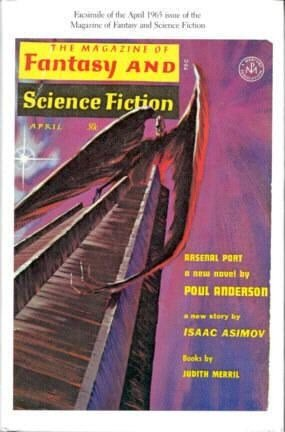
SSW: The Annotated Facsimile of THE MAGAZINE OF FANTASY AND SCIENCE FICTION, April 1965, edited by Edward Ferman (with an introduction by Ferman and memoirs by most of the contributors to the issue, edited by Ferman and Martin H. Greenberg), Southern Illinois University Press, 1981


This was one of a series of books the Southern Illinois University Press issued in their "Alternatives" line, devoted to fantasy and sf, which published a number of volumes from 1990, including collections of Cornell Woolrich's fantasticated fiction (which can be read here), with essays by Francis Nevins and Barry Malzberg, and the first collection of Algis Budrys's book-review essays, for Galaxy magazine, Benchmarks: Galaxy Bookshelf, in 1985 (and similar collections of his later work have been published by Ansible Editions). The Science Fiction of Mark Clifton (1980), edited by Malzberg and Greenberg (with an introduction by Judith Merril), which can be read here, was one of a number of similar books SIU Press was publishing in the same years that were, for no obvious reason, not under the "Alternatives" aegis. Another, less improbably segregated from the "Alternatives" label, was 
Exeunt Murderers: The Best Mystery Stories of Anthony Boucher (1983), edited by Nevins and Greenberg.

They issued only two facsimile issues of fiction magazines during the run, in hardcover editions, one devoted to one of the most promising, as it was laden by current and future stars of the magazine and sf, issues of Astounding Science Fiction, July 1939, and this one, devoted to the first issue Edward Ferman would consider as one he fully edited, as he was the editor succeeding Avram Davidson, who had been editing remotely from Mexico for his last year or so, and his father, the publisher of F&SF, Joseph Ferman, wasn't at all sure it would make for a Good Look to install his young son, four years out of college, as the editor at once, so called himself "editor" as well as publisher during the transition--with Ted White, later to edit Fantastic and Amazing for a decade, continuing as Assistant Editor and Robert P. Mills, editor of Mercury Mystery, Bestseller Mystery, Venture Science Fiction, and of F&SF just before Davidson (and having been managing editor of Ellery Queen's Mystery Magazine while that was still a Mercury Press  property) as staff advisor, younger Ferman was able to make his mark, as the various memoirs as well as the evidence of his issues, and longest term of anyone as editor (and eventually publisher) of the magazine, has made clear.

This issue was a good one, and Ferman can be reasonably proud of it, as he was, as he settled into the full role beyond the "Managing Editor" credit he took for this and previous issues, as they worked through most of the Davidson-selected inventory. (In this issue, at least the M. J. Engh story, her second and last to be published as by "Jane Beauclerk", of a loose and widely-spaced trilogy of stories; "Lord Moon" having been a story eventually bought by the departing Davidson, and, probably only coincidentally, her last F&SF story--she's not been hugely prolific. Engh is probably best-known for her first novel, Arslan, published in the UK as A Wind from Bukhara, which I couldn't help but be reminded of during the recent fracas in Russia, when the mercenary army Putin has been employing for various ugly business around the world briefly threatened to attack him,) Also notable, Gerald Jonas's charming poem "Imaginary Numbers in a Real Garden", a decent Isaac Asimov story (as he informs us in his essay, one solicited by Playboy as one of three vignettes to be written in response to an illustration...and, despite Algis Budrys as a tapped-temporarily [as Asimov remembers it, at least] fiction editor [or sub-editor] seeking to accept Asimov's second draft, it being bounced by the upper hierarchy)(Steven Cooper was kind enough to point me to the relevant Playboy issue, December 1966, which features Jack Gregory's sculpture, as photographed by Seymour Mednick, and the three vignettes Playboy went with: "Playback" by Arthur C. Clarke. "Lovemaking" by Frederik Pohl [which Pohl called "Making Love" in his collections] and "Cephalotron" by Thomas Disch [which Disch called "Fun with Your New Head" in his collections]. Gahan Wilson has his first F&SF cartoon in this issue, a regular feature (as with Asimov's essays, which would continue till Asimov's death in 1992) for the next 17 years...whatever ended Wilson's run in the magazine apparently also had enough bad blood to it for Wilson to not provide a memoir. "T P Caravan" also has his last F&SF contribution in this issue, and sadly also doesn't have a latter-day essay.

Len Guttridge would have only two more F&SF stories, despite living into his 90s; then-young Robert Rohrer would have only one more in F&SF, his last in the fantastica magazines (two stories, one each in Cele Goldsmith Lalli's Fantastic and Amazing appeared between his last two in Ferman's magazine)(in comments below. Rich Horton notes that Rohrer wrote to comment on RH's blogpost about Rohrer's career), and Roderic Hodgins has never published in fantastica magazines again (though he did keep a hand in, as a science and medicine reporter for Life magazine [not, alas, a long-term job for him given the essential folding of the magazine not long after, with sporadic specials and revivals], apparently before turning his day-job efforts toward clinical psychology). Judith Merril didn't offer an essay, either, though she might've been under the weather by the time this book was being put together in 1980...the eclecticism of the work she was reviewing (as well as assembling in her annual) was notable. And Ted Thomas's short-form science and speculation column, which ran in the magazine for a few years in the '60s, was a nice counterpoint to Asimov's essays (the film and other a/v reviews wouldn't reappear in the magazine till Samuel Delany, initially reviewing 2001, would begin a column in '68, after Charles Beaumont's column in the latter '50s ended with his ill health...William Morrison's very occasional stage reviews ended with Beaumont's; Baird Searles, Harlan Ellison, Kathi Maio, Lucius Shepherd, Dave Skal and others would follow Delany). 

Patti Abbott has the balance of Short Story Wednesday reviews posted and linked here.

And here's the FMI listing for the Playboy issue, slightly augmented:

    Playboy [v13 #12, December 1966] (quarto) 
    Details supplied by Paul Di Filippo (with some additions, the variant titles of the Pohl and Disch vignettes from ISFDB citations).
    • 126 · An Expensive Place to Die [Part 1 of 3] · Len Deighton · n.
    • 138 · Accidentally Good · Robert Ruark · ss
    • 141 · So Pretty and So Green · MacKinlay Kantor · ss
    • 165 · The Truth About Orlik · Gerald Kersh · ss
    • 182 · The Only Game in Town · Garson Kanin · ss
    • 215 · The Scamp He Would a Scribbler Be · Poggio Bracciolini (as "retold" by John Keefauver) from Facetiae (1470) (the "Ribald Classic"; the volume was the first printed jokebook in Europe, a collection of satirical vignettes) illustration uncredited
    • · Fantastic Trio
    • 220 · Playback · Arthur C. Clarke · ss
    • 221 · Lovemaking · Frederik Pohl · ss [variant title of "Making Love"] (as in Day Million et al.)
    • 222 · Cephalatron · Thomas M. Disch · ss [variant title of "Fun with Your New Head"] (as in the collection of that title and others)


Friday, November 29, 2019

Gahan Wilson, 1930-2019; John Simon, 1925-2019 (and Jonathan Miller and Clive James)


I first encountered the work of Gahan Wilson no later than some time in 1972; John Simon in 1975. I probably saw Wilson's cartoons in one magazine or another, I made it to 8yo in '72 so it certainly wasn't Collier's, the first living-wage-paying (for cartoons) market he would contribute to, nor Fantastic, later one of my favorite magazines, which was the first magazine he contributed to (and was very happy to have the $7.50 per cartoon they paid him for the several they bought at Ziff-Davis Publications and ran in the fantasy magazine, along with a single panel in its sf companion Amazing Stories instead in 1953). His cartoons were the primary focus of most of his audience, and not improperly; he was consistently cited throughout his his career, after coming to prominence in the 1960s, as the overlapping heir to Charles Addams in the world of the macabrely humorous panel cartoon, and there was a certain consanguinity with Edward Gorey in both men's work; Wilson also, in drawing his monsters and to some degree his human figures, could also seem to streamline the elaborate grotesqueries of Basil Wolverton. Though, from early on, Wilson contributed art (illustration as well as cartoons) and prose (fiction and critical writing) and sometimes hybrid, heavily illustrated fiction that was a bit too text-heavy to count as graphic fiction, to a wide array of markets which included nearly every important US newsstand fantasy-fiction magazine to flourish during his career ...starting in Fantastic, as noted, he contributed illustration to two of the very last issues of the original run of Weird Tales in 1954, would publish a monthly cartoon in The Magazine of Fantasy and Science Fiction, from 1965 to 1981, along with occasional short stories and reviews mostly of horror fiction books, was a columnist on film (and cover artist) for The Twilight Zone Magazine in the 1980s, contributed installments of the mostly book-review column "The Den" and cover and other illustration for the 1980s-onward Weird Tales revival, and was a book review columnist (and cover artist) for Realms of Fantasy in the 1990s (and a cover and interior illustration for a fantasy issue of eclectic little magazine Conjunctions); all this in addition to his regular cartoon (and infrequent cover) contributions to The New YorkerPlayboyNational Lampoon (the trio usually cited in his obituaries), and a variety of other magazines including Punch and Paris Match, and a syndicated newspaper strip, Gahan Wilson's Sunday Comics, which ran from 1974-77, which I recall from The Boston Globe, I believe, in its last year and a half (I don't think the Hartford Times  nor Courant had it, sadly, in earlier years when my family and I were in Connecticut). But I know I was aware of Wilson no later than "The Science Fiction Horror Movie Pocket Computer", as reprinted in Best SF '71, the 1972 volume of Harry Harrison and Brian Aldiss's best-of-the-year annual, and I was lucky to have the Berkley US paperback edition, since the Sphere UK softcover edition, under a less date-infected title, reprinted the flow-chart bit of humor almost illegibly. That piece of work might've been the first thing I saw from National Lampoon, as well, though my first experience with that magazine, and Wilson's running strip there, Nuts (named as well as created in 
response to Charles Schulz's Peanuts and meant to delve a bit deeper into the confusions and distresses the world presents to young children), and it was one of books my father had kicking around the house...I first saw Playboys and New Yorkers at a similar age. Took me a while to catch up with an issue of Punch, though I had certainly read work from it over the years. In the next year or so, I would read Wilson's illustrated story in Harlan Ellison's anthology Again, Dangerous Visions, the title of the story being the image of a flat little blob or stain which becomes the villain of the story as the narrative unfolds, with Ellison's typically lengthy introduction to the story filling us in on Wilson and how Ellison met him while the cartoonist was sketching sf and fantasy fans at a convention, on a project for Collier's in the mid-late '50s (I assume that never made it to print in the magazine, as I've not seen mention of it elsewhere). 
Wilson edits and sculpts the Lovecraft statue that serves as the first trophy of the WFA

I have enjoyed his short fiction whenever I've encountered it since, but have yet to read his collection 
The Cleft and Other Odd Tales, nor his other prose collections (Gahan Wilson's Cracked Cosmos, a 1975 YA-targeted volume mostly overlapping with The Cleft..., and the new Borderlands Press item The Little Purple Book of Phantasies), which I need to rectify (I do have at least one of the two Fantagraphics collections which mix short stories and cartoons). Such illustrated, not quite graphic (though close), novels as Eddie Deco's Last Case and Everyone's Favorite Duck are very much worth seeking out, along with the vast majority of all his work.

And do see Gahan Wilson: Born Dead, Still Weird, if you haven't...widely online, currently no extra charge for Amazon Prime customers.

Roz Chast remembers Gahan Wilson


John Simon I was first made aware of by the amusing, mostly enjoying its own presumption, little book The Best, a collection of essays by Peter Passell and Leonard Ross, which cited Simon as the Best Film Critic; an impulse buy for my father, I assume, in the 1975 Pocket Books paperback. Simon has been deservedly criticized for the degree to which he has written and apparently occasionally said rude things about the appearance of some actors, and such, but is also too often dismissed as a snobbish boor, as opposed to someone who usually stated his opinions intelligently, elegantly and no more goofily nor crankishly than did most of his cohort of film or theater critics (Pauline Kael, Andrew Sarris, Roger Ebert, Frank Rich, I feel I can confidently rest my case without descending to Rex Reed nor Bosley Crowther), and less so and less often than


most. He also wrote fine literary and music criticism, and his unwillingness to give full marks for intent unfulfilled nor novelty as a virtue in itself was often not sufficiently appreciated, nor was his hailing good and better work when he found it, which was often. Including the good and better work by his peers, and his great respect for such critics who had gone before, such as James Agee. His work thus struck me as not altogether different from the primarily literary critics I've admired most, including Anthony Burgess, Dorothy Parker, Damon Knight, Algis Budrys, Joanna Russ, Barry Malzberg, Vivian Gornick, Richard Lupoff, Avram Davidson, John Leonard and others...and, like these others, I've reviewed a few of Simon's books here, if not as frequently nor as well as I'd like. 

Here is the Internet Archive's cache of Simon's New York magazine stage reviewshere is his blog, Uncensored John Simon.

Christopher Bonanos on John Simon


From the NY/NJ Regional News Network running segment discussed above:


Gahan Wilson previously in Sweet Freedom

John Simon so far likewise

I have not been as influenced, nor from such an early age, by either Jonathan Miller (despite very much enjoying Beyond the Fringe and The Body in Question, among some of his other work) nor Clive James (having read only a bit of his work), but I thought I might add this segment here...as indicative of how they were willing to take the afflatus from any given circumstance, as public intellectuals...


Todd Mason 


Friday, October 20, 2017

FFM: The Magazine of Fantasy and Science Fiction, January 1976, edited by Edward Ferman (Mercury Press 1975)

Stories by Joanna Russ, Kit Reed and Stuart Dybek, and the best columnists in the fiction-magazine field.

This was the first issue of F&SF I ever held in my hand. It might not've been the first issue to appear on the newsstand of the Hazardville, CT, drug store where I bought my comic books, then running at an industry standard of a quarter apiece, except for the fatter ones. I had bought a very few paperback books off the spinner rack next to the comics, including a copy of Harry Harrison's anthology of new fiction (and an Alfred Bester memoir) Nova 4 as a birthday gift for my father. That edition was a Manor Book, a reputedly mobbed up outfit that seemed overrepresented on the paperback spinner rack, even as there was never any lack of Charlton Comics in the comic-book spinner (similar accusations). Considering the degree to which magazine distribution in the '70s was often a great source of legit business and money laundering for certain entrepreneurs, it might've been almost surprising how many DC and Marvel and Archie and Gold Key comics were also on the racks, though I'm sure the distribution mobsters weren't going to lose any legit profit just to make their brothers in paperback or comics publishing happier or richer. 
    Meanwhile, the little magazine rack had some items of interest from time to time...I bought an issue of National Lampoon there, I think a bit earlier or later since I road my bike over to do so, less likely in December. My mother confiscated and returned it to the store, and got a refund, delivering a ukase to me and a bored clerk never to attempt a similar transaction again. (I think my father, a Playboy subscriber for some years, must've bought the other two or three issues around the house. I assume my mother bought the Playgirls, or Dad bought them for her...possible she ordered it through Publisher's Clearing House. She never believed you could win their sweepstakes without buying something.)
    And I had certainly been aware of digest-sized fiction magazines. The earliest reading I remember vividly includes a science-fiction pulp reprint magazine, which one I still haven't rediscovered, and a DC sf comic book, likewise; I loved my few copies of Humpty Dumpty and Children's Digest magazines when four and five and six, and Alfred Hitchcock's Mystery Magazine, which for some reason was stacked in the young readers' section of the Enfield Library in 1974-76, and a few Analogs were around the house from my father's haphazard collecting. But I'd never seen this title before...and might not've seen it again at the drugstore. What was almost certainly true is that I probably had 50c or 90c on me, rather than a dollar, so I knew I couldn't afford this magazine even as I flipped through it. I was even familiar with the magazine by name, and as a source of stories I had read read in various anthologies and collections. 
First US collections from each writer to include these stories.
    So it was another couple of years before I caught up with it again, through a 1971 back issue in the Londonderry Junior High library, and then the March 1978 issue. Winter's boon, fiction magazines for me in those years, clearly...I'd started buying new AHMMs with the January 1978 issue. And after falling in love, I ordered a box of back issues from the magazine, which never arrived. The Fermans & co. were kind enough to send a replacement...and among those warehoused items, smelling fascinatingly of wood and ink after sitting on palette stacks for a couple of years, was a copy of this issue, so I could read it in, if I'm not mistaken, the autumn of 1978.
resembles Trump.
    Three stories within made the strongest impression. "My Boat" by Joanna Russ was a fascinating meld of Philip Roth-esque discussion between two Jewish men of a certain age, the protagonist relating the adventures of his and two adolescent friends' (a girl and a boy) from decades earlier, and their sort of modified Peter Pan-esque experience, with an overlay of Lovecraftian flavors. 
    Kit Reed's "Attack of the Giant Baby" involves an experiment that goes awry, and an infant with a passion for Malomars who is enlarged (along with a favorite toy), and what can result from that. The attention to wryly sketched-in detail is what made the story both grounded and hilarious, far more so than, say, the film Honey, I Blew Up the Kid...which I believe faced some legal questions for its similarity in certain aspects to this short story.
    Stuart Dybek's "Horror Movie" is an urban nightmare...a young adolescent, not quite raising himself but coming close and having more traumatic events than usual go down in this particular day, has to deal with various sorts of predator including an apparently supernatural one...the basic Geist of horror, a fiction (or other narrative) which is in large part about learning to cope with the terrors we all face, though some of us more than others, was very explicitly spelled out by this story from fairly early in my reading. 
    The other stories were pleasant but minor--a slight "Black Widowers" story by Isaac Asimov, one of several rejected by Ellery Queen's Mystery Magazine but with some tangential relevance to fantastic fiction, so they were good-enough reasons to have Asimov's name on the cover aside from citation of his monthly pop-science column. Gary Wolf's cover story, or at least the cover by David Hardy, might also have been a(n admitted) literary ancestor of Bender the robot in the television series Futurama (though I don't trust my faint memory of this, and should Go Check)...Wolf's clever, amiable work would eventually include the literary adventures of Roger Rabbit, the rather more sophisticated source for the mixed animation/live action film.
    And I must admit I haven't yet sought out the issue to reread the stories by Haskell Barkin (an old friend of Harlan Ellison and an occasional fantasist) or Michael Coney (a Canadian writer prone to sometimes goofy, sometimes quietly effective work), neither of which made a strong impression (or at least a lasting one). Good examples of Asimov's
science column and Baird Searles coping as best he might with one of the poor 1970s ER Burroughs film adaptations are joined by a cute, grim Gahan Wilson cartoon, one of F&SF's infrequent letters columns, and Algis Budrys's fine assessment of the work of, and reminiscence about, two of the more distinctive older writers in the field, "Lester Del Rey" (actually Leonard Knapp, but known to all his friends and spouses as Del Rey), who had been a mentor to Budrys early in the latter's career, and R. A. Lafferty, who had begun writing and publishing in middle age in the latest '50s, in part to keep himself away from alcohol, and had already cleared his own distinctive path through little and fantastic-fiction magazines...and of another veteran, one who came up in the same years as Budrys himself, if a half-dozen earlier, Poul Anderson. 

The ISFDB index:
The earlier UK collection (1978 vs. 1981)
For more of today's books, and mostly actual books, please see Patti Abbott's blog.

Friday, December 4, 2009

Friday's "Forgotten"...: FIRST WORLD FANTASY AWARDS edited by Gahan Wilson (Doubleday 1977) and (the album) Jawbox: FOR YOUR OWN SPECIAL SWEETHEART


Cover by Gahan Wilson, of course:

From the Contento Indices:

First World Fantasy Awards ed. Gahan Wilson (New York: Doubleday 0-385-12199-7, Oct ’77, $8.95, 311pp, hc)
9 · Introduction · Gahan Wilson · in
11 · Map of Providence · Gahan Wilson · il
15 · The Convention · Kirby McCauley · ar *
17 · About the Fantasy Awards · Gahan Wilson · ar *
19 · The Awards · Gahan Wilson · bi *
21 · The Bat Is My Brother · Robert Bloch · ss Weird Tales Nov ’44
36 · Beetles · Robert Bloch · ss Weird Tales Dec ’38
46 · Acceptance Speech · Robert Bloch · sp *
53 · About Robert Bloch · Misc. · bg *
55 · from The Forgotten Beasts of Eld · Patricia A. McKillip · ex New York: Atheneum, 1974
63 · An Essay · Robert Aickman · ar *
66 · Pages from a Young Girl’s Journal · Robert Aickman · nv F&SF Feb ’73
97 · The Events at Poroth Farm · T. E. D. Klein · na From Beyond the Dark Gateway #2 ’72
137 · A Father’s Tale [Brigadier Ffellowes] · Sterling E. Lanier · nv F&SF Jul ’74
168 · Sticks · Karl Edward Wagner · nv Whispers Mar ’74
187 · Come Into My Parlor · Manly Wade Wellman · ss The Girl With the Hungry Eyes, ed. Donald A. Wollheim, Avon, 1949
198 · Fearful Rock · Manly Wade Wellman · na Weird Tales Feb ’39 (+2)
253 · About Manly Wade Wellman · Misc. · bg
254 · The Ballantines · Misc. · bg
256 · Lee Brown Coye // An Appreciation · Gahan Wilson · ar Whispers #3 ’74
260 · The Bait [Fafhrd & Gray Mouser] · Fritz Leiber · vi Whispers Dec ’73
263 · The Vampire in America · Manly Wade Wellman · ar Whispers Dec ’73
268 · The Shortest Way [Dama (& Vettius)] · David Drake · ss Whispers Mar ’74
277 · From “Chips and Shavings” · Lee Brown Coye · ar Mid-York Weekly Oct 17 ’63
279 · The Soft Wall · Dennis Etchison · ss Whispers Jul ’74
290 · Toward a Greater Appreciation of H.P. Lovecraft · Dirk W. Mosig · ar Whispers Jul ’73
302 · The Abandoned Boudoir · Joseph Payne Brennan · pm Whispers Jul ’74
302 · Cradle Song for an Abandoned Werewolf [“Cradle Song for a Baby Werewolf”] · H. Warner Munn · pm Whispers Jul ’73
303 · Guillotine · Walter Shedlofsky · pm The Fantastic Acros, 1970
304 · The Farmhouse · David A. Riley · ss New Writings in Horror and the Supernatural #1, ed. David A. Sutton, London: Sphere, 1971; Whispers Jul ’74

Okay, so, more than any other single book, except perhaps the Ellison collection/anthology Partners in Wonder, this one's responsible for my typing this bit of electronically-captured prose...for it was a rather delayed but nonetheless welcome celebration and representation of the First World Fantasy Convention, in Providence, RI, in 1975 (venue chosen in honor of H.P. Lovecraft, in whose likeness the annual award statues, the Howards, are struck, from a design by editor and world-famous cartoonist Wilson. I was aware, distantly, of the fannish subculture that had developed around sf and fantasy, and had spread to help create similar subcultures around crime fiction and comics (and was helping to create one around punk rock as this book was being published, even as it had particularly around folk music in the '60s), but this book is also an invitation to the ongoing World Fantasy Conventions and all their sibling gatherings, publication, etc. Isaac Asimov's introductions to The Hugo Winners volumes and the SFWA Nebula Award anthologies also had a similar effect, but they documented the fannish apparatus rather more sketchily than the speech transcripts, the bits of on-the-scene journalism and other matter usually not published in a trade-press (as opposed to fannish-press) book, left out at libraries where not-particularly-innocent children can stumble right across them (I was already a fan of first Life Achievement Award-winner Robert Bloch, whose stories collected here were more rare [at that time] than good, and of Manly Wade Wellman (his sample stories are better and more representative), and certainly knew of J.P. Brennan's and Robert Aickman's work...but I believe this might've been my first exposure to Dennis Etchison, Fritz Leiber, and certainly to T.E.D. Klein and Patricia McKillip, her excerpt being the major representative of non-horror fantasy in these proceedings (though David Drake, whose work I believe I'd seen in The Year's Best Horror Stories annual, skirts the line there, too). Never did develope a taste for Sterling Lanier's club stories in the Brigadier Ffellowes series, in the tradition of Gerald Kersh and Lord Dunsany, among others (who did it better)...Lanier might be remembered longest for being the editor at the Philly-suburb how-to publisher Chilton who encouraged them to take on a much-rejected epic sf novel by newish writer Frank Herbert, Dune, which gave him some leeway to publish some further fiction titles there, including his own work. And Lee Brown Coye...just the other day, the town of Hamilton, NY, saw an auction to fundraise to preserve a mural Coye did there...all in all, a fine anthology, but a more important document (that Stuart Schiff's Whispers magazine started publishing best-of/new fiction anthologies the next year didn't hurt, either).

The newly rereleased album's cover on DeSoto, and the original Atlantic cover.


Meanwhile, a "forgotten" album is about to be re-released...Jawbox was the best of the punk/postpunk bands to form in DC in the late '80s (better than Fugazi, certainly, and better than such wonderful live acts that recorded poorly as Fidelity Jones or Autoclave...), and they did one superb (incorporating their wonderful ep and another anthology track) and one good album on Dischord Records, the legendary DC-based indie label, and went on to sign with Atlantic Records in 1993, the first of the DC punk bands to follow in the wake of Husker Du to take that gamble (it paid off about as poorly for them as for the Minneapolis band...though, having interviewed Jawbox with my then not yet Ex Donna some months back and having been one of their most voluble fans in the various media available to me at the time ["alternative" newspaper, fanzine, radio--the show Sweet Freedom, actually], I ran into J. Robbins at someone else's concert just after they'd signed the contract and just after I'd sold my first short story, and we wondered just how much of the world was breathlessly awaiting our next steps). Since then, Jawbox has broken up (it's been a dozen years now) and while their members, particularly Kim Coletta, have made a real label out of DeSoto Records (formerly an injoke that various DC sorts would slap on their self-released items), having released among much else an excellent odds and ends collection My Scrapbook of Fatal Accidents and now a remastered version of the first, brilliant Atlantic album, For Your Own Special Sweetheart, which I thought sounded pretty damned good the first time around...to promote this rerelease, the band will be reforming to play on NBC's chat show Late Night with Jimmy Fallon on December 8th. Perhaps a tour will follow, which would be nice.


Here's FYOSS, including the song "Motorist" inspired by J.G. Ballard's novel Crash, recorded well before the David Cronenberg-directed film adaptation.

For more of today's books, please see Patti Abbott's blog.