Please see Patti Abbott's blog for this week's list of links to others' reviews!
Jay Neugeboren, in his introduction
to the published form of Foley's memoirs in progress at the time of her
death, notes the dire state she found herself in, barely getting by on
her royalties from editing Best American Short Stories (after
four decades at that desk, she had taken over from the founding editor,
her friend, after he was killed in England by Nazi bombing from the
air), mourning the death of her son (who had been a drug addict,
apparently a heroin junkie), isolated and ailing. Which seems very
strange indeed, given the breadth of her early career, before and during
founding and editing Story (or, as she always refers to it, STORY...all caps and in italics), and leaving Story to take on the BASS position and
divorcing Whit Burnett, who kept the magazine they had co-founded (and
ran it into the ground, though also saw it revived fleetingly twice
before his death and the eventual revival of the title for a decade by
the Writer's Digest people).


Incomplete as the account is, Foley had packed a lot of living into
her first decades, beginning her memoirs with a reminiscence of lonely
and abused childhood after her parents became seriously ill and had to
place Foley and siblings with resentful relatives (or other surrogates),
but loving the legacy of the library her parents had assembled, which
traveled with the younger Foleys. Not long after high school, Alice Paul
finds Foley doing some small tasks at the Socialist Party hq in New
York, when coming over with other Women's Party activists looking for
reinforcements to protest that antifeminist crusader, Woodrow Wilson,
returning from Europe (particularly amusing when we consider how
famously his wife would be the voice of the, and probably the acting,
President in his ill last years (he is easily among our most overrated
Presidents); Foley, Paul and the other protestors were jailed but not
processed, and Foley's firsthand career investigating the corruption of
the larger society had begun. She would be drawn into journalism,
working with Cornelius Vanderbilt in Los Angeles (and serving as one of
the key editors on CV's paper there), meeting Whit Burnett and moving
with him to New York and then onto foreign correspondence for major
papers in Paris and Vienna, and beginning to publish Story in the
face of the early 1930s narrowing of the short-fiction markets,
particularly among the more intellectual and arty generalist magazines
(Mencken and Nathan's move from the fiction-heavy The Smart Set to the essay-oriented The American Mercury being a key impetus, another being the closure of the key experimental little magazine transition to fiction, rather than poetry, just before Foley and Burnett took the plunge). Meanwhile, Story
would publish the first stories, and later work, of folks ranging from
John D. MacDonald to J. D. Salinger, Zora Neale Hurston to William
Saroyan, (almost) Ernest Hemingway and his inspiration, Gertrude Stein
(neither of whom Foley was ever terribly impressed with as people) to
(definitely) Nelson Algren (whom she liked enormously till his public
rudeness about his affair with Simone de Beauvoir), Carson McCullers to
John Cheever, Kay Boyle to Erskine Caldwell, Peter de Vries to Norman
Mailer. While building this legacy, she developed long friendships the
likes of fellow reporter and historian William Shirer and a banker
turned writer/publisher who was going by Rex Stout (and introduced him
to the model
 |
| note Foley credits her son with co-editing |
|
|
|
|
|
for Nero Wolfe...Foley suspects Stout modeled Archie Goodwin on himself).
And as incomplete as this review is under the current circumstances,
most of this book is written in great good humor (with the necessary
seriousness brought to many issues of the times, and nostalgia never
allowed to go unchecked) and touches on the careers and Foley's
interactions with many more folks than I cite here (hell, Neugeboren, in
going through the notes and the completed majority of the manuscript,
finds himself wondering what happened to such Foley discoveries as A. I.
Bezzerides--apparently no film buff, Jay). Eminently rewarding, as well
as sobering as one considers how Foley's late life was spent.
 |
Actually, the second issue, 1950, w/expanded title...
Cover by George Salter |
This week, the "forgotten" books links are being compiled by Evan Lewis (who goes by Dave Lewis in some circumstances) at his blog, Davy Crockett's Almanack of Mystery, Adventure and the Wild West. I'll be hosting the links the following Friday, and then Evan, and then me, and one more pass before founder Patti Abbott can regain access to reliable blog-propagation
Meanwhile, I hope I shall be able to put my mind back together for
next week's links, but it's currently blown by the ease with which I was
able to find information on three or four books online which had been
eluding me for years, when I cast about for substitutes for the book I
intended to do this week, which I haven't had time to finish, much less
think about even long enough for a slapdash entry. Managing to dig out
information on such somewhat enigmatic and/or influential books on my
young reading as Eric Berger's anthology For Boys Only or Emile Schurmacher's Strange Unsolved Mysteries (and
further discovering that this journeyman writer had a diverse if
obscure career, writing paperback originals, men's sweat magazine
articles and, earlier, for Collier's, as well as for the tv series Coronado 9--and, apparently, his daughter became a sort of small-time newspaper magnate) or Nancy Faulkner's Witches Brew could've
made for a decent entry...if any of these books but the Berger were
actually good...and remarkable the paths this kind of engine-searching
can take one down, so that coming across a Reader's Digest imitation called This Month led indirectly to Pacific, a literary magazine at Mills College,
indexed by Dennis Lien at the FictionMags Index pages, that published
such diversely influential people on my life as Charles Neider (he of
the large Mark Twain collections from Doubleday that I plunged through
when about 10), Woody Guthrie, George P. Elliott and a slew of major
poets, and Iola Brubeck, already married to husband Dave who was just
starting to catch fire in the SF Bay area as a jazz musician and
composer. Perhaps it's notable that Fantasy Records, formed to offer
recordings of Brubeck's bands, stole its first label logo from the
Salter-designed title logotype of F&SF.
But, for now, what I'm going to do is steal an excellent notion Evan
has been engaging in at his blog, in showing early issue covers (in all
their often off-point glory) of such important magazines as Weird Tales
(a magazine that in its first year was only a very poor representative
of how great and important it would become--not altogether unlike Black Mask
in its first year), and run some of the covers from the subsequent
first issues I have read...with some bare-bones comments I hope to
augment later.
Thanks to Evan for the inspiration...and apologies for any
encroachment! One thing I note in looking at the issues below, is how
often some of the same bylines appear in various first issues (and,
with some stretching, including the second for F&SF)...Manly
Wade Wellman, H. L. Gold, Kris Neville, Theodore Sturgeon, Damon
Knight...of course, all were either major writers, even if at the time
up and comers, or in Gold's case, and perhaps in Neville's as well,
examples of people who could've done even better as writers if they'd
allowed themselves, or if life had allowed them, to do so...
 |
| 1949; cover by Bill Stone |
F&SF began life with a slightly goofy-looking photo cover (stablemate EQMM's
photo covers were a mixed bag as well), and an issue that featured
Theodore Sturgeon's charming, funny sf story "The Hurkle is a Happy
Beast" (so the immediate expansion of the title wasn't too taxing) and a
slew of reprints...Perceval Landon's "Thurnley Abbey" being the one
which resonated enough with Ramsey Campbell to make his Fine Frights rarities anthology...though I remember enjoying that story, I can't for the life of me remember details.
The second issue includes Ray Bradbury's revised "The Exiles" (which had in an earlier form, "The Mad Wizards of Mars," appeared in the Canadian magazine Maclean's)
and Damon Knight's first story he was proud to claim, "Not with a
Bang," a solid, grim joke story in the mode of his "To Serve Man"...and a
more distinctively F&SF cover, by the staff genius, George
Salter. (And...the first Gavagan's Bar story by Fletcher Pratt and L.
Sprague de Camp...and a fine Robert Arthur, in his "Murchison Morks"
series...and the first and best of the Papa Schimmelhorn stories by R.
Bretnor...all firmly establishing a fine tall-tale tradition of fantasy
and borderline sf in the magazine. Interesting how much of the horror
fiction in the first two issues comes from reprints...but there was so
much more good horror fiction to reprint than either gentler fantasies
or sf.)
The Magazine of Fantasy, Fall 1949
Publisher: Mystery House, Inc. (The American Mercury, essentially, and Mercury Mystery, Ellery Queen's Mystery Magazine and offshoots)
The Magazine of Fantasy and Science Fiction, Winter-Spring 1950
 |
| 1939; cover by H.W. Scott |
The first issue has the cover novel by Russell, and, perhaps even
more brilliant, "Trouble with Water" by H. L. Gold and "Where Angels
Fear..." by Manly Wade Wellman. Unz.org lets you read this issue. John W. Campbell, already well on his way to revolutionizing the sf field with his work as editor of Astounding Science Fiction,
reportedly in his heart of hearts preferred fantasy fiction, or at
least seized upon the excuse of the relatively paranoid premise of
Russell's novel (which is sf by any reasonable measure) to launch a
magazine that would specialize in the kind of one-fantasticated-element
fantasy that H. G. Wells and , latterly, Thorne Smith had specialized in
(Smith being a consistent bestseller before his rather early death, in
the years just before this magazine's founding). Despite encouraging
better-written and, famously, more realistically extrapolated (or
"hard") sf in his sf magazine, JWC was also a lifelong fan of fringe
science, and would also push that in both fiction and nonfictional work
in the magazine...with some not altogether healthy effects, eventually.
His colleague, Ray Palmer, at Ziff-Davis's fiction magazines, tended to
push rather more adventure-oriented and stereotypically "pulpy" fiction,
but also had some interest in fringe science and mysticism that would
eventually make its mark in his magazines, and beyond...Palmer was one
of the great early advocates of UFOs as alien visitors, for example.
Palmer would eventually leave fiction-magazine publishing (per se) in
favor of such titles as Fate, and turn his last sf magazine, Other Worlds, into Flying Saucers from Other Worlds for its last issues.
Feature Novel
Sinister Barrier by Eric Frank Russell, pp. 9-94 - PDF
Short Stories
Who Wants Power? by Mona Farnsworth, pp. 95-106 - PDF
Dark Vision by Frank Belknap Long, pp. 107-116 - PDF
Trouble With Water by H.L. Gold, pp. 117-130 - PDF
"Where Angels Fear---" by Manly Wade Wellman, pp. 131-136 - PDF
Closed Doors by A.B.L. Macfadyen, Jr., pp. 137-150 - PDF
Death Sentence by Robert Moore Williams, pp. 151-164 - PDF
Cover by H.W. Scott, - PDF
 |
| 1939; cover by Rudolph Belarski |
Strange Stories is my entry for this title at the PulpWiki; as noted there, it was founded in 1939, a very good year for fantasy-fiction pulp titles in the US (Unknown, Famous Fantastic Mysteries, and the originally sf-oriented Fantastic Adventures were all launched that year, as well, as was Startling Stories at the same house as Strange, though Startling
would last much longer and only very occasionally mix in anything more
fantasy than sf). The Thrilling Group didn't seem to have much faith in
this title...Mort Weisinger's editorial byline was nowhere in evidence
(and they folded the magazine as soon as he left to edit DC Comics), it
didn't get house ads with the sf title Thrilling Wonder Stories nor
its other stablemates, and while it wasn't a first-rate magazine to
judge by the first issue, the only one I've read, it was certainly on
par with their other titles under Weisinger. Even the cover of this
issue is more suggestive, to me at least, of the "shudder" pulps, which
emphasized fake-supernatural villains often torturing (with graphic
description) their victims--S&M Scooby-Doo fiction, as it's often
been referred to (and it has had some continuing influence and heirs).
The Manly Wade Wellman story is the best here (and the best-remembered
work the magazine would publish), though the pair each from Bloch and
Kuttner are certainly pleasant enough, though not by any means either
writer at the top of his game.
From ISFDb: Contents:
 |
| 1952; cover by Barye Phillips and Leo Summers |
Fantastic, of course, would end up serving as one of the most
durable of fantasy-fiction magazines in the US, and two years after its
founding in 1952 was merged with Fantastic Adventures, giving it
roots going back, as noted above, to 1939. But it was launched as a
departure by publishers Ziff-Davis and editor Howard Browne (also a
writer who a bit of a Raymond Chandler disciple), who had been noting
the falling fortunes of their pulp line (by 1952, they had folded all
but FA and their sf title Amazing Stories; such once-profitable items as Mammoth Mystery and Mammoth Adventure
were long gone), and they were well on their way to becoming what
Ziff-Davis/ZD has been over the decades since, a publisher of
large-format specialized nonfiction magazines (and their offshoots on
cable television and the web)...but B.G. Davis, particularly, had an
affection for fiction magazines, and Browne, who had succeeded Ray
Palmer as fiction magazine editor for ZD, was never a great fan of sf,
and particularly pulp sf, and more than game to attempt a semi-slick new
fantasy/sf magazine that might feature crime-fiction crossover
appeal...Ziff-Davis had even had aborted plans to remake Amazing thus
in 1950, going as far as to produce an "ashcan" (non-distributed dummy)
issue of what that might look like, but they waited till launching Fantastic to remake Amazing as its slightly less-interesting twin (Amazing's first semi-slick issue
had as a cover story a sfnal joke, theoretically written by then-hot
gossip-mongers Lait and Mortimer, called "Mars Confidential!"...in the
manner of their bestselling books such as New York Confidential! and such, which presumably lent their name to the hugely successful Confidential! magazine soon thereafter). Fantastic
got the big prize in its first year, a story from Mickey Spillane
(easily the bestselling fiction writer in the world at the time) which
had been mentioned in a Life magazine profile of Spillane...and
there was part of the rub, the story Spillane submitted was apparently
1) completely "spoiled" in the Life article and 2) extremely
awful, by Browne's lights, so he ghosted another (much to Spillane's
apparent eventual irritation), "The Veiled Woman," and the third issue
of Fantastic reportedly sold over 300,000 copies (an enormous
amount for a fiction magazine at any time). The Browne is a good
pastiche that only rarely ventures over into parody. But, for this first
issue, Browne's relatively nonchalant attitude toward sf and perhaps
editing generally was still on display...for the fiction, while paid for
at a then impressive 5c/word (the other US fiction magazines in sf and
fantasy were then able to pay 3c/word as their regular top rate, and
most didn't pay that well), was a very mixed bag:
Contents (from ISFDb)("fep" is front endpaper, or inside the front
cover..."They Write" being author blurbs attributed to the writers
themselves; a reproduction of Pierre Roy's painting "Danger on the
Stairs" is on the back cover, an odd attempt at "class"):
The most memorable story in the issue is the Asimov, a charming
fantasy about What If a young married couple, riding on a train on a
seat facing that of a man capable of showing them alternate realities,
had never met. Ray Bradbury's "The Smile" is probably the best-known
story from the issue, which seems to assume that 1) the Mona Lisa is
painted on canvas, and 2) it was likely to have been on loan to some
midwestern US gallery when armageddon struck. The Neville and the Outlaw
are solid, decent fantasy stories, while the Gold and the Miller are
examples of the weaker work by these writers; Gold, particularly, is
better remembered as an editor (see directly below) than as a writer,
despite such occasional brilliant work as "Trouble with Water" (see
above). The Hickey and the Fairman are utterly routine sf stories, from
writers (like Browne) who had been part of Ray Palmer's stable of
regular contributors, and while Sam Martinez's fantasy is slightly less
overfamiliar, only very slightly less, in its account of a woman so
annoying that Hell won't have her. This is the only story credited to
Martinez in ISFDb, so I wonder idly if this is another Browne ghost job.
I must admit I have no memory of the Chandler (a "classic" reprint
from a little magazine from only a year or three previous), despite
reading it when I read the rest of the issue, some 35 years ago...I
barely remember the Outlaw, other than thinking it was a better Bradbury
than the Bradbury was.
 |
| 1953; cover by Richard Powers |
Of course, one of the inspirations to Ziff-Davis in attempting a
"slicker" set of fiction magazines was the breakout commercial as well
as artistic success of Galaxy Science Fiction magazine, launched
1950, with H. L. Gold as editor. Magazines which are in the black
financially within the first several issues were as rare then as they
are now, and Galaxy had made every effort to have a sophisticated
package of design and content, though being published on relatively
lesser-grade paper hampered that a bit. Gold, like Browne, only less
casually so, (and like Campbell, probably) preferred good fantasy even
to good sf, and a few years into Galaxy's run was secure enough to attempt an Unknown-like companion to the sf title...the then-smashing success of Fantastic for ZD probably didn't hinder the timing of Beyond's release, in 1953, with a cover format that aped that of Galaxy
(only with a black half-border around the cover illustration rather
than a white one), and a first cover from Richard Powers, in his
Surrealist (particurlarly Tanguy)-influenced mode.
Contents (from ISFDb):
2 • Beyond • essay by H. L. Gold
4 • . . . And My Fear Is Great . . . • novella by Theodore Sturgeon
4 • . . . And My Fear Is Great . . . • interior artwork by Ashman
60 • All of You • short story by James V. McConnell
60 • All of You • interior artwork by Balbalis
69 • The Day the World Ended • short story by Frank M. Robinson
69 • The Day the World Ended • interior artwork by James
79 • The Springbird • short story by Roger Dee
79 • The Springbird • interior artwork by Barth
92 • Babel II • novelette by Damon Knight
92 • Babel II • interior artwork by Ed Emshwiller [as by Emsh ]
116 • Share Alike • short story by Jerome Bixby and Joe E. Dean
116 • Share Alike • interior artwork by Kossin
128 • The Wedding • short story by Richard Matheson
128 • The Wedding • interior artwork by John Fay
136 • Eye for Iniquity • novelette by T. L. Sherred
136 • Eye for Iniquity • interior artwork by Sibley
I also bought and first read this issue 35 years ago...in 1978, when these relics from the early 1950s
seemed ancient, in their quarter-century-old status (I was just over
half as old as they, after all). My memory over the years has faded
heavily in regard to the Robinson, the Dee (which I remember as
wistful), the Bixby and Dean (which I remember as clever), and the
Matheson. "All of You" seemed both heavyhanded and funny, but certainly
is memorable enough, as a sort of inversion of "The Lovers" by Philip
Jose Farmer (published not too long before to much attention in Startling Stories); "Babel II" (which I had seen in an anthology a few years before) was deft and funny and, like Sinister Barrier,
could easily slip into any sf context. Sherred's "Eye for Iniquity"
remains my second-favorite story by him, sharing with his debut sf story
"E for Effort" not just a title format but a healthy disrespect for
authority figures. The Sturgeon was impressive to me at the time, as
well, and I should reread it, dealing as it did with repressed sexuality
and envy in a way that would turn out to be very common coin in Beyond, a magazine more than any other I've read (though the comic magazine Help!
came close) that clearly desperately wanted to be more open about its
sexual concerns than it thought it was allowed to be. If fantasy fiction
if often even more fraught thus than most other forms of fiction
(reaching as does so openly into the subconscious), few if any magazines
in the field have felt that so intensely than Beyond...edited by
the very hands-on, psychologically-oriented, and, at the time,
extremely afflicted (by agoraphobia and an obsessive perfectionism, most
obviously) Gold.
 |
| 1973; cover by Tim Kirk |
Skipping ahead a couple of decades, in part because I never have
gotten around to picking up the first issues of such 1960s magazines as
the Magazine of Horror, Shock, nor Gamma, nor such important little magazines in the field as Macabre nor Space and Time nor Trumpet nor Weirdbook, it's notable to me how relatively modest the soon clangorous Whispers magazine (edited
and published by Stuart David Schiff) was at the beginning of its run
as probably the most important of 1970s little magazines in the fantasy
and horror fields:
- 1 • Whispers # 1, July 1973 • interior artwork by Bill Lorenzo
- 2 • Editorial (Whispers # 1, July 1973) • essay by Stuart David Schiff
- 3 • News (Whispers # 1, July 1973) • essay by Stuart David Schiff
- 8 • Renunciation of the Right of First Option to Buy Arkham House • essay by Donald Wandrei
- 10 • Whispers # 1, July 1973 • interior artwork by Denis Tiani
- 10 • Outsider • poem by Walter Shedlofsky
- 11 • The House of Cthulhu • short story by Brian Lumley
- 21 • Whispers # 1, July 1973 • interior artwork by Bill Lorenzo
- 22 • Toward a Greater Appreciation of H. P. Lovecraft: The Analytical Approach • essay by Dirk W. Mosig
- 33 • Whispers # 1, July 1973 • interior artwork by Stephen Fabian
- 34 • The Urn • short story by David A. Riley
- 41 • Robert Howard and the Stars • essay by E. Hoffmann Price
- 46 • The Cats of Anubis • poem by Robert E. Howard
- 47 • The Willow Platform • short story by Joseph Payne Brennan
- 61 • Whispers # 1, July 1973 • interior artwork by Randall Spurgin
- 62 • The Altar • poem by Richard L. Tierney
- 62 • Cradle Song for a Baby Werewolf • poem by H. Walter Munn
- 62 • Guillotine • (1970) • poem by Walter Shedlofsky
- 62 • Whispers # 1, July 1973 • interior artwork by Harry O. Morris
- 63 • The End (Whispers # 1, July 1973) • essay by Stuart David Schiff
- 64 • Whispers # 1, July 1973 • interior artwork by Denis Tiani
- bc • Whispers # 1, July 1973 • interior artwork by Lee Brown Coye
-which
in no way is meant to slight the contents of the first issue (including
short fiction from Joseph Payne Brennan, Brian Lumley and David
Riley...though I'm least fond, in Lumley's work, of his Lovecraftian
pieces). But soon Whispers would be packed with fine fiction (and relatively little of the amusing verse of this first issue, that last rather a pity).
 |
| 1993, cover by David Malin |
And we then jump ahead another two decades (as I never have gotten
around to picking up the first issues of even such likely titles as The Twilight Zone Magazine, its offshoot Night Cry, and such notable other little magazines as Grue or Cemetery Dance...to another little magazine that impressed even more than such contemporaries as Strange Plasma and Century, the unfortunately-titled Crank! (edited and published by Bryan Cholfin, d/b/a Broken Mirrors Press in the latter capacity)...I
managed to miss the first issues of these others, as well, and even of
the magazine that would publish my first short story, Algis Budrys's Tomorrow Speculative Fiction...it was too easy to miss the first issues in those days...but Crank! was even better than the Budrys magazine, or the rather good, with bad covers, sf magazine Science Fiction Age, or its eventual fantasy companion, for a number of years filling the hole left on newstands by the folding of Fantastic (in 1980--officially, Amazing incorporated it) and Twilight Zone (in 1989), Realms of Fantasy (1994-2011)...I missed their first issues, too...
Contents:
3 • Clap if You Believe • short story by Robert Devereaux
11 • Punctuated Evolution • short story by Garry Kilworth
21 • Mortal Remains • short story by Rosaleen Love
32 • Wax Me Mind • short story by A. A. Attanasio
44 • His Oral History • short story by Jonathan Lethem
49 • Blumfeld, an Elderly Bachelor • short story by Carter Scholz
57 • The Thief, the Princess, and the Cartesian Circle • short story by Gwyneth Jones
70 • Hymenoptera • short story by Michael Blumlein
It's also a sad fact of my memory that I clearly remember reading
this issue, and enjoying all the stories (though future issues would be
even better) but even the story by my friend A. A. Attanasio doesn't
resolve clearly enough for me to say what it was about at this
moment...as I could for his story "Ink from the New Moon" published a
year before...so, at least to this extent, these are indeed "forgotten"
stories...very good forgotten stories (at least I thought so at the
time) I should reacquaint myself with...some day! Crank! had an impressive roster of contributors throughout its run, and The Best of Crank! volume as well as its issues are highly recommended.
Related post: Fantastic's 6th editor, Barry Malzberg, interviews its third, Cele Goldsmith/Lalli.
Also: October 1978 issues of the four bestselling US fantasy magazines at that time...

In
1953, Avon Books decided to join in on the "literary magazine of
original content in paperback format" fun already in progress at least
at New American Library's Mentor line, with their
New World Writing, and at Pocket Books, with their slightly younger series of anthologies,
Discovery,
edited or co-edited for six volumes/issues by Vance Bourjaily. Avon
more than most publishers played both the digest-sized magazine and
paperback book sides of the fence simultaneously in the 1940s and into
the 1950s...along with
Murder Mystery Monthly and Donald Wollheim's
Avon Fantasy Reader and
Avon Science Fiction Reader (later merged as
Avon Science Fiction and Fantasy Reader
in a fit of creative energy), Avon both assembled, and reprinted
others', anthologies and collections of contemporary mimetic fiction,
and published them both in and out of the
Modern Short Story Monthly
sequence of arguably books, arguably magazine issues, including
publications collecting short stories of authors such as Louis Bromfield
and Somerset Maugham, and anthologies such as the one edited
anonymously for (UK) Faber hardcover publication in 1929 as
My Best Story and reissued by Avon in 1942 as
The Avon Book of Modern Short Stories.

But, by 1953, with "mass market"-format paperbacks clearly making
greater inroads in the market (this was the format favored by such
industry leaders as Bantam and Pocket, after all), and the Mentor and
Pocket "prestige" anthology series noted above already launched, Avon
recruited
Partisan Review
editors Phillips and Rahv to select a mix of fiction, essays and
criticism, and poetry for Avon's own entry into this sweepstakes; the
first volume was highlighted by first publication of
Flannery O'Connor's "A Good Man is Hard to Find",
along with critical material by Diana Trilling and Irving Howe, other
fiction by Robert Musil and Robie Macauley and others, an excerpt from
Colette's memoirs, and Lysander Kemp and Barbara Howes as two of "Six
Poets" featured. The packaging fell somewhere between the ugly but
functional early
New World Writing
covers, which would list their volume's entire contents, and the
somewhat Mondrian-influenced covers favored by the Pocket Books series
(please see below). Mentor's self-congratulatory tags--"Good reading for
the millions"--were not as much in evidence on the Avon volumes,
perhaps in part because Avon was never as invested as NAL in snob
appeal, even with this project, seeming as it did like a beefier and
much better-distributed version of the editors' typical issues of
Partisan Review.

The
second volume/issue of the Avon, despite apparently selling a decent
but unspectacular (by early '50s paperback standards) half-million
copies between them, would be the last for Avon, and featured an even
more impressive lineup of fiction, including first English translation
(by Anthony Kerrigan) of Jorge Luis Borges's fantasy "Funes the
Memorious", an excerpt from Mary McCarthy's
The Group,
and work by Herbert Gold, Delmore Schwartz, Alberto Moravia and
Elizabeth Hardwick (and a memoir by Herman Hesse, and critical writing
by rightwing icon Hilton Kramer) among many others. (As noted, Pocket
had pulled the plug on
Discovery after the sixth issue/volume, in 1955, after two years;
New World Writing
would continue to appear from Mentor till 1960, with an improving set
of covers eventually, then from 1960 through 1964, beginning with the
16th issue/volume and ending with the 22nd,
NWW
would be published in a paperback line J.B. Lippincott might have
created for that purpose.) Aside from such smaller publishers'
periodical books such as
New Directions, from the imprint of the same name, or such no-bones-about-it magazines as
Evergreen Review,
the paperback publishers would limit themselves to one-shot original
anthologies in contemporary-mimetic fiction (such as Lion Books had done
in the early '50s) till the latter '60s, and NAL, this time through the
Signet imprint, getting back into the market with
New American Review (and competitors of sorts such as the Book of the Month Club's
Works in Progress--and it's notable that NAL would let
New American Review
go, as well, to be published first by Simon and Schuster [though not as
a Pocket Book, amusingly, Pocket having been an offshoot of S&S and
reunited as its primary paperback line in 1966, but as an S&S
Touchstone imprint offer], and then, after several years, by Bantam as
American Review).
Not
yet seen by me (but now on order) was the third volume, which in the
frequent tradition of such things skipped houses on over to Berkley, to
become
The Berkley Book of Modern Writing, for its last issue/volume.

So, it's probably a pity that no more
Avon (or
Berkley)/
Moderns were issued, but anything slated for a fourth volume presumably appeared in
Partisan Review
instead...and at least these, and their Pocket and NAL counterparts,
were reaching for a period in the early '50s an audience at least fifty
times greater than those of such little magazines as
Partisan or
Hudson Review or
The Paris Review (founded at about the same time)...while Ballantine Books did something similar with Frederik Pohl's
Star Science Fiction
series, and a very few others flourished (I'm not aware of any similar
western series, for example, and such British annuals as
Winter's Tales and
Winter's Crimes, beginning in the latter 1950s, had rather haphazard penetration of the US market....)
For more of today's books, please see
Patti Abbott's blog.

#7 was the most legendary of issues/volumes of
NWW, featuring working-title excerpts of
Catch-22 and, as by "Jean-Louis", of
On the Road.


***It's also notable, to me at least, how much scrambled information
there is online and in print about these series, with at least one
source insisting that New American Library/Mentor published
New World Writing through 1964, another that
NWW folded in 1959 (Mentor's last volume, and Lippincott's first, appeared in 1960); information on
Discovery and the
Avon/Berkley Book of Modern Writing trio might be less inaccurate, but that's mostly because there's even less of it...


At bottom,
Partisan Review and Avon books from
PR from 1953-54; then, two of the four volumes of
Story magazine's early 1950s parallel adventure in book publishing, apparently, much as with
Whispers magazine and anthology series in the '70s and '80s, the
Story
volumes might've mixed new fiction with selections from the magazine
issues...and they were published by Ace Books owner A. A. Wyn, possibly
in tandem with David McKay for the first volume...
New World Writing had
been the New American Library's pioneering literary magazine in
mass-market paperback book format for fifteen Mentor-imprint (smugly
branded "good reading for the millions") volumes beginning in 1951, and
then decamped for seven volumes to Lippincott and their somewhat more
expensive paperback line, starting with this issue (and its amateurish
cover) and folding in 1964. And while the Mentor editions usually had
longer tables of contents than the Lippincott anthologies, this first
issue for the new decade has what could be fairly called a rather
impressive line-up:
from WorldCat, augmented:
5 * Editor's Note / Richardson & Smith
11 * Tell me a riddle / Tillie Olsen --
58 * Lolita Lepidoptera / Diana Butler --
85 * Low-lands / Thomas Pynchon --
109 * Five poems / Irving Feldman --
115 * Three lonely men / Leslie Garrett (excerpt from The Faces of Hatred and Love...probably that which was published, with serious revision, as The Beasts)
135 * You that love England / Kingsley Amis --
146 * Dancing the jig / Anne Sexton --
154 * Martin the fisherman / John Knowles --
163 * A penny for the ferryman / John F. Gilgun --
188 * A season in paradise / E.N. Sargent --
223 * You have to draw a line somewhere / Judson Jerome --
231 * The law and Lady Chatterly / Harriet F. Pilpel and Nancy F. Wechsler --
241 * The credence table / Jack Richardson --
278 * Two poems / Jack Marshall --
282 * The listener / John Berry
...which
thus includes, in their first publication, Olsen's most famous work of
fiction, Butler's first published essay (a well-made case that Nabokov's
most famous work of fiction is quite intentionally as much about his
passion for butterflies as it is a study of pedophilia or a travelogue
of the US), Pynchon's second published short story, Sexton's first
published short story, and so on through Berry's brief recounting of a
charming anecdote remade into not quite a fable.

I've
not yet had the opportunity to read most of the second half of this
issue yet, though am amused to see, for example, that John Knowles (best
remembered for the novel A Separate Peace) was an editor at Holiday
magazine, and wonder how well he got on with staff writer Alfred Bester
(they might've even dated, for what little I know, if one dated per se
in those still unfriendly times). The Olsen was a remarkable and for me
rather painful read (as it's about a married couple, parents of adult
children, facing their last years with little hope for happiness for
either, and the protagonist being a woman who had never managed to live
the life she had expected to, after early political adventure and
imprisonment, only to find herself limited to a life in service to a
husband she's not completely bitterly estranged from, though habituated
to, and children she could never find complete fulfillment in raising
nor feel comfortable actually interacting with as adults)(this is rather
close to my own family situation in several ways at the moment)...it's
told also in a rather discursive and personalized style that has not
been too widely imitated since, distinctive even in comparison to those
other writers who've taken a similar tack with the form of their
narrative.

The
Pynchon is very funny, and if rather indicative of a young man's
attempt to take in the estate of a middle-aged married couple, is still
energetic and charming in a way that, say, John Kennedy Toole's rather
contemporaneous A Confederacy of Dunces is usually credited
with...this is how to do antic for adults correctly...Pynchon's affinity
with another, somewhat older contemporary, R. A. Lafferty, becomes
somewhat clearer than I've recalled previously, and there's yet another
reason to be sorry it took Lafferty till middle-age to begin writing for
the likes of New Mexico Quarterly and Science Fiction (the
magazine of that title, also an important early market for the likes of
Carol Emshwiller and peripherally for Edward Hoch)...
The Sexton is unsurprisingly almost a prose-poem, and Poetry magazine or American Poetry Review
today might be willing to publish it as a poem in prose format...the
unnamed protagonist is dancing at an otherwise dull dinner party, and a
chair catches her eye, manages to remind her of her tense childhood and
particularly of one dinner among many with a controlling mother and a
distant, alcoholic father. (As Philip Larkin noted at about this time, "They fuck you up, your mum and dad./They may not mean to, but they do....")
And
in the course of calling Brit expatriate writers (and presumably other
artists) back home to fight the Gray Tories and other similar things,
Kingsley Amis notes that he finds the totality of Evelyn Waugh's The Loved One false, even if every detail is true. Well, it won't be the last time Amis is wrong, if he is.
I'll be finishing this and reporting on the balance. For more prompt and complete reviews, please see Patti Abbott's blog.
Related posts:
FFB:
THE AVON BOOK OF MODERN WRITING (1953) and No. 2 (1954) ed. William
Phillips & Philip Rahv, among other "paperback magazines"/periodical
books
The first set is comprised of what could've been found on a
theoretical Very well-stocked newsstand (as some were) in late March,
1965...the English-language professional magazines specializing
in publishing fantasy fiction (though all of the science fiction and
mystery magazines were not averse to publishing some fantasy or horror
or at least material running up to the very edges, nor the eclectic
fiction magazines, of which there were a few non-littles still extant at
that time...). For some reason, the March issues, or the earlier issues
in each case, have somewhat better covers...either better-executed, or
better subjects, or perhaps just a touch less blatantly sleazy in Gamma's
case. Some of he second set might just have been on the stands instead,
given the vagaries of magazine distribution...and certainly the
undercapitalized Gamma (which folded with the issued dated September) and the microbudgeted Magazine of Horror had erratic schedules (Gamma had announced a stablemate, crime-fiction magazine Chase, which was published by MOH's publisher instead...and was much less handsome for it).
 |
| Cover by Agosta Morol |
 |
| Cover by Fred Wolters |
 |
| Cover by Gray Morrow |
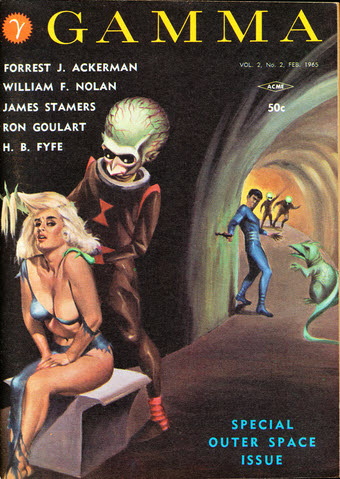 |
| Cover by John Healey |
 |
| Cover by Bert Tanner |
The notable facts of these issues are several, not least that John Brunner appears in the April issue of the Magazine of Horror,
and any number of other fantastic-fiction issues at about this time (as
the always-prolific Brunner was working up to some of the best work in
his career);
the March F&SF features one of Roger
Zelazny's most important early stories, while the April issue is perhaps
most significant as the first issue that Edward Ferman edited
on his own (even though his father, publisher Joseph Ferman, still had
the formal title of "editor" as he had since Davidson's resignation the
previous year), not "using up" the inventory that Avram Davidson had
purchased for the magazine, and introducing Gahan Wilson's first monthly
cartoon (Wilson had contributed cartoons to Fantastic in the 1950s, as well as having already made a career for himself in Playboy, The New Yorker
and other slick magazines by 1965)...Southern Illinois University Press
published a facsimile of this issue in hardcover, with added memoirs by
several of the contributors including Ferman, in 1981. Meanwhile, these
were almost the last issues edited by the similarly important Cele Lalli, who had begun editorship of Fantastic and its stablemate Amazing as Cele Goldsmith;
when the magazines were sold at mid-year to independent publisher Sol
Cohen, as Cele G. Lalli she would stay with Ziff-Davis as a notable
editor of bridal magazines. Here's a decent appreciation for some of the early issues of the Magazine of Horror, which Robert A. W. Lowndes was able to keep afloat from 1963-1971, and a more comprehensive one here...and
not long after these issues, edited by Kyril Bonfiglioli with the help
of fellow writer and artist Keith Roberts, the British institution Science Fantasy would change title to SF Impulse...while its elder sibling, New Worlds, underwent similar changes and eventually even greater ones...
Indices courtesy ISFDb:
Science Fantasy, March 1965
Magazine of Horror, April 1965
The Magazine of Fantasy and Science Fiction, March 1965
Fantastic: Stories of Imagination, March 1965
Gamma, February 1965
 |
| Cover by Gray Morrow |
 |
| Cover by Fred Wolters |
 |
Cover uncredited (perhaps a rush job
by Keith Roberts) |
 |
Cover by John Healey, which would be recycled much later by Mike Shayne
Mystery Magazine, then also under the editorship of Charles Fritch
|

The last major subsets of "firsts" among the fiction magazines that got me hooked were arguably books, most of them...
Alfred Hitchcock's Mystery Magazine
for January, 1978 was the first adult fiction magazine purchased for me
new, 75c and the best bargain in fiction magazines at the time. And,
unusually for
AHMM covers of the time, it was competently
composed...and there were memorable stories from Lawrence Block and Jack
Ritchie, particularly. Inasmuch as I'd already collected some mid-'60s
back issues, and read a few more borrowed from the Enfield Central
Library, I was given the funds to buy a subscription...and not too long
after, I was able to procure a copy of the first
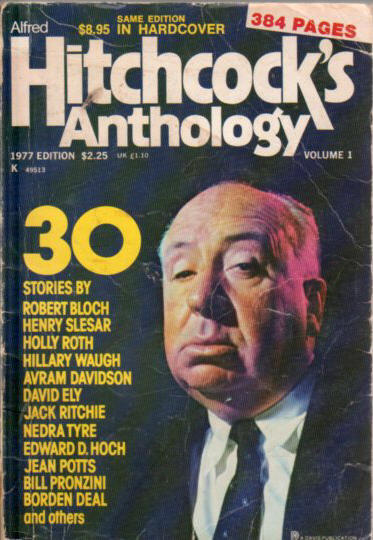
Alfred Hitchcock's Anthology,
which many reference sources would prefer not to call a magazine,
despite being issued periodically to newsstands by magazine publisher
Davis Publications (who also issued
Ellery Queen's Mystery Magazine and the
Ellery Queen's Anthologies,
which the Hitchcock item imitated), although a Dial Press hardcover
edition was also published which tried to disguise the all-
AHMM
selections as one of the eclectic anthologies Robert Arthur and Harold
Q. Masur would ghost for Hitchcock and Random House. These, instead,
were edited by the magazine's editors...in the manner of the many
previous Dell paperbacks taking their contents from
AHMM.

The early
AHA issues/volumes
had a Very rich backfile to draw on, so you can see how addictive they
could be, as well...at about the same time, I was not only also picking
up new issues of
EQMM and
Mike Shayne Mystery Magazine, but was always happy to stumble over such treasures of the recent past as
The Saint Mystery Magazine,,,and, several years later, in 1985, a clangourous new porject popped up, the
New Black Mask, even as
MSMM was beginning to go into its final tailspin, Each issue of
New Black Mask,
all published as books by HBJ, which would also sell you a subcription
to the series just like a magazine, featured a remarkable mix of writers
spanning the range of hardboiled and noir ficton and bit beyond. I
actually picked up the last volum as
NBM to keep first, then collected most of the rest as I catch could, and also the successor series,
A Matter of Crime (after the trademark holders of
Black Mask challenged
NBM's right to use the title).

I started reading the eclectic little magazines (as distinct from fantasy-fiction littles such as
Whispers), aside from arguably
Short Story International
(which was a nonprofit that used good paper and charged twices as much
for itself per issue than most of the other fiction digests...but it was
on newsstands, unlike most littles), with
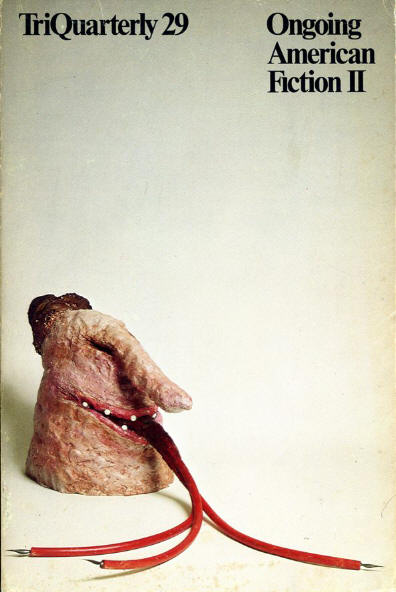
TriQuarterly, which in its first decade particularly was offering one great issue
after another,
particularly when Robert Onopa was associated with the magazine, in the
latter '70s. A snobbish backlash over the SF issue (Algis Budrys,
Ursula Le Guin, Thomas Disch, Samuel Delany) severed most of the staff,
including Onopa, from the magazine, which has yet to fully recover its
quality of those years...the subscribers, I guess, had been pushed to
their limits by the previous western (Dorothy Johnson, Cormac McCarthy,
et al.),
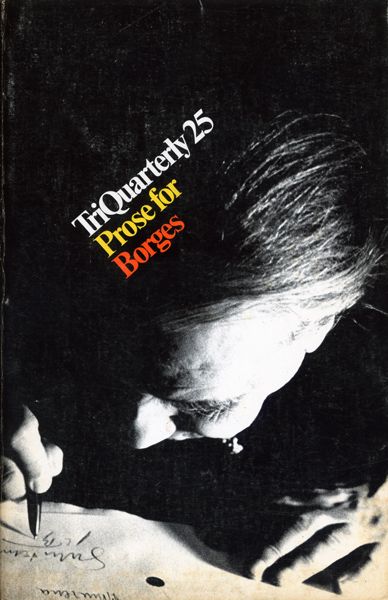
"Love and Hate," and other theme issues, including
"Prose for Borges" and more. (
TriQuarterly has gone
web-only just recently.)

Of course, even before I began reading the little magazines that were no-bones-about-it magazines (such as also
The Paris Review and
Antaeus...it took me a while to find
The Ontario Review and
Boulevard and the comparitively dull
Story revival), I had found some of the periodical book/magazine projects that had begun in the 1950s, such as
New World Writing
(the 6th volume/issue featured a long excerpt from Louis Armstrong's
memoirs, contemporary Japanese haiku in translation, and more),

and their modern descendents, such as the Doubleday Literary Guild loss-leader
Works in Progress (which in the first issue I had offered the best chunk of Alix Shulman's
Memoirs of an Ex-Prom Queen). I tumbled to
New Directions and
New American Review (later simply
American Review) and
Evergreen Review (in those largely post-censorial times) not long after.

...come to think of it, mentioning
Evergreen
reminds me of two other categories of fiction magazine that I haven't
quite yet nostalgically surveyed...the humorous and the erotic (the
latter had quite a vogue in the '80s and '90s, ranging from
Yellow Silk to
Paramour, from
Future Sex to
Blue Blood).

 Bantam first commissioned from Clarence Petersen a not quite (but somewhat) potted history of their corporate adventure in 1970, and then had him do another edition five years later...I haven't seen the earlier edition, but the second volume is engaging enough and only in part a more literary Annual Report to the stockholders. Some of it is almost candid, in describing various missteps, and Petersen, at the time of the first version still reviewing paperbacks for the Chicago Tribune, rather happy to be able to note the successes and victories of other paperback houses from time to time in his narrative.