Showing posts with label sf. Show all posts

Wednesday, December 22, 2021

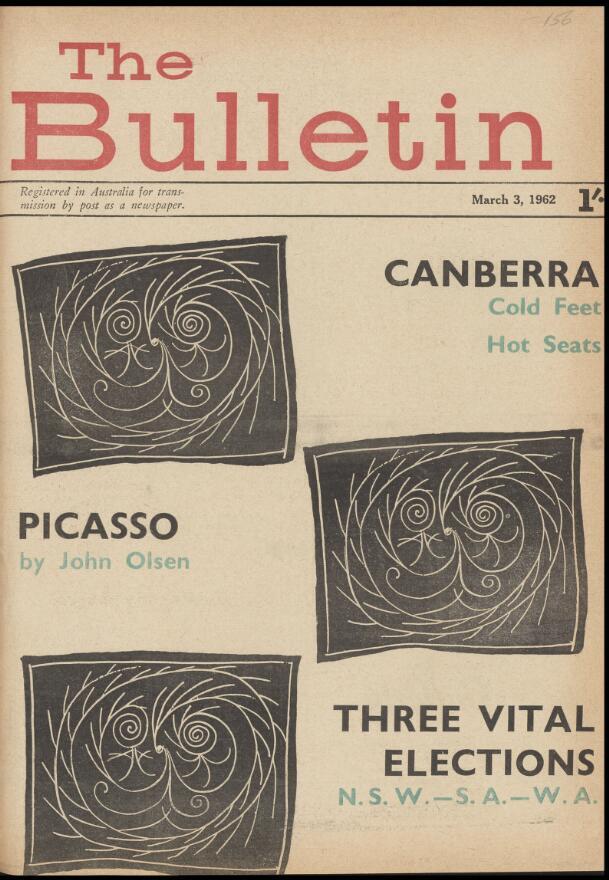
Short Story Wednesday: "It Could Be You" by Frank Roberts, THE BULLETIN (Australia) 3 March 1962 and reprinted variously since

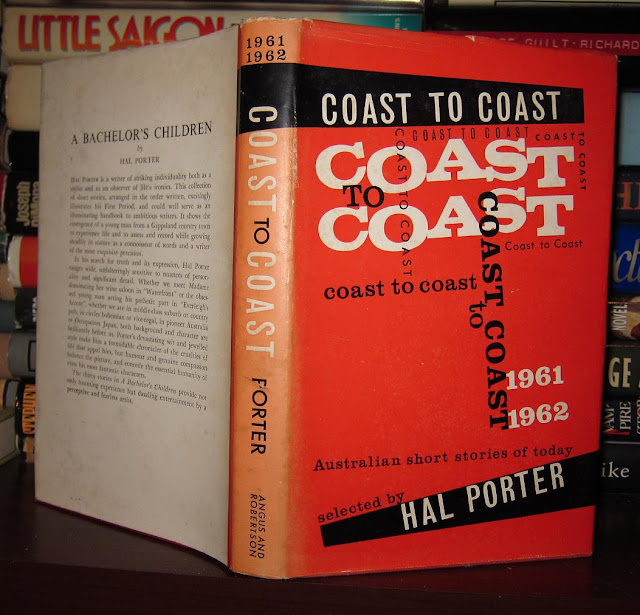
"It Could Be You" by Australian reporter and short story writer Frank Roberts is perhaps his best-remembered story, and was first published in a fairly typical issue of the public affairs magazine The Bulletin...not only did it see reprints in the U.S. in Short Story International (the September 1964 issue) and the Judith Merril speculative fiction best-of -the-year in 1965, but had previously been included in the Australian bi-annual best-short-stories series Coast to Coast volume covering 1961-62, and was later featured in a pioneering 1968 anthology of Australian sf edited by John Baxter, and in a few other anthologies, including a volume devoted to satire, edited in 1972 by the same Hal Porter who edited the '61-'62 Coast to Coast, and that book titled after the Roberts story. 

And it's a story that certainly stuck with me when I first read it, in the Merril annual, borrowed from a Nashua, NH, Public Library in 1978, age 13 (by the reckoning of some, the golden age of SF). John Boston, editor, critic and historian, in reviewing the Merril volume recently on the Galactic Journey blog, noted that its central concept "is not exactly a new idea to readers of the SF magazines, but it’s sharply written and no longer than it needs to be." Sharply written, and with a certain verisimilitude that could be missing from what Kingsley Amis had tagged "comic inferno" stories, even those written for Galaxy magazine at its height, in the 1950s and 1960s; the story is an acidic indictment of what we as humans will put up with in terms of random cruelty if the circumstances are Justified Just So...it might be that this story, down to its last-line twist of the emotional knife, was particularly adept to speaking to me as an adolescent reader in a New Hampshire town not overwhelmingly friendly to recent arrivals nor nonconformity, but it holds up on re-reading, even if the notion of humans in various ways hunted by peers has seen a lot more variations in the decades since 1962...in part because the metaphor remains both relevant and powerful. 


As noted, I first read "It Could Be You" in Judith Merril's The Year's Best S-F: 10th Annual Edition (1965, mostly selecting stories from 1964 publications). Merril was much taken with the then relatively new US magazine Short Story International, which reprinted stories in English or in translation into English from a wide variety of sources, and which ran 1963-67 and then was revived by the same publisher in 1977, and this iteration of the magazine survived into 1997 (when I found 1978 issues after reading this Merril volume, I wasn't at first aware the magazine had ever folded). The Roberts story first had been published in the Australian news-analysis magazine The Bulletin in its 3 March 1962 issue, and from there had been included in the appropriate volume of  the biannual Best Australian Short Stories anthology, Coast to Coast: Australian Stories of Today: 1961-1962, edited for this issue by Hal Porter (published, as the series was, by Angus and Robertson, Ltd, and distributed throughout the Commonwealth and to some extent in the US)--sadly, though, the Porter bi-annual failed to specify which issues of The Bulletin the several stories from that magazine in the volume were taken from. Short Story International picked up "It Could Be You" for a 1964 issue, where Merril saw it and took if for her annual (using the excuse that it was a 1964 story for most US readers, at least; the James T. Farrell story which follows the Roberts in the Merril book, reprinted from The Socialist Call in 1958 by SSI in 1964 was included under similar pretenses. Sadly, at no point in the Merril book is the Roberts story properly credited to its first publication site, either). 

This odd elision continued when Australian editor John Baxter included the story in The Pacific Book of Australian SF (Angus & Robertson, 1968), where at least Baxter cited The Bulletin without giving the issue date. Subsequent editions were apparently no more specific, at best, such as U.S. expatriate editor Tom Boardman, Jr., in his U.K. "instant remainder" anthology Science Fiction Stories (Octopus Books 1979). At least one major reference work in Australia erroneously attributes first appearance to the Coast to Coast volume, as well.

Here's the issue of  The Bulletin, which is archived by the National Library of Australia online at this link:


For more of today's short story selections, please see Patti Abbott's blog.


Even given the typically cheap package this discount/instant remainder book received, it's odd how much the foreground character looks like a quick and dirty take on Sylvester Stallone as Rambo. Not quite what the target audience was likely to be, in 1979 nor later...


Friday, June 29, 2018

FFB: THE UNEXPECTED edited by Leo Margulies (Pyramid 1961); THE BEST FROM FANTASY AND SCIENCE FICTION 9th Series (aka FLOWERS FOR ALGERNON AND OTHER STORIES) edited by Robert P. Mills (Doubleday 1960)

In English, and probably in any language, the most consequential and certainly the most sustained fantasy-fiction magazines have been Weird Tales (or WT), running for 31 years in its first form and revived multiply since (the most recent revival having run for 26 years, if some of them very lean indeed) and The Magazine of Fantasy and Science Fiction (F&SF), soon to enter its 7oth year of continuous publication. In the earliest 1960s, Robert P. Mills was editing F&SF (and therefore the annual best-of anthologies drawn from it), which had absorbed his magazine Venture Science Fiction shortly beforehand, and while publisher Joseph W. Ferman was the credited editor of Bestseller Mystery Magazine, the last remaining crime-fiction magazine at publisher Mercury Press after they sold Ellery Queen's Mystery Magazine (where Mills had been Managing Editor since 1948) and Mercury Mystery had been folded, I suspect Mills had an editorial  hand in there, as well. Leo Margulies had purchased the assets of Short Stories, Inc., the publishers of Short Stories and the folded Weird Tales...Margulies continued to publish Short Stories for a while, and though his one consistent title in the last couple decades of his life was Mike Shayne Mystery Magazine,  he hoped to revive Weird Tales...and did so, for four issues in 1973-74. But in 1961, Margulies published two
anthologies drawn from Weird Tales, the first such to be published explicitly as anthologies from Weird Tales,  though they didn't advertise that fact on their covers: The Unexpected and The Ghoul Keepers, both almost exclusively drawn from the issues edited by Dorothy McIlwraith, who had edited both Short Stories and Weird Tales in the 1940s and '50s.  And so, today's books...the first of three  Robert Mills annual volumes from F&SF, and the first McIlwraith-issues volume (aside from Wellman's story) Margulies put together from WT...two impressive sets of contributors, and not a few notable stories between them...

In a sense, Mills and McIlwraith were both "third editors" of their respective groundbreaking magazines ...Mills followed the four-year solo editorship of Anthony Boucher (legally William White, but known even to friends mostly as "Tony") and Boucher and J. Francis "Mick" McComas's founding stint as co-editors of the magazine for its first five years of publication (and several years of development before that). Mills had been managing editor since the launch in 1949, as well, but even with that and his excellent work at Venture, there was a certain amount of pressure in the new gig. If not nearly the audience resistance that Dororthy McIlwraith faced at Weird Tales, when she succeeded long-term second editor Farnsworth Wright (first editor Edwin Baird did little of note beyond get the magazine out for the first year, and publish WT's first "scandalous" and always most notorious story, "The Loved Dead" by C. M. Eddy, and first contributions by H. P. Lovecraft and Clark Ashton Smith). Wright's magazine had been a receptive market to Lovecraft, Smith, Robert E. Howard, August Derleth, Edmond Hamilton, Manly Wade Wellman, the magazine's most popular contributor Seabury Quinn, and such younger writers as Robert Bloch, Fritz Leiber, Catherine L. Moore, Henry Kuttner (these last two would soon marry and collaborate heavily and constantly), Carl Jacobi and Mary Elizabeth Counselman; he also favored purple prose and exoticism, and had some peculiar crotchets...he consistently rejected Leiber's "Fafhrd and Gray Mouser" sword and sorcery fantasies, which found their early home with Unknown Fantasy Fiction instead, as did "Smoke Ghost", Leiber's best early horror story. McIlwraith brought a greater modernism and broader appeal to the magazine, and published Ray Bradbury, Margaret St. Clair, Richard Matheson, Joseph Payne Brennan, Robert Heinlein, Theodore Sturgeon, Jim Kjelgaard (best remembered now as the author of Big Red and its sequels) and all the previously-mentioned contributors who were still willing and able to contribute, and reprinted some of the others' work...and was roundly condemned by such staunch fans of the Wright magazine as Donald Wollheim, who founded The Avon Fantasy Reader in part to publish something more reminiscent of what Wright's WT had been.
    The Best from Fantasy and Science Fiction: Ninth Series ed. Robert P. Mills (Doubleday LCC# 52-5510, 1960, $3.95, 264pp, hc)
    Also as Flowers for Algernon and Other Stories (Ace, 1966); British editions omit Feghoots [pun vignettes], Ace pb editions omit Feghoots and the poetry by Schenck, Buck, Belkin and Brode; retained are the Lewis, Aldiss and McClintic poems; Mills's headnotes also removed.
    • 7 · Introduction · Robert P. Mills · in
    • 9 · Flowers for Algernon · Daniel Keyes · nv F&SF Apr 1959
    • 41 · Me · Hilbert Schenck, Jr. · pm F&SF Aug 1959
    • 42 · A Different Purpose · Kem Bennett · ss F&SF Nov 1958
    • 62 · A Vampire’s Saga · Norman Belkin · pm F&SF May 1959
    • 63 · Ralph Wollstonecraft Hedge: A Memoir · Ron Goulart · vi F&SF May 1959
    • 67 · Sportsman’s Difficulity · Doris Pitkin Buck · pm F&SF Mar 1959
    • 68 · “All You Zombies—” · Robert A. Heinlein · ss F&SF Mar 1959
    • 81 · An Expostulation · C. S. Lewis · pm F&SF Jun 1959
    • 82 · Casey Agonistes · Richard M. McKenna · ss F&SF Sep 1958
    • 94 · Through Time and Space with Ferdinand Feghoot: XI · Grendel Briarton · vi F&SF Feb 1959
    • 95 · Eastward Ho! · William Tenn · ss F&SF Oct 1958
    • 113 · Through Time and Space with Ferdinand Feghoot: XIV · Grendel Briarton · vi F&SF May 1959
    • 114 · Soul Mate · Lee Sutton · ss F&SF Jun 1959
    • 130 · Call Me Mister · Anthony Brode · pm F&SF Feb 1959
    • 131 · What Rough Beast? · Damon Knight · nv F&SF Feb 1959
    • 156 · Classical Query Composed While Shampooing · Doris Pitkin Buck · pm F&SF Jul 1959
    • 157 · Far from Home · Walter S. Tevis · ss F&SF Dec 1958
    • 161 · Space Burial · Brian W. Aldiss · pm F&SF Jul 1959
    • 162 · Invasion of the Planet of Love · George P. Elliott · ss F&SF Jan 1959
    • 173 · Through Time and Space with Ferdinand Feghoot: X · Grendel Briarton · vi F&SF Jan 1959
    • 174 · Dagon · Avram Davidson · ss F&SF Oct 1959
    • 184 · Pact · Winston P. Sanders (Poul Anderson) · ss F&SF Aug 1959
    • 200 · To Give Them Beauty for Ashes · Winona McClintic · pm F&SF Sep 1959
    • 201 · No Matter Where You Go · Joel Townsley Rogers · nv F&SF Feb 1959
    • 222 · Through Time and Space with Ferdinand Feghoot: XII · Grendel Briarton · vi F&SF Mar 1959
    • 223 · The Willow Tree · Jane Rice · ss F&SF Feb 1959
    • 233 · Through Time and Space with Ferdinand Feghoot: XIII · Grendel Briarton · vi F&SF Apr 1959
    • 234 · The Pi Man · Alfred Bester · ss F&SF Oct 1959
    • 252 · The Man Who Lost the Sea · Theodore Sturgeon · ss F&SF Oct 1959
    • 264 · Through Time and Space with Ferdinand Feghoot: XV · Grendel Briarton · vi F&SF Jun 1959
The Ace paperback edition contents, as a result, under both titles:
The offerings in both books are impressive--check out these sets of contributors, and the most key stories in each, even in the pointlessly dressed-down Ace and UK editions of the Mills (though the Ace movie tie-in edition pictured at the top has the amusing distinction of seeming to have three titles). The WT volume surveys eleven stories from a dozen years of the magazine, with only the Wellman and Leiber stories likely to have been the purchases of Wright rather than McIlwraith; the F&SF volume surveys issues from 1958 and '59, with a number of stories almost certainly purchased by Boucher as editor. Margulies dedicates his book to Donald R. Bensen, the publisher's editor at Pyramid, and quite likely all but a collaborator in the editorial selections as well as clerical/rights work Margulies definitely credits him with: "To Don Bensen, without whom these stories were written, but without whom they would not be in this book"; on the first edition, back cover, "H. H. Holmes" (Boucher as book reviewer for The New York Herald-Tribune, while also reviewing as Boucher for the NY Times) has a praiseful pull-quote (in a sense praising his own work in part); Margulies would dedicated his next WT anthology (reviewed here soon) to Holmes/Boucher, "who asked for more"...Mills dedicates his volume to Boucher and McComas, "who are truly responsible for this book's existence...and to Anne, Alison and Freddie, who contribute so much to the editor's."

The first story in the Margulies, and the last (non-joke story) in the Mills are both by Theodore Sturgeon, the only writer shared by both books, and, till now not having read them within more than several years of each other, I'm struck by how even more similar they are than might be expected...yet the later story, "The Man Who Lost the Sea", is not in any way a retread (and is Sturgeon's one story included by Martha Foley in her annual Best American Short Stories volumes), a science fiction story that nonetheless does in its more non-linear way recapitulates several of the key aspects of the far more unnerving horror story "The Professor's Teddy-Bear".  Both stories deal rather directly with the notion of the boy being the father of the man, and of how the man, coming to understand the full import of his experience in the present, comes to a fuller understanding of the strangeness of his earlier experiences...whether in the context of dealing with a literal psychic vampire creature in the form of a young child's teddy bear, or in the understanding of the full import of early experiences of near-death in exploring new and dangerous environments, in the ocean and elsewhere. Sturgeon's literary grace and deftness in putting across sensory experience in fiction is on full display, as is his fascination with bits of arcane knowledge that he will use as another anchor, along with his exploration of the emotional states of his characters, and their legacies of trauma, in their usually extreme or at least very strange circumstances, to build his stories around. He wants to show you several kinds of wonders simultaneously, and in his many best stories, the integration of these desires is utterly effective. There's a reason he was Ray Bradbury's chiefest literary model, and such an inspiration and goad to writers ranging from Kurt Vonnegut to Judith Merril to Isaac Asimov. 

And Daniel Keyes. "Flowers for Algernon" is, rather obviously, the most famous story in the F&SF volume as things were in 1966, and still, along with Walter Miller's "A Canticle for Leibowitz" and Stephen King's "The Gunslinger", still among the more famous stories the magazine has published so far. It, and Robert Heinlein's "'All You Zombies-'" and perhaps still Richard McKenna's first story, "Casey Agonistes", are probably the most widely-read stories in Mills's anthology ...the Heinlein a key late short story in his career, and also a further mining of a key trope for him, notably less emotionally explored in his earlier story "By His Bootstraps", involving a very peculiar sort of time paradox and its results, and the McKenna a very powerful yet gentle sort of horror/fantasy, though McKenna's early death didn't allow him to capitalize much on the enormous popular success of his first and only fully-finished novel The Sand Pebbles, an autobiographical recent-historical story dealing in part with his experiences in East Asia as a seaman in the years before WW2.  Likewise, Walter Tevis, more widely known (or at least his novels are, as sources for films) for The Hustler and its sequel The Color of Money (you might think of Paul Newman), and The Man Who Fell to Earth (and David Bowie), has a particularly charming and resonant vignette, "Far From Home", for which he also titled his one powerful collection of short fiction. But "Flowers for Algernon," the tale of a mentally challenged man who undergoes an experimental medical procedure which makes of him a genius, and the joys and dangers this offers him emotionally and otherwise, is a story which has a visceral appeal particularly to the kind of person drawn to science fiction, but which also has almost as strong a hold on less sf-prone readers, particularly as delicately but straightforwardly told, in the form of diary entries by the protagonist Charly, about his experiences and those of the lab mouse Algernon who has also undergone an earlier test of the procedure.


Among the familiar stories (at least since their early reprint in the Margulies book)  in The Unexpected are Fredric Brown's "Come and Go Mad", Fritz Leiber's "The Automatic Pistol" and Manly Wade Wellman's "The Valley Was Still", an historical fantasy set during the waning days of the US Civil War, later adapted, with a slightly heavy hand but still effectively, for an episode of  the first version of the tv series The Twilight Zone, "Still Valley"; such stories as Margaret St. Clair's "Mrs. Hawk" and Ray Bradbury's "The Handler" (not to be confused with Damon Knight story of the same title) in the WT book, and Alfred Bester's "The Pi Man", "William Tenn"'s "Eastward Ho!", Knight's "What Rough Beast" and Avram Davidson's "Dagon" in the Mills book are all very good examples of what their authors could do, if not the first stories one might think of from them or the magazines, and the other stories in the books are at least more than simply worth preserving, in 1960 and '61 when these books were first issued, and today--and the openness of Dorothy McIlwraith and Robert Mills to writers whom one might not think of as "typical" for their magazines, such as Frederik Pohl and Isaac Asimov in WT, or George P. Elliott (who was, like John Ciardi and others, a lifelong enthusiast of and occasional contributor to fantastic literature, as well as Barry Malzberg's mentor of sorts in the latter's university career) and Joel Townsley Rogers in F&SF, are on display here as well. I suspect I'll have more to say about them, soon.

For more of today's books, please see Patti Abbott's blog.

Below, earlier-edition covers for the Mills volumes--Doubleday rarely did better than providing merely functional at best covers for the hardcover editions of the series over the decades, and the UK reprint isn't notably better in this case--and the full view of the second-edition package of the Margulies...Pyramid had adopted a sort of semi-uniform "look" for its anthologies drawn from fantasy magazines that the newer covers reflected...it was certainly easier to read while browsing a paperback rack, if less splashily colorful.


Photo by Bill Crider

Friday, September 2, 2016

FFB: INTERSECTIONS: THE SYCAMORE HILL ANTHOLOGY edited by John Kessel, Mark L. Van Name and Richard Butner (Tor 1995/6); MIRRORSHADES: THE CYBERPUNK ANTHOLOGY, edited by Bruce Sterling (Arbor House 1986)

In the early/mid and into the latter 1980s, a knot of some of the more adventurous sf writers started seeing themselves as a school, which some of them dubbed "the Movement" (leaving themselves gapingly open for all sorts of digestive jokes), and which editor/writer/critic Gardner Dozois tagged the "cyberpunks"...as a collective promotional tool, this wasn't the worst gambit, though in retrospect some of the writers so tagged got more out of it than others, and the one held up as exemplar, William Gibson, was among those least interested in public discussion about whether he was Movement Cyberpunk or not (which contrasts pleasantly with the predicament of Joe R. Lansdale, who along with Clive Barker would be hailed as a leader of the horror-fiction "splatterpunks" not too long after, apparently a label he despised and indicative of a similarly self-conscious clubbiness he wanted little or nothing to do with). And it's no fun having a clubhouse if you don't have outsiders to rail against...quite aside from those sf writers, and vocal readers, who found the cyberpunks inherently offputting for their desire to be Bleeding Edge, there were similarly ambitious, often young writers emerging in sf at the same time that the C-punks (and others) recognized as having a different, if somewhat congruent, literarily sophisticated, culturally-curious approach...and they were soon tagged, originally by Michael Swanwick (see below) perhaps but enthusiastically by the Movementists, "the Humanists" (while cyberpunks, borrowing from one of their older and most visionary members, Rudy Rucker, were often rather "transhumanist")... It happens that, even separated by a decade as they are, these two anthologies are interesting core samplings of the "cyberpunks" and the "humanists"...with a representation of the "other" camp within each...

Bruce Sterling's pseudonymously-published quasi-"samsidat" (and utterly uncopyrighted) fanzine Cheap Truth (though the archive at this link doesn't include the complete contents of the fanzine's one-sheet/two-page issues) featured the other cyberpunks as well, under their own pen-names, and their takes on the current scene in the 1980s; here's Sterling on the initial volume of Gardner Dozois's still-continuing best of the year annual: 

*  ICE CRACKS UP WITH '83 BEST OF THE YEAR  **

        THE YEAR'S BEST SCIENCE FICTION FIRST ANNUAL COLLECTION, Gardner
Dozois, ed., Bluejay, $9.95.

        With this volume, Bluejay Books has delivered a stinging duellist's
slap to the slack jowls of the anthology market.  Bluejay's daring must be
roundly applauded and they've come through with a real bug-crusher in this
575-page colossus.

        Veteran editor Gardner Dozois blithely ignores the stock list of Neb
and Hugo nominees to give us work of genuine merit from the most esoteric of
markets.  The man's masochistic dedication to the genre -- he reads SF in
truly industrial quantity -- has never been more in evidence.  His opening
Summation repays close reading for its quick-witted ideology and sagacious
grasp of industry dynamics.

        The book is remarkable for its lack of clunkers.  Even the worst
stories here can be read with a straight face.  The best can stand with
anything written in the past ten years.  More importantly, they show an
earnest effort by '80's writers to scrap old formulas and speak in a modern
vocabulary.

        Greg Bear serves as the exemplar.  His two stories included here have
won dual Nebulas, itself a very promising sign.  As co-editor of the SFWA
Forum, the man was in the heart of the beast, and his daring attempts to
transcend his own limits are therefore doubly praiseworthy.

        His bizarre OMNI story of '82, "Petra," showed something odd stirring
in the Bear attic.  With "Hardfought" and "Blood Music," the man has thrown
restraint to the winds.

        "Hardfought" may be thick with jargon and laden with annoying
attempts at verse.  But it burns with genuine visionary intensity and its
Stapledonian daring arouses real wonder.  This is what SF is about.

        "Blood Music" has a ludicrous plot and has filed the serial numbers
from Sturgeon's "Microcosmic God."  But Bear knows what to borrow, and the
ending goes for broke.  Bear's reckless energy has made him a writer to watch
-- and to emulate.

        Efforts by more established writers show the effect of a real thaw.
Silverberg's "Multiples" is one of his best in years: smooth, devastatingly
plausible, a brilliant idea handled with great skill.  Tanith Lee is at her
unique best with "Nunc Dimittis," a dark fantasy that shimmers with
necro-eroticism.  R. A. Lafferty spryly tramples convention with a story from
his splendid small-press collection, "Golden Gate."  Lafferty has always been
a cult figure.  He will still be a cult figure a hundred years from now.

        Particularly heartening are the efforts of the "'80's Generation,"
listed by Dozois as Bear, Cadigan, Gibson, Kelly, Kennedy, Kessel, Murphy,
Robinson, Shiner, Sterling, Swanwick, and Willis -- surely one of the oddest
groupings ever.  Seven have stories here -- the rest figure prominently in
the Honorable Mentions.

        If these heirs-designate were dropped into a strong magnetic field,
Gibson, Shiner, Sterling, Cadigan and Bear would immediately drift to one
pole.  Swanwick, Robinson, Kessel, Kelly, Murphy and Willis would take the
other.

        Leigh Kennedy goes her own goddamn way.  Her story, "Her Furry Face,"
demonstrates Kennedy's unique style:  low-key, determined prose combined with
an unflinching and peculiar vision.  Reading Leigh Kennedy is like having
your housecat show up with a small dead pterodactyl in its jaws.

        Pat Cadigan's "Nearly Departed" is a psi story, not overly burdened
with technological literacy.  But its tough-minded lack of sentiment keeps
reader interest up.

        Bruce Sterling's "Cicada Queen" shows this ambitious writer manfully
wrestling with this complex Mechanist/Shaper future society.  It should have
been a novel, and apparently will be.

        No review could be complete without a mention of Jack Dann's "Blind
Shemmy."  This story is so sharp-edged that it ought to be read with forceps.

        Altogether, Dozois' collection is excellent, both for what it is and
for what it promises.  Its Summation and thorough list of Honorable Mentions
are worth the price in themselves.  Winter is over -- prepare for spring
cleaning.

Here, as well, are writers Michael Swanwick and James Patrick Kelly discussing, from half a decade ago, the ferment of the 1980s; Swanwick wrote one of the first articles, for Isaac Asimov's Science Fiction Magazine, about the arguable emerging schools:


The complete discussion from which this is the third excerpt can be seen here...

What helps make these key anthologies of the "camps" that they are, aside from the fiction collected in them and the writers involved, are the introduction to Sterling's volume by the editor, which helps, in still somewhat propagandizing mode (a bit tongue in cheek, but only a bit, and how large a bit sometimes changing from paragraph to paragraph) and, in Intersections, the notes from the story and excerpt contributors about the writer-conference feedback provided for each story in its form as presented, and what the writers made of that.  The generational feel of each group is still strong, even given that Intersections features some writers who came into the field a bit later (such as Jonathan Lethem and Michaela Roessner) as well as the artistic outlier Carol Emshwiller, who first published in the 1950s and was a fully mature artist by the turn of the '60s at the latest (and whose contribution is an excerpt from her first, somewhat eccentric western novel, Ledoyt) ...though John Shirley, for example, among the Other Guys, had begun publishing several years/a half decade before most of the others (and his contribution is the novel excerpt in the earlier book), as had Rudy Rucker...and while his work isn't collected in Mirrorshades, certainly the 1960s veteran Charles Platt was a supporter of the new approaches and their spirit. Also, of course, notable: the presence in each anthology a story by a member of the "opposing camp": Kelly's story in the Sterling book, and Sterling's in the "humanist" document...also, a version of the evergreen, and often expanded, "Turkey City Lexicon" essay about What Not to Do with and in Your Story, a product of a lot of critical apparatus applied within and outside such workshops as the Turkey City sessions of the 1980s (a "cradle of cyberpunk" as the current SFWA-posted version notes)...

Things, as they often do, have kept me from reading enough of the contents of these books to comment much on the stories themselves at this time...soon, I hope. 


Intersections: The Sycamore Hill Anthology ed. John Kessel, Mark L. Van Name & Richard Butner (Tor 0-312-86090-0, Jan ’96 [Dec ’95], $23.95, 384pp, hc) Anthology of stories written at the 1994 invitation-only Sycamore Hill Writers’ Conference, with comments by the writers about their experiences. Authors include Karen Joy Fowler, Alexander Jablokov, Michaela Roessner, and Maureen F. McHugh.

13 · Introduction: Fun in the Burn Ward · John Kessel, Mark L. Van Name & Richard Butner · in *

22 · Bicycle Repairman [Chattanooga] · Bruce Sterling · nv *
60 · The Marianas Islands · Karen Joy Fowler · ss *
76 · Sex Education · Nancy Kress · nv *
97 · The Hardened Criminals · Jonathan Lethem · nv *
129 · The Escape Artist · Michaela Roessner · ss *
148 · Body & Soul · Robert Frazier · ss *
168 · The Fury at Colonus · Alexander Jablokov · nv *
193 · Homesick · Maureen F. McHugh · ss *
211 · from Ledoyt · Carol Emshwiller · ex *
231 · The Miracle of Ivar Avenue ["Hollywood" series] · John Kessel · nv *
269 · Missing Connections · Mark L. Van Name · nv *
296 · That Blissful Height · Gregory Frost · nv *
332 · Horses Blow Up Dog City · Richard Butner · ss *
349 · The First Law of Thermodynamics · James Patrick Kelly · nv *
375 · Appendix I: The Turkey City Lexicon: A Primer for SF Workshops · Lewis Shiner · ar *
383 · Appendix II: Sycamore Hill Attendees · Anon. · ms *

Mirrorshades: The Cyberpunk Anthology ed. Bruce Sterling (Arbor House 0-87795-868-8, Dec ’86 [Nov ’86], $16.95, 239pp, hc) Anthology of 12 stories by Gibson, Bear, Rucker, Cadigan, and others, plus a preface on the “cyberpunk” movement.

ix · Preface · Bruce Sterling · pr
1 · The Gernsback Continuum · William Gibson · ss Universe 11, ed. Terry Carr, Doubleday, 1981
13 · Snake-Eyes · Tom Maddox · ss Omni Apr ’86
35 · Rock On · Pat Cadigan · ss Light Years and Dark, ed. Michael Bishop, Berkley, 1984
44 · Tales of Houdini · Rudy Rucker · ss Elsewhere v1, ed. Terri Winding & Mark Alan Arnold, Ace, 1981
51 · 400 Boys · Marc Laidlaw · ss Omni Nov ’83
68 · Solstice · James Patrick Kelly · nv IASFM [now Asimov's Science Fiction] Jun ’85
108 · Petra · Greg Bear · nv Omni Feb ’82
128 · Till Human Voices Wake Us · Lewis Shiner · ss F&SF May ’84
142 · Freezone · John Shirley · ex Eclipse, John Shirley, Bluejay, 1985
182 · Stone Lives · Paul Di Filippo · nv F&SF Aug ’85
207 · Red Star, Winter Orbit · Bruce Sterling & William Gibson · nv Omni Jul ’83
228 · Mozart in Mirrorshades · Bruce Sterling & Lewis Shiner · ss Omni Sep ’85

the hardcover editions--two books that weren't sold on the strength of their covers:

Some of this was originally published on Apr 26, 2013; for more reviews of books for today, please see Patti Abbott's blog! (upon appearance in its earlier form) and the blog today for this expanded form.

Friday, December 4, 2015

FFB redux: Ed Gorman guest post: LEARNING TO KILL by Evan Hunter as Ed McBain; Mason on HRF Keating: CRIME & MYSTERY: THE 100 BEST BOOKS; Richard Lupoff & Don Thompson, eds.: ALL IN COLOR FOR A DIME; Peter Nicholls, ed. SCIENCE FICTION AT LARGE

Two posts from 2011 that didn't get quite the number of eyetracks they could...particularly Ed's, posted after mine below....


Friday, April 15, 2011


FFBs: HRF Keating: CRIME & MYSTERY: THE 100 BEST BOOKS; Lupoff & Thompson, eds.: ALL IN COLOR FOR A DIME; Peter Nicholls, ed. SCIENCE FICTION AT LARGE


H.R.F. Keating passed on 27 March [2011], and we lost another gentleman, by all accounts, in the CF field, one who had been a fine fiction-writer (most famously for the Inspector Ghote stories) and critic both, and this book, widely available but barely in print (the current edition is handsome, but still a product of the collapsed Carroll & Graf; one hopes Running Press or someone might reissue it), is a gimmicky (in format, and I think the first of its series for C&G, which series has also included notable volumes on sf and horror fiction) but no less valuable selection of a hundred important and valuable books in the CF field, most of them of the "true" mystery rather than suspense or other related fields, some collections (leading off, unsurprisingly, with a Poe collection) though most novels, all given two-page essays to limn their virtues and what flaws they overcome. The Keating assessments are bookended by Patricia Highsmith's two-page introduction (even Highsmith had nothing but good to say of Keating) and an unsigned "Publisher's Note" adding a 101st entry, for one of Keating's Ghotes. Aside from the insightful and deftly-written vignette entries, Keating also doesn't respect received wisdom: he nominated for Ross Macdonald The Blue Hammer and for John D. MacDonald The Green Ripper, the often-dismissed last novels in the two Macs' famous series (Lew Archer and Travis McGee), and makes the case for these specific novels well (hey, I started reading RM with The Blue Hammer, and I wasn't sorry), while the all but inarguable classics (Stanley Ellin's short fiction, The Maltese Falcon, Murder on the Orient Express, The Friends of Eddie Coyle) are treated similarly. Despite at least one dunderheaded comment I've seen, going on about how "outdated" this book is since it was published in 1988 (remarkable how books spoil, isn't it), the book is joy to go through, argue with, and be informed as well as amused by.

Also "outdated" (I mean, it hardly deals with comics after the '40s! I mean, come on!), All in Color for a Dime, which I've reread in the Krause Publications 1997 reissue, retains the enthusiasm of the new ground being tilled (since most of the essays at least have roots in articles in the Lupoffs' Xero and the Thompsons' Alter-Ego, with Comic Art the pioneering comics fanzines [while Xero, at least, also dealt with other matters] from the earliest '60s, and this book was pioneering when first published in 1970). The contributors run most of the changes one could want on their subject matter (and they range from such passionate professional writers of fiction and pop-culture history as Ron Goulart, Harlan Ellison, and Lupoff himself through folks with feet in multiple camps such as Ted White and Jim Harmon, to folks whose primary work was extraliterary, but nonetheless, such as Chris Steinbrunner, had a long engagement in criticism or other sorts of similar work in literary circles--Steinbrunner was, among other things, Ellery Queen Mystery Magazine's a/v columnist for a decade or so: "Bloody Visions"). While, as I mentioned last week, the Blue Beetle is nowhere mentioned (the book is not attempting to be comprehensive), the coverage of the evolution of the Love Romances Publications line of comics, Planet Comics and its stablemates, would be worth the price of the book alone, as would the pioneering Lupoff article on Captain Marvel and his eventual clan, or Ellison on the George Harriman-esque George Carlson (only Carlson was busy where Harriman was lean).


New material was added to the reissue, but here's the ISFDB index to the Ace edition pictured above:


Science Fiction at Large, the first anthology of critical essays (speech transcriptions rendered into essay form) I read, which had somehow found its way into my first high-school's brand-new library in 1978, and featured impressive essays by Ursula K. Le Guin and Thomas Disch which were to grow into or form important parts of later books (UKL's "Science Fiction and Mrs. Brown" was collected in her The Language of the Night; "The Embarrassments of Science Fiction" is integral to Disch's The Dreams Our Stuff Is Made Of and has been collected in his On SF), as well as by Harry Harrison, Alan Garner, John Brunner, Robert Sheckley, Philip K. Dick, and the editor; Edward De Bono's introduction to his take on "lateral thinking" was very useful to me then, and remains so. I haven't yet reread John Taylor's essay, and Alvin Toffler's remains slight. A book worth seeking out.

ISFDB indes:


For more of this week's "forgotten" books, please see Patti Abbott's blog.

5 comments:

John said...
I nearly wrote about one of the Inspector Ghote books for this week's FFB. But I'm saving it for a larger article on five of Keating's books - a sample of his fiction contributions to the genre. I found a few new authors well worth reading from this book. I'd like to track down his Christie book - he was a huge fan. Also Murder Must Appetize sounds like unusual genre history reading. Food in the crime novel. Do you know anything about that?

[Word verification for this comment: Polessi. (noun) What an Italian character in a Harry Stephen Keeler novel calls a cop.]
Richard R. said...
I have the later edition of All In Color... and enjoyed it. I didn't expect it to cover too far into the century as it states "for a dime" in the title and that price changed for most comics by, what?, 1956? Sooner? They were a dime when I started buying them, but went to 12 cents and then 15 cents not too long after.

It's an entertaining look at the industry, as I recall.
Todd Mason said...
Looking forward to that, John (the Keating essay, not so much the neo-Keeler incidents). I haven't read that, nor seen it, but CF and particularly classic mystery buffs so love their associational exploration (not that, say, sf writers haven't had their cookbooks over the years).

Yeah, Rick, I was joking (about the kind of imbecile who thinks that 100 BEST BOOKS is outdated because it doesn't cover books published after it...as if anyone is fool enough to propose a finalized and unchanging canon of literature through the ages...not even Mortimer Adler...). Though that a few relatively obscure, once popular figures weren't touched on at all (or now not obscure at all, such as Carl Barks) was almost too bad. But there hasn't been Too much written about PLANET COMICS since, I think.
George said...
For once, I have all three of your FFB books! I actually bought the Keating book when it came out and slowly read all the 100 books he recommended!
Todd Mason said...
Yes, this is nostalgia day except for the Keating, so I'm not too surprised they were in your collection, as well (I have the Ace paperback of ALL IN COLOR in a box somewhere, as well). I have read perhaps the equivalent (given the various collections of Poe) of about twenty of Keating's hundred (plus the publisher's one). I'd run a bit higher with the two Horror Hundreds, and I'd have to take a look a the SF and fantasy books again...