Friday, November 11, 2011

FFB: NEGLECTED VISIONS edited by Barry N. Malzberg, Martin Harry Greenberg and Joseph D. Olander (Doubleday 1979)


Neglected Visions is an interesting anthology in several ways, not least in being a fine collection of short fiction, much of it previously uncollected and all of it out of print at time of publication in 1979; also, it was the first collaborative anthology between prolific anthologists (and frequent collaborators) Barry Malzberg and Martin Harry Greenberg (Barry, whom I've quizzed briefly about this book, remembers Joseph Olander's role as being relatively slight, and that Olander was approaching his retirement from work with Greenberg), as well as being a relatively early book in both their compilation careers. Also unusually, Malzberg and Greenberg/Olander take credit for discrete selections here, with Barry putting in the Mark Clifton, Kris Neville, Peter Phillips, Norman Kagan and F.L. Wallace stories, and his collaborators including the Christopher Anvil, Randall Garrett, Robert Abernathy and Wyman Guin items. Along with getting one more story in, Malzberg also provides a general introduction, and the selectors switch off introducing the stories themselves. Malzberg and Greenberg would do something altogether similar again in Uncollected Stars (Avon, 1986), which I briefly reviewed sometime back, with collaborators Piers Anthony and Charles G. Waugh (in that same review I cited Ramsey Campbell's Fine Frights, which shares the Phillips story with this one...the only story among them I'd read before picking up Neglected Visions).

None of these stories are particularly well-known even among most fantasy and sf "insiders" with the possible exception of Randall Garrett's remarkably thoroughly worked-out "The Hunting Lodge" (a breathless adventure of an assassin's attempt to kill one of the nearly-immortal "senators" who have divvied up North America into personal fiefdoms), a work cited by James Blish as well as the editors here as a jewel, sadly rare in the torrent of facile work he produced to order to fill the pages of Astounding Science Fiction in the latter 1950s and early 1960s, when editor John W. Campbell, Jr. seemed to have grown weary of his task, and was often editing on autopilot (Garrett, by himself and in collaboration particularly with Robert Silverberg or Lawrence Janifer and often under pseudonynms, apparently appeared more times in the magazine than any other contributor of fiction). Garrett would actually try again with his frequently impressive Lord D'Arcy stories in the early '60s and onward (among scattered other examples of solid or better work), but old hacking habits died hard. This cover inspired a lot of machismic discomfort in the sf-fan community at the time, inspiring jokes about, ho ho, the model being John Campbell's "wife"...

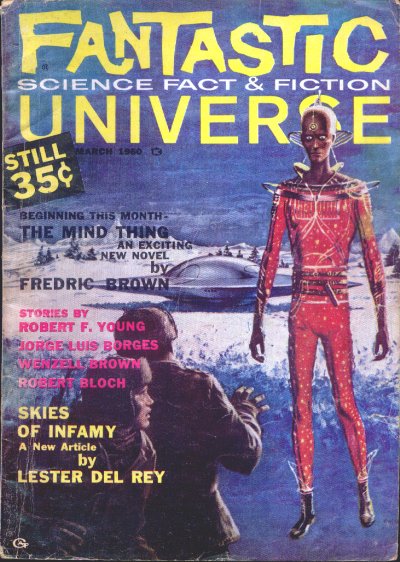
Big Digression: It's little wonder that along with the winnowing of the flood of digest-sized sf and fantasy magazines that popped up in the early 1950s to augment the pulp titles, with opportunist publishers aware of the success of the new Galaxy (particularly), Fantastic and The Magazine of Fantasy and Science Fiction, and the reinvigorated, more mature and briefly more successful than ever Startling Stories and its stablemates, that Earl Kemp's Who Killed Science Fiction? struck such a chord in 1960, as the book publishers were pulling back from their experiments with sf in the early '50s, the potential for ever more mature, well-written and adventurous sf seemed to be disappearing, and as Astounding and Galaxy languished [along with the latter's newly-purchased stablemate, If, treated as a commercial step-sibling] even as they continued to include good and better fiction with the mediocre and worse, F&SF under Robert Mills was the blandest it would be for decades, if still good [Mills had done better at the shortlived companion Venture Science Fiction previously], and Fantastic and Amazing were only beginning to recover from the utterly disinterested editorship of Paul W. Fairman, under his former assistant, the green but adventurous Cele Goldsmith...and all the other magazines in the field were dead by the end of 1960, H.S. Santesson's Fantastic Universe (the last issue had a garish cover and the beginning of a serialization of The Mind Thing by Fredric Brown and stories by Robert Bloch and Jorge Luis Borges; it was a stablemate of the US edition of The Saint Mystery Magazine, which Santesson also began editing in '59, succeeding Sam Merwin, who had edited Startling and would move on to Mike Shayne Mystery Magazine) and Robert A. W. Lowndes's Science Fiction (the last title of the Columbia pulp and digest chain, publishers of some of the last crime-fiction and western pulps and the last sports-fiction pulp) being the last stragglers to fold. End of digression, pretty much.


The book begins with a story by retired psychologist Mark Clifton, who turned to sf as a medium for social criticism with vigor, but also (as Malzberg notes) with a keen commercial sense of how to appeal to his primary editor, John Campbell, by writing the kind of stories (about psionic abilities and other ESP-related matters) that JWC was particularly fascinated by in the early to mid 1950s; with "Clerical Error," Clifton was able to strenuously criticize specifically his former profession and the adjoining one of psychiatry, the government cult of classified information, and the tension between actual creative thought and survival in bureaucracy, essentially all matters close to Campbell's heart as well; Barry suspects the rather easy ending was created either in anticipation of Campbell's desire for such, or at his editorial command. The story has not aged badly, as, ridiculously, the degree of these problems hasn't lessened in the slightest since 1956, where it hasn't worsened. Barry has been championing Clifton fairly consistently since the latter 1970s, at least, and has been instrumental in bringing at least some of his work back into print, though the collection (co-edited with Greenberg), The Science Fiction of Mark Clifton (Southern Illinois University Press, 1980), as Barry recalls, sold less than 700 copies--not that SIU Press did much to support it. Clifton's novel with Frank Riley, They'd Rather Be Right, won the second Hugo Award given to a novel, in 1955.

"Christopher Anvil" (Harry Crosby)'s "Mind Partner" is also a story about madness, identity and perception, by another "pet" writer of Campbell's, though perhaps it's notable that this story, which Barry suggests is Anvil's best and it's certainly the best I've read by him, was published in Frederik Pohl's Galaxy instead. This one offers a private investigator trying to help bust an apparent drug ring, who move from mostly well-appointed house to house, but leaving a wake of despondent, psychotic addicts whenever authorities close in but fail to apprehend them. It turns out the pushers can alter perception in remarkably labyrinthine ways, including those of anyone who threatens them; our protagonist goes through a not quite recursive set of experiences as dark (in implication often more than in incident) and as well-told as the best of Philip Dick's similar work, and even though this was not one of Barry's choices, it's certainly akin to Malzberg's work in this mode, as well. Like the Clifton, it has a rather too-neat ending, but remains strange and engaging throughout.

Kris Neville's "Ballenger's People" is the story in the book closest to Malzberg's heart, "the best thing [Neville] has ever written and the best American short story published in its crazy year." as he puts it in the story's headnote; yesterday, he noted in email, "[It] had an enormous influence on my work; I read it at exactly the right time (1967 when published in Galaxy)." It tells the story of a man named Ballenger, whom we discover contains multitudes as well as a pure and abiding love for a percussionist named Angelique and, not irrelevantly, a bone to pick with a Columbia Record Club-style company he had bought his previous love-interest's videotapes from. It is a deft study of not quite functional madness and its affects on those around the madness or treating with their own less obvious sort, akin to both Malzberg's work and Robert Coover's, among others'. And thus, it, too, as is the Garrett which follows, to a great extent another story about identity, perception of identity, and distortion.

"Lost Memory" continues to be a very grim joke, both the title pun and the story as a whole, losing little of its power on rereading, about well-meaning robots doing their best to return an apparently fallen alien machine to mechanical health...while the human within the damaged spaceship they've found does his best to find a way to help them understand his plight. Malzberg notes that he almost chose Phillips's "Dreams are Sacred" over this one, but noted that what made the choice easier was how many writers had echoed "Dreams" over the years, including Barry himself, while "Lost Memory" seemed to serve as the last word on its theme. "Junior," by Robert Abernathy, which follows, is a much lighter sort of conceptual breakthrough comedy, involving a rebellious young male among a society of sentient and hidebound as well as shellbound mollusc-like creatures. It's a bit cute for my taste, but is pleasant and clever enough. It was a Greenberg/Olander choice and Barry also looks upon it fondly.

"Laugh Along with Franz" by Norman Kagan was another important story in Barry's career, inasmuch as it challenged him to consider writing sf professionally, as well as providing the example that the kind of thing he wanted to write could be published in sf media. Rather in the mode of the film of The Graduate, only more imaginatively and earlier, and even moreso in the mode of such satirical writers (at least when in that mood) as Herbert Gold and Philip Roth and Bruce Jay Friedman or Muriel Spark, only as informed as their fellow-travelers Ray Nelson or (Ms.) Jody Scott (and certainly Malzberg as well) by sf tradition and, of course, by such allied work as Kafka's as well as by the Beat-begetting-Hippie counterculture, the story deals with a young software engineer at IBM (redubbed ICM) coming to some realizations about what really matters in life, and what might just be a tissue of lies, convenient for the powerful.

Wyman Guin, perhaps more exclusively famous (to the extent that he is) for What Is Reality fiction than anyone else in sf, thanks to his once widely-reprinted "Beyond Bedlam" (far superior to Evan Hunter's slightly later drugged society story "Malice in Wonderland," if perhaps missing the snappy ad lines of Huxley's most famous fiction), is instead represented here by a mildly misogynist but otherwise deft fantasy, "My Darling Hecate." Guin didn't quite learn the right lessons from Fritz Leiber's Conjure Wife, in this story of an accidental but nonetheless powerful witch, who has remarkable powers she can barely control, when she puts her mind to it. But, again, it plays out rather cleverly, particularly in the manner in which her subconscious plays havoc with the world around her.

I'd just begun the Wallace story, as I write this, the previous night, and while it starts promisingly, with yet another sort of spy or agent making his way through a dangerous city on a world inhabited by amphibian humanoids, I might or might not get to finish it before revising this later today. Barry is almost as enthusiastic about Wallace's work as he is about Clifton's; he sees Wallace's fiction as similar in approach and in reframing the questions we should be asking in science fiction, though Wallace was writing for (the no less demanding, and in both similar and different ways eccentric) H. L. Gold, founding editor of Galaxy, who grew more removed from his editorial work in later '50s less from simply burning out, as Campbell was, than by the weight of failure to achieve his ambitions with his magazine, and the effects of both WW2-induced agoraphobia and pain meds he took, even before an auto-accident during an attempt to go out nearly killed him; this is why Frederik Pohl was apparently editing Galaxy and If in all but title no later than 1960, and gradually doing more and more of the work for some time before that. That Wallace was so strongly associated with Gold's version of the magazine might've been a contributing factor in Wallace leaving sf in the late '50s, not finding Pohl the same sort of editor; as Malzberg notes, Wallace published some mystery novels and then ceased writing fiction.

And I've finally noted, all these stories come from either Campbell's Astounding (before its retitling as Analog in 1960), or from Gold's Galaxy and Beyond, or Pohl's 1960s Galaxy (and Pohl had been pretty deeply involved with Galaxy as a contributor of fiction and literary agent for a lot of the other contributors from nearly its beginning under Gold).

All told, while this book (moreso than the latter Uncollected Stars), has fiction which tends to cluster, as repeatedly noted, around questions of perception and identity, while touching on rather than for the most part dealing directly with other great themes that sf can lend itself to, it's an excellent book to sit and read. And, like the later volume, if not quite to the same extent as the Clifton collection, it was not a commercial success. Like nearly every other book published in the Doubleday Science Fiction imprint, particularly at the production nadir of that line in the late '70s, it's poorly bound (the trade hardcover has a glue binding, not sewn, and in every other way is identical to the probable SF Book Club edition of the time, another arm of Doubleday), given an inept cover (in this case moreso than most even for D-day...just look at it), and, as Barry notes, "Doubleday packaged the book contemptuously and dumped it as they dumped all Doubleday sf. Sales were miserable." The Doubleday Science Fiction imprint depended on library sales for nearly all of its income (and was hardly unique in this in hardcover publishing at the time, or for at least a decade or so beforehand and after), and expected those sales to come to a certain amount whether a given book was good, bad or indifferent; no one in Garden City was going to make much effort to help distinguish any given item published thus. The Asimov books would sell better, and Ellison's Dangerous Visions anthology too, or at least sell consistently for longer, but Asimov didn't write much sf any longer, and his sf books from Doubleday were usually about as clumsily-packaged as everyone else's. Everyone else could cry themselves a river. And even as The Simarillion was setting sales records for hardcover fiction, and the Levin/Tryon/Blatty/King/Rice horror blockbuster trend was starting to become impossible to ignore, no one at D-day was going to try to suggest that a Doubleday Fantasy or Doubleday Horror imprint might be a useful, much less a profitable, idea...nah, those books could continue to be "Doubleday Science Fiction" if they were by some writer a D-day staffer had editorially/promotionally decided wrote sf, five or fifteen years previously...hence, for example, the mislabeling thus of Manly Wade Wellman's John the Balladeer novels in their original editions. (Wellman's historical fantasy novels, too:)

And, frankly, these stories remain (at least) good reading, though they also remain difficult to find without seeking out this long out-of-print volume or their original magazine appearances...but you could do much worse with much more effort. The story headnotes and the pointers to more work by the assembled alone might be worth the few bucks to pick up a library discard like mine, in decent shape (mine from the Public Library of Des Moines).

And many thanks to Barry Malzberg for letting me pepper him with questions.

upgraded slightly from the Contento index:
Neglected Visions ed. Barry N. Malzberg, Martin H. Greenberg & Joseph D. Olander (Doubleday, 1979, hc) 212pp. Each of the stories is followed by a selective bibliography of the author's other short fiction (and the anthologies and collections where they have been reprinted) and novels.

vii · Introduction · Barry N. Malzberg · in
1 · Clerical Error · Mark Clifton · nv Astounding Feb ’56
35 · Mind Partner · Christopher Anvil · nv Galaxy Aug ’60
65 · Ballenger’s People · Kris Neville · ss Galaxy Apr ’67
77 · The Hunting Lodge · Randall Garrett · nv Astounding Jul ’54
109 · Lost Memory · Peter Phillips · ss Galaxy May ’52
122 · Junior · Robert Abernathy · ss Galaxy Jan ’56
130 · Laugh Along with Franz · Norman Kagan · nv Galaxy Dec ’65
153 · My Darling Hecate · Wyman Guin · nv Beyond Fantasy Fiction Nov ’53
171 · Delay in Transit · Floyd L. Wallace · na Galaxy Sep ’52

For more of today's books, please see organizer Patti Abbott's blog.

Thursday, November 10, 2011

Tuesday, November 8, 2011

Tuesday's Overlooked Films and/or Other A/V: the early links

Left: The Luis Ortiz biography of the Emshwillers referred to in the Carol Emshwiller interview.

Below: From the publisher's note: Carol Emshwiller's fiction has received an NEA grant and a Pushcart Prize, as well as the Philip K. Dick, Nebula and World Fantasy Awards. In 2005 she received the World Fantasy Award for Lifetime Achievement.

Thanks to all contributors and readers...and I suspect a few more links might be on their way in today...we shall see!

Bill Crider: Mr. Brooks (trailer)

Brian Arnold: comedian John Pinette; Tales of the Tinkerdee

David Schmidt: Curse of the Black Widow

George Kelley: Much Ado About Nothing (1993)

Iba Dawson: Rope

Ivan Shreve: Detective Story (1951)

James Reasoner: The Dakotas

Jerry House: An Interview with Arthur Conan Doyle (1927; early sound newsreel)

John Charles: Reel Injun

Juri Nummelin: The Jericho Mile

Lawrence Person: Frankenstein (1910)

Patti Abbott: Love with a Proper Stranger

Randy Johnson: The films of Herb Jeffries

Ron Scheer: Buchanan Rides Alone

Scott Cupp: The High Crusade

Stacia Jones: The Phantom Creeps (cont'd)

Todd Mason: The International Animation Festival (1977-78) and its components; the short films of Ed Emshwiller and an interview with Carol Emshwiller; from Roy Wheldon's musical setting of Rudy Rucker's novel, Like a Passing River (please see below)

Walter Albert: Michael Shayne, Private Detective (1940)

Yvette Banek: The Adventures of Tartu

Related matters:Brent McKee: The US Commercial TV Status Report

Ed Gorman: The Bride Wore Black

George Kelley: Page Eight; The Age of Movies: Selected Writings of Pauline Kael
Patti Abbott: Margin Call

Todd Mason:
MaxiCat was a Yugoslav cartoon character who flourished in a series of shorts for television out of Zagreb in the early 1970s; I first came across the cartoons in the thoroughly enjoyable International Animation Festival, aka the International Festival of Animation series on PBS, hosted by Jean Marsh, in 1977-78 (there were two seasons of 13 episodes each).


Sadly, some of the more clever MaxiCat cartoons aren't posted as yet, but perhaps they still exist somewhere. These two aren't bad examples:


And among the other work the Festival introduced many of us to was Munro, which I highlighted previously, and the 1974 short animation Oscar-winner, "Closed Mondays":


Or such National Film Board of Canada productions as "Hunger":


And the Hubleys' charming "Moonbird"


And what might well be the first animated film:


I'm pretty sure I first saw Ed Emshwiller's pioneering animation "Relativity" on the Festival as well, but alas that film doesn't seem to be up, either. But the also pioneering "Sunstone" is:


And "Thanatopsis":


And this study of landscapes and forms and of his wife, the writer Carol Emshwiller (also the film's title; she served as model for so many of the paintings he signed as "Emsh", such as the right-side-up one at the head of this post):


A brief interview segment, featuring Ed Emshwiller and Morton Subotnick:

Ars Electronica 1988 - Morton Subotnick, Ed Emshwiller from ars history on Vimeo.


And an interview with Carol Emshwiller, on her 90th birthday this year, about her work as a writer (and her Collected Stories) and tangentially about her work with her husband:


And, finally this week, the central song from Roy Wheldon's setting of Rudy Rucker's autobiographical novel All the Visions to music, the song "Like a Passing River" (featuring lyrics translated by Gary Snyder from the poet Han Shan):

Friday, November 4, 2011

FFB: THE WESTERN HALL OF FAME and THE MYSTERY HALL OF FAME ed. Bill Pronzini, MH Greenberg (& Chas. Waugh), HIGH GEAR ed. Evan Jones

Some quick takes this week, but nonetheless some important books, the first one at least to me.
The first edition.

High Gear was the first anthology of sports fiction I read, as a kid; my father was a (mostly) amateur auto-racing driver (mostly sports cars, both track and auto-cross racing--the latter long-term road-racing, sometimes with my mother as navigator) in Alaska in the early and mid 1960s, and the Bantam Pathfinder edition of this anthology presumably caught his eye at the racks or someone else's eye who thought it would be a good gift. Certainly it was to me...it was my first encounter with the fiction of William Campbell Gault, William F. Nolan, John D. MacDonald, William Saroyan (beating out first exposure to My Name is Aram by a year or two), war-correspondent legend Bill Mauldin and some guy named Steinbeck; it wasn't my first experience with Thurber, but close, as well as with such sports-fiction specialists (along with Gault) as Ken Purdy and Henry Gregor Felsen. I don't know anything about this Evan Jones (there seem to be, possibly, several active in the literary world in the last century) except that he also seems to have edited some western and otherwise frontier-oriented anthologies...and that he had excellent taste as an editor here.

(High Gear and The Western Hall of Fame contents courtesy the Contento indices)
High Gear ed. Evan Jones (Bantam Pathfinder EP32, Jul ’63, 45¢, 184pp, pb); Reissue (original: Bantam, Mar ’55).

1 · First Skirmish · Henry Gregor Felsen · ss, 1954
16 · Change of Plan · Ken Purdy · ss Atlantic Monthly Sep ’52
23 · Dirt-Track Thunder · William Campbell Gault · ss Argosy, 1946
38 · The Ragged Edge · William F. Nolan · ss Sports Car Journal, 1957
52 · The Affair of the Wayward Jeep · Bill Mauldin · ss The Saturday Evening Post Jun 27 ’53
68 · Elimination Race · John D. MacDonald · ss Colliers Sep 13 ’52
83 · Smashup · James Thurber · ss New Yorker Oct 5 ’35
89 · Head-On · Robert Switzer · ss Esquire Feb ’53
94 · Hearse of the Speedway · Peter Granger · ss Esquire, 1936
105 · 1924 Cadillac for Sale · William Saroyan · ss, 1948
110 · Money on Morgan · Robert Westerby · ss Esquire, 1938
117 · The $20,000,000 Decision · Cameron Hawley · ss Colliers Jan 22 ’54
136 · Throttle Shy · Frank Harvey · ss Argosy Sep ’52
150 · The Phantom Flivver · Frank Luther Mott · ss The Saturday Evening Post Jan 28 ’50
161 · A Model T Named “It” · John Steinbeck · ss Ford Times Jul ’53
165 · The Magnificent Torpedo · Dean Evans · ss Argosy Oct ’51
178 · Flags in Castelfiorentino · Francis Steegmuller · ss New Yorker, 1951

A rather blurry image of the Pathfinder reprint edition my father had, which he's given to me.

The Western Hall of Fame ed. Bill Pronzini & Martin H. Greenberg (William Morrow and Co. 0-688-02220-0, 1984, $17.95, 376pp, hc, cover by Terry Fehr) [Western]

5 · Introduction · Bill Pronzini & Martin H. Greenberg · in
11 · The Blue Hotel · Stephen Crane · nv Colliers Nov 26, 1898
45 · The Notorious Jumping Frog of Calaveras County · Mark Twain · ss, 1867
53 · The Outcasts of Poker Flat · Bret Harte · ss Overland Monthly Jan, 1869
67 · An Afternoon Miracle · O. Henry · ss Everybody’s Magazine Jul ’02
81 · Tappan’s Burro · Zane Grey · nv Ladies Home Journal Jun ’23
131 · Wine on the Desert · Max Brand · ss This Week Jun 7 ’36
141 · Stage to Lordsburg · Ernest Haycox · ss Colliers Apr 10 ’37
159 · A Day in Town · Ernest Haycox · ss Colliers Jan 1 ’38
177 · The Indian Well · Walter Van Tilburg Clark · ss, 1943
197 · A Man Called Horse · Dorothy M. Johnson · ss Colliers Jan 7 ’50
215 · Outlaw Trail · S. Omar Barker · ss The Saturday Evening Post Jan 3 ’59
231 · Blood on the Sun · Thomas Thompson · ss The American Magazine Jun ’54
249 · Stubby Pringle’s Christmas · Jack Schaefer · ss (YA chapbook, Houghton Mifflin, 1964)
265 · The Winter of His Life · Lewis B. Patten · ss The Colorado Quarterly, 1953
275 · Isley’s Stranger · Clay Fisher · ss (Legends and Tales of the Old West, edited by S. Omar Barker for WWA, Doubleday 1962)
309 · Lost Sister · Dorothy M. Johnson · ss Colliers Mar 30 ’56
323 · Paso Por Aqui · Eugene Manlove Rhodes · nv The Saturday Evening Post Feb 20 ’26 (+1)

What's notable to me in this anthology, with its stories chosen by polling the members of the Western Writers of America, with a simplified Australian ballot (essentially, please name your choice for best western short story ever, and your four or so [more if you like] other suggestions for the anthology) is in who isn't in the book...such younger writers as Joe Lansdale and Loren Estleman were still establishing themselves in 1983-84, but the absence of the Els--Elmer Kelton and Elmore Leonard--seems a bit odd, though perhaps their stars have risen among their peers in the last quarter-century. (Old favorite of mine Shirley/Lee Hoffman barely wrote any short fiction in the western field, pretty much going straight into the novels with The Valdez Horses and her first-novel Spur; rather comparable to Samuel Delany's entry into the sf scene.) Also, and even more surprising to me, is that not a damned one of these stories was first published in a western-fiction magazine, pulp, digest or otherwise, though the "Clay Fisher" story was apparently first published in the "1962 Doubleday WWA anthology," as the Spur Awards page on the WWA site puts it (not bothering to name the anthology!--though Pronzini and Greenberg fail to do so, as well, in the copyrights detail page). I've just received this book, so haven't yet had the opportunity to go through it...though it does look inviting, save the Zane Grey story (which, I'm amused to note, was first published in The Ladies Home Journal...given the machismic anxiety of some western readers, I'm sure that datum wouldn't help, but of course Grey, in the manner of Stephen King, wrote badly enough on a regular basis to transcend the usual audiences for his kind of fiction at the time...and perhaps, as I occasionally am with King, I'll be pleasantly surprised by this novella).


(courtesy WorldCat)
The Mystery Hall of Fame.
New York : Morrow, 1984
edited by Bill Pronzini; Martin Harry Greenberg; Charles Waugh; from polling of the Mystery Writers of America.
467 pp. ; 22 cm.

Contents: The purloined letter / Edgar Allen Poe --
The adventure of the speckled band / Sir Arthur Conan Doyle --
The oracle of the dog / G.K. Chesterton --
The monkey's paw / W.W. Jacobs --
The problem of cell 13 / Jacques Futrelle --
The hands of Mr. Ottermole / Thomas Burke --
The two bottles of relish / Lord Dunsany --
The gutting of Couffignal / Dashiell Hammett --
Accident / Agatha Christie --
Red wind / Raymond Chandler --
Rear window / Cornell Woolrich --
The house in Goblin Wood / John Dickson Carr --
Don't look behind you / Fredric Brown --
The nine mile walk / Harry Kemelman --
The specialty of the house / Stanley Ellin --
Love lies bleeding / Philip MacDonald --
Lamb to the slaughter / Roald Dahl --
No parking / Ellery Queen --
The oblong room / Edward D. Hoch --
Sweet fever / Bill Pronzini.

Now, this selection seems less surprising, though to find Kemelman muscling past the likes of Ross Macdonald, or John D. McD for that matter, seems not so much a gross injustice as a product of the time of the polling. However, as wonderful a story as W. W. Jacobs's "The Monkey's Paw" is, it has essentially no business being in this book...as opposed to the Silverberg and Greenberg The Horror Hall of Fame. The Pronzini was polled in, and published here over Pronzini's objection (a jusst case of modesty overruled). There is perhaps one too many classic stories here of murder and eating the evidence, but the gimmick was pretty irresistible, and the stories are indeed classics (though John Collier's "A Touch of Nutmeg Makes It" might still be the most insidious of this class among the early stars). (Also notable to me is the number of typos in some WorldCat listings...fixed above...) Another recent purchase (simultaneous, actually), but I've read more of the selections above before, and don't actively dislike the work of any of the writers collected here, so expect to have a more familiar good time going through this one.

For more of this week's books, please see Patti Abbott's blog.

And, a late bulletin: it seems that, even as Robert Silverberg has edited or co-edited two poll-driven Fantasy Hall of Fame volumes, that Dale Walker (again with the WWA polled? Yes, as it turns out) produced a 1997 Western Hall of Fame (index from Contento):


The Western Hall of Fame Anthology
ed. Dale L. Walker (Berkley 0-425-15906-X, Dec ’97, $5.99, 268pp, pb) [Western]

vii · Introduction · Dale L. Walker · in
xi · Author Notes · Dale L. Walker · ss
1 · The Defense of Sentinel · Louis L’Amour · ss 5 Western Novels Magazine Oct ’52
11 · Gun Job · Thomas Thompson · ss Colliers Feb 28 ’53
33 · The Luck of Roaring Camp · Bret Harte · ss Overland Monthly Aug, 1868
45 · The Blue Hotel · Stephen Crane · nv Colliers Nov 26, 1898
77 · To Build a Fire · Jack London · ss The Youth’s Companion May 29 ’02
95 · The Burial of Letty Strayhorn · Elmer Kelton · ss New Trails, ed. John Jakes and Martin H. Greenberg, Doubleday, 1994
109 · Hell on the Draw · Loren D. Estleman · ss The New Frontier, ed. Joe R. Lansdale, Garden City, NY: Doubleday, 1989
125 · A Horse for Mrs. Custer · Glendon Swarthout · ss
145 · The Face · Ed Gorman · ss The Best Western Stories of Ed Gorman, Swallow Press, 1992
159 · Candles in the Bottom of the Pool · Max Evans · ss, 1973
189 · The Shaming of Broken Horn · Bill Gulick · ss The Saturday Evening Post Feb 13 ’60
207 · No Room at the Inn [Sabrina Carpenter; John Quincannon] · Bill Pronzini · ss Crime at Christmas, ed. Jack Adrian, Equation, 1988
221 · Geranium House · Peggy Simson Curry · ss Frontiers West, ed. S. Omar Barker, Doubleday, 1959
233 · Three-Ten to Yuma · Elmore Leonard · ss Dime Western Magazine Mar ’53
249 · The Tin Star · John M. Cunningham · ss Colliers Dec 6 ’47
267 · Permissions · Dale L. Walker · ms

--that certainly redresses some of the slights of the first set...while adding some more! At least this one (and the second Silverberg) could've been, as the SFWA sf HOF volumes were, tagged Volume 2...

...and, for the hell of it, here's the comparison of the two Fantasy Hall of Fames, the first from a World Fantasy Convention attendees poll, the second from a SFWA poll a decade and a half later:

The Fantasy Hall of Fame ed. Robert Silverberg & Martin H. Greenberg (Arbor House 0-87795-521-2, Oct ’83, $16.95, 431pp, hc)

9 · Introduction · Robert Silverberg · in
13 · The Masque of the Red Death · Edgar Allan Poe · ss Graham’s Lady’s and Gentleman’s Magazine May, 1842
21 · An Inhabitant of Carcosa · Ambrose Bierce · ss San Francisco Newsletter Dec 25, 1886
26 · The Sword of Welleran · Lord Dunsany · ss The Sword of Welleran and Other Stories, London: G. Allen, 1908
42 · The Women of the Wood [earlier version of “The Woman of the Wood”, Weird Tales Aug ’26] · A. Merritt · nv The Fox Woman & Other Stories, Avon, 1949
76 · The Weird of Avoosl Wuthoqquan · Clark Ashton Smith · ss Weird Tales Jun ’32
86 · The Valley of the Worm [James Allison (past lives of)] · Robert E. Howard · nv Weird Tales Feb ’34
110 · Black God’s Kiss [Jirel of Joiry] · C. L. Moore · nv Weird Tales Oct ’34
143 · The Silver Key [Randolph Carter] · H. P. Lovecraft · ss Weird Tales Jan ’29
157 · Nothing in the Rules · L. Sprague de Camp · nv Unknown Jul ’39
191 · A Gnome There Was · Henry Kuttner · nv Unknown Oct ’41
221 · Snulbug · Anthony Boucher · ss Unknown Dec ’41; F&SF May ’53
239 · The Words of Guru [as by Kenneth Falconer] · C. M. Kornbluth · ss Stirring Science Stories Jun ’41
248 · Homecoming · Ray Bradbury · ss Mademoiselle Oct ’46
263 · Mazirian the Magician [Dying Earth] · Jack Vance · ss The Dying Earth, Hillman, 1950
282 · O Ugly Bird! [John] · Manly Wade Wellman · ss F&SF Dec ’51
296 · The Silken-Swift · Theodore Sturgeon · nv F&SF Nov ’53
318 · The Golem · Avram Davidson · ss F&SF Mar ’55
325 · That Hell-Bound Train · Robert Bloch · ss F&SF Sep ’58
341 · Kings in Darkness [Elric] · Michael Moorcock · nv Science-Fantasy #54 ’62
375 · Pretty Maggie Moneyeyes · Harlan Ellison · nv Knight May ’67
399 · Gonna Roll the Bones · Fritz Leiber · nv Dangerous Visions, ed. Harlan Ellison, Garden City, NY: Doubleday, 1967
424 · The Ones Who Walk Away from Omelas · Ursula K. Le Guin · ss New Dimensions 3, ed. Robert Silverberg, Nelson Doubleday, 1973

The Fantasy Hall of Fame ed. Robert Silverberg (HarperPrism 0-06-105215-9, Mar ’98 [Feb ’98], $14.00, 562pp, tp) Anthology of 30 fantasy stories from 1939 to 1990, chosen by SFWA members. Introduction by Silverberg; individual story introductions by Martin H. Greenberg.
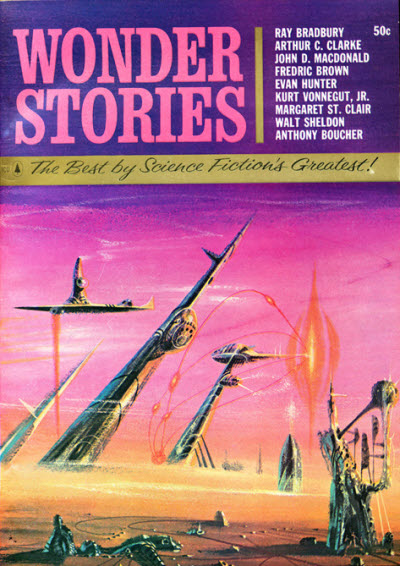
vii · Introduction · Robert Silverberg · in
1 · Trouble with Water · H. L. Gold · ss Unknown Mar ’39
21 · Nothing in the Rules · L. Sprague de Camp · nv Unknown Jul ’39
47 · Fruit of Knowledge · C. L. Moore · nv Unknown Oct ’40
77 · Tlön, Uqbar, Orbis Tertius [1941] · Jorge Luís Borges · ss Labyrinths, New Directions, 1962
91 · The Compleat Werewolf [Fergus O’Breen] · Anthony Boucher · na Unknown Apr ’42
137 · The Small Assassin · Ray Bradbury · ss Dime Mystery Magazine Nov ’46
153 · The Lottery · Shirley Jackson · ss New Yorker Jun 26 ’48
161 · Our Fair City · Robert A. Heinlein · ss Weird Tales Jan ’49
177 · There Shall Be No Darkness · James Blish · nv Thrilling Wonder Stories Apr ’50
211 · The Loom of Darkness [“Liane the Wayfarer”; Dying Earth] · Jack Vance · ss The Dying Earth, Hillman, 1950
221 · The Man Who Sold Rope to the Gnoles [as by Idris Seabright] · Margaret St. Clair · ss F&SF Oct ’51
225 · The Silken-Swift · Theodore Sturgeon · nv F&SF Nov ’53
243 · The Golem · Avram Davidson · ss F&SF Mar ’55
249 · Operation Afreet [Steven Matuchek; Ginny Greylock] · Poul Anderson · nv F&SF Sep ’56
277 · That Hell-Bound Train · Robert Bloch · ss F&SF Sep ’58
289 · Bazaar of the Bizarre [Fafhrd & Gray Mouser] · Fritz Leiber · nv Fantastic Aug ’63
311 · Come Lady Death · Peter S. Beagle · ss Atlantic Monthly Sep ’63
327 · The Drowned Giant · J. G. Ballard · ss The Terminal Beach, London: Gollancz, 1964
337 · Narrow Valley · R. A. Lafferty · ss F&SF Sep ’66
349 · Faith of Our Fathers · Philip K. Dick · nv Dangerous Visions, ed. Harlan Ellison, Garden City, NY: Doubleday, 1967
379 · The Ghost of a Model T · Clifford D. Simak · nv Epoch, ed. Roger Elwood & Robert Silverberg, Berkley, 1975
393 · The Demoness · Tanith Lee · ss The Year’s Best Fantasy Stories #2, ed. Lin Carter, DAW, 1976
405 · Jeffty Is Five · Harlan Ellison · ss F&SF Jul ’77
423 · The Detective of Dreams · Gene Wolfe · nv Dark Forces, ed. Kirby McCauley, Viking, 1980
439 · Unicorn Variations · Roger Zelazny · nv IASFM Apr 13 ’81
461 · Basileus · Robert Silverberg · ss The Best of Omni Science Fiction, No. 5, ed. Don Myrus, Omni, 1983
477 · The Jaguar Hunter · Lucius Shepard · nv F&SF May ’85
501 · Buffalo Gals, Won’t You Come Out Tonight · Ursula K. Le Guin · nv Buffalo Gals and Other Animal Presences, Capra Press, 1987
527 · Bears Discover Fire · Terry Bisson · ss IASFM Aug ’90
537 · Tower of Babylon · Ted Chiang · nv Omni Nov ’90

Two covers that leave much to be desired...the newer book's being a bit less dire...

Thursday, November 3, 2011

anthologies from fiction magazines...

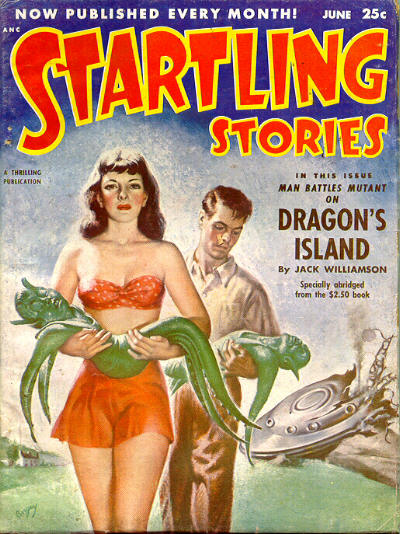
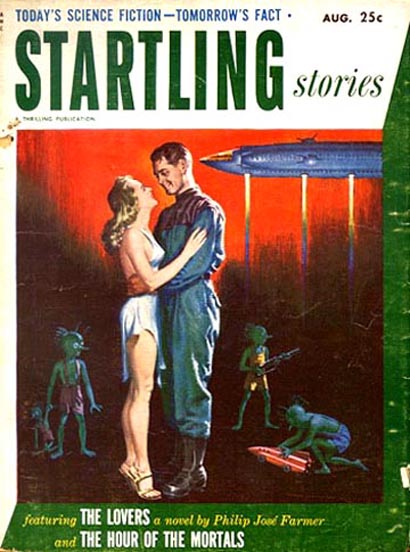
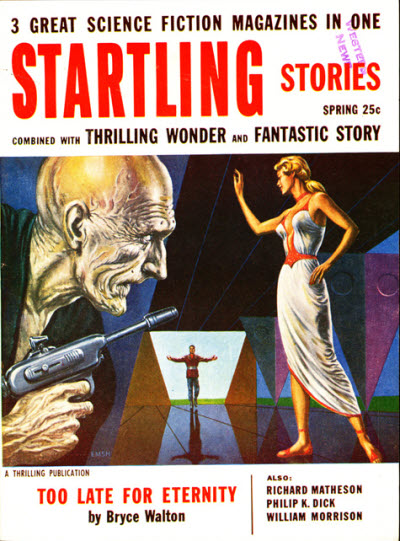
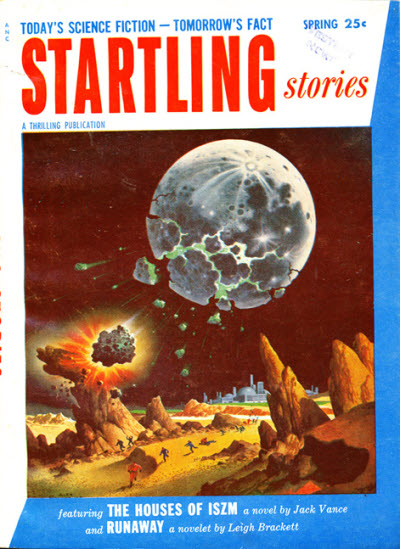
collects stories from Startling Stories and Thrilling Wonder Stories

Almost five years of blogging here, almost 400 posts, almost 60K pageviews since May 2009 (for some reason, that's when Blogger started tallying). So, here's a post that will just grow, I suspect...

Fiction magazines that have had anthologies abstracted from them:

Alfred Hitchcock's Mystery Magazine
Amazing (aka Amazing Stories aka Amazing: Fact and Science Fiction Stories...)
Analog (aka Astounding Stories of Super-Science aka Astounding Science Fiction...)
Antioch Review
Argosy


Beat to a Pulp
Beyond
Black Mask
Botteghe Oscure

Clean Sheets
Cricket Magazine

Dime Detective
Doc Savage

Ellery Queen's Mystery Magazine
Elysian Fields Quarterly
Event Horizon
Evergreen Review

Famous Fantastic Mysteries
Fantastic
Fantastic Novels
Fantastic Universe

Galaxy

If (aka If: Worlds of Science Fiction; aka Worlds of If)

The Magazine of Fantasy and Science Fiction (aka The Magazine of Fantasy)
Manhunt

New Worlds
The Noble Savage

Omni/Omni Online
Ontario Review

The Paris Review
Partisan Review
Planet Stories
Playboy

The Saint Mystery Magazine
The Saturday Evening Post
Sci-Fiction
The Shadow
The Smart Set
Space Squid
Startling Stories
The Strand Magazine
Strange Tales
Super-Science Stories

Tin House
Thrilling Wonder Stories
TriQuarterly

Unknown Fantasy Fiction (aka Unknown Worlds)

Weird Tales
West
Whispers

Yellow Silk

Zoetrope All-Story


Tuesday, November 1, 2011

Tuesday's Overlooked Film and/or Other A/V: a few more links (and some text) added...

Thanks, as always, to all contributors and readers...and hope you've had a fine Hallowe'en (and All Saints Day), so far!


Bill Crider: 3 Godfathers (trailer)

Brian Arnold: The Pogo Special Birthday Special; The Devil and Daniel Mouse

Chuck Esola: Trick or Treat (1986)

Dan Stumpf: Transatlantic

Ed Gorman: The Seventh Victim

Eric Peterson: Keys to Tulsa

Evan Lewis: Three Little Pigskins

Iba Dawson: Whip It!

Jack Seabrook: Robert Bloch on Television: "The Cure" (Alfred Hitchcock Presents)

Jackie Kashian: The Comedy Bureau: Morning Debriefing

James Reasoner: Abbott and Costello Meet Frankenstein

Jerry House: "Ricky the Drummer" (The Adventures of Ozzie and Harriet)

John Charles: You Will Die at Midnight (aka Morirai a mezzanotte)

Kliph Nesteroff: The Schleppers: Stale Gags & Stale Food in Mid-Century Manhattan (courtesy Jackie Kashian and Marc Maron)

Patrice and Joe Green: "Burning Man 2011"

Patti Abbott: The Girl with Green Eyes

Randy Johnson: Tarzan and the Valley of Gold

Ron Scheer: Go West (1925)

Scott Cupp: The Ghost in the Invisible Bikini

Stacia Jones: "Jenifer"; "Pelts" (Masters of Horror)

Todd Mason: Borgen (aka Government [literally "Castle"]); The Big Broadcast Hallowe'en Special (classic radio drama)--please see below...

Yvette Banek: Holiday (1938)

Related Matters:

B.V. Lawson: Media Murder

Brent McKee: Man Up; Charlie's Angels (2011)

Elizabeth Foxwell's The Bunburyist

Frederik Pohl: The NASA Conference on Speculative Technology

George Kelley: Margin Call

John Charles: Video Nasties: The Definitive Guide

Stacia Jones: November Films to Watch For (on cable)

Borgen is, as US carriage station Link TV (visible mostly on cable and particularly satellite services, but cleared overnights on KRCB in the San Francisco Bay Area and some other broadcast sources) is quick to note, from the same producers as the original, Danish version of The Killing (a US version is seen on cable station AMC). I haven't watched either version of The Killing yet, but Link is also rather happy to compare Borgen to The West Wing, but to judge by the first episode, the Danish series is far less about cutesy wish-fulfillment than the Sorkin thing was, and is more comparable in most ways to The Good Wife, only without the criminal court matters to inject the more melodramatic notes. Instead, some reasonably well-prepared-for quick tragedies and problems (sudden death, drug abuse, complex sexual and romantic matters) intrude instead, in what is mostly the account of Birgitte Nyborg, the head of the posited Moderate Party (rather comparable to the actual Radical Party of Denmark; all the parties are somewhat renamed here, so that the Danish Social Democrats become the "Labor Party" in the series, and Venstre, the Danish liberal party, becomes the "Liberal Party"), and how she is, in public approval, catapulted ahead of the leaders of the Liberal and Labor parties by her "Gary Hart moment" during the last televised debate before a parliamentary election (as the expected winners have their own Mondale-Glenn-style spat). The pilot episode is witty, reasonably well-worked out (even with the melodramatic flourishes mentioned above), and bodes well for the rest of the series...for the majority of, at least, the US that can't see Link TV (most visible on Dish Network and DirecTV), Link is posting the episodes for two weeks after their debut on their website. If you enjoy politically-engaged drama that involves well-developed characters, who are quite aware of how the professionalism of their work in politics, television news, or public relations is often the most corrupt aspect of that work, you should definitely give this well-captioned series a shot (and since it does involve Danes, they occasionally speak in English, as well, sometimes for half a sentence, sometimes at length).

WAMU-FM (in DC) has been broadcasting the umbrella program of radio drama and variety The Big Broadcast since the early '60s, when some of the programs it plays regularly had just gone off the air (CBS wrapped up their last two regular dramatic series in 1962, and would try again in 1973, with the CBS Radio Mystery Theater). At this point, The Big Broadcast has settled on some recurring favorites for Hallowe'en week, for the 2.5 hours which follow the usual first 90 minutes devoted to their usual offer of Yours Truly, Johnny Dollar, Dragnet and Gunsmoke at the top of the package...and they took the opportunity to run among the grimmest and most graphic of the Dragnet and Gunsmoke episodes (for that matter, host Ed Walker seems almost apologetic at times for running a horror-themed special package at all).

Here's the rundown:
The Big Broadcast: October 30, 2011

7:00 p.m. Johnny Dollar
11/27/60 #716 The Empty Threat Matter (CBS) (21:18)

7:23 p.m. "The Chicken Heart" from Arch Oboler's Drop Dead album

07:30 p.m. Dragnet
09/24/49 #17 The Brick Bat Slayer (NBC) (29:30)

08:00 p.m. Gunsmoke
02/21/53 #44 The Meshougah (Sus.) (CBS) (29:46)

08:30 p.m. Suspense
12/05/46 The House in Cypress Canyon w/Robert Taylor (Roma Wines) (CBS) (29:50)

09:00 p.m. Escape
11/05/47 #013 Evening Primrose (Sus.) (CBS) (29:30)

09:30 p.m. Quiet Please
08/09/48 The Thing on the Fourble Board (Sus.) (MBS) (24:30)

10:00 p.m. Mercury Theater on the Air
10/30/38 #17 War of the Worlds (Sus.) (CBS) (59:34)

--The adaptation of the John Collier story for Escape isn't exactly subtle, but it is vigorous. If you've missed any of these over the years, you can always pick and choose with your audio playback device among them...but they're all at least pretty good, and the Quiet Please certainly deserves its classic status (the Gunsmoke nearly as good). You have a little less than a week, till Sunday night ET, to listen to these on the archived link given above...and, as noted, not quite two weeks from now to catch Borgen's pilot online (it's available on DVD, but I'm not sure yet if it's a Region 0, as much as that usually means now). TM