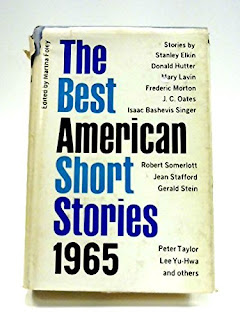
The Best American Short Stories 1965 edited by Martha Foley and David Burnett
 The 10th Annual of the Year’s Best S-F edited by Judith Merril
Best Detective Stories of the Year, 20th Annual Collection edited by Anthony Boucher
World's Best Science Fiction: 1965 edited by Donald A. Wollheim and Terry Carr
Prize Stories 1965: The O. Henry Awards edited by Richard Poirier and William Abrahams
The Best Plays of 1964-1965
edited by Otis L. Guernsey, Jr.
The Great SF Stories: 1964 edited by Robert Silverberg and Martin H. Greenberg (2001)
The Best American Plays, Sixth Series: 1963-1967 edited by John Gassner and Clive Barnes (1971)
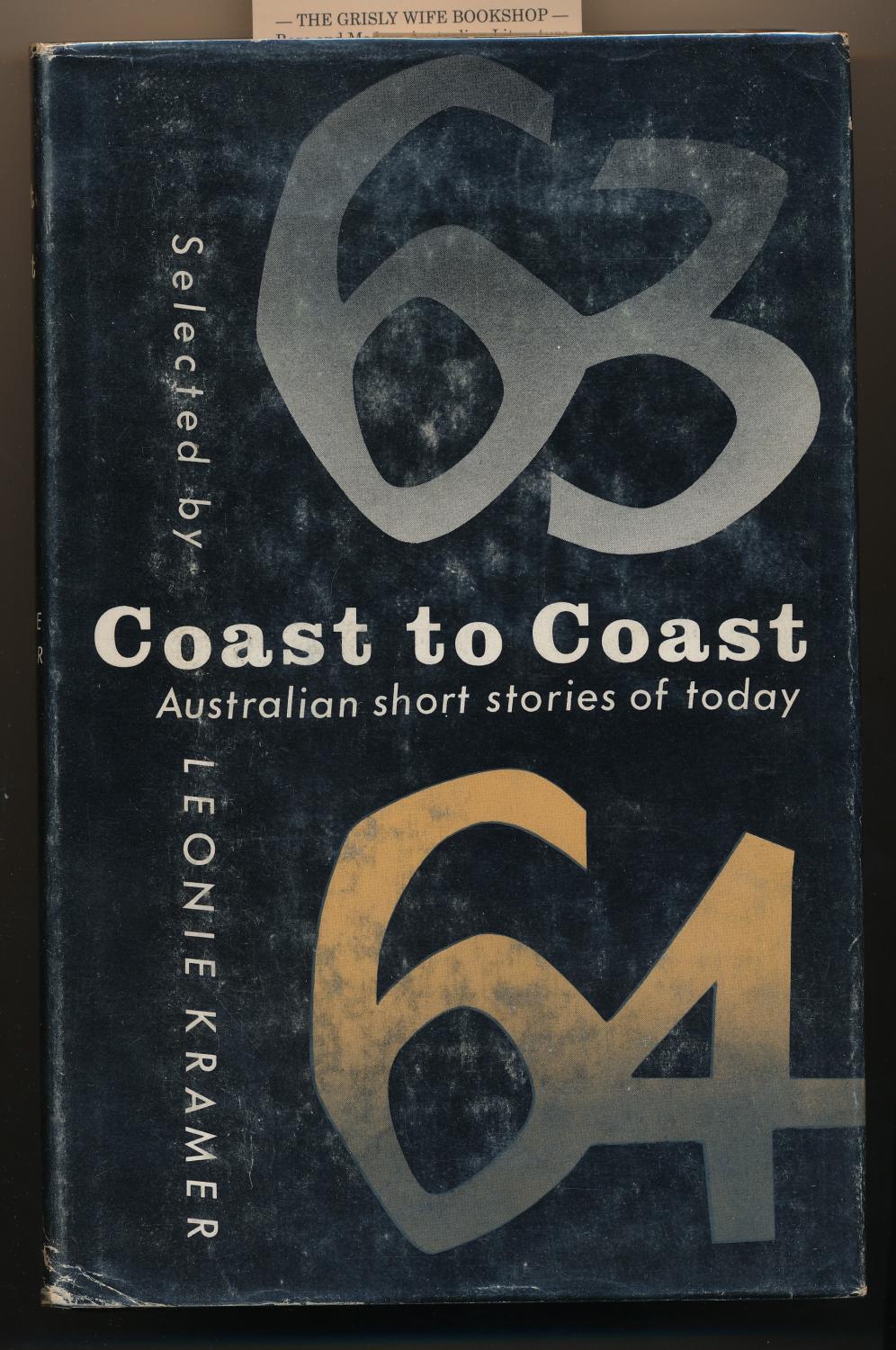
Coast to Coast: Australian Short Stories of Today 1963-1964 edited by Leonie Kramer (1965)
In 1965, the five best of the year fiction annuals (imagine a time where only five such series existed, one new that year, albeit a sixth was issued biennially in Australia, even then) were facing some number magic: the 50th
In 1965, the five best of the year fiction annuals (imagine a time where only five such series existed, one new that year, albeit a sixth was issued biennially in Australia, even then) were facing some number magic: the 50th
annual Best American Short Stories (there was also a 50th anniversary Best of the Series); the 20th annual Year's Best Detective Stories; the 10th volume of Judith Merril's annual (the only series still being edited by its founder, aside from the new one), the first as noted from Donald Wollheim and Terry Carr; and the 45th volume of The O. Henry Awards (which lost a few volumes after the then-current editor in 1951 died unexpectedly, and Doubleday was clearly considering discontinuing the series, before eventually continuing several years later). There's number magic in regards to these volumes now, as well: they were fifty years old the year I first attempted this survey (and there was the "Century of BASS" volume in 2015 along with the annual series entry); and for me there's a personal number magic, inasmuch as the stories collected in these volumes were mostly first published in the year I first emerged into the world, too: 1964. (The
O. Henry book, as they did in those years, collects stories first published from June 1963 to June '64, and the Coast to Coast series was devised to draw from the two previous years in each volume; the other volumes include a few stragglers, as well, with various excuses employed.) The Foley and the Merril saw both hardcover and paperback editions; the other four prose compilations saw only one edition each (the first Ace annual didn't get a book club edition, as later volumes would; the Boucher and Poirier/Abrahams possibly did get book-club hardcovers, but no paperbacks; the publishers of Coast to Coast had a London office and presses to go with theirs in Sydney and Melbourne; my copy of the UK edition set one back 26 shillings in '65). I'd just become fully aware of the Aussie series, which began in the 1940s and ran at least into the '70s; as far as I know (in December, 2021), there were no British nor other Anglophone annuals nor biannuals being published in 1965 (nor later, drawing explicitly on 1964 publications from multiple sources) but Oz's books should've come to my full attention earlier! It's notable how the intentionally eclectic fiction anthologies will restrict themselves to writers from the US (O. Henry), North America (BASS), Australia (Coast to Coast); the other fiction anthologies attempt to be international, if not too surprisingly and rather slightly so, in most cases.
John Brunner is represented in three volumes, with the same short story. A number of the playwrights are represented by the same play between the two drama volumes. Dennis Lynds has a story in each of the Best Detective and the BASS volumes, John D. MacDonald one each in the Merril S-F (a hot-rod youth v. cops/elders horror story from Cosmopolitan) and the Best Detective, Joseph Nesvaba has different stories from his Vampires, Ltd. in both the Merril and the Wollheim/Carr SF volumes; Fritz Leiber and Thomas Disch have two stories each in the speculative fiction annuals. Joyce Carol Oates has stories, different ones, in both O. Henry and BASS; Isaac Bashevis Singer has different stories, one each, in the Foley and the Merril. Peter Beagle is in the O. Henry with what I believe to be his third published short story (two of them followed his first novel, A Fine and Private Place), the impressive and straightforward fantasy "Come Lady Death", from an issue of The Atlantic.
More important measures, than the blown opportunity to write these up in detail on their golden anniversary (things were in some ways Even More trying, at least for me, in 2015, than they have been for the human species as a default of late), come to mind...these were, as all art and commerce is, products of their time, and their time was one of a number of emerging forces in the arts and culture...newly energized liberation movements hadn't quite come to full strength, so that the remarkable lack of women contributors in comparison to the men, even in the annuals edited by women, would be a lot less likely to happen today (and certainly more would be made of it); ethnic and other diversity also only starting to be felt...the contemporary-mimetic short fiction anthologies are less imbalanced than the others, where two feature no contributions by women at all, but none are indicative of an equal access to the fields being surveyed. And the barriers between "high" and "low" and Dwight Macdonald's "midcult" culture, never terribly robust, were crumbling in every way, as is positively indicated by the contents here, albeit it did mean that slight work is as likely to be showcased along with the more lasting--as in previous volumes in these series or the later volumes...just perhaps in later volumes with a slightly less gleeful sense of artificial restrictions being breached in both the magazines and other sources (very much including theaters, obviously) consulted and the range of sources being consulted by each of the sets of editors. Abrahams, particularly, in his introduction to the O. Henry volume, can almost be heard to be shaking his head in wonder at how fiction writers do not attempt to change their tone nor approach when writing for Partisan Review or The Ladies Home Journal...perhaps, unfortunately, part of what led the publishers to eventually see fiction as dispensable in the large-circulation magazines.

Meanwhile, the fiction annuals, which had had as accompaniment a humor annual for three volumes at the turn of the 1950s, and would soon after 1965 see the advent of Best Magazine Article and Best Political Cartoon annuals in the US, did have a yearbook cousin in The Best Plays annual, which underwent its own major change in 1965, when founding editor Burns Mantle was succeeded by Owen Guernsey, who would edit or co-edit the series for some decades. My memory of looking at some of the 1970s volumes was hazier than I thought, as I'd remembered the volumes reprinting the entirety of the selected plays, when actually they instead featured synopses of and excerpts from the scripts, with the first-time exception in the 1965 volume (the 48th), perhaps because of a book contract elsewhere for Neil Simon, of an extensive photo sequence instead, representing The Odd Couple...with Art Carney playing Felix along with Walter Matthau as Oscar.
Then I finally stumbled across the not-quite-annual volume, edited by John Gassner in its early issues, which with its delayed 1963-67 volume did collect the notable plays of 1964 and thereabouts in their entirety...a book delayed by Gassner's death, as he was preparing the final selections, and finally published in 1971, with new editor Clive Barnes's headnotes, introductions, and tweaking of the content for purposes of both representation and lack of reprint rights availability (and Barnes's not always flattering descriptions of the items included and those which got away are refreshingly earnest, if not always supportive of the notion of a Best-Of so much as Representation-Of anthology). Barnes would continue with even more widely-spaced volumes into the next decades.

 Fuller reviews of these books will be forthcoming soon (or so I hoped at mid-decade), as I get further along in each (I'm reading or rereading each more or less together, and these are not slender volumes!), and I had hoped, when first posting this in 2015, to present an interview with Kit Reed (who died in 2017), among much else the author of the lead-off story in the Merril volume, "Automatic Tiger"...perhaps the story which got her the most early attention in fantasy and sf circles (and her career was one rather gracefully devoted to fantastic fiction, crime fiction and contemporary-mimetic fiction in nearly equal measure). Meanwhile, along with introducing/presenting the only image online I'm aware of the Best Plays volume's cover (with a gracious assist from Alice Chang)(my copy deaccessioned from a Belfast, Eire public library, of all places), I will at least provide some preliminary indices...and perhaps even a few more comments over the course of the day. (I will note that Flannery O'Connor's lead-off story in the O. Henry volume, "Revelation," was offered the "first prize" in this volume, I suspect, more as memorial for her than as measured judgement of this story, not, I'd suggest, one of the best she'd published, though solid work.)
Indices below; for more of today's books, almost all more thoroughly considered, please see Patti Abbott's blog.
Indices courtesy William Contento/Galactic Central
and WorldCat with a few corrections and added bells and whistles (and ghosts of layout imports into ever-clunky Blogspot).


And, in 2001, a latecomer chose to join this company, in the form of Robert Silverberg and Martin H. Greenberg's one-volume continuation of the Great SF Stories series Greenberg had been editing with Isaac Asimov...the last Asimov volume, finished up as Asimov lay dying, also treated with stories from the year 1963, meant to be the last in that series from DAW Books since DAW's own first annual, the World's Best SF cited above, began in '65 choosing among 1964 publication. But Silverberg, Greenberg and NESFA Press were all game, and gave a revival a shot...apparently to little response, critically or commercially, in the wake of the 11 September attacks and whatever else drew attention away. Eppur si muove.


Contents:
7 · Introduction · Donald A. Wollheim & Terry Carr · in
Meanwhile, the fiction annuals, which had had as accompaniment a humor annual for three volumes at the turn of the 1950s, and would soon after 1965 see the advent of Best Magazine Article and Best Political Cartoon annuals in the US, did have a yearbook cousin in The Best Plays annual, which underwent its own major change in 1965, when founding editor Burns Mantle was succeeded by Owen Guernsey, who would edit or co-edit the series for some decades. My memory of looking at some of the 1970s volumes was hazier than I thought, as I'd remembered the volumes reprinting the entirety of the selected plays, when actually they instead featured synopses of and excerpts from the scripts, with the first-time exception in the 1965 volume (the 48th), perhaps because of a book contract elsewhere for Neil Simon, of an extensive photo sequence instead, representing The Odd Couple...with Art Carney playing Felix along with Walter Matthau as Oscar.
Then I finally stumbled across the not-quite-annual volume, edited by John Gassner in its early issues, which with its delayed 1963-67 volume did collect the notable plays of 1964 and thereabouts in their entirety...a book delayed by Gassner's death, as he was preparing the final selections, and finally published in 1971, with new editor Clive Barnes's headnotes, introductions, and tweaking of the content for purposes of both representation and lack of reprint rights availability (and Barnes's not always flattering descriptions of the items included and those which got away are refreshingly earnest, if not always supportive of the notion of a Best-Of so much as Representation-Of anthology). Barnes would continue with even more widely-spaced volumes into the next decades.
 Fuller reviews of these books will be forthcoming soon (or so I hoped at mid-decade), as I get further along in each (I'm reading or rereading each more or less together, and these are not slender volumes!), and I had hoped, when first posting this in 2015, to present an interview with Kit Reed (who died in 2017), among much else the author of the lead-off story in the Merril volume, "Automatic Tiger"...perhaps the story which got her the most early attention in fantasy and sf circles (and her career was one rather gracefully devoted to fantastic fiction, crime fiction and contemporary-mimetic fiction in nearly equal measure). Meanwhile, along with introducing/presenting the only image online I'm aware of the Best Plays volume's cover (with a gracious assist from Alice Chang)(my copy deaccessioned from a Belfast, Eire public library, of all places), I will at least provide some preliminary indices...and perhaps even a few more comments over the course of the day. (I will note that Flannery O'Connor's lead-off story in the O. Henry volume, "Revelation," was offered the "first prize" in this volume, I suspect, more as memorial for her than as measured judgement of this story, not, I'd suggest, one of the best she'd published, though solid work.)
Indices below; for more of today's books, almost all more thoroughly considered, please see Patti Abbott's blog.
Indices courtesy William Contento/Galactic Central
and WorldCat with a few corrections and added bells and whistles (and ghosts of layout imports into ever-clunky Blogspot).

And, in 2001, a latecomer chose to join this company, in the form of Robert Silverberg and Martin H. Greenberg's one-volume continuation of the Great SF Stories series Greenberg had been editing with Isaac Asimov...the last Asimov volume, finished up as Asimov lay dying, also treated with stories from the year 1963, meant to be the last in that series from DAW Books since DAW's own first annual, the World's Best SF cited above, began in '65 choosing among 1964 publication. But Silverberg, Greenberg and NESFA Press were all game, and gave a revival a shot...apparently to little response, critically or commercially, in the wake of the 11 September attacks and whatever else drew attention away. Eppur si muove.

- The Best American Short Stories 1965 ed. Martha Foley & David Burnett (Houghton Mifflin, 1965, x+405pp, hc) [RRH]
- 1 · Center of Gravity · L. J. Amster · nv The Saturday Evening Post Mar 14 1964
- 45 · The Returning · Daniel De Paola · ss Prairie Schooner Spr 1964
- 57 · The Transient · Stanley Elkin · nv The Saturday Evening Post Apr 25 1964
- 93 · Opening Day · Jack Gilchrist · ss Georgia Review Spr 1964, as by John Shafter
- 99 · The Gesture · James W. Groshong · ss The Antioch Review Sum 1964
- 113 · Sarah · Martin J. Hamer · ss Atlantic Monthly Jan 1964
- 125 · Sherry · Maureen Howard · nv The Hudson Review Aut 1964
- 167 · A Family Man · Donald Hutter · ss The Saturday Evening Post Feb 22 1964
- 187 · The Month of His Birthday · Henia Karmel-Wolfe · ss Mademoiselle Dec 1964
- 199 · Heart of Gold · Mary Lavin · nv The New Yorker Jun 27 1964
- 223 · A Blue Blonde in the Sky Over Pennsylvania · Dennis Lynds · ss The Hudson Review Spr 1964
- 241 · The Guest · Frederic Morton · ss The Hudson Review Win 1964
- 251 · The Application · Jay Neugeboren · ss Transatlantic Review Oct 1964
- 259 · First Views of the Enemy · Joyce Carol Oates · ss Prairie Schooner Spr 1964
- 271 · The Practice of an Art · Leonard Wallace Robinson · ss The Saturday Evening Post Sep 5 1964
- 283 · A Sacrifice · Isaac Bashevis Singer · ss Harper’s Feb 1964
- 291 · Eskimo Pies · Robert Somerlott · ss Atlantic Monthly Jan 1964
- 299 · The Visit · Elizabeth Spencer · ss Prairie Schooner Sum 1964
- 313 · The Tea Time of Stouthearted Ladies · Jean Stafford · ss The Kenyon Review Win 1964
- 325 · For I Have Wept · Gerald Stein · ss The Saturday Evening Post Jan 4-11 1964
- 345 · There · Peter Taylor · nv The Kenyon Review Win 1964
- 371 · The Last Right · Lee Yu-Hwa · ss The Literary Review Sum 1964
- 385 · Biographical Notes · [Misc.] · bg
- 393 · The Yearbook of the American Short Story, January 1 to December 31, 1964 · [Misc.] · bi
-
The 10th Annual of the Year’s Best S-F ed. Judith Merril (Delacorte, 1965, $4.95, 400pp, hc)
- Automatic Tiger · Kit Reed · ss F&SF Mar 1964
- The Carson Effect · Richard Wilson · ss Worlds of Tomorrow Nov 1964
- The Shining Ones · Arthur C. Clarke · ss Playboy Aug 1964
- Pacifist · Mack Reynolds · ss F&SF Jan 1964
- The New Encyclopaedist · Stephen Becker · vi F&SF May 1964
- The Legend of Joe Lee · John D. MacDonald · ss Cosmopolitan Oct 1964
- Gas Mask · James D. Houston · ss Nugget 1964
- A Sinister Metamorphosis · Russell Baker · ss The New York Times 1965
- Sonny · Rick Raphael · ss Analog Apr 1963
- The Last Secret Weapon of the Third Reich · Josef Nesvadba · ss Vampires Ltd., (New York: A. Vanous 1964)
- Descending · Thomas M. Disch · ss Fantastic Jul 1964
- Decadence · Romain Gary; trans. by Richard Howard · ss Saga 1964
- Be of Good Cheer · Fritz Leiber · ss Galaxy Oct 1964
- It Could Be You · Frank Roberts · ss The Bulletin 3 March 1962; reprinted in Coast to Coast: Australian Short Stories of Today 1961-1962 edited by Hal Porter (Sydney, Australia: Angus & Robertson 1962) and in Short Story International, September 1964
- A Benefactor of Humanity · James T. Farrell · ss The Socialist Call 1958
- Synchromocracy · Hap Cawood · ss motive (as by simply "Cawood") Nov 1964
- The Search · Bruce Simonds · pm F&SF Jun 1964
- The Pirokin Effect · Larry Eisenberg · ss Amazing Jun 1964
- The Twerlik · Jack Sharkey · ss Worlds of Tomorrow Jun 1964
- A Rose for Ecclesiastes · Roger Zelazny · nv F&SF Nov 1963
- The Terminal Beach · J. G. Ballard · nv New Worlds Mar 1964
- Problem Child · Arthur Porges · ss Analog Apr 1964
- The Wonderful Dog Suit · Donald Hall · ss The Carleton Miscellany Spring 1964 (as part of "Three Tales: Aspersia, or the Sad Story of an Unhappy Little Girl; The Cat Who Thought He Was a Story; The Wonderful Dog Suit")
- The Mathenauts · Norman Kagan · ss If Jul 1964
- Family Portrait · Morgan Kent · ss Fantastic Aug 1964
- The Red Egg · José Maria Gironella; trans. by Terry Broch Fontseré · ss the translated collection Phantoms and Fugitives (Sheed & Ward 1964)
- The Power of Positive Thinking · M. E. White · ss New Directions #18 1964
- A Living Doll · Robert Wallace · ss Harper’s Jan 1964
- Training Talk · David R. Bunch · ss Fantastic Mar 1964
- A Miracle Too Many · Philip H. Smith & Alan E. Nourse · ss F&SF Sep 1964
- The Last Lonely Man · John Brunner · ss New Worlds May/Jun 1964
- The Man Who Found Proteus · Robert H. Rohrer, Jr. · ss Fantastic Nov 1964
- Jachid and Jachida (as "Yachid and Yechida") · Isaac Bashevis Singer · ss Die goldene keyt 1964; as translated by Singer and Elizabeth Pollet, Short Friday and Other Stories (Farrar, Straus and Giroux 1964)
- Summation · Judith Merril · ms
- Honorable Mentions · [Misc.] · bi
Best Detective Stories of the Year: 20th Annual Collection
| Editor: | Anthony Boucher |
|---|---|
| Publisher: | New York : E.P. Dutton & Co., 1965. |
9 Introduction/Anthony Boucher
13 H as in Homicide / Lawrence Treat (ss) Ellery Queen’s Mystery Magazine Mar 1964
31 Routine Investigation / Robert Twohy (ss) Ellery Queen’s Mystery Magazine Apr 1964
39 No Way Out / Dennis Lynds (ss) Mike Shayne Mystery Magazine Feb 1964
55 Payoff / Ellery Queen (ss) Cavalier Aug 1964, as “Crime Syndicate Payoff”
61 Temple by the River / Leon Comber (ss) The Strange Cases of Magistrate Pao, Charles E. Tuttle 1964; Short Story International Aug 1978
75 Return of Schlock Homes / Robert L Fish (ss) Ellery Queen’s Mystery Magazine Jun 1964
89 Short and Simple Annals / Dan J. Marlowe (ss) Alfred Hitchcock’s Mystery Magazine Aug 1964
103 The Ingenious Mind of Mr. Rigby Lacksome / Ernest Bramah (ss) Max Carrados Mysteries (Hodder and Stoughton, London 1927)
135 Credit to Shakespeare / Julian Symons (ss) Murder! Murder!, Fontana 1961, as “Credit to William Shakespeare”; Ellery Queen’s Mystery Magazine Nov 1964
145 A Soliloquy in Tongues / William Wiser (ss) Cosmopolitan May 1964
159 Papa Tral's Harvest / Barry Perowne (nv) Ellery Queen’s Mystery Magazine Mar 1964
183 Blurred View / John D. MacDonald (ss) This Week Feb 23 1964
189 Reunion / Edward D. Hoch (ss) The Saint Mystery Magazine December 1964
219 Violet / Hal Ellson (ss) Mike Shayne Mystery Magazine May 1964
233 A Case for the UN / Miriam Allen deFord (ss) Ellery Queen’s Mystery Magazine Jul 1964
245 Legacy of Office / Rog Phillips (ss) Alfred Hitchcock’s Mystery Magazine Jun 1964
259 The Yearbook of the Detective Story / Anthony Boucher:
259 Bibliography
262 Awards
264 Necrology
267 Honor Roll
13 H as in Homicide / Lawrence Treat (ss) Ellery Queen’s Mystery Magazine Mar 1964
31 Routine Investigation / Robert Twohy (ss) Ellery Queen’s Mystery Magazine Apr 1964
39 No Way Out / Dennis Lynds (ss) Mike Shayne Mystery Magazine Feb 1964
55 Payoff / Ellery Queen (ss) Cavalier Aug 1964, as “Crime Syndicate Payoff”
61 Temple by the River / Leon Comber (ss) The Strange Cases of Magistrate Pao, Charles E. Tuttle 1964; Short Story International Aug 1978
75 Return of Schlock Homes / Robert L Fish (ss) Ellery Queen’s Mystery Magazine Jun 1964
89 Short and Simple Annals / Dan J. Marlowe (ss) Alfred Hitchcock’s Mystery Magazine Aug 1964
103 The Ingenious Mind of Mr. Rigby Lacksome / Ernest Bramah (ss) Max Carrados Mysteries (Hodder and Stoughton, London 1927)
135 Credit to Shakespeare / Julian Symons (ss) Murder! Murder!, Fontana 1961, as “Credit to William Shakespeare”; Ellery Queen’s Mystery Magazine Nov 1964
145 A Soliloquy in Tongues / William Wiser (ss) Cosmopolitan May 1964
159 Papa Tral's Harvest / Barry Perowne (nv) Ellery Queen’s Mystery Magazine Mar 1964
183 Blurred View / John D. MacDonald (ss) This Week Feb 23 1964
189 Reunion / Edward D. Hoch (ss) The Saint Mystery Magazine December 1964
219 Violet / Hal Ellson (ss) Mike Shayne Mystery Magazine May 1964
233 A Case for the UN / Miriam Allen deFord (ss) Ellery Queen’s Mystery Magazine Jul 1964
245 Legacy of Office / Rog Phillips (ss) Alfred Hitchcock’s Mystery Magazine Jun 1964
259 The Yearbook of the Detective Story / Anthony Boucher:
259 Bibliography
262 Awards
264 Necrology
267 Honor Roll
| Description: | 271 pages ; 21 cm |
|---|
Prize Stories 1965 : The O. Henry Awards
| Editors: | Richard Poirier; William Miller Abrahams |
|---|---|
| Publisher: | Garden City, N.Y. : Doubleday & Co., 1965. |
| ix Introduction / by William Abrahams -- 1 Revelation / Flannery O'Connor (ss), The Sewanee Review, Spring 1964 21 Ocean / Sanford Friedman (nv) Partisan Review, Winter 1964 53 The Ballad of Jesse Neighbours / William Humphrey (ss) Esquire September 1963 73 Homecoming / Tom Mayer (ss) Harper’s Magazine August 1963 81 Mama and the Spy / Eva Manoff (ss) Mademoiselle August 1963 93 Sunday's Children / Nancy A.J. Potter (ss) Four Quarters, November 1963 103 Margins / Donald Barthelme (ss) The New Yorker, February 22 1963 109 If Lost Return to the Swiss Arms / Leon Rooke The Carolina Quarterly Winter 1963 115 There / Peter Taylor nv The Kenyon Review Winter 1964 149 Come Lady Death / Peter S. Beagle (ss) The Atlantic Monthly September 1963 165 First Views of the Enemy / Joyce Carol Oates (ss) Prairie Schooner Spring 1964 177 Fifty-Fifty / Leonard Wolf (ss) The Kenyon Review Autumn 1963 189 Sucker / Carson McCullers (ss) The Saturday Evening Post September 28 1963 199 Love in the Winter / Daniel Curley (ss) The Colorado Quarterly Winter 1964 213 A Woman of Her Age / Jack Ludwig (ss) The Quarterly Review of Literature Vol. 12 233 What I Wish (Oh, I Wish) I Had Said / Arthur Cavanaugh (ss) McCall’s August 1963 249 The Hounds of Summer / Mary McCarthy (ss) The New Yorker 14 September 1963 287 Chaos, Disorder and the Late Show / Warren Miller (ss) The Saturday Evening Post October 5 1963 |
| Description: | xii, 295 pages ; 22 cm. |
|---|
The World’s Best Science Fiction: 1965 ed.
Donald A. Wollheim & Terry Carr, editors (Ace G-551, 1965, 50¢, 288pp, pb)
12 · Greenplace · Tom Purdom · ss F&SF Nov 1964
26 · Men of Good Will · Ben Bova & Myron R. Lewis · ss Galaxy Jun 1964
32 · Bill for Delivery [Al & Sam] · Christopher Anvil · ss Analog Nov 1964
53 · Four Brands of Impossible · Norman Kagan · nv F&SF Sep 1964
86 · A Niche in Time · William F. Temple · ss Analog May 1964
103 · Sea Wrack · Edward Jesby · nv F&SF May 1964
123 · For Every Action · C. C. MacApp · ss Amazing May 1964
131 · Vampires Ltd. · Josef Nesvadba; trans. by Iris Urwin · ss Vampires Ltd., New York: A. Vanous 1964
142 · The Last Lonely Man · John Brunner · ss New Worlds May/Jun 1964
160 · The Star Party · Robert Lory · ss F&SF Sep 1964
169 · The Weather in the Underworld · Colin Free · ss Squire Jun 1965
178 · Oh, to Be a Blobel! · Philip K. Dick · ss Galaxy Feb 1964
199 · The Unremembered · Edward Mackin · ss New Worlds Mar 1964
211 · What Happened to Sergeant Masuro? · Harry Mulisch; trans. by Roy Edwards · nv The Busy Bee Review: New Writing from the Netherlands No.1 1964
235 · Now Is Forever · Thomas M. Disch · ss Amazing Mar 1964
252 · The Competitors · Jack B. Lawson · nv If Jan 1964
279 · When the Change-Winds Blow [Change War] · Fritz Leiber · ss F&SF Aug 1964
The Great SF Stories: 1964
ed. Robert Silverberg & Martin H. Greenberg (NESFA Press 1-886778-21-3, Jan 2002, $25.00, 395pp, hc, cover by Eddie Jones).
Anthology of 15 stories first published in 1964, a continuation of the series originally edited by Isaac Asimov and Greenberg. Authors include Norman Spinrad, Poul Anderson, and John Brunner. Foreword and introduction by Silverberg, who discusses why he decided to do the anthology, and the state of the US and science fiction in 1964. Order from NESFA Press, PO Box 809, Framingham MA 01701; [www.nesfapress.com].
- 13 · Foreword · Robert Silverberg · fw
- 15 · Introduction · Robert Silverberg · in
- 19 · Outward Bound · Norman Spinrad · nv Analog Mar ’64
- 47 · The Kragen · Jack Vance · na Fantastic Jul ’64
- 103 · The Master Key [Nicholas van Rijn] · Poul Anderson · nv Analog Jul ’64
- 135 · The Crime and the Glory of Commander Suzdal · Cordwainer Smith · ss Amazing May ’64
- 151 · The Graveyard Heart · Roger Zelazny · na Fantastic Mar ’64
- 201 · Purple Priestess of the Mad Moon · Leigh Brackett · ss F&SF Oct ’64
- 217 · The Last Lonely Man · John Brunner · ss New Worlds May/Jun ’64
- 231 · Soldier, Ask Not [Childe Cycle] · Gordon R. Dickson · na Galaxy Oct ’64
- 283 · A Man of the Renaissance · Wyman Guin · nv Galaxy Dec ’64
- 319 · The Dowry of Angyar · Ursula K. Le Guin · ss Amazing Sep ’64
- 335 · When the Change-Winds Blow [Change War] · Fritz Leiber · ss F&SF Aug ’64
- 343 · The Fiend · Frederik Pohl · ss Playboy Apr ’64
- 349 · The Life Hater [Berserker] · Fred Saberhagen · ss If Aug ’64
- 357 · Neighbor · Robert Silverberg · ss Galaxy Aug ’64
- 371 · Four Brands of Impossible · Norman Kagan · nv F&SF Sep ’64
The Best Plays of 1964-65
| Editor: | Otis L Guernsey |
|---|---|
| Publisher: | New York : Dodd Mead, ©1965. |
434 pages : illustrations by Al Hirschfeld ; 24 cm.
|