Showing posts sorted by relevance for query monad. Sort by date Show all posts

Friday, December 28, 2012

FFB: MONAD: Essays on Science Fiction [except when they are about fantasy or are poems about a writer's life, and such], Number One (September 1990), edited by Damon Knight (Pulphouse)

the paperback edition
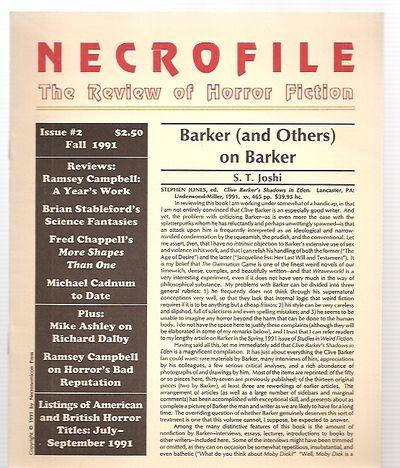
Monad, Damon Knight's last editorial project, produced three issues or volumes (1990-1993), depending how you looked at the hardcover and paperback editions published by the busy, and soon overextended, small house (Pulphouse Publishing briefly attempted, amid all their other projects, to publish their eponymous fiction magazine weekly). But it was a good and useful series of books (or issues)...from perhaps the last great decade for publishing  non-academic critical magazines in a non-virtual format, on paper rather than on the web. And Monad was as spare and lean (with no illustration and a single column of easy-to-read typography on the pages) as most of the other major magazine productions of that era were busy, whether we looked to The Armchair Detective or Science Fiction Eye (soon SF Eye, to be less exclusive) or The Scream Factory...even the similarly no-nonsense Necrofile, like TSF about horror fiction and related matter, didn't have the bare bones elegance of Monad...nor would bare*bones, the more crime-fiction-oriented successor to TSF, and the direct ancestor of the blog of that title.

Knight had begun writing criticism along with his earliest published fiction (and cartoons and illustration), in the 1940s, the critical writing sparked by the example of Frederik Pohl's reviews, and Knight's mostly published in the better examples of the more "sercon" (serious and constructive, which could be taken at face value or imply an earnest dullness) fanzines of the day, as well as in Knight's own fanzine, Snide. In the 1950s, Knight and Lester del Rey co-edited and published two issues of Science Fiction Forum, as a more purely critical little magazine/fanzine, but apparently did no more till Knight revived the title Forum as that of the house organ of the Science Fiction Writers of America, of which he was a primary founder and its first president. While some projects like this one ran indefinitely (Inside Science Fiction became Riverside Quarterly, and lasted forty years in all), many more have been mayflies (Harry Harrison and Brian Aldiss's SF Horizons managed two similarly impressive issues in the mid-'60s). Others, such as the titles mentioned above, had intermediate-length runs, and made names for themselves at least in certain circles...anyone who suffered through my squibs on this blog knows that I'm tempted to try to trace as many of those as possible, but I will desist for a moment (noting only, for example, that SF Eye had roots in Bruce Sterling's one-sheet zine Cheap Truth as well as editor/publisher Stephen Brown's work on such earlier, more conventional critical magazines as Douglas Fratz's Thrust). 


Index of the contents courtesy ISFDb:

The contributions to the first Monad are suitably impressive, and, as often the case with Knight's works, begin with a matter of some controversy, as Knight notes that his original announcement of the series called for essays from writers of fantasticated fiction, rather than from fans or academic students of any tenure or "anecdotalists" (such as, one suspects, Sam Moskowitz); Knight prints Tom Whitmore's letter objecting to this policy, and in his editorial Knight notes that it's not so much a ukase as a flexible statement of intent. But, he continues, only the writers of speculative fiction are working from the inside of the art.  The balance of the book is laden with anecdote, but not solely the anecdotal.

Ursula Le Guin's essay is driven in large part by her recent completion of a fourth volume, Tehanu, in what had been for some years the Earthsea trilogy, and how over the course of writing the component novels, each in its turn, the very fact that she was a woman writing about outsiders in the heroic tradition (a dark-complected man, a woman, children) hit home, and slowly a critique of hierarchy and authority developed as her feminism and anarchism coalesced through her resolution and exploration of these tensions. Even as she credits particularly T. H. White and Tolkien for expanding the idiom before her, it's difficult to see how most of the more ambitious epic fantasy since her contribution would've been written without the example of her work (and that of Fritz Leiber and Jack Vance, among a small number of other most influential folks--I shall have to return to Le Guin's other critical writing to see how much her predecessors such as C. L. Moore, Leigh Brackett and Sylvia Townsend Warner, to say nothing of Woolf and her Orlando, nudged and influenced her).


The Aldiss is an excerpt from his then-just-published book-length memoir, Bury My Heart at W. H. Smith's (the British bookstore); Aldiss had served as literary editor for the Oxford Mail newspaper from early on in his career, and had had some commercial and artistic success with his contemporary-mimetic fiction along with his fantaticated thoughout his career. The Disch is a poem, apparently originally in his1972 limited-edition chapbook The Right Way to Figure Plumbing; "An All-Day Poem" is, in part, how art helps the artist cope with the great ugliness, and small reverses, life hands us (Disch's mother is losing her fight with cancer as he writes). Bruce Sterling takes a somewhat bemused pass through the realms of modern literary theory, the post-Structuralist, post-Derrida and Bakhtin era (and this inspired an answer essay for the second Monad by John Barnes). And Knight rounds us out with a fine short essay that limns his early childhood first  experiences with injustice (and the other Large Things mentioned in the title) and how he found them recapitulated in the crotchets of fellow editors and similar folk in his professional career as an artist.

Knight was one of the pioneering critics of note in fantastic-fiction circles, and remains controversial to this day (he would not stay his hand when he felt an affront to the art was being perpetrated, and Ed Gorman hasn't forgiven him for that yet). And yet Monad's three issues/volumes are a nice core-sampling of the most influential and serious critical writers active in its years (with some exceptions, such as Knight's great students Algis Budrys and Barry Malzberg, and Joanna Russ, who was already scaling back her critical writing in the face of health matters).  Knight, like most of the more ambitious writer/editor/publishers in the field of the popular critical magazine, would tend to move online for much of what he wrote in this wise after Monad...as much as he continued with this kind of activity, as opposed to his writing instruction activities, as reflected by his Creating Short Fiction.

For more of today's books, please see Patti Abbott's blog. I will be gathering the links next week. ("Be there. Aloha.")

Friday, November 18, 2016

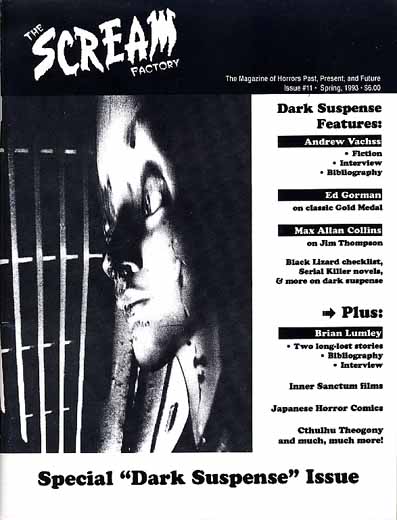
FFM: THE ARMCHAIR DETECTIVE, THE SCREAM FACTORY and SCIENCE FICTION EYE (and MONAD) among the vanished critical magazines...

The Penny Press fiction magazines, Ellery Queen's Mystery Magazine, Alfred Hitchcock's Mystery Magazine, Asimov's Science Fiction and Analog Science Fact and Fiction will with the January issues decrease frequency from 10 issues a year to bimonthly with added pages per issue, in the manner of the fatter bimonthly issues that The Magazine of Fantasy and Science Fiction has been publishing for several years.  So, we don't have even theoretically monthly newsstand fiction magazines now, even if we do have a small slew of fiction titles at most Barnes & Noble stores and at too few other newsstands. AHMM has just published its 60th anniversary issue, while EQMM has been celebrating its 75th year of publication all through 2016; Asimov's will be publishing its 40th anniversary issue soon, while Analog celebrated its 85th birthday in 2015.  The UK-based Crimewave hasn't published an issue  for several years, so the only other crime-fiction titles to get much newsstand distribution at all these days are The Strand (usually three issues per year since 1998) and the even more infrequent horror and suspense magazine Cemetery Dance (usually one or two issues per year of late, since 1988)...the criminous nonfiction (critical and publishing news) magazine Mystery Scene joins them.  That magazine, founded by Ed Gorman and Robert Randisi, and edited in recent years by Kate Stine, can often be found with Locus, the not dissimilar magazine about science fiction and fantasy and to some extent horror (a strong component of early coverage in Mystery Scene, as well), and Romantic Times, about romance fiction...

But Kate Stine had another similar job earlier, as editor of The Armchair Detective, the first elaborate quarterly crime-fiction fanzine that I came across, and the first to have much of a presence on newsstands, from the earlier years of Allen J. Hubin's stewardship. By the time I came across it, it was publishing generally interesting (if at times a bit potted) articles on all sorts of crime-fiction writers and historical trends, and considerations of film and related media, book reviews...and, frequently, at least a little new fiction in most issues in the early 1990s...a time one could also find, on better newsstands, Stephen Brown's Science Fiction Eye (originally co-edited and -published by Dan Steffan, and which became SF Eye for its last two issues), dealing with sf but also fantasy and as much related matter as possible, and Bob Morrish, John Scoleri and Peter Enfantino's The Scream Factory, a magazine about horror and related matter in all media. While TAD was meant to be encyclopedic, touching on every sort of crime-fiction they could pack in (most other CF critical magazines to follow often started out with a more limited focus, even if, for example, Jim Huang's The Drood Review, the first version of Clues, before Elizabeth Foxwell's revival, or Steve Lewis's initial newsletter form of Mystery*File began with a similarly wide remit), SF Eye tended toward explorations of the bleeding edge as much as possible, as it was in part a vastly more elaborate extension of the intentionally modest-looking one-sheet Cheap Truth, the original organ of the nascent Cyberpunks. TSF seemed to take from both column A and column B, seeking to report on the
full range of horror (in fact, one of the best-loved issues was about "the Worst in Horror" through the decades), but also expressing special love for the more flashy sorts of horror, including the better work offered by the nascent Splatterpunks and other practitioners of even more copiously bleeding edge materials. And SF Eye and Scream Factory both ran at least some fiction as they went along, as well...these weren't the first fantastic-fiction critical magazines to have a certain heft to them, by any means; Armchair had taken some of its inspiration from such earlier magazines about fantastic fiction as Amra, George Scithers's heroic fantasy critical fanzine, The Arkham Collector, the second and less elaborate magazine from August Derleth's horror and fantasy specialist book publishers Arkham House (their little magazine of some decades before, The Arkham Sampler, had been more a mostly-fiction title), as well as such fairly elaborate productions as Inside SF/Riverside Quarterly, Science Fiction Review, and the later Fantasy Newsletter;  the recently late Douglas Fratz's
Thrust (later Quantum) would eventually merge with SF Eye, while the most
elaborate long-running critical magazine in sf/fantasy circles, Algol, later Starship, took on as professional an appearance as it could, with very handsome full-color covers, before being folded into editor/publisher Andrew Porter's more frequently-published competitor to Locus, Science Fiction Chronicle (among other magazines of note during the decade were NonStop and Lawrence Person's Nova Express, while the best guide to the exploding "zine culture" was Mike Gunderloy, and eventually his partners' and successors' Factsheet Five, taking its title from a reference in a John Brunner story). The Scream Factory eventually folded, giving way to the more criminous bare*bones; the short-lived newsmagazine Horror and the rather more durable critical magazine Necrofile followed (and Paula Guran's email newsletter DarkEcho), as well...but while they lasted in the '90s, the most exciting and diverse of the critical magazines were our cited trio (and that they all presented a bit of fiction didn't hurt, in my estimation)...with the few issues of Damon Knight's return to critical magazine editing, and writing criticism, being the notable counterpoint as described below:


Friday, December 28, 2012


FFB: MONAD: Essays on Science Fiction [except when they are about fantasy or are poems about a writer's life, and such], Number One (September 1990), edited by Damon Knight (Pulphouse)

the paperback edition
Monad, Damon Knight's last editorial project, produced three issues or volumes (1990-1993), depending how you looked at the hardcover and paperback editions published by the busy, and soon overextended, small house (Pulphouse Publishing briefly attempted, amid all their other projects, to publish their eponymous fiction magazine weekly). But it was a good and useful series of books (or issues)...from perhaps the last great decade for publishing  non-academic critical magazines in a non-virtual format, on paper rather than on the web. And Monad was as spare and lean (with no illustration and a single column of easy-to-read typography on the pages) as most of the other major magazine productions of that era were busy, whether we looked to The Armchair Detective or Science Fiction Eye (soon SF Eye, to be less exclusive) or The Scream Factory...even the similarly no-nonsense Necrofile, like TSF about horror fiction and related matter, didn't have the bare bones elegance of Monad...nor would bare*bones, the more crime-fiction-oriented successor to TSF, and the direct ancestor of the blog of that title.

Knight had begun writing criticism along with his earliest published fiction (and cartoons and illustration), in the 1940s, the critical writing sparked by the example of Frederik Pohl's reviews, and Knight's mostly published in the better examples of the more "sercon" (serious and constructive, which could be taken at face value or imply an earnest dullness) fanzines of the day, as well as in Knight's own fanzine, Snide. In the 1950s, Knight and Lester del Rey co-edited and published two issues of Science Fiction Forum, as a more purely critical little magazine/fanzine, but apparently did no more till Knight revived the title Forum as that of the house organ of the Science Fiction Writers of America, of which he was a primary founder and its first president. While some projects like this one ran indefinitely (Inside Science Fiction became Riverside Quarterly, and lasted forty years in all), many more have been mayflies (Harry Harrison and Brian Aldiss's SF Horizons managed two similarly impressive issues in the mid-'60s). Others, such as the titles mentioned above, had intermediate-length runs, and made names for themselves at least in certain circles...anyone who suffered through my squibs on this blog knows that I'm tempted to try to trace as many of those as possible, but I will desist for a moment (noting only, for example, that SF Eye had roots in Bruce Sterling's one-sheet zine Cheap Truth as well as editor/publisher Stephen Brown's work on such earlier, more conventional critical magazines as Douglas Fratz's Thrust). 


Index of the contents courtesy ISFDb:

The contributions to the first Monad are suitably impressive, and, as often the case with Knight's works, begin with a matter of some controversy, as Knight notes that his original announcement of the series called for essays from writers of fantasticated fiction, rather than from fans or academic students of any tenure or "anecdotalists" (such as, one suspects, Sam Moskowitz); Knight prints Tom Whitmore's letter objecting to this policy, and in his editorial Knight notes that it's not so much a ukase as a flexible statement of intent. But, he continues, only the writers of speculative fiction are working from the inside of the art.  The balance of the book is laden with anecdote, but not solely the anecdotal.

Ursula Le Guin's essay is driven in large part by her recent completion of a fourth volume, Tehanu, in what had been for some years the Earthsea trilogy, and how over the course of writing the component novels, each in its turn, the very fact that she was a woman writing about outsiders in the heroic tradition (a dark-complected man, a woman, children) hit home, and slowly a critique of hierarchy and authority developed as her feminism and anarchism coalesced through her resolution and exploration of these tensions. Even as she credits particularly T. H. White and Tolkien for expanding the idiom before her, it's difficult to see how most of the more ambitious epic fantasy since her contribution would've been written without the example of her work (and that of Fritz Leiber and Jack Vance, among a small number of other most influential folks--I shall have to return to Le Guin's other critical writing to see how much her predecessors such as C. L. Moore, Leigh Brackett and Sylvia Townsend Warner, to say nothing of Woolf and her Orlando, nudged and influenced her). 

The Aldiss is an excerpt from his then-just-published book-length memoir, Bury My Heart at W. H. Smith's (the British bookstore); Aldiss had served as literary editor for the Oxford Mail newspaper from early on in his career, and had had some commercial and artistic success with his contemporary-mimetic fiction along with his fantaticated thoughout his career. The Disch is a poem, apparently originally in his1972 limited-edition chapbook The Right Way to Figure Plumbing; "An All-Day Poem" is, in part, how art helps the artist cope with the great ugliness, and small reverses, life hands us (Disch's mother is losing her fight with cancer as he writes). Bruce Sterling takes a somewhat bemused pass through the realms of modern literary theory, the post-Structuralist, post-Derrida and Bakhtin era (and this inspired an answer essay for the second Monad by John Barnes). And Knight rounds us out with a fine short essay that limns his early childhood first  experiences with injustice (and the other Large Things mentioned in the title) and how he found them recapitulated in the crotchets of fellow editors and similar folk in his professional career as an artist.

Knight was one of the pioneering critics of note in fantastic-fiction circles, and remains controversial to this day (he would not stay his hand when he felt an affront to the art was being perpetrated, and Ed Gorman hasn't forgiven him for that yet). And yet Monad's three issues/volumes are a nice core-sampling of the most influential and serious critical writers active in its years (with some exceptions, such as Knight's great students Algis Budrys and Barry Malzberg, and Joanna Russ, who was already scaling back her critical writing in the face of health matters).  Knight, like most of the more ambitious writer/editor/publishers in the field of the popular critical magazine, would tend to move online for much of what he wrote in this wise after Monad...as much as he continued with this kind of activity, as opposed to his writing instruction activities, as reflected by his Creating Short Fiction.

For more of today's literary choices, please see Patti Abbott's blog. Next week, I'll be filling in for her here.


Friday, March 27, 2015

Friday's "Forgotten" Books: MONAD Number Two, March 1992, edited by Damon Knight (Pulphouse Publishing)

Paperback edition above, hc below.

As noted here previously,  Damon Knight's Monad, as a periodical book (subscriptions available) was sadly short-lived, producing only three issues/volumes before the overextended publisher gave up the ghost (unlike Algis Budrys, who bought his magazine Tomorrow Speculative Fiction and published it himself after the first and only Pulphouse issue, Knight perhaps decided he didn't need to gamble his own cash). Knight's editorial here notes that the first two issues break nearly every rule he set out for himself in the first editorial, and indeed the subtitle is no more true for this issue than for the previous, as the essays collected here are nearly as much about fantasy fiction and literary criticism as about sf per se

The quality of the essays is about as good as in the first issue, as well, with William Wu's account of being perceived as not writing Sufficiently Orientally about East Asian and particularly East Asian-American matters a wry tale, Wu trying his damnedest to be both fair and kind but his head clearly still shaking No as he types, with utmost justification.

Contents, courtesy ISFDb:

Brian Aldiss, in a piece first delivered at an IAFA convention, makes some interesting observations about how home-bound, and comfortable in being so, the majority of British fantasy before the latter 1970s had been (British characters even often living rather cheerfully with their household haunts), vs. the quest tendency prevalent in US fantasy...even Arthur eventually settled, though Aldiss takes more interest in another poem usually attributed to the anonymous composer of "Sir Gawain and the Green Knight."

Gary Westfahl's first essay is the weakest in the volume, making valid points about various sorts of and reasons for sequelization, but tying that to a rather tiresomely distended running joke of creating or repurposing terms for these various methods and devices; the butterfly is definitely broken by time the wheel stops turning.

John Barnes replies to Bruce Sterling's essay in the first volume, taking Sterling to task for his rather facile dismissal of modern critical theory, without ignoring the flaws and limits of the array of critical approaches he cites.

Thomas Perry looks closely at Robert Heinlein's first published sf story, "Lifeline," and among other things cites Alexei Panshin for his misconstruction of the story in the latter's critical writing on Heinlein (Perry is too kind, however, to Cory and Alexei Panshin's The World Beyond the Hill, their attempt at a critical history of sf that won an extremely undeserved Hugo not long before this issue was published). Perry's joke about the death of a journalist character in the story is particularly fine. (Perry apparently didn't know, or perhaps didn't remember, that the Thrilling Wonder Stories story contest Heinlein didn't choose to send his story to was subsequently won by first sf-story author Alfred Bester.)

John Sladek briefly and wittily (of course) limns some of the inspiration for and subtext of his novels Roderick and Tik-Tok, and robot narratives generally.  BBC Radio 4 and possibly NPR and Pacifica Radio listeners' loss is our gain here.

Westfahl is in much better form with his second essay, which is a good brief survey, by an academic critic of sf, of how and why much of the academic criticism of sf goes awry, or misses its own point (sometimes by intent and out of practical necessity), and how some for which this is true is still better work than The World Beyond the Hill, which he deftly outlines as pitiful with plenty of supporting evidence, despite, as he notes, having within it at least an interesting and useful consideration of the influence and underappreciated qualities of A. E. van Vogt's early sf...and this in a critical magazine edited by Knight, who first gained widespread attention in the speculative-fiction community, in the late 1940s, for his critiques of van Vogt's widely-hailed early work not long after the latter was first published. Westfahl is also judicious about the strengths and weaknesses of critical works of peers ranging from Darko Suvin through Paul A. Carter (one of the first I read, when his The Creation of Tomorrow, and I, were new) to Norman Spinrad (whose critical work in the last decade or so has been underappreciated and usually rather better than his more recent, and sparse, fiction).

J.R. Dunn's letter rather forcefully, if at excessive length, takes issue with an assertion of Ursula K. Le Guin's in her essay in the first issue, and there's some justice and some useful reference in the churn of his argument.

One could wish for more Knight in this issue beyond the editorial, but one could certainly wish the magabook had had a longer run.  I still need to pick up the third and final issue.

For more of today's books, please see Evan Lewis's blog (and his Hammett-tribute story in the current Alfred Hitchcock's Mystery Magazine), as he fills in for Patti Abbott (with her own new story in the new magazine Betty Fedora) this week.

Friday, April 10, 2015

FFB: SF HORIZONS, edited by Brian Aldiss and Harry Harrison (1964 and 1965 issues; facsimile reprint in boards 1975, Arno Press)

 Here's Brian Aldiss in 1964:

I avoid the usual term "mainstream" which erroneously suggests two things: a) that all sf writers are equal in aim, attitude and ability, and b) that all other writers are equal in aim, attitude and ability, and that all their works are homogenous.

That this line appears in a footnote to an essay about the literary difficulties in writing good sf, using an early novel by Jack Williamson as a jumping off point (while making copious note of the similarities of too much of the work still being written and published in the early-mid 1960s), leaves open the question of how formative reading that in 1979 might've been for the 15yo me, or even more likely, how much I would've found it utterly apropos, an excellent and all but thrown-away statement of a point most people (as it turns out) won't even argue with, so ingrained in their worldview that there's an Us and a Them and the demarcations are clear (except when they aren't). (Romance-fiction fans and writers these days might be the most disturbing example of accepting a ghetto mentality, as Judith Merril might've been the first to put it in re: fantasy and sf, inasmuch as so many of them buy into the writer's guideline commercial notion that it Isn't Really a Romance if it doesn't have a Happily Ever After, or potentially HEA, ending. Romeo and Juliet ain't no romance, you fool...just look at that ending.)

This was an excellent project that probably didn't sustain itself financially, while its editor/publishers were trying to make a living from writing...Damon Knight and Lester Del Rey similarly, in the late 1950s, produced two issues of a Science Fiction Forum that calls out for reprint or posting online, but hasn't seen any yet, as far as I know, even though Knight revived the title for one of the publications of the Science Fiction Writers of America when he co-founded it in the mid '60s. Before SF Horizons, there was PITFCS and Xero; since, we've certainly had Monad and SF Eye, and others that have had a similar ambitious remit (a few, such as Richard Geis's Science Fiction Review/The Alien Critic, Andrew Porter's Algol/Starship, and Douglas Fratz's Thrust/Quantum, which have occasionally approached the same adventurous feel). Maybe Inside SF/Riverside Quarterly as well...if your magazine lasts any length of time, it has to change names (SF Eye began as Science Fiction Eye). 

If you pick up the facsimile volume, or the original issues, today, you'll have access to some of  James Blish's criticism (collected since in volumes from Advent: Publishers), but in its natural environment, cheek by jowl with an excellent interview with C. S. Lewis and Kingsley Amis conducted by Brian Aldiss, and a good one with William Burroughs conducted anonymously (but by someone, I'm told possibly James Blish, who met Burroughs at a meeting of the New York City-based Hydra Club, a periodical gathering of writers and fans that flourished in the 1950s into the '60s); Burroughs is quick to note how much he admires the work of Theodore Sturgeon, Eric Frank Russell (rather unsurprisingly) and (perhaps more surprisingly) C. S. Lewis, in whose work Burroughs sees a strong kinship with his own. I'm not sure the Aldiss essays here (as by him and by "C. C. Shackleton," a regular pseudonym of his often for more satirical writing) have all been collected elsewhere, but one hopes so (the long take on three contemporary UK writers--Lan Wright, Donald Malcolm and J. G. Ballard--is utterly engaging); the editorial in the second issue, attributed to both Harrison and Aldiss, is a particularly acute brief analysis of the great appeal of what has come to be known as the technothriller, albeit ranging as far as Advise and Consent in the then-current crop, and tracing their roots through John Buchan's espionage novels as well as Ian Fleming's incidentally tech-obsessed entries. Harrison's close reading of an F. L. Wallace novel, and issue-taking with Blish's criticism of Aldiss's "Hothouse" stories in the first issue, seems unlikely to have been reprinted elsewhere so far, and that's a pity. Okuno Takeo and Francesco Biamonti's short surveys of sf in Japan and Italy are useful snapshots (Biamonte notes that Umberto Eco had devoted a chapter in a then recent book to how he felt Italian sf should be developed), the kind of coverage that Charles Brown was later keen to continue in Locus magazine, in dealing with international sf and fantasy worldwide. 

For those who seek out the Arno Press reprint: be aware that the text pages are on acid-free paper, but for some reason the endpapers are not. That atop not reprinting the magazine covers in the book, for no obvious reason, and slapping on what I suspect is a slightly expensively embossed and cutesy cover, perhaps one used on all the Arno SF line at the time; their books were clearly meant for the library trade, and before recently purchasing this copy, I'd first read a copy I borrowed and reasonably promptly returned to the Hawaii State Library's central branch, all those years ago.

Images and indices courtesy ISFDB:
Title: SF Horizons 
Authors: Harry Harrison and Brian W. Aldiss 
Year: 1975 
Publisher: Arno Press
Notes: Photographic reprint of the two issues of the British journal/fanzine, originally published in 1964 and 1965.
Library binding on acid-free paper, less than five hundred copies printed.
No price or pub month in book.
Book cover artist not credited.


Please see a recollection of the first set of FFB links, and the rest of this week's ttiles, on this celebration of the first seven years of Friday Books at Patti Abbott's blog.