Showing posts with label writing. Show all posts

Friday, October 14, 2016

FFB: Isaac Asimov, autobiographical works

Of all the writers perhaps best known for their science fiction writing, the most thoroughly autobiographied has been Isaac Asimov. There the anecdotes that introduced nearly all his 399 monthly columns, most about science or mathematics, for The Magazine of Fantasy and Science Fiction (F&SF) (and perhaps a few in his similar work for Venture Science Fiction, Astounding Science Fiction/Analog, Science Digest and his editorials for Isaac Asimov's Science Fiction Magazine/Asimov's Science Fiction, among many others), and a slew of interviews throughout his life, he provided running autobiographical commentary in his collection The Early Asimov, the anthology Before the Golden Age, and much of the other relatively casual writing he contributed to such projects as The Hugo Winners volumes he introduced and wrote individual story introductions for. And there are the one essay and three volumes of explicit autobiography he wrote in his latter decades, as well as his collected letters (edited by his brother, Newsday editor Stanley Asimov), three retrospective collections of the range of his published work (one each to commemorate his 10oth, 200th and 300th published book, with the first volume of his autobiography Officially tied for 200th) and a final (so far) volume devoted to excerpts from his autobiographical writing with additional reminiscence by his widow, Janet Jeppson/Asimov. 

His earliest example of formal autobiography I'll deal with here is the essay he wrote for the Isaac Asimov issue of F&SF, the third in their irregular series devoting a portion of an issue to celebration of one or another major writer in the field who also has contributed notably to the magazine itself (the first two were devoted to Theodore Sturgeon and Ray Bradbury; since the Asimov, writers have ranged from Fritz Leiber through Kate Wilhelm to, most recently, David Gerrold, who might be the least F&SF-heavy of the honorees so far). Asimov's essay for that issue was "Portrait of the Writer as a Boy", and it served as a template for the Early Asimov and Before the Golden Age reminiscences cited above, as well as the seeds of the eventual book-length works. Like most of his F&SF essays, it was collected in a series of volumes for Doubleday,  this one Science, Numbers and
I (1968); my father picked up the 1969 Ace paperback reprint, and it was the first bit of science-fiction writer autobiography I remember reading. 

Asimov was soon being nudged, if not too hard, into considering writing a full-length autobiography; he reports that his usual response to such a suggestion is that his life had been exceedingly dull; he wrote. He had other jobs, most of them academic aside from his World War 2 work as a civilian and soldier, but otherwise he wrote. And it's true that relatively little of his life was devoted to much else beside his compulsion to write, and his desire to explain, and to have a reasonably good time when not writing or doing such similar activities as giving lectures or talks to audiences, and socializing in various circumstances, both among lifelong friends and acquaintances in sf/fantasy fandom, fellow writers, his academic and scientific peers, and the eventual wider circle of people who knew him to one degree or another, due to his work with the American Humanist Society or simply through the publicity attendant on his productivity and sustained popularity as a writer. 
His first near-bestseller, The Intelligent Man's Guide to Science, helped free him from any financial dependence on anything but further writing for the rest of his career, and the branching out he was able to do (into projects such as Asimov's Guide to the Bible and Asimov's Guide to Shakespeare, joke and limerick collections, other sorts of pop-history and eventually even bestselling sf novels). What he was doing throughout this period was also keeping a meticulous daily journal, a task he began as a youth and continued apparently till he could no longer, in his last months of life, as he was dying of AIDS in 1992, he apparently being one of those so unfortunate as to receive a contaminated blood transfusion. One of his last projects was to produce a third volume of autobiography, eventually published as I. Asimov, which was a somewhat more anecdotal, slightly less guarded roll through some of the same territory as his first two fat volumes, In Memory Yet Green and In Joy Still Felt, which also, of course, dealt with his life since the 1979-80 publication of the first two volumes, if not in as great detail as those had...he was writing and revising some of the third volume, and his non-fiction collaboration with Frederik Pohl, Our Angry Earth, from his hospital beds. 
As fellow F&SF columnist Algis Budrys noted in reviewing the books for the magazine, Asimov only occasionally draws great thematic lessons from the wealth of detail he provides, and doesn't dwell too obviously on some of his opinions of those closest to him...he makes no bones, in the first two volumes, about how much more he appreciated his daughter Robyn than his son David throughout their lives together, and how much happier he was with Jeppson than with his first wife, nee Gertrude Blugerman. Much of his early adulthood, and the accounts of if in all the volumes, was consumed by his fights with administrators and other sorts of boss at Columbia University, where he took his degrees, and Boston University, where he was for most of his life officially an associate professor at the medical school...one of the small notes of triumph at the end of the second volume is that his old antagonists at the medical school had all passed from the scene, as he went from strength to strength in the outside world , and he was finally declared, with no greater requirement of time or coursework from him, a full professor of biochemistry. As Budrys also suggests, the accumulation of detail and how he manages to keep the recounting of those details lively through multiple hundreds of pages gives the reader some sense of how Asimov the man and writer worked...even when he's not so explicit as describing his plight ca. 1960, where he rather looked upon himself as a failure: not yet having had his breakaway success with the Guide to Science, still dependent on a low salary at a third-rate medical school, not happy in his marriage nor able to make his wife happy, his relations with his children a mixed bag at best, and decreasingly happy even with his work in sf, or his ability to continue to contribute to it (very much aware of his significance to the field in the '40s and '50s, but even as the decade wore on and his success began to flower in other writing, feeling himself more and more a dinosaur in the field of writing he loved best...something he wouldn't shake till the '70s, though he marked as a turning point a conversation with the ill-fated Evelyn Del Rey in the mid-'60s, when he noted his feelings of obsolescence to her, and she replied, "Isaac, when you write sf, you are the field"). Things got much better before they got worse again. 
I've yet to read the Jeppson excerpts volume, released on the tenth anniversary of Asimov's death, but I probably will, sooner or later. Having just been dipping back into the first two volumes, and finding them as easy to dig into as I did upon first reading them as a teen, I can say they are more than a useful look into Asimov himself, while of course first and foremost that. 

For more of today's books, please see Patti Abbott's blog.


Lester Del Rey (or Leonard Knapp), Evelyn Del Rey. Frederik Pohl, Carol Metcalf Ulf Pohl

Friday, March 27, 2015

Friday's "Forgotten" Books: MONAD Number Two, March 1992, edited by Damon Knight (Pulphouse Publishing)

Paperback edition above, hc below.

As noted here previously,  Damon Knight's Monad, as a periodical book (subscriptions available) was sadly short-lived, producing only three issues/volumes before the overextended publisher gave up the ghost (unlike Algis Budrys, who bought his magazine Tomorrow Speculative Fiction and published it himself after the first and only Pulphouse issue, Knight perhaps decided he didn't need to gamble his own cash). Knight's editorial here notes that the first two issues break nearly every rule he set out for himself in the first editorial, and indeed the subtitle is no more true for this issue than for the previous, as the essays collected here are nearly as much about fantasy fiction and literary criticism as about sf per se

The quality of the essays is about as good as in the first issue, as well, with William Wu's account of being perceived as not writing Sufficiently Orientally about East Asian and particularly East Asian-American matters a wry tale, Wu trying his damnedest to be both fair and kind but his head clearly still shaking No as he types, with utmost justification.

Contents, courtesy ISFDb:

Brian Aldiss, in a piece first delivered at an IAFA convention, makes some interesting observations about how home-bound, and comfortable in being so, the majority of British fantasy before the latter 1970s had been (British characters even often living rather cheerfully with their household haunts), vs. the quest tendency prevalent in US fantasy...even Arthur eventually settled, though Aldiss takes more interest in another poem usually attributed to the anonymous composer of "Sir Gawain and the Green Knight."

Gary Westfahl's first essay is the weakest in the volume, making valid points about various sorts of and reasons for sequelization, but tying that to a rather tiresomely distended running joke of creating or repurposing terms for these various methods and devices; the butterfly is definitely broken by time the wheel stops turning.

John Barnes replies to Bruce Sterling's essay in the first volume, taking Sterling to task for his rather facile dismissal of modern critical theory, without ignoring the flaws and limits of the array of critical approaches he cites.

Thomas Perry looks closely at Robert Heinlein's first published sf story, "Lifeline," and among other things cites Alexei Panshin for his misconstruction of the story in the latter's critical writing on Heinlein (Perry is too kind, however, to Cory and Alexei Panshin's The World Beyond the Hill, their attempt at a critical history of sf that won an extremely undeserved Hugo not long before this issue was published). Perry's joke about the death of a journalist character in the story is particularly fine. (Perry apparently didn't know, or perhaps didn't remember, that the Thrilling Wonder Stories story contest Heinlein didn't choose to send his story to was subsequently won by first sf-story author Alfred Bester.)

John Sladek briefly and wittily (of course) limns some of the inspiration for and subtext of his novels Roderick and Tik-Tok, and robot narratives generally.  BBC Radio 4 and possibly NPR and Pacifica Radio listeners' loss is our gain here.

Westfahl is in much better form with his second essay, which is a good brief survey, by an academic critic of sf, of how and why much of the academic criticism of sf goes awry, or misses its own point (sometimes by intent and out of practical necessity), and how some for which this is true is still better work than The World Beyond the Hill, which he deftly outlines as pitiful with plenty of supporting evidence, despite, as he notes, having within it at least an interesting and useful consideration of the influence and underappreciated qualities of A. E. van Vogt's early sf...and this in a critical magazine edited by Knight, who first gained widespread attention in the speculative-fiction community, in the late 1940s, for his critiques of van Vogt's widely-hailed early work not long after the latter was first published. Westfahl is also judicious about the strengths and weaknesses of critical works of peers ranging from Darko Suvin through Paul A. Carter (one of the first I read, when his The Creation of Tomorrow, and I, were new) to Norman Spinrad (whose critical work in the last decade or so has been underappreciated and usually rather better than his more recent, and sparse, fiction).

J.R. Dunn's letter rather forcefully, if at excessive length, takes issue with an assertion of Ursula K. Le Guin's in her essay in the first issue, and there's some justice and some useful reference in the churn of his argument.

One could wish for more Knight in this issue beyond the editorial, but one could certainly wish the magabook had had a longer run.  I still need to pick up the third and final issue.

For more of today's books, please see Evan Lewis's blog (and his Hammett-tribute story in the current Alfred Hitchcock's Mystery Magazine), as he fills in for Patti Abbott (with her own new story in the new magazine Betty Fedora) this week.

Friday, December 28, 2012

FFB: MONAD: Essays on Science Fiction [except when they are about fantasy or are poems about a writer's life, and such], Number One (September 1990), edited by Damon Knight (Pulphouse)

the paperback edition
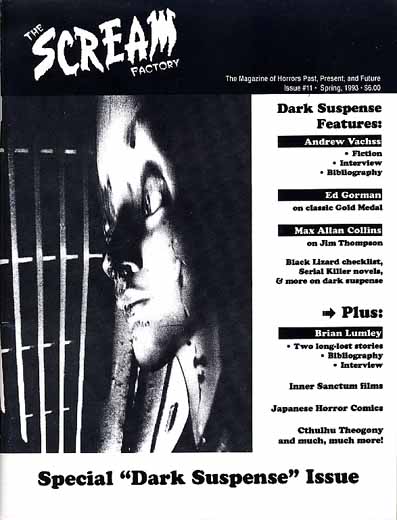
Monad, Damon Knight's last editorial project, produced three issues or volumes (1990-1993), depending how you looked at the hardcover and paperback editions published by the busy, and soon overextended, small house (Pulphouse Publishing briefly attempted, amid all their other projects, to publish their eponymous fiction magazine weekly). But it was a good and useful series of books (or issues)...from perhaps the last great decade for publishing  non-academic critical magazines in a non-virtual format, on paper rather than on the web. And Monad was as spare and lean (with no illustration and a single column of easy-to-read typography on the pages) as most of the other major magazine productions of that era were busy, whether we looked to The Armchair Detective or Science Fiction Eye (soon SF Eye, to be less exclusive) or The Scream Factory...even the similarly no-nonsense Necrofile, like TSF about horror fiction and related matter, didn't have the bare bones elegance of Monad...nor would bare*bones, the more crime-fiction-oriented successor to TSF, and the direct ancestor of the blog of that title.

Knight had begun writing criticism along with his earliest published fiction (and cartoons and illustration), in the 1940s, the critical writing sparked by the example of Frederik Pohl's reviews, and Knight's mostly published in the better examples of the more "sercon" (serious and constructive, which could be taken at face value or imply an earnest dullness) fanzines of the day, as well as in Knight's own fanzine, Snide. In the 1950s, Knight and Lester del Rey co-edited and published two issues of Science Fiction Forum, as a more purely critical little magazine/fanzine, but apparently did no more till Knight revived the title Forum as that of the house organ of the Science Fiction Writers of America, of which he was a primary founder and its first president. While some projects like this one ran indefinitely (Inside Science Fiction became Riverside Quarterly, and lasted forty years in all), many more have been mayflies (Harry Harrison and Brian Aldiss's SF Horizons managed two similarly impressive issues in the mid-'60s). Others, such as the titles mentioned above, had intermediate-length runs, and made names for themselves at least in certain circles...anyone who suffered through my squibs on this blog knows that I'm tempted to try to trace as many of those as possible, but I will desist for a moment (noting only, for example, that SF Eye had roots in Bruce Sterling's one-sheet zine Cheap Truth as well as editor/publisher Stephen Brown's work on such earlier, more conventional critical magazines as Douglas Fratz's Thrust). 


Index of the contents courtesy ISFDb:

The contributions to the first Monad are suitably impressive, and, as often the case with Knight's works, begin with a matter of some controversy, as Knight notes that his original announcement of the series called for essays from writers of fantasticated fiction, rather than from fans or academic students of any tenure or "anecdotalists" (such as, one suspects, Sam Moskowitz); Knight prints Tom Whitmore's letter objecting to this policy, and in his editorial Knight notes that it's not so much a ukase as a flexible statement of intent. But, he continues, only the writers of speculative fiction are working from the inside of the art.  The balance of the book is laden with anecdote, but not solely the anecdotal.

Ursula Le Guin's essay is driven in large part by her recent completion of a fourth volume, Tehanu, in what had been for some years the Earthsea trilogy, and how over the course of writing the component novels, each in its turn, the very fact that she was a woman writing about outsiders in the heroic tradition (a dark-complected man, a woman, children) hit home, and slowly a critique of hierarchy and authority developed as her feminism and anarchism coalesced through her resolution and exploration of these tensions. Even as she credits particularly T. H. White and Tolkien for expanding the idiom before her, it's difficult to see how most of the more ambitious epic fantasy since her contribution would've been written without the example of her work (and that of Fritz Leiber and Jack Vance, among a small number of other most influential folks--I shall have to return to Le Guin's other critical writing to see how much her predecessors such as C. L. Moore, Leigh Brackett and Sylvia Townsend Warner, to say nothing of Woolf and her Orlando, nudged and influenced her).


The Aldiss is an excerpt from his then-just-published book-length memoir, Bury My Heart at W. H. Smith's (the British bookstore); Aldiss had served as literary editor for the Oxford Mail newspaper from early on in his career, and had had some commercial and artistic success with his contemporary-mimetic fiction along with his fantaticated thoughout his career. The Disch is a poem, apparently originally in his1972 limited-edition chapbook The Right Way to Figure Plumbing; "An All-Day Poem" is, in part, how art helps the artist cope with the great ugliness, and small reverses, life hands us (Disch's mother is losing her fight with cancer as he writes). Bruce Sterling takes a somewhat bemused pass through the realms of modern literary theory, the post-Structuralist, post-Derrida and Bakhtin era (and this inspired an answer essay for the second Monad by John Barnes). And Knight rounds us out with a fine short essay that limns his early childhood first  experiences with injustice (and the other Large Things mentioned in the title) and how he found them recapitulated in the crotchets of fellow editors and similar folk in his professional career as an artist.

Knight was one of the pioneering critics of note in fantastic-fiction circles, and remains controversial to this day (he would not stay his hand when he felt an affront to the art was being perpetrated, and Ed Gorman hasn't forgiven him for that yet). And yet Monad's three issues/volumes are a nice core-sampling of the most influential and serious critical writers active in its years (with some exceptions, such as Knight's great students Algis Budrys and Barry Malzberg, and Joanna Russ, who was already scaling back her critical writing in the face of health matters).  Knight, like most of the more ambitious writer/editor/publishers in the field of the popular critical magazine, would tend to move online for much of what he wrote in this wise after Monad...as much as he continued with this kind of activity, as opposed to his writing instruction activities, as reflected by his Creating Short Fiction.

For more of today's books, please see Patti Abbott's blog. I will be gathering the links next week. ("Be there. Aloha.")

Thursday, August 19, 2010

Friday's "Forgotten" Books, College Edition: DREAM MAKERS II: Interviews by Charles Platt; ESSENTIAL WORKS OF ANARCHISM, edited by Marshall Shatz


I matriculated at the University of Hawaii, Manoa as a prospective triple-major (English, Political Science, and an interdisciplinary Planetary Science major), in the Honors Program, and proceeded to take on 18-21 credits per semester of the most challenging courses I could make my way into for the first two semesters, while going in every direction that looked interesting extracirricularly. I was appointed Editor-in-Chief of Hawaii Review, the only literary magazine on campus in those years before Manoa, as an 18-year-old frosh; that appointment was rescinded by the Board of Publications for essentially frivolous reasons and against their own rules, without my (or my successor) being able to get the funds from the BOP to produce any issues. That, while enervating, was lost a bit in the rush of three friends and my campaign, as the Green Slate, for the student Senate of the Associated Students of UH...there were 19 senatorial slots in the College of Arts and Sciences, and 24 candidates. My friend Keiko was easily elected, and I came in 19th, so barely was; our running-mates Darius and Greg placed in the last five in vote totals. We were all motivated to one degree or another by opposition to the Maranatha Christian-cult incumbents on the Senate, who were able to ram through various questionable bills and resolutions in my freshman year; we foiled some of their further attempts, despite most of the executive offices in the new administration being held by Maranathans who had been senators the previous year (Keiko transferred to Barnard College at Columbia U over the summer, but Greg, whose brother was a newly elected Maranathan senator, and Darius were able to enter the senate as Keiko and others dropped out...one of the two School of Engineering senators, Kevin, was an ally on some of these matters, and was also, like Keiko, a punk-rock enthusiast rather more seriously than I was...as a favor, later, in part to thank him for letting me crash with his family, I bankrolled in part his concert event, the Second Pacific Nu Musik Festival, which was a watershed in Hawaiian punk and new wave events). I also became, more by default than anything else, the president of the Honolulu Science Fiction Society.

So it would be hard to blame my reading in those Hawaiian years for my extraordinarily mixed record as a student in 1982-1983, when after three semesters I dropped out of the UH, halfway through my incumbency, and having taken writing courses with Robert Onopa (a 300-level course as a second-semester freshman) and A. A. Attanasio (a graduate seminar in my sophomore year's first and only Hawaiian semester). But I was certainly still reading The Magazine of Fantasy and Science Fiction and the horror-fiction magazine and anthology series Whispers and Ellery Queen's Mystery Magazine and while growing decreasingly happy with the tack The Atlantic was taking, this new incarnation of Harper's was interesting. As was, among the books I was quite happy to find, the now rather obscure collection of interviews with and profiles of sf and fantasy writers called Dream Makers II, the second such volume, assembled by the ever-contentious Charles Platt, who nonetheless with these books was channeling the rather more openhearted and professionally smooth approach of one of his idols, Alfred Bester, who loved writing sf but loved writing and editing (and particularly profiling) for Holiday magazine in its glory years in the 1960s about as much. Platt's first volume did reasonably well, for a collection of interview-based essays, and Platt was able to get backing to touch base with a similar range of writers for the second volume, including such folks as the half-paralyzed and sporadically enraged Keith Laumer, grimly determined to get past the strokes that hadn't yet utterly incapacitated him; Joanna Russ explicitly Outing herself as lesbian, still a relatively bold move in 1983 even if not much of a suprise to those who'd been reading her more autobiographical work; Jerry Pournelle expressing his appreciation for Mussolini and the Fascists, and revealing that he had been, briefly, after his service in the US military in the Korean War, a member of the US Communist Party, largely out of disgust with what he'd just experienced (and, one gathered, his still-strong fetish for Order and Hierarchy), and generally reading how a second set of major writers in the field felt they should present themselves and their work, and what Platt made of them as interview subjects, usually in their homes when they were game to have him over. Fascinating stuff, and certainly Platt's piece on Theodore Sturgeon in this volume didn't make it any easier to miss (what would turn out to be) Sturgeon's last writers' workshop, on one of the neighbor islands, which I couldn't afford to attend so didn't apply for (this was in a period of trying to make my way without taking more money from my parents, which turned out not to work so very well in the depressed job market of 1983-84 Honolulu/Oahu).

Well, having left Hawaii to rejoin my parents, brother and cat, who had moved in '83 to the DC suburbs in Virginia, I got some jerk jobs and began saving money to return to school there, going on to fill out some core requirements at Northern Virginia Community College in 1985, where in working on the campus paper I met Frank Lawrence, my Green/libertarian-left political interests didn't lessen, and in reading a column in Utne Reader about a Canadian journal that sounded particularly interesting, I sent off for a copy of Our Generation, the libertarian socialist and anarchist magazine, which in that issue featured long essays by Noam Chomsky and Murray Bookchin, and shorter pieces (iirc) by George Woodcock and Janet Biehl, among others. Our Generation would soon be supplemented by such more local productions as Social Anarchism, which I would eventually contribute to editorially, and such more farflung publications as The Match! (from an eccentric DIY publisher in Arizona) and Freedom (the anarchist newspaper/newsletter of long standing out of England), and I cast about and supplemented reading the likes of Emma Goldman's massive and often breathtaking Living My Life and Woodcock's and Chomsky's and Daniel Guerin's books, and the likes of Sonia Johnson's political memoirs, with anthologies such as Marshall Shatz's slightly potted but useful and interesting Essential Works. It was nice to have early work by such a Green mover and shaker as Daniel Cohn-Bendit handily cheek-by-jowl with that of Paul Goodman, and both brought together with such progenitors as Proudhon and Bakunin, Kropotkin and Godwin. As with Johnson, not a few of the feminists I was reading voraciously as well, very much including Joanna Russ and the all but anarchist Ursula Le Guin, were echoing much of what the left-libertarian foremothers had noted, applying it to new circumstances. Both on my last academic campus, George Mason University, and off, I grew more involved with the anarchist, libertarian-socialist, Green and other activities at hand, and helped start a few. Very busy times. And some very good reading, to say the least.

Tables of Contents:

For the Platt, from WorldCat:
The first anthology.

Description: xv, 300 p. : ports. ; 21 cm.
Contents:
Jerry Pournelle --
Larry Niven --
Christopher Priest --
William S. Burroughs --
Arthur C. Clarke --
Alvin Toffler --
John Sladek --
D.M. Thomas --
Keith Roberts --
Andre Norton --
Piers Anthony --
Keith Laumer --
Joe Haldeman --
Fritz Leiber --
Robert Anton Wilson --
Poul Anderson --
Jack Vance --
Theodore Sturgeon --
L. Ron Hubbard --
Joanna Russ --
Janet Morris --
The best of/third edition.
Joan D. Vinge --
Harry Harrison --
Donald A. Wollheim --
Edward L. Ferman --
Kit Reed --
James Tiptree, Jr. --
Stephen King.
Responsibility: by Charles Platt.

for the Shatz, from the table of contents in the online version, link above:
Preface ix

Introduction xi

Part I. Anarchism in Theory: Classics of Anarchist
Thought 1

WILLIAM GODWIN: The Father of Anarchism
Enquiry Concerning Political Justice 3

MAX STIRNER: Individualist Anarchism
The Ego and His Own 42

PIERRE-JOSEPH PROUDHON: Mutualist
A Bantam mm paperback!
Anarchism
General Idea of the Revolution in the Nineteenth
Century 81

MICHAEL BAKUNIN: Revolutionary Anarchism
God and the State 123
Statism and Anarchy 155

PETER KROPOTKIN: Anarchist Communism
The Conquest of Bread 184

LEO TOLSTOY: Christian Anarchism
The Kingdom of God Is Within You 229


Part II. The Mind of the Anarchist: Memoirs and
Autobiographies 267

PETER KROPOTKIN : The "Repentant
Nobleman"
Memoirs of a Revolutionist 269

EMMA GOLDMAN: Anarchism and the
Liberated Woman
Living My Life 312

ALEXANDER BERKMAN: "Propaganda by
the Deed"
Prison Memoirs of an Anarchist 356

RUDOLF ROCKER: The Anarchist "Melting Pot"
The London Years 393


Part III. Anarchism in Practice: Firsthand
Descriptions 423

JOSIAH WARREN: The Cincinnati Time Store
and the Modern Times Colony
Practical Details in Equitable Commerce 425
Practical Applications of the Elementary Principles
of "True Civilization" 443

VOLINE: Nestor Makhno and Anarchism in the
Russian Revolution
The Unknown Revolution 450

FRANZ BORKENAU: The Anarchists in the
Spanish Civil War
The Spanish Cockpit 484


Part IV. Anarchism Today: Anarchist Themes in
the Contemporary World 515

HERBERT READ: Anarchism and Man's
Freedom
Existentialism, Marxism and Anarchism 517

DANIEL GUÉRIN: Workers' Self-Management
of Industry
Anarchism 539

DANIEL AND GABRIEL COHN-BENDIT:
Anarchism and Student Revolt
Obsolete Communism: The Left-Wing Alternative 553

ROEL VAN DUYN: The Kabouters of Holland
Proclamation of the Orange Free State 569

PAUL AND PERCIVAL GOODMAN: Restoration
of the Community
Communitas 575


Suggestions for Further Reading 598
Index of Persons 601


For more "forgotten" books in the midst of college-years memoirs, see Patti Abbott's blog for a guide to the other participants...