Showing posts with label Whispers. Show all posts

Wednesday, December 27, 2023

SSW: Jeff Segal and Todd Mason on David Drake, 24 September 1945-10 December 2023


Todd Mason:

As readers of this blog might've seen before, the fifth volume of The Year's Best Horror Stories: Series V edited by Gerald W. Page, was a kind of revelation to me...evidence that such favorite writers of mine already as Robert Bloch, Fritz Leiber, Manly Wade Wellman, Harlan Ellison and Joseph Payne Brennan were still actively writing new work...and look at all their similarly-active peers, whose work I would read in this volume for the firstime (hell, Tanith Lee, Arthur Byron Cover, H. Warner Munn and Charles Grant had new, previously unpublished stories in the book). And one of the writers new to me, with an elegant dark historical fantasy (reprinted from F&SF), was David Drake...and I would come to welcome his short stories in this mode and related ones over the next decade as I found and read them, in YBHS, in the First World Fantasy Awards volume edited by Gahan Wilson, in Whispers anthologies (and, eventually, in issues of the magazine the anthologies were mostly drawn from--which Drake helped putogether), and in Fantastic and Ramsey Campbell's anthology Superhorror, in Kirby McCauley's anthology Frights...and the only non-fantasy/horror story in the materials I had at hand was a "Hammer's Slammers" story in an issue of Destinies, a paperback magazine edited by James Baen for Ace Books, which was the last sf magazine my father would buy for himself, into early 1979. It didn't make as much of an impression on me. Eventually, I had a secondhand copy of the first Hammer's Slammers anthology, but only read some of it, without getting caught up in it--Jeff Segal had a much more engaged (and sensible) response.

David Drake continued to do interesting work in likely and unlikely places over the next several decades, until recent ill-health kept him from writing fiction any longer, but I had lostrack of his work, while being aware of it being in the marketplace. I should still pick up some of his anthologies along with some of his novels and certainly his collections I let slip by. (I was a bit late on the scene to buy most of his and Karl Wagner's Carcosa collections of Manly Wade Wellman's work and others when they were new.)

Unsurprisingly, he has been remembered as a gracious friend and acquaintance by many, even those who might never, say, take part in, nor read, his collaboration on one book with Newt Gingrich and Marianne Ginther (athe time, still married to Gingrich). And among his fans who goto know him rather better than I did is my old friend Jeff Segal:


Jeff Segal:

An especially important author, and sometimes-editor, in my reading evolution, along with his late friends and associates Karl Edward Wagner and Manly Wade Wellman (though my appreciation of Wellman really kicked-in later, as I matured enough to appreciate the authentically Appalachian settings of a lot of his horror and fantasy fiction).

The first Drakes that ripped into my awareness were: one of his I-was-there Vietnam War-set horrors, the vignette "Best of Luck"; and the historical axe & sorcery (or is it sorcery?) chiller "The Barrow Troll", a tale with one of Drake's bitterly ironic finales.

Drake was a vocal advocate for fantastic fiction, especially pulp magazine-era stories, and both his short fiction and novels often served as tributes to neglected books. Publishers Tor and Baen Books have repackaged his short fiction in many combinations, but also encouraged him to promote and harken back to worthy novels and stories by other hands, which too often had been half-forgotten over the decades. For example, his dark tale "The Automatic Rifleman" was inspired by Fritz Leiber's "The Automatic Pistol", which he also heartily recommended to his readers, and I would finally track it down some years afterward (Leiber's classic Weird Tales story opts for a supernatural premise, rather than the apocalyptic-sf direction Drake employed). 


I wrote to him, and eventually we corresponded about failed military missions; he steered me toward a classic, The March Up Country: A Translation of Xenophon's Anabasis, a primary-source historical and inspirational work (which the multi-lingual Drake likely read in its original Greek), and I dipped into it recently when studying the evolution of Walter Hill's movie The Warriors (1979) (Anabasis inspired both the Sol Yurick source-novel and the film).
My first exposure to the "Hammer's Slammers" mercenary yarns which made Drake famous...or notorious...was in a secondhand copy of the 1979 Ace paperback collection with that title. The stories, reinforced with contextual essays, displayed the universe from the POV of a far-future frontline warfighter. One of them, "Cultural Conflict", reads like a critique of the film Aliens, except it was published half a decade before that movie dominated the 1986 summer boxoffice (I saw it three times in theaters). I read the collection too swiftly and the effect of its concentrated violence was somewhat sickening at first, until I broke down how Drake achieved his effects on a literary level. The Slammers stories, and eventually novels and role-playing games, hammered Drake's name into the world of science fiction, though I'd argue that his finest military-oriented sf novel was the standalone Redliners (1996), which he admitted was a cathartic experience to write, allowing him to expel the toxins of war he hadn't known he still carried. It is also a magnificent achievement in creating, to borrow Harry Harrison's term, a "deathworld".

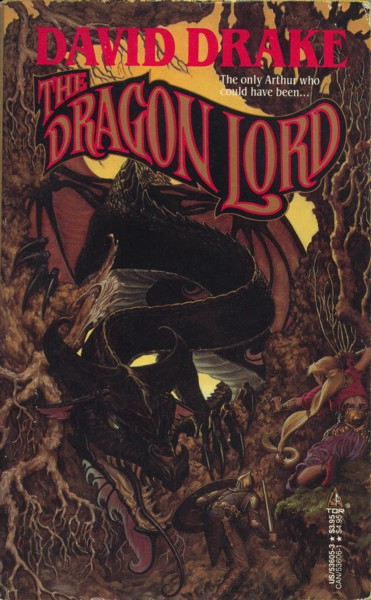
Drake's writing style, distinctly lean and ruthlessly efficient, and his raptor's eye for detail, plus his obsessions and quirks, would often stretch creative muscle over simple or awkward plotting. A case in point is The Dragon Lord, one of my favorite novels of his, a savage take on historical myth with the Camelot crowd, warts and all, serving as supporting players--its wonky back-and-forth traveling plot-structure was more than balanced by the quality of the writing, the research and some engaging characters (traveling and quests are often a part of Drake's longer works regardless of genre; for instance, his Lord of Isles cycle, an epic set almost a 1000 years after a fantasy world's apocalypse, is charmingly told, for all its ambition, in the kind of simple structure that Edgar Rice Burroughs built a successful career around--scatter your protagonists and send them off on separate adventures, while having them attempt to find one another). And The Dragon Lord demonstrated another of the author's talents: the ability to craft credibly menacing creatures with genuine impact and weight; the epic's maturing wyvern, conjured into the world by the scraggly Merlin at the behest of a typically cynical and Drake-esque King Arthur, intended to be employed as a WMD against those pesky Saxons, is used sparingly throughout the book...but it comes across as one helluva intimidating threat by the climax of the story.
Drake was adept in writing horror (primarily in short stories), fantasy (often based in realistically-rendered historical backdrops, though some of his work thus was set in newly-created worlds), and science fiction, the last in harsh military-sf or similarly rugged space opera. He had no qualms about mixing genres. The first and stronger of his two Tom Kelly espionage novels, Skyripper, is as devotedly a Cold War pursuit-thriller as any of its early-Reagan-era ilk, the McGuffin involving a cracked, ingenious Soviet scientist who wants to defect to the US in order to share his conceptual space-warfare plans with Uncle Sam to ward off "an alien invasion" he claims will occur...but there are hints that something is "off" during the brutal multi-threat spy hunt, which results in a hell of an ending, in the tradition of "Just because you're paranoid doesn't mean THEY aren't after you.”
Drake had many interests I share, which would continuously come roaring into his fiction (paleozoology, for instance). History, myth and classical-era literature were integral to much of his bibliography, rather like a bloodthirsty Roger Zelazny (Zelazny's 1969 novel Damnation Alley offered a proto-Drake hardman in a killer vehicle on a nightmare-filled deathworld road-trip). Drake also demonstrated some fascinating contradictions, such as delight in battle-glory action-filled sword & sorcery stories by Robert Howard, and Fritz Leiber (whose Fafhrd and The Gray Mouser bromance tales were repeatedly a big influence on Drake's own characters, fantasy and otherwise) but...Drake's own haunted Vietnam War service acquainted him with the effects of genuine brutality, where there is little glory. [And Leiber, who leaned toward pacifism, was very aware of this in a way that Howard was not. --tm]

Karl Edward Wagner and Drake cowrote a short story that was published in the 1974 first issue of the "little"/"semi-pro" fantasy-fiction magazine Midnight Sun. The tale predated the cult films Without Warning (1980) and Predator (1987) but anticipated something of the alien hunter/predator-on-Earth scenario, though set in ancient Rome. In the '80s, Drake and Wagner nursed the tale into a full-length novel, Killer, which I enjoyed, despite Drake's bad experience with this particular project. The Roman Empire and its frontiers provided a backdrop for his cycle of short bromance historical fantasies featuring the lethal Centurion, Vettius, and his cunning two-fisted merchant pal Dama, as they confront menaces both human and unnatural. Rome also was the setting or inspiration for some of his other short and long fiction. He may have gained a larger audience with the short tale "Ranks of Bronze", which, along with Orson Scott Card's "Ender's Game", I first encountered in the initial volume of Jerry Pournelle's anthology There Will Be War. "Bronze" was expanded into a well-received Bildungsroman novel, which inspired some follow-up books (I first learned about Bildungsromane on his website, an invaluable resource for his fans and scholars).

Not all of Drake's work "popped" for me. For instance, the first and only novel in his proposed "Crystal Walls" series, The Sea Hag, displayed some lively imagination but fell short of the Jack Vance-ian heights he was aiming for. And the follow up to Skyripper seemed to be set in an alternate universe where the conundrum the first book had been building up to was erased. However, a lot of his odd experiments rocked. I warmed up to his "RCN" space-opera series, based, sometimes literally, on Patrick O'Brian's historical Aubrey/Maturin novels. His expansion of Jim Kjelgaard's 1951 paleolithic novel Fire Hunter, The Hunter Returns, enthralled me as much as the original had. His two novels based on Henry Kuttner and C. L. Moore's "Clash By Night", The Jungle and Surface Action, were crammed full of terra-formed Venusian future-naval dreadnaught engagements and horror-choked jungles and seas, another striking deathworld. His take on the Cthulhu Mythos, by way of Joseph Conrad, "Than Curse the Darkness",
was a uniquely feral entry into the pantheon and provided a frightening and absolutely inhuman interpretation of Nyarlathotep, the Dweller in Darkness itself; no chatty Dark Man avatar for this version of the Crawling Chaos (unlike the walking dudes of Robert Bloch's early "The Shadow from the Steeple" and Stephen King's much later The Stand)--Drake's Nyarlathotep was an other-dimensional alien cancer attempting to metastasize throughout our world, summoned to the Congo by those who had been maimed by the Colonials. After humanity has been granted a breather to continue existing, the survivors reflect upon the situation; an American gunslinger, retained as a bodyguard, realizes that he and the singularly unempathic party he is with are the "good guys" and has himself a good laugh. A patented David Drake approach to their victory. That yarn scarred me quite deeply as did a lot of Drake's other efforts.
Finally, he could be quite prescient. His three "Jed Lacey" stories, involving a diagnosed sociopath who is subjected to a behavior-modifying aversion/Ludovico Technique due to his crimes, but who is subsequently "repurposed" as an investigator because he's useful to his AI-governed society, is set in a "Nation without Walls," a near-future United States riddled with omnipresent surveillance technology...a reality accepted by much of the population. When these stories began appearing in the 1970's, a Nation without Walls must have seemed comfortably like fanciful speculative fiction to most readers... 
David Drake and his contributions won't be forgotten by me.

--Jeff Segal

For more of today's short-story posts, please see Patti Abbott's blog.

Wednesday, August 24, 2022

SSW: Jean Goldschmidt: "The Testament of Uncle George", STORY: THE MAGAZINE OF DISCOVERY, May 1967, edited by George Dickerson; Dennis Etchison:"The Pitch", WHISPERS, October 1978, edited by Stuart David Schiff: Short Story Wednesdays

 This issue can be read here.

The Etchison story can be read here.


Jean Goldschmidt's "The Testament of Uncle George" and Dennis Etchison's "The Pitch" are disturbing if also extremely ultraviolet/gallows-humorous stories, about the results of rather bad family dynamics, to put it mildly. Goldschmidt's was written at the beginning of a very short career, abruptly terminated by a 1971 traffic accident that killed her and her husband James Kempton about four years after their marriage; her husband was Murray Kempton's son. Her story was published in the first (perhaps only?) Scholastic Magazines-owned issue of Story, given a new subtitle and with this issue once again Volume 1, No. 1, purchased in 1966 from the Burnetts with Hallie Burnett now officially a Consulting Editor and Whit Burnett demoted to Advisory Editor and still the "Director of the STORY College Creative Awards", one of which was bestowed upon the Goldschmidt story for 1967.  Etchison's is the product of a writer in a successful midpoint of his career, if not as successful as he deserved; it was published in the horror and fantasy magazine Whispers, probably the most influential horror-fiction magazine of its time, and was reprinted in Gerald W. Page's The Year's Best Horror Stories volume for the following year, despite not being an actual horror story, any more than Robert Bloch's Psycho was, but instead an intense yet somewhat offhanded suspense story, as a number of Etchison's stories were. Similarly, Goldschmidt's story involves a young woman, Gwendolyn, alienated from her family (her father dies when she is very young; her mother marries her husband's brother, though not out of 19th Century tradition, and soon gives birth to a half-brother/half-cousin to the young woman, before divorcing her second husband and leaving Gwendolyn in the care of various family, their son Rudy with his father (who revels in the name George Washington Bridge while publishing Irving Wallace-style novels as "G. W. Bridgeport"), before she conducts various affairs which end poorly, and then commits suicide. Gwendolyn and Rudy, long separated, finally meet in their late teens, and have a multiply unfortunate romantic affair. 

Etchison's story features a loner who is nonetheless a very adept demonstrator and pitchman for several kinds of slicing and dicing food-processing devices...one who tolerates no sort of condescension nor rudeness directed at himself, and who seems oddly reticent to demonstrate the knives that are to be sold with the devices, and never takes off his gloves. It seems that as a young boy, his mother, overbearingly monitoring his piano practice from the kitchen, once was too incautious in how she let him know of her displeasure. Things do not come to what would be considered a conventionally happy conclusion in either story, either in the slow build of the strangeness of the Etchison protagonist, who likes to go by "C-Note", nor between Gwendolyn/Wendy and her uncle and her brother/cousin, told in a somewhat showily arch but not off-putting manner, as each of her characters tries and fails to find a comfortable role in day-to-day society.

These two writers began as essential contemporaries, with Etchison beginning to publish in the campus and then professional press in 1963, Goldschmidt in 1966 and with this story in '67; Etchison had his own rather less drastic bad luck in 1971, when the publishing house that was to issue his first collection went bankrupt just as his book was going to press, just after publishing the first edition of Karl Edward Wagner's first collection, Darkness Weaves. Etchison began to write scripts and novels by the late '60s, based as he was in Los Angeles, and began to edit anthologies, including both those devoted to horror and related work as Cutting Edge and Metahorror, and the much more eclectic small press anthology Lord John Ten, celebrating a decade of the Lord John Press's various interests. While Goldschmidt contributed to various magazines and The Village Voice during her foreshortened career...a retrospective of her work and some brief memoirs, My View is Incomplete, was published in 2001 with an introduction by Grace Paley. Etchison published a career retrospective, Talking in the Dark, in 2001, but continued to publish until shortly before his death from cancer in 2019. 

In a sense, one can see how both of their work grew out of some similar influences, such as Robert Bloch and Shirley Jackson (and Evelyn Waugh), but notably both the younger writers, in these stories among others, start at a point a bit beyond where the characters in the most typical work of Bloch or Jackson might still be attempting to pretend to be somewhat conventional or not prone to disconcerting urges; there's little pretense thus among the characters in these and other works by the '60s kids, who are also drawing in part on such writers as Donald Barthelme and Robert Coover, and fellow, slightly older '60s kids Joyce Carol Oates and Barry Malzberg (the latter two at Syracuse rather than at Etchison's Berkeley or Goldschmidt's Sarah Lawrence), or the slightly elder Carol Emshwiller and Patricia Highsmith. 

Etchison might be the single most influential writer of his generation on the current horror and suspense-fiction field, in the way he explores characters who are not anchored to conventional empathy nor to consensus reality any more than our more disturbing fellow citizens are; I shall have to read more of Goldschmidt's small body of surviving work, to see if she would've likely continued to take a slightly more antic approach to the same sort of neo-Gothic that fascinates Oates, and not too dissimilar from that which has driven the darker visions of Kate Wilhelm, Ursula Le Guin, Margaret Atwood or Octavia Butler.

For more of today's short-fiction reviews, please see Patti Abbott's blog.

The Fictionmags Index listing for this issue of Whispers:

Index to the Story issue forthcoming...


Friday, March 9, 2018

FFB: WHISPERS: AN ILLUSTRATED ANTHOLOGY OF FANTASY AND HORROR edited by Stuart David Schiff (Doubleday 1977)

This is the fortieth anniversary year of my youthful falling in love with new fiction magazines (and magazines such as The Atlantic Monthly and OMNI, which featured fiction prominently), and none of them did I love more intensely than Whispers magazine (founded 1973), whose first best-of anthology (with a few new stories mixed in) this was. I managed to find it in a library in 1978, the year after it was published, and the year after I first learned of Whispers magazine's existence, thanks to Gerald W. Page's The Year's Best Horror Stories, Series V (DAW Books, 1977) and the next volume, and particularly Gahan Wilson's First World Fantasy Awards (Doubleday 1977). The anthology series which followed this first volume continued to be a mixture of reprints from the magazine and, increasingly,  new stories, and the Doubleday volumes (eventually six of them) began to appear more frequently than new issues of the magazine itself, which had to be financed entirely by editor and publisher Stuart Schiff, whose dentistry practice allowed him to fund his ever more elaborate and handsome little magazine. (The anthology series had handsomer jackets than most Doubleday releases of the era, even if the magazine usually was more striking, given Schiff didn't have to negotiate with the Doubleday art department with what he published on his own.)

Whispers magazine had been Schiff's attempt, initially modestly, at bringing something similar to Weird Tales back into print (and as he was doing so, the four-issue run of Leo Margulies's revival of WT, edited by Sam Moskowitz, came and and quickly went), as a showcase for horror and borderline suspense fiction, and dark and heroic fantasy fiction. And from its early issues, it was featuring fiction as good as or better than that appearing in better-paying magazines and other markets. 
1979 paperback reprint
This wasn't quite a who's who of horror writing in the 1970s, as an all-stag group (with the possible exception of the now-vanished Robin Smyth) and missing a few of the other male major players, but it's an impressive array, and at least pretty good stories from them all (with the exception, by my lights, of a typically minor Brian Lumley Cthulhu story). Karl Wagner's "Sticks" is perhaps his best-remembered horror fiction, David Drake's "The Barrow Troll" one of his best-loved historical fantasies with an horrific edge to it, and while none of the other stories loom as large in their authors' careers (the Ramsey Campbell is perhaps closest), this was a thoroughly enjoyable introduction to what Schiff brought together in his anthologies to come, and (minus the book reviews and relevant small press and large-publisher news) the magazine. Future volumes would feature even fewer reprints from sources largely unavailable to US readers, but a few more...including David Campton's brilliant "At the Bottom of the Garden" in Whispers II. And after the first volume, the series was published, misleadingly, under the Doubleday Science Fiction imprint...mostly notable for an even more meager promotion budget.

1987 reprint
The horror boom was already beginning to burgeon by 1977, as Stephen King joined Ira Levin, Thomas Tryon, William Peter Blatty and others as repeatedly bestselling writers, H. P. Lovecraft had gained a mass audience, and publishers were already willing to take a gamble on anthologies ...Doubleday would engage Charles Grant's Shadows series of original anthologies beginning in 1978; Kirby McCauley's Frights had appeared in 1976, and his Dark Forces would come in 1980. Paperback versions of all these were rolling out as well...and not a few little magazines in horror would follow Schiff's example, and join such other veteran small-press magazines as Weirdbook and Nyctalops. 

For more of today's reviews, please see Patti Abbott's blog...and her new collection, I Bring Sorrow and Other Tales of Transgression.


Friday, August 18, 2017

FFM/B: New fantasy short fiction on the US newsstands & bookshelves, late 1976: ARIEL, Autumn 1976, edited by Thomas Durwood; CHACAL, Winter 1976, edited by Arnie Fenner and Byron Roark; FANTASTIC, November 1976, edited by Ted White; THE MAGAZINE OF FANTASY AND SCIENCE FICTION, October, November and December 1976, edited by Edward Ferman; WHISPERS, December 1976, edited by Stuart David Schiff; FLASHING SWORDS #3: WARRIORS AND WIZARDS, edited by Lin Carter; THE YEAR'S BEST FANTASY STORIES, Volume 2, edited by Lin Carter; THE YEAR'S BEST HORROR STORIES, Series 4, edited by Gerald W. Page


Short fantasy fiction on the American racks, late 1976:

There were other magazines and other books publishing new fantasy fiction (including horror and often along with crime or science fiction), but in the last months of 1976, these are the eight magazines and anthology series offering the most new fiction in the field. Two were new, three were semi-professional or "little" magazines, two theoretically best of the year anthologies featuring some new fiction, one a specialized sword & sorcery anthology series, and three were magazines which had offered special Fritz Leiber issues (Fantastic in 1959, F&SF in 1969 and Whispers in 1979)...


F&SF and Fantastic were low-budget but professional magazines, both put together in the houses of their editors, Edward Ferman's F&SF from Cornwall, Connecticut and Ted White's Fantastic, with companion Amazing Science Fiction, in Falls Church, Virginia. Ferman also published his magazine, having inherited its concern, Mercury Press, from his father, Joseph Ferman; White was working for a very modest stipend from Ultimate Publications, which amounted to a retirement job for magazine veteran Sol Cohen and a diversified holding for his junior partner Arthur Bernhard, who published other low-budget magazines on his own. A few other newsstand fantasy-fiction magazines had briefly appeared on the newsstands to join Fantastic and F&SF in the 1970s, including Coven 13, purchased, retitled and edited by Gerald W. Page as Witchcraft and Sorcery in the early 1970s, a brief run of Worlds of Fantasy magazine from the Galaxy group of magazines (where Cohen had worked just before setting up Ultimate in 1965), two issues of Gerry Conway's The Haunt of Horror (as a fiction magazine; publisher Marvel went on to relaunch the title as a large-format comic book), and the first briefly flourishing attempt to revive Weird Tales, in 1973-74 by Leo Margulies, at that point still trying to expand his line beyond the long-running Mike Shayne Mystery Magazine. But Fantastic (since 1952) and F&SF (since 1949) had been the consistently-appearing magazines in the field, helped to continue in part by both usually featuring some science fiction in their mix. Even in these days of a resurgence in fantasy (Tolkien, Richard Adams, Richard Bach) and horror (Ira Levin, William Peter Blatty, Stephen King) fiction as potent commercial forces in book form, fantasy including some horror wasn't necessarily going to sell copies of a fiction magazine by itself in sustainable quantity...though F&SF was the only fantastic-fiction magazine to steadily increase its circulation throughout the '7os,

and Fantastic, which had with the previous issues gone from bimonthly to quarterly publication, saw issues which included authorized pastiches of Robert Howard's Conan the Barbarian stories, usually by Lin Carter or Carter with L. Sprague de Camp, do rather well in sales. And both Ferman and White's magazines were well-regarded, offering usually good to brilliant fiction on their modest budgets, perhaps in part due to the continuing lack of other markets that would pay more for such fiction... with rare exceptions in the cases of (sophisticated) general-interest and gendered "slick" magazines such as The New Yorker, The Atlantic Monthly, Cavalier, Playboy, Redbook or Mademoiselle. There were little magazines, such as TriQuarterly, Antaeus or Ontario Review (and, in their own way, the then-relatively new
folkloric journal Parabola), which were open to some fantasy as well as part of their regular remit, and there had been a longstanding tradition of such little magazines within the fantastic-fiction community, as well...Stuart David Schiff's Whispers was becoming one of the most prominent of these, meant in its own way to be a sort of Weird Tales revival of its own, like Witchcraft and Sorcery before it devoted to a WT-like mix of horror and mostly dark fantasy.

Weirdbook, Nyctalops and Fantasy and Terror, three of the other notable US little magazines in the field, produced no issues in late '76 (in the UK, Dark Horizons did publish such an issue, and if one wishes to fault me for not including the late 1976 issue of Midnight Sun or the final, 1976 issue of Joseph Payne Brennan's long-running Macabre, I'd have to concede one had a case), but two new entries did, both in their ways hoping to demonstrate that relatively elegant, large-format packaging could be achieved on even a modest budget: Arnie Fenner's Chacal and Thomas Durwood's Ariel. Both were largely but not exclusively devoted to epic fantasy, and both would continue for several issues (nine and four, respectively) over the next several years, Chacal soon (essentially) changing its title to Shayol (and the editorship eventually passing on to Pat Cadigan) and Durwood from issue two throwing in with Betty and Ian Ballantine at their Peacock Press imprint and changing the title formally to Ariel: The Book of Fantasy

When the Ballantines had sold their paperback company, Ballantine Books, completely to Random House a few years previously, Lin Carter had lost one of his regular gigs, editing their line of Adult Fantasy reissues and infrequent new books, some of the latter anthologies he would edit of short fiction. Happily for him, he picked up two new annual projects, an anthology series devoted to publishing new sword and sorcery fiction, Flashing Swords!, published by Dell Books, and editorship of a new best-of-the-year (mostly) reprint anthology for DAW Books, joining Donald A. Wollheim's sf annual and what had become, with its fourth volume, Gerald W. Page's The Year's Best Horror Stories (the players do tend to recur in various roles in the small world of fantasy-fiction publishing in this era). And because it remained a relatively small world of fantasy and horror short-fiction publishing, both the Carter Fantasy and the Page Horror annuals were allowed, as Wollheim didn't allow himself in his series, to publish original stories in the BOTY volumes, rather than depend solely on reprints from the year's books and magazines...even given the quality of much of what those newsstand and little magazines were publishing. Page, on balance, was a better editor
of his books (including his own original-fiction anthologies Nameless Places and Heroic Fantasy), but Carter's books have their charm, as well, and draw from more than their share of notable contributors and present some very good fiction, reprinted from the other publications noted here and others beyond.  With both editors including the original stories mentioned previously, these annual series were important showcases for new as well as reprinted fantasy fiction. 

Some contents (indices courtesy the FictionMags and Contento Anthology Indexes and ISFDB) and comments on them: 
This is a very good set of months for F&SF, even if the December issue isn't quite up to the previous two, even with a fine Varley and a Jennings. The all-star issue features fine work from Bloch, Ellison, Le Guin, Wellman and Cowper...the Bretnor is one of the earlier annoying Schimmelhorn stories, where the misogyny will out rather intensely (Raylyn Moore, in the December issue, can usually be counted on for some loathing of her own gender as well).  The Damon Knight story is pretty brilliant, and it's an otherwise good issue built around him, with a very fine Joanna Russ book essay. Meanwhile, the Budrys book essay in the December issue is definitely one of the highlights there. Beware Ray Bradbury poetry. 
    Fantastic [v25 #5, November 1976] ed. Ted White (Ultimate Publishing Co., Inc., $1.00, 132pp, digest, cover by Doug Beekman)  Note: title on spine is “Fantastic Stories
Fantastic was in the midst of its several-years' experiment of explicitly labeling itself a fantasy-only magazine, with a special emphasis on sword and sorcery fiction. I've liked Brian Lumley's "Tharquest" only marginally better than Carter's "Thongor" over the years...but the Leiber and de Camp columns are fine, the other fiction mostly engaging. 
One of the last issues of Whispers before its companion Doubleday anthology series began...and one of the best of the magazine issues to be published, with the Etchison and Campton stories highly memorable. I'll need to refresh my memory of the Lafferty.
    Note a certain similarity to the Chacal contents, only with more engagement with comics, notably but not exclusively Batman comics...

    Flashing Swords! #3: Warriors and Wizards ed. Lin Carter (Dell 2579, Aug ’76, $1.25, 272pp, pb) Cover: Don Maitz
It was not possible for me to pass up a book with new fiction from Leiber and Davidson in 1978...

Note that Carter, not for the first nor last time, is kind enough to include two of his own stories (including one based on a Clark Ashton Smith fragment) among the reprinted Year's Best...the two new stories in this volume have no previous publication site specified.

While Page includes none of his own fiction, I suppose one could "fault" him for digging three times into his own anthology and magazine, and for going back an extra year for the Witchcraft and Sorcery story (but a Lafferty deserves the showcase)...but that would be foolishness, seeing the diversity of the sources tapped for this BOTY, along with the two newly-published short stories and Price's essay...

For more of today's books, please see Patti Abbott's blog.