Showing posts with label Jeff Segal. Show all posts

Wednesday, December 27, 2023

SSW: Jeff Segal and Todd Mason on David Drake, 24 September 1945-10 December 2023


Todd Mason:

As readers of this blog might've seen before, the fifth volume of The Year's Best Horror Stories: Series V edited by Gerald W. Page, was a kind of revelation to me...evidence that such favorite writers of mine already as Robert Bloch, Fritz Leiber, Manly Wade Wellman, Harlan Ellison and Joseph Payne Brennan were still actively writing new work...and look at all their similarly-active peers, whose work I would read in this volume for the firstime (hell, Tanith Lee, Arthur Byron Cover, H. Warner Munn and Charles Grant had new, previously unpublished stories in the book). And one of the writers new to me, with an elegant dark historical fantasy (reprinted from F&SF), was David Drake...and I would come to welcome his short stories in this mode and related ones over the next decade as I found and read them, in YBHS, in the First World Fantasy Awards volume edited by Gahan Wilson, in Whispers anthologies (and, eventually, in issues of the magazine the anthologies were mostly drawn from--which Drake helped putogether), and in Fantastic and Ramsey Campbell's anthology Superhorror, in Kirby McCauley's anthology Frights...and the only non-fantasy/horror story in the materials I had at hand was a "Hammer's Slammers" story in an issue of Destinies, a paperback magazine edited by James Baen for Ace Books, which was the last sf magazine my father would buy for himself, into early 1979. It didn't make as much of an impression on me. Eventually, I had a secondhand copy of the first Hammer's Slammers anthology, but only read some of it, without getting caught up in it--Jeff Segal had a much more engaged (and sensible) response.

David Drake continued to do interesting work in likely and unlikely places over the next several decades, until recent ill-health kept him from writing fiction any longer, but I had lostrack of his work, while being aware of it being in the marketplace. I should still pick up some of his anthologies along with some of his novels and certainly his collections I let slip by. (I was a bit late on the scene to buy most of his and Karl Wagner's Carcosa collections of Manly Wade Wellman's work and others when they were new.)

Unsurprisingly, he has been remembered as a gracious friend and acquaintance by many, even those who might never, say, take part in, nor read, his collaboration on one book with Newt Gingrich and Marianne Ginther (athe time, still married to Gingrich). And among his fans who goto know him rather better than I did is my old friend Jeff Segal:


Jeff Segal:

An especially important author, and sometimes-editor, in my reading evolution, along with his late friends and associates Karl Edward Wagner and Manly Wade Wellman (though my appreciation of Wellman really kicked-in later, as I matured enough to appreciate the authentically Appalachian settings of a lot of his horror and fantasy fiction).

The first Drakes that ripped into my awareness were: one of his I-was-there Vietnam War-set horrors, the vignette "Best of Luck"; and the historical axe & sorcery (or is it sorcery?) chiller "The Barrow Troll", a tale with one of Drake's bitterly ironic finales.

Drake was a vocal advocate for fantastic fiction, especially pulp magazine-era stories, and both his short fiction and novels often served as tributes to neglected books. Publishers Tor and Baen Books have repackaged his short fiction in many combinations, but also encouraged him to promote and harken back to worthy novels and stories by other hands, which too often had been half-forgotten over the decades. For example, his dark tale "The Automatic Rifleman" was inspired by Fritz Leiber's "The Automatic Pistol", which he also heartily recommended to his readers, and I would finally track it down some years afterward (Leiber's classic Weird Tales story opts for a supernatural premise, rather than the apocalyptic-sf direction Drake employed). 


I wrote to him, and eventually we corresponded about failed military missions; he steered me toward a classic, The March Up Country: A Translation of Xenophon's Anabasis, a primary-source historical and inspirational work (which the multi-lingual Drake likely read in its original Greek), and I dipped into it recently when studying the evolution of Walter Hill's movie The Warriors (1979) (Anabasis inspired both the Sol Yurick source-novel and the film).
My first exposure to the "Hammer's Slammers" mercenary yarns which made Drake famous...or notorious...was in a secondhand copy of the 1979 Ace paperback collection with that title. The stories, reinforced with contextual essays, displayed the universe from the POV of a far-future frontline warfighter. One of them, "Cultural Conflict", reads like a critique of the film Aliens, except it was published half a decade before that movie dominated the 1986 summer boxoffice (I saw it three times in theaters). I read the collection too swiftly and the effect of its concentrated violence was somewhat sickening at first, until I broke down how Drake achieved his effects on a literary level. The Slammers stories, and eventually novels and role-playing games, hammered Drake's name into the world of science fiction, though I'd argue that his finest military-oriented sf novel was the standalone Redliners (1996), which he admitted was a cathartic experience to write, allowing him to expel the toxins of war he hadn't known he still carried. It is also a magnificent achievement in creating, to borrow Harry Harrison's term, a "deathworld".

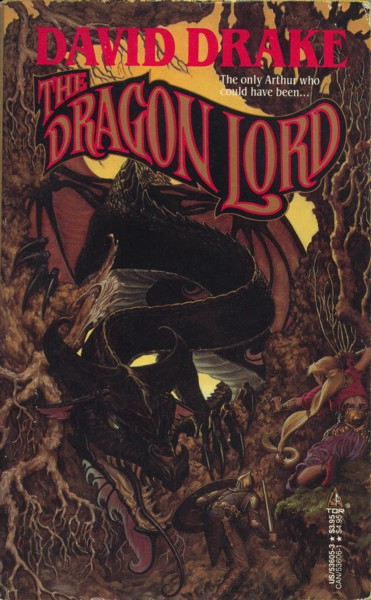
Drake's writing style, distinctly lean and ruthlessly efficient, and his raptor's eye for detail, plus his obsessions and quirks, would often stretch creative muscle over simple or awkward plotting. A case in point is The Dragon Lord, one of my favorite novels of his, a savage take on historical myth with the Camelot crowd, warts and all, serving as supporting players--its wonky back-and-forth traveling plot-structure was more than balanced by the quality of the writing, the research and some engaging characters (traveling and quests are often a part of Drake's longer works regardless of genre; for instance, his Lord of Isles cycle, an epic set almost a 1000 years after a fantasy world's apocalypse, is charmingly told, for all its ambition, in the kind of simple structure that Edgar Rice Burroughs built a successful career around--scatter your protagonists and send them off on separate adventures, while having them attempt to find one another). And The Dragon Lord demonstrated another of the author's talents: the ability to craft credibly menacing creatures with genuine impact and weight; the epic's maturing wyvern, conjured into the world by the scraggly Merlin at the behest of a typically cynical and Drake-esque King Arthur, intended to be employed as a WMD against those pesky Saxons, is used sparingly throughout the book...but it comes across as one helluva intimidating threat by the climax of the story.
Drake was adept in writing horror (primarily in short stories), fantasy (often based in realistically-rendered historical backdrops, though some of his work thus was set in newly-created worlds), and science fiction, the last in harsh military-sf or similarly rugged space opera. He had no qualms about mixing genres. The first and stronger of his two Tom Kelly espionage novels, Skyripper, is as devotedly a Cold War pursuit-thriller as any of its early-Reagan-era ilk, the McGuffin involving a cracked, ingenious Soviet scientist who wants to defect to the US in order to share his conceptual space-warfare plans with Uncle Sam to ward off "an alien invasion" he claims will occur...but there are hints that something is "off" during the brutal multi-threat spy hunt, which results in a hell of an ending, in the tradition of "Just because you're paranoid doesn't mean THEY aren't after you.”
Drake had many interests I share, which would continuously come roaring into his fiction (paleozoology, for instance). History, myth and classical-era literature were integral to much of his bibliography, rather like a bloodthirsty Roger Zelazny (Zelazny's 1969 novel Damnation Alley offered a proto-Drake hardman in a killer vehicle on a nightmare-filled deathworld road-trip). Drake also demonstrated some fascinating contradictions, such as delight in battle-glory action-filled sword & sorcery stories by Robert Howard, and Fritz Leiber (whose Fafhrd and The Gray Mouser bromance tales were repeatedly a big influence on Drake's own characters, fantasy and otherwise) but...Drake's own haunted Vietnam War service acquainted him with the effects of genuine brutality, where there is little glory. [And Leiber, who leaned toward pacifism, was very aware of this in a way that Howard was not. --tm]

Karl Edward Wagner and Drake cowrote a short story that was published in the 1974 first issue of the "little"/"semi-pro" fantasy-fiction magazine Midnight Sun. The tale predated the cult films Without Warning (1980) and Predator (1987) but anticipated something of the alien hunter/predator-on-Earth scenario, though set in ancient Rome. In the '80s, Drake and Wagner nursed the tale into a full-length novel, Killer, which I enjoyed, despite Drake's bad experience with this particular project. The Roman Empire and its frontiers provided a backdrop for his cycle of short bromance historical fantasies featuring the lethal Centurion, Vettius, and his cunning two-fisted merchant pal Dama, as they confront menaces both human and unnatural. Rome also was the setting or inspiration for some of his other short and long fiction. He may have gained a larger audience with the short tale "Ranks of Bronze", which, along with Orson Scott Card's "Ender's Game", I first encountered in the initial volume of Jerry Pournelle's anthology There Will Be War. "Bronze" was expanded into a well-received Bildungsroman novel, which inspired some follow-up books (I first learned about Bildungsromane on his website, an invaluable resource for his fans and scholars).

Not all of Drake's work "popped" for me. For instance, the first and only novel in his proposed "Crystal Walls" series, The Sea Hag, displayed some lively imagination but fell short of the Jack Vance-ian heights he was aiming for. And the follow up to Skyripper seemed to be set in an alternate universe where the conundrum the first book had been building up to was erased. However, a lot of his odd experiments rocked. I warmed up to his "RCN" space-opera series, based, sometimes literally, on Patrick O'Brian's historical Aubrey/Maturin novels. His expansion of Jim Kjelgaard's 1951 paleolithic novel Fire Hunter, The Hunter Returns, enthralled me as much as the original had. His two novels based on Henry Kuttner and C. L. Moore's "Clash By Night", The Jungle and Surface Action, were crammed full of terra-formed Venusian future-naval dreadnaught engagements and horror-choked jungles and seas, another striking deathworld. His take on the Cthulhu Mythos, by way of Joseph Conrad, "Than Curse the Darkness",
was a uniquely feral entry into the pantheon and provided a frightening and absolutely inhuman interpretation of Nyarlathotep, the Dweller in Darkness itself; no chatty Dark Man avatar for this version of the Crawling Chaos (unlike the walking dudes of Robert Bloch's early "The Shadow from the Steeple" and Stephen King's much later The Stand)--Drake's Nyarlathotep was an other-dimensional alien cancer attempting to metastasize throughout our world, summoned to the Congo by those who had been maimed by the Colonials. After humanity has been granted a breather to continue existing, the survivors reflect upon the situation; an American gunslinger, retained as a bodyguard, realizes that he and the singularly unempathic party he is with are the "good guys" and has himself a good laugh. A patented David Drake approach to their victory. That yarn scarred me quite deeply as did a lot of Drake's other efforts.
Finally, he could be quite prescient. His three "Jed Lacey" stories, involving a diagnosed sociopath who is subjected to a behavior-modifying aversion/Ludovico Technique due to his crimes, but who is subsequently "repurposed" as an investigator because he's useful to his AI-governed society, is set in a "Nation without Walls," a near-future United States riddled with omnipresent surveillance technology...a reality accepted by much of the population. When these stories began appearing in the 1970's, a Nation without Walls must have seemed comfortably like fanciful speculative fiction to most readers... 
David Drake and his contributions won't be forgotten by me.

--Jeff Segal

For more of today's short-story posts, please see Patti Abbott's blog.

Wednesday, April 5, 2017

Jeff Segal on Robert Bloch: a guest post

Marvel Comics sequential art adaptations, and secondhand paperbacks which mixed his stories in among those from other writers whose careers began and flourished during the pulp-magazine era, were my introduction to the punning prose of Robert Bloch. With an eye-catching cover illustrating "That Hell-Bound Train", the Ballantine/Del Rey Books The Best of Robert Bloch was the first collection I purchased of his work, which introduced me to the ironic resolutions to his science fiction tales. I was also thus acquainted with Bloch's psychologically-driven fiction (most famously, of course, in Psycho) and his early involvement in the Cthulhu Mythos. 
My favorite Bloch moment of my youth was reading "The Head Man" in a vintage anthology during,
I think, high school. That tale of witchcraft targeting the Third Reich and of mixed-up severed heads had me roaring with laughter.
Even with all of the subsequent Bloch that I've collected and read, I realize that I've only experienced a fragment of his literary legacy, not even counting his radio drama, teleplays and screeplays. I look forward to experiencing more of his more than half-century of work in coming decades, I hope in affordable, comprehensive editions. 
The movie Psycho should not be his only headstone, given the extent of his contributions to several genres as well as his non-fiction.


Possibly Jeff's introduction to
"The Head Man"...


The 1975 Marvel large-format B&W reprint magazine issue where Jeff
 first read the Bloch and other adaptations detailed on the cover...

Monday, November 9, 2015

The Night We Caught the Hallowe'en Show: guest post by Jeff Segal

I watched the documentary Halloweenville late Friday night, the 30th, taking notes on how enthusiastically Lambertville, NJ celebrates the holiday and which streets to visit. That exposure, plus what I found on the internet, assured us of a more entertaining adventure. Local Lambertville filmmaker/musicians Paul Kaye & Gary P. Cohen helmed the doc and they recruited actress Deborah Reed to narrate. She is known, with good reason, among cult film fans for her role in the legendary Troll 2 as the bespectacled queen of the goblins, vicious vegan monsters who convert hapless humans into greenery so they can be eaten.

Saturday, October 31, 2015
  
Though Saturday's temps never rose beyond the low sixties, the cheery sun was out all day and there wasn't much wind when sundown brought temperatures down to the upper forties and early fifties. I had on my clunky large ankle-cradling shoes, thick jeans, a multi-pocketed zipper up vest that had belonged to my father UNDER my oversized Hawaiian shirt and a large multipocketed black jacket (the heaviest of my lighter jackets, which in conjunction with the rest of them, probably adds up to a winter coat) so I was quite comfortable lumbering around two quaint towns Hallowe'en night: New Hope, PA, where we eventually ate and shopped, is separated from NJ's Lambertville by a sheet-metal automobile and pedestrian bridge that clanks as we walk over it...and we did lots of footwork. My cousin Joe and my buddy Jeff were dressed in traditional more serious winter outerwear.  While killing time in New Hope, waiting for sundown, we ate at the Logan Inn--good, tasty food but too pricy for my comfort. We didn't encounter any scary phenomena, save for the bill, but ghosts would have certainly given us more bang for our buck if we had! Once it grew dusky, we packed our purchases of New Hope fudge and gourmet popcorn away, clanged back over the bridge, and re-entered the transformed Lambertville. I had switched the Christmas-decoration-festooned, guinea pig-sized rubber spider that I had been carrying (Nastassja Kinski once, gingerly, had patted it, its sole brush with celebrity) with the dog-sized rubber cockroach that I had decked out with a Santa cap, a pet sized Santa coat and Christmas mittens, plus a spiked collar and leash. The Christmas roach (as my cousin dubbed it), often evokes cringing revulsion in many onlookers once they realize what it is and I cradled it in one arm like Paris Hilton does her barking rat-dogs, jiggling it around for maximum jointed-leg-twitching effect. It did its magic Hallowe'en night, provoking much conversation and gasps. 


Evidently, there are side streets of decorated houses and neat businesses, most of which we didn't have time to side-track down. But we did tour the most popular street in Lambertville, which the police close to automobile traffic for several hours Hallowe'en evening. Many residential and businesses owners decorate along that drag, with second and third stories featuring illuminated or moving figures against windows, things dangling out of the window frames, webs stretching from top floors down to their postage-stamp-sized front yards. I recognized some of the props as pop-up Hallowe'en store merchandise from the current season or previous years, but the owners often utilized them in ways that maximized their efficiency or modified them. There were plenty of created-from-scratch figures and scenarios, some I recognized from the Halloweenville documentary. I think I saw the one house where the owner made use of hooded, caped performers in expressionless golden masks--she confessed in the film that she had discovered that they disturbed visitors more than the more obvious monsters that she had once employed; the house front and yard looked familiar but I didn't see any masked figures doing odd rituals...they still might have been lurking about.  Amid the concerts of ghostly noises some owners played, a ghoulish rock band pounded out classic dark rock tunes such as a track from the Pink Floyd album Dark Side of the Moon. To accommodate the hundreds of trick 'r treaters (including parents, older siblings and many costumed pets, some in glow-in-the-dark outfits to prevent them from getting stepped on), many owners stocked BARREL LOADS of goodies. A significant portion of the revelers were costumed. We only saw a portion of them but some folks were pushing a huge enclosed transparent illuminated crib with their multiple monkey-garbed children, another family had their children in a huge carrier dressed like a waste management truck. A child too young to be watching or reading Watchmen was dressed as Rorschach. The most impressive spectacle of the evening had at least two strong adults operating an Imperial Walker the size of of a large bulky camel, complete with classic "Imperial March" theme playing in a loop. The four-legged costume didn't walk swiftly up the street but the crowds did part out of respect for it. 

[Unrelated to the documentary, except from the same year's festivities:]


This is the type of well-populated small-town Halloween celebration nostalgically envisioned by the movie Trick 'R Treat. I'm sure that the revelry could be juxtaposed with adventures down creepier parts of town where there are more shadows than people and among more rural patches in Lambertville; that was the geographical contrast mapped out by the Trick 'R Treat film and could be used as a template for Lambertville as well. 

Tuesday, February 18, 2014

Overlooked Films and A/V guest post: Jeff Segal on his recent horror and suspense film documentary and tv viewing...and videotape nostalgia


Recently, I watched The Man Who Saw Frankenstein Cry, a swiftly-paced documentary on ham-fisted yet sincere monster-loving actor/writer/director Paul Naschy's life and career, with
from The Man Who Saw Frankenstein Cry
plenty of comment on the prolific King of Spanish Horror Cinema from the likes of his wife and brood, as well as director-turned-commentator John Landis, Mick Garris, the unflappable Jack Taylor (a somnolent chap who squeezed many cult/exploitation/horror film roles in between international vacations), Living Dead at the Manchester Morgue director Jorge Grau, and many more, plus behind-the-scenes photos and footage, film clips, etc. Highly recommended to the Naschy fan and general Eurotrash scholars.

I've also recently caught the Brian Clemens' Thriller episode, "Screamer," featuring Legend of Hell House and
The Innocents actress Pamela Franklin as an imperiled American (!) in backwoods Britain (sadly, the winsome Franklin suppressed her lovely British accent for the part and was saddled with an unflattering 'do). Clemens was known for his clever scripting of The Avengers and sundry twilight-era Hammer horrors but his 1970s UK Thriller anthology show, which I've never previously seen, has taken plenty of heat over the years. Clemens previously co-wrote and produced the suspenseful original version of And Soon the Darkness, which also starred Franklin.


I've seen Slice and Dice, a clip-packed documentary about slasher films which included footage from Michele Soavi's Stagefright, Mario Bava's Bay of Blood and the black-gloved, straight razor-filled giallos that flooded the market between them. The production runs through the expected slasher-film antecedents: Psycho, Peeping Tom, the Italian gialli titles and Black Christmas, then gleefully plunges into the genre proper. I've also watched From Romero To Rome, another British doc charting the influence of the original Night of the Living Dead, the rise of Spanish zombies with Tombs of the Blind Dead and Living Dead at the Manchester Morgue (though they neglected the numerous Iberian Paul Naschy movies that involved traditional or Romeroesque zombies), and the effect of Dawn of the Dead and Lucio Fulci's Zombie Flesh Eaters on the genre; a good sampling of subsequent Italian movies, including Fulci's increasingly surreal oeuvre, are addressed by, among others, writer and cinema scholar Kim Newman.

from Rewind This!
I've watched Rewind This!, one of several documentaries dedicated to the rise and fall of the video market, which also includes the perspective of the Japanese as well as, included in the DVD's "special features," bits on the British Video Nasty debacle. This production should be pure nostalgia for many who read the Horror discussion lists (the psychological narcotic of nostalgia is a topic that turns up in those special feature segments as well). Rewind This! dedicates a lot of its running time to the horror and exploitation market, with veteran huckster Charles Band and others chiming in; the makers of the documentary acknowledge that the horror/exploitation market may not be the only points of interest for the retro-video fans but they are some of the most visible. 


I borrowed, rented and traded videotapes through the 1980s and much of the '90s and only began purchasing them new late in that decade, at a time when the writing on their wall was "Goodbye obsolete format, signed, DVD." During the first decade of the 21st century, I began picking among flea market vendors for a few videotape-only rarities and even ordered  VHS titles from online vendors, for those films not yet on DVD....

Friday, November 12, 2010

Guest FFB: Jeff Segal on THE FIEND IN YOU edited by Charles Beaumont (Ballantine, 1962)

My friend Jeff Segal is a writer, a true fan of the outré among much else, and a civil servant native to and residing in the Philadelphia area. (My own FFB offer this week follows, below--TM)


from the Contento index:

The Fiend in You ed. Charles Beaumont (Ballantine F641, 1962, 50¢, 155pp, pb)
vi · Introduction · Charles Beaumont · in
7 · Finger Prints · Richard Matheson · ss *
14 · Fool’s Mate · Stanley Ellin · ss Stanley Ellin’s Mystery Magazine, 1948; EQMM Nov ’51
31 · Big, Wide, Wonderful World · Charles E. Fritch · vi F&SF Mar ’58
35 · The Night of the Gran Baile Mascara · Whit Burnett · ss Transition Fll ’29; EQMM Jul ’65
46 · A Punishment to Fit the Crimes · Richard M. Gordon · ss, 1962
54 · The Hornet · George Clayton Johnson · ss Rogue Sep ’62
59 · Perchance to Dream · Charles Beaumont · ss Playboy Oct ’58
68 · The Thirteenth Step · Fritz Leiber · ss *
75 · The Conspiracy · Robert Lowry · ss New York Call Girl, 1958 (a Lowry collection)
84 · Room with a View · Esther Carlson · ss Fantastic May/Jun ’53
90 · The Candidate · Henry Slesar · ss Rogue, 1961
98 · One of Those Days · William F. Nolan · ss F&SF May ’62
103 · Lucy Comes to Stay · Robert Bloch · ss Weird Tales Jan ’52
110 · The Women · Ray Bradbury · ss Famous Fantastic Mysteries Oct ’48
121 · Surprise! · Ronald Bradford · ss, 1962
127 · Mute · Richard Matheson · nv *

In addition to being an acclaimed fiction-writer and screenwriter for tv and the cinema, the late Charles Beaumont served as an editor. Along with another versatile writer in The Group, William F. Nolan, auto-racing enthusiast Beaumont co-edited the nonfiction theme anthologies, The Omnibus of Speed and When Engines Roar.

He is listed as the solo editor for the psychological-horror anthology The Fiend in You (Ballantine 1962). Beaumont included selections from Group associates Nolan, Richard Matheson (two yarns, in fact) and George Clayton Johnson.

Beaumont's premise, summed up in the introduction, is that the traditional fear-figures--ghosts, shape-shifters, witches, vampires, etc.--were no longer scary. "...After centuries of outstanding service to the human imagination, the classic terrors...have suddenly found themselves unable to get work, except as comedians. [1] We love them, of course. And we feel sorry for them. But we are not afraid of them any more."

So, The Fiend in You offers a "new" horror, a menace which would replace the traditional things that went bump in the night. The new monster he focuses on is The Mind. Beaumont quips, in Robert Blochian fashion, that "These stories must be taken internally. Any one of them could serve to prod the slumbering fiend in you."

The bulk of the contributions were copyrighted 1962. Several had been previously published as recently as '62, though a few of the tales date back to the 1930s and late '40s. With the Mind as monster as a thematic link, Beaumont pillaged distinct genres to fill out this book.

The first of the sixteen stories is Matheson's "Finger Prints," about the male narrator's uncomfortable encounter and subsequent victimization on a bus by a manipulative passenger...or so it appears. I had not previously read the yarn but noted its connection to other very personal short stories and novels by the author which pit a contemporary man against a force which upsets his equanimity and even threatens his masculinity.

The anthology concludes with another Matheson, "Mute," which is the story of a young child, altered by a strange experiment, who nonetheless responds to the affection of a foster mother. It is a perceptive story about an attempt to "advance" an individual and the expression of humanity by which the child connects again with our species was reminiscent of Theodore Sturgeon's work.

Mystery writer Stanley Ellin's "Fool's Mate," as with a few other tales here, had been published some decades previously; the story of one man's cold marriage and hot obsession over chess with no opponent, it shares themes of literal split personality and obsession with several of the other stories. Ellin's dark humor contrasts with the initial grim Matheson tale even as it showcases another horror of the mind.

"Let's have a nightmare" a protagonist suggests in "Big, Wide, Wonderful World," a short work by Charles E. Fritch which depicts what, at first, appears to be a speculative future whose inhabitants are insulated by scheduled doses of medication from the nightmares that would otherwise afflict the population. When Chuck persuades his two friends to go off their regimented meds, just to briefly endure the novel effects, Fritch anticipates the rich and varied rubber reality which still informs everything from Robert McCammon's "I Scream Ice Cream" to, more obviously, The Matrix. The reader is left wiser than the surviving characters.

Whit Burnett's ironic "The Night of the Gran Baile Mascara" involves murder and madness in Spain. Burnett's rich style neatly endows the story with a dream-like quality, right through the climax that circles back to the opening passages.

Richard M. Gordon's "A Punishment to Fit the Crime" is an overtly supernatural story built around the trial of a historic personage and the folks whose gory deaths made him into a legend. The defendant's plea that he is ill and wasn't properly raised encourage the infernal judge to impose a peculiar and exquisitely ironic sentence. The reader's knowledge of historical true-crime might untangle the twist from the ending before they finish it, but the story is otherwise amusing.

Of Beaumont's circle of friends, I have read the least amount of George Clayton Johnson. His effort, "The Hornet," could have been written in the heyday of the pulp magazine Weird Tales. A parable of karmic retribution that anticipates the climax of Peter Straub's novel Ghost Story, it doesn't shoulder as much thematic weight as the other tales from the Group included here but does provide a few moments of light entertainment and an open ending.

Beaumont's own contribution, "Perchance to Dream," addresses the intrusion of nightmares into the real world. The story begins naturally enough, given the objectives of The Fiend in You, with a psychiatric-couch confession and depicts the protagonist's belief that each time he dreams, he will advance one step closer to certain doom. It is well-written and may have resonance with folks disturbed in their waking hours by their particularly trying nightmares. It even offers an alarming Robert Bloch-caliber concluding zinger.

Fritz Leiber's "The Thirteenth Step" toys with a supernatural occurrence at an Alcoholics Anonymous meeting. The state of mind of the frazzled female protagonist and the cynicism she encounters from other alkies would seem to be the primary reasons that this yarn was included, but the intrusion of the unnatural into a vividly-described mundane setting (one that he might have had some personal knowledge of) very much brands the tale with Leiber's stamp.

Robert Lowry's "The Conspiracy" at first seems like it will match the opening Matheson tale in terms of ordinary folks placed into a psychologically extraordinary situation (a couple and the seemingly drunken woman who claims she lives in their apartment) but takes a trip into the Twilight Zone by the conclusion.

Esther Carlson's "Room with a View," featuring a hungry artist who creates an alternate imaginary world for himself, definitely fleshes out several recurring themes in the book. As with Ellin's "Fool's Mate," it case-studies a gradual descent into insanity and concludes on a fateful, if logical, note. And as with several other stories, the protagonist's obsession, depicted in great detail by Carlson, leads to his undoing.

Henry Slesar's wicked contribution, "The Candidate," establishes the corroding mindset of someone caught up in office politics before introducing what may or may not be the uncanny. The meat of the story, about the power of belief, is an elaborate set-up for its abrupt and chilling twist conclusion. It is one of several stories dwelling on the darker side of obsession and self-delusion but handles these aberrant mindsets differently than do the other tales.

Nolan's peculiar contribution, "One of These Days," drops the reader into someone's already insane mindset, with the entire story rendered off-kilter. It is probably the most peculiar fiction Nolan's written I have read to date, even allowing for Helltracks, his novel-length expansion of the tale "Lonely Train A' Comin'." Here, the subjective narrative that gives "One of These Days" bizarre perspective.

Robert Bloch's "Lucy Comes to Stay" is one of his aberrant-psychology tales, involving here a hapless young woman whose best friend violently schemes to free her from clinging family members. Or is there a best friend? The story was adapted, with relatively restrained changes, for the Amicus-produced, Bloch-scripted horror portmanteau anthology film, Asylum. Decades of writing certainly had not blunted the genre-hopping author's skills and "Lucy Comes to Stay" is as potent as Bloch's Depression-era fiction.

Ray Bradbury's "The Women" is, after the Ellin and the Burnett, the oldest story included in the book. It involves a man caught unknowingly in a rivalry, if one can call it that, between two feminine forces. H. P. Lovecraft, burdened with neuroses over the ladies, might approve of the depiction of one of the "women", though even he might wonder why that vast force would pay attention to a mere mortal. The symbolism of a feminized ocean as casual destroyer should have earned this tale more attention.

Ronald Bradford's "Surprise!" is another yarn that quickly shrugs off the reality-anchor of an opening sentence declaring it set on the hottest day ever in the town of Beaglesville and swiftly descends into the insanity of its characters. The subjective narrative is reminiscent of the Nolan story. While applauding the creativity invested in such stories, I usually find them gimmicky to the point of being difficult to follow since we are offered protagonists that we cannot easily empathize with. However, The Fiend in You would be less complete without such stories.

Beaumont largely succeeds in his objective of showing the many monstrous faces of the Mind, thanks to the variety of tales he included. One wishes that he edited even more anthologies in his tragically short but prolific career.

[1] Though the scope and execution of The Fiend in You is solid, Beaumont knew that bump-in-the-nighters had made a comeback prior to the publication of the book, not just in televised Creature Feature packages and the success of periodicals such as Famous Monsters of Filmland, but also with a revival of new movie production--the colorful Hammer monster costumers, the thickly atmospheric cinema of Italy, the Edgar Allan Poe movies of Roger Corman [including the notable The Masque of the Red Death, adapted by Beaumont and R. Wright Campbell--TM] and aesthetically successful one-shots such as City of the Dead (aka Horror Hotel), The Haunting, Curse (or Night) of the Demon, The Innocents, and the adaptation of Fritz Leiber's novel Conjure Wife which Beaumont himself co-scripted with Matheson, Burn, Witch, Burn! (aka Night of the Eagle). Psychological frights would continue to be popular in fiction and visual entertainment but not to the exclusion of shambling monstrous terrors; the traditional monsters could occasionally still terrify fans, though they often had to be as brutal as the era they were written or filmed in.

--Jeff Segal

For more of Friday's "Forgotten" Books, please see Patti Abbott's blog.