The Year’s Best Horror Stories: Series V ed. Gerald W. Page (DAW, July 1977, 0-87997-311-0, $1.50, 237pp, pb)
Todd Mason:
As readers of this blog might've seen before, the fifth volume of The Year's Best Horror Stories: Series V edited by Gerald W. Page, was a kind of revelation to me...evidence that such favorite writers of mine already as Robert Bloch, Fritz Leiber, Manly Wade Wellman, Harlan Ellison and Joseph Payne Brennan were still actively writing new work...and look at all their similarly-active peers, whose work I would read in this volume for the first time (hell, Tanith Lee, Arthur Byron Cover, H. Warner Munn and Charles Grant had new, previously unpublished stories in the book). And one of the writers new to me, with an elegant dark historical fantasy (reprinted from F&SF), was David Drake...and I would come to welcome his short stories in this mode and related ones over the next decade as I found and read them, in YBHS, in the First World Fantasy Awards volume edited by Gahan Wilson, in Whispers anthologies (and, eventually, in issues of the magazine the anthologies were mostly drawn from--which Drake helped put together), and in Fantastic and Ramsey Campbell's anthology Superhorror, in Kirby McCauley's anthology Frights...and the only non-fantasy/horror story in the materials I had at hand was a "Hammer's Slammers" story in an issue of Destinies, a paperback magazine edited by James Baen for Ace Books, which was the last sf magazine my father would buy for himself, into early 1979. It didn't make as much of an impression on me. Eventually, I had a secondhand copy of the first Hammer's Slammers anthology, but only read some of it, without getting caught up in it--Jeff Segal had a much more engaged (and sensible) response.
David Drake continued to do interesting work in likely and unlikely places over the next several decades, until recent ill-health kept him from writing fiction any longer, but I had lost track of his work, while being aware of it being in the marketplace. I should still pick up some of his anthologies along with some of his novels and certainly his collections I let slip by. (I was a bit late on the scene to buy most of his and Karl Wagner's Carcosa collections of Manly Wade Wellman's work and others when they were new.)
Unsurprisingly, he has been remembered as a gracious friend and acquaintance by many, even those who might never, say, take part in, nor read, his collaboration on one book with Newt Gingrich and Marianne Ginther (at the time, still married to Gingrich). And among his fans who got to know him rather better than I did is my old friend Jeff Segal:
Jeff Segal:An especially important author, and sometimes-editor, in my reading evolution, along with his late friends and associates Karl Edward Wagner and Manly Wade Wellman (though my appreciation of Wellman really kicked-in later, as I matured enough to
appreciate the authentically Appalachian settings of a lot of his horror
and fantasy fiction).
The first Drakes that ripped into my awareness were: one of his I-was-there Vietnam War-set horrors, the vignette "Best of Luck"; and the historical axe & sorcery (or is it sorcery?) chiller "The Barrow Troll", a tale with one of Drake's bitterly ironic finales.
Drake was a vocal advocate for fantastic fiction, especially pulp magazine-era stories, and both his short fiction and novels often served as tributes to neglected books. Publishers Tor and Baen Books have repackaged his short fiction in many combinations, but also encouraged him to promote and harken back to worthy novels and stories by other hands, which too often had been half-forgotten over the decades. For example, his dark tale "The Automatic Rifleman" was inspired by Fritz Leiber's "The Automatic Pistol", which he also heartily recommended to his readers, and I would finally track it down some years afterward (Leiber's classic Weird Tales story opts for a supernatural premise, rather than the apocalyptic-sf direction Drake employed).

I wrote to him, and eventually we corresponded about failed military missions; he steered me toward a classic, The March Up Country: A Translation of Xenophon's Anabasis, a primary-source historical and inspirational work (which the multi-lingual Drake likely read in its original Greek), and I dipped into it recently when studying the evolution of Walter Hill's movie The Warriors (1979) (Anabasis inspired both the Sol Yurick source-novel and the film).
My first exposure to the "Hammer's Slammers" mercenary yarns which made Drake famous...or notorious...was in a secondhand copy of the 1979 Ace paperback collection with that title. The stories, reinforced with contextual essays, displayed the universe from the POV of a far-future frontline warfighter. One of them, "Cultural Conflict", reads like a critique of the film Aliens, except it was published half a decade before that movie dominated the 1986 summer boxoffice (I saw it three times in theaters). I read the collection too swiftly and the effect of its concentrated violence was somewhat sickening at first, until I broke down how Drake achieved his effects on a literary level. The Slammers stories, and eventually novels and role-playing games, hammered Drake's name into the world of science fiction, though I'd argue that his finest military-oriented sf novel was the standalone Redliners (1996), which he admitted was a cathartic experience to write, allowing him to expel the toxins of war he hadn't known he still carried. It is also a magnificent achievement in creating, to borrow Harry Harrison's term, a "deathworld".
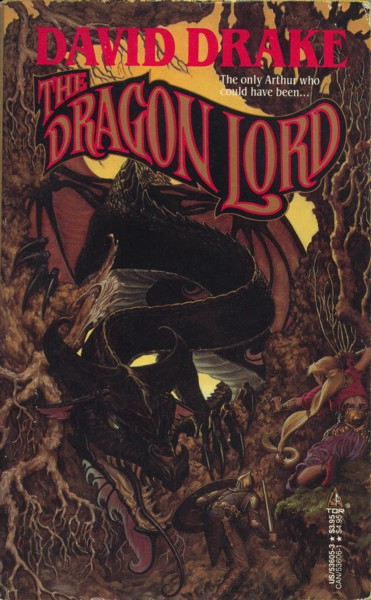
Drake's writing style, distinctly lean and ruthlessly efficient, and his raptor's eye for detail, plus his obsessions and quirks, would often stretch creative muscle over simple or awkward plotting. A case in point is The Dragon Lord, one of my favorite novels of his, a savage take on historical myth with the Camelot crowd, warts and all, serving as supporting players--its wonky back-and-forth traveling plot-structure was more than balanced by the quality of the writing, the research and some engaging characters (traveling and quests are often a part of Drake's longer works regardless of genre; for instance, his Lord of Isles cycle, an epic set almost a 1000 years after a fantasy world's apocalypse, is charmingly told, for all its ambition, in the kind of simple structure that Edgar Rice Burroughs built a successful career around--scatter your protagonists and send them off on separate adventures, while having them attempt to find one another). And The Dragon Lord demonstrated another of the author's talents: the ability to craft credibly menacing creatures with genuine impact and weight; the epic's maturing wyvern, conjured into the world by the scraggly Merlin at the behest of a typically cynical and Drake-esque King Arthur, intended to be employed as a WMD against those pesky Saxons, is used sparingly throughout the book...but it comes across as one helluva intimidating threat by the climax of the story.
Drake was adept in writing horror (primarily in short stories), fantasy (often based in realistically-rendered historical backdrops, though some of his work thus was set in newly-created worlds), and science fiction, the last in harsh military-sf or similarly rugged space opera. He had no qualms about mixing genres. The first and stronger of his two Tom Kelly espionage novels, Skyripper, is as devotedly a Cold War pursuit-thriller as any of its early-Reagan-era ilk, the McGuffin involving a cracked, ingenious Soviet scientist who wants to defect to the US in order to share his conceptual space-warfare plans with Uncle Sam to ward off "an alien invasion" he claims will occur...but there are hints that something is "off" during the brutal multi-threat spy hunt, which results in a hell of an ending, in the tradition of "Just because you're paranoid doesn't mean THEY aren't after you.”
Drake had many interests I share, which would continuously come roaring into his fiction (paleozoology, for instance). History, myth and classical-era literature were integral to much of his bibliography, rather like a bloodthirsty Roger Zelazny (Zelazny's 1969 novel Damnation Alley offered a proto-Drake hardman in a killer vehicle on a nightmare-filled deathworld road-trip). Drake also demonstrated some fascinating contradictions, such as delight in battle-glory action-filled sword & sorcery stories by Robert Howard, and Fritz Leiber (whose Fafhrd and The Gray Mouser bromance tales were repeatedly a big influence on Drake's own characters, fantasy and otherwise) but...Drake's own haunted Vietnam War service acquainted him with the effects of genuine brutality, where there is little glory. [And Leiber, who leaned toward pacifism, was very aware of this in a way that Howard was not. --tm]
Karl Edward Wagner and Drake cowrote a short story that was published in the 1974 first issue of the "little"/"semi-pro" fantasy-fiction magazine Midnight Sun. The tale predated the cult films Without Warning (1980) and Predator (1987) but anticipated something of the alien hunter/predator-on-Earth scenario, though set in ancient Rome. In the '80s, Drake and Wagner nursed the tale into a full-length novel, Killer, which I enjoyed, despite Drake's bad experience with this particular project. The Roman Empire and its frontiers provided a backdrop for his cycle of short bromance historical fantasies featuring the lethal Centurion, Vettius, and his cunning two-fisted merchant pal Dama, as they confront menaces both human and unnatural. Rome also was the setting or inspiration for some of his other short and long fiction. He may have gained a larger audience with the short tale "Ranks of Bronze", which, along with Orson Scott Card's "Ender's Game", I first encountered in the initial volume of Jerry Pournelle's anthology There Will Be War. "Bronze" was expanded into a well-received Bildungsroman novel, which inspired some follow-up books (I first learned about Bildungsromane on his website, an invaluable resource for his fans and scholars).
Not all of Drake's work "popped" for me. For instance, the first and only novel in his proposed "Crystal Walls" series, The Sea Hag, displayed some lively imagination but fell short of the Jack Vance-ian heights he was aiming for. And the follow up to Skyripper seemed to be set in an alternate universe where the conundrum the first book had been building up to was erased. However, a lot of his odd experiments rocked. I warmed up to his "RCN" space-opera series, based, sometimes literally, on Patrick O'Brian's historical Aubrey/Maturin novels. His expansion of Jim Kjelgaard's 1951 paleolithic novel Fire Hunter, The Hunter Returns, enthralled me as much as the original had. His two novels based on Henry Kuttner and C. L. Moore's "Clash By Night", The Jungle and Surface Action, were crammed full of terra-formed Venusian future-naval dreadnaught engagements and horror-choked jungles and seas, another striking deathworld. His take on the Cthulhu Mythos, by way of Joseph Conrad, "Than Curse the Darkness",
was a uniquely feral entry into the pantheon and provided a frightening and absolutely inhuman interpretation of Nyarlathotep, the Dweller in Darkness itself; no chatty Dark Man avatar for this version of the Crawling Chaos (unlike the walking dudes of Robert Bloch's early "The Shadow from the Steeple" and Stephen King's much later The Stand)--Drake's Nyarlathotep was an other-dimensional alien cancer attempting to metastasize throughout our world, summoned to the Congo by those who had been maimed by the Colonials. After humanity has been granted a breather to continue existing, the survivors reflect upon the situation; an American gunslinger, retained as a bodyguard, realizes that he and the singularly unempathic party he is with are the "good guys" and has himself a good laugh. A patented David Drake approach to their victory. That yarn scarred me quite deeply as did a lot of Drake's other efforts.
Finally, he could be quite prescient. His three "Jed Lacey" stories, involving a diagnosed sociopath who is subjected to a behavior-modifying aversion/Ludovico Technique due to his crimes, but who is subsequently "repurposed" as an investigator because he's useful to his AI-governed society, is set in a "Nation without Walls," a near-future United States riddled with omnipresent surveillance technology...a reality accepted by much of the population. When these stories began appearing in the 1970's, a Nation without Walls must have seemed comfortably like fanciful speculative fiction to most readers...
David Drake and his contributions won't be forgotten by me.
--Jeff Segal