Showing posts with label publishing. Show all posts

Wednesday, December 27, 2023

SSW: Jeff Segal and Todd Mason on David Drake, 24 September 1945-10 December 2023


Todd Mason:

As readers of this blog might've seen before, the fifth volume of The Year's Best Horror Stories: Series V edited by Gerald W. Page, was a kind of revelation to me...evidence that such favorite writers of mine already as Robert Bloch, Fritz Leiber, Manly Wade Wellman, Harlan Ellison and Joseph Payne Brennan were still actively writing new work...and look at all their similarly-active peers, whose work I would read in this volume for the firstime (hell, Tanith Lee, Arthur Byron Cover, H. Warner Munn and Charles Grant had new, previously unpublished stories in the book). And one of the writers new to me, with an elegant dark historical fantasy (reprinted from F&SF), was David Drake...and I would come to welcome his short stories in this mode and related ones over the next decade as I found and read them, in YBHS, in the First World Fantasy Awards volume edited by Gahan Wilson, in Whispers anthologies (and, eventually, in issues of the magazine the anthologies were mostly drawn from--which Drake helped putogether), and in Fantastic and Ramsey Campbell's anthology Superhorror, in Kirby McCauley's anthology Frights...and the only non-fantasy/horror story in the materials I had at hand was a "Hammer's Slammers" story in an issue of Destinies, a paperback magazine edited by James Baen for Ace Books, which was the last sf magazine my father would buy for himself, into early 1979. It didn't make as much of an impression on me. Eventually, I had a secondhand copy of the first Hammer's Slammers anthology, but only read some of it, without getting caught up in it--Jeff Segal had a much more engaged (and sensible) response.

David Drake continued to do interesting work in likely and unlikely places over the next several decades, until recent ill-health kept him from writing fiction any longer, but I had lostrack of his work, while being aware of it being in the marketplace. I should still pick up some of his anthologies along with some of his novels and certainly his collections I let slip by. (I was a bit late on the scene to buy most of his and Karl Wagner's Carcosa collections of Manly Wade Wellman's work and others when they were new.)

Unsurprisingly, he has been remembered as a gracious friend and acquaintance by many, even those who might never, say, take part in, nor read, his collaboration on one book with Newt Gingrich and Marianne Ginther (athe time, still married to Gingrich). And among his fans who goto know him rather better than I did is my old friend Jeff Segal:


Jeff Segal:

An especially important author, and sometimes-editor, in my reading evolution, along with his late friends and associates Karl Edward Wagner and Manly Wade Wellman (though my appreciation of Wellman really kicked-in later, as I matured enough to appreciate the authentically Appalachian settings of a lot of his horror and fantasy fiction).

The first Drakes that ripped into my awareness were: one of his I-was-there Vietnam War-set horrors, the vignette "Best of Luck"; and the historical axe & sorcery (or is it sorcery?) chiller "The Barrow Troll", a tale with one of Drake's bitterly ironic finales.

Drake was a vocal advocate for fantastic fiction, especially pulp magazine-era stories, and both his short fiction and novels often served as tributes to neglected books. Publishers Tor and Baen Books have repackaged his short fiction in many combinations, but also encouraged him to promote and harken back to worthy novels and stories by other hands, which too often had been half-forgotten over the decades. For example, his dark tale "The Automatic Rifleman" was inspired by Fritz Leiber's "The Automatic Pistol", which he also heartily recommended to his readers, and I would finally track it down some years afterward (Leiber's classic Weird Tales story opts for a supernatural premise, rather than the apocalyptic-sf direction Drake employed). 


I wrote to him, and eventually we corresponded about failed military missions; he steered me toward a classic, The March Up Country: A Translation of Xenophon's Anabasis, a primary-source historical and inspirational work (which the multi-lingual Drake likely read in its original Greek), and I dipped into it recently when studying the evolution of Walter Hill's movie The Warriors (1979) (Anabasis inspired both the Sol Yurick source-novel and the film).
My first exposure to the "Hammer's Slammers" mercenary yarns which made Drake famous...or notorious...was in a secondhand copy of the 1979 Ace paperback collection with that title. The stories, reinforced with contextual essays, displayed the universe from the POV of a far-future frontline warfighter. One of them, "Cultural Conflict", reads like a critique of the film Aliens, except it was published half a decade before that movie dominated the 1986 summer boxoffice (I saw it three times in theaters). I read the collection too swiftly and the effect of its concentrated violence was somewhat sickening at first, until I broke down how Drake achieved his effects on a literary level. The Slammers stories, and eventually novels and role-playing games, hammered Drake's name into the world of science fiction, though I'd argue that his finest military-oriented sf novel was the standalone Redliners (1996), which he admitted was a cathartic experience to write, allowing him to expel the toxins of war he hadn't known he still carried. It is also a magnificent achievement in creating, to borrow Harry Harrison's term, a "deathworld".

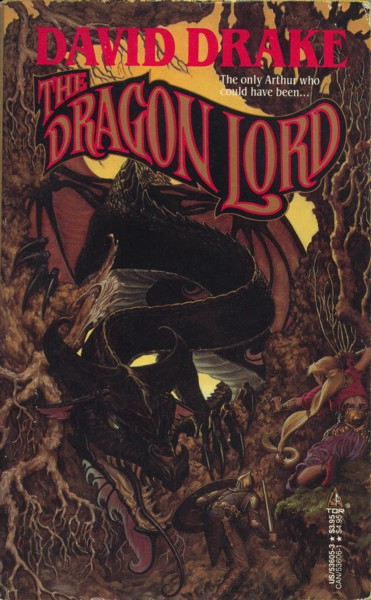
Drake's writing style, distinctly lean and ruthlessly efficient, and his raptor's eye for detail, plus his obsessions and quirks, would often stretch creative muscle over simple or awkward plotting. A case in point is The Dragon Lord, one of my favorite novels of his, a savage take on historical myth with the Camelot crowd, warts and all, serving as supporting players--its wonky back-and-forth traveling plot-structure was more than balanced by the quality of the writing, the research and some engaging characters (traveling and quests are often a part of Drake's longer works regardless of genre; for instance, his Lord of Isles cycle, an epic set almost a 1000 years after a fantasy world's apocalypse, is charmingly told, for all its ambition, in the kind of simple structure that Edgar Rice Burroughs built a successful career around--scatter your protagonists and send them off on separate adventures, while having them attempt to find one another). And The Dragon Lord demonstrated another of the author's talents: the ability to craft credibly menacing creatures with genuine impact and weight; the epic's maturing wyvern, conjured into the world by the scraggly Merlin at the behest of a typically cynical and Drake-esque King Arthur, intended to be employed as a WMD against those pesky Saxons, is used sparingly throughout the book...but it comes across as one helluva intimidating threat by the climax of the story.
Drake was adept in writing horror (primarily in short stories), fantasy (often based in realistically-rendered historical backdrops, though some of his work thus was set in newly-created worlds), and science fiction, the last in harsh military-sf or similarly rugged space opera. He had no qualms about mixing genres. The first and stronger of his two Tom Kelly espionage novels, Skyripper, is as devotedly a Cold War pursuit-thriller as any of its early-Reagan-era ilk, the McGuffin involving a cracked, ingenious Soviet scientist who wants to defect to the US in order to share his conceptual space-warfare plans with Uncle Sam to ward off "an alien invasion" he claims will occur...but there are hints that something is "off" during the brutal multi-threat spy hunt, which results in a hell of an ending, in the tradition of "Just because you're paranoid doesn't mean THEY aren't after you.”
Drake had many interests I share, which would continuously come roaring into his fiction (paleozoology, for instance). History, myth and classical-era literature were integral to much of his bibliography, rather like a bloodthirsty Roger Zelazny (Zelazny's 1969 novel Damnation Alley offered a proto-Drake hardman in a killer vehicle on a nightmare-filled deathworld road-trip). Drake also demonstrated some fascinating contradictions, such as delight in battle-glory action-filled sword & sorcery stories by Robert Howard, and Fritz Leiber (whose Fafhrd and The Gray Mouser bromance tales were repeatedly a big influence on Drake's own characters, fantasy and otherwise) but...Drake's own haunted Vietnam War service acquainted him with the effects of genuine brutality, where there is little glory. [And Leiber, who leaned toward pacifism, was very aware of this in a way that Howard was not. --tm]

Karl Edward Wagner and Drake cowrote a short story that was published in the 1974 first issue of the "little"/"semi-pro" fantasy-fiction magazine Midnight Sun. The tale predated the cult films Without Warning (1980) and Predator (1987) but anticipated something of the alien hunter/predator-on-Earth scenario, though set in ancient Rome. In the '80s, Drake and Wagner nursed the tale into a full-length novel, Killer, which I enjoyed, despite Drake's bad experience with this particular project. The Roman Empire and its frontiers provided a backdrop for his cycle of short bromance historical fantasies featuring the lethal Centurion, Vettius, and his cunning two-fisted merchant pal Dama, as they confront menaces both human and unnatural. Rome also was the setting or inspiration for some of his other short and long fiction. He may have gained a larger audience with the short tale "Ranks of Bronze", which, along with Orson Scott Card's "Ender's Game", I first encountered in the initial volume of Jerry Pournelle's anthology There Will Be War. "Bronze" was expanded into a well-received Bildungsroman novel, which inspired some follow-up books (I first learned about Bildungsromane on his website, an invaluable resource for his fans and scholars).

Not all of Drake's work "popped" for me. For instance, the first and only novel in his proposed "Crystal Walls" series, The Sea Hag, displayed some lively imagination but fell short of the Jack Vance-ian heights he was aiming for. And the follow up to Skyripper seemed to be set in an alternate universe where the conundrum the first book had been building up to was erased. However, a lot of his odd experiments rocked. I warmed up to his "RCN" space-opera series, based, sometimes literally, on Patrick O'Brian's historical Aubrey/Maturin novels. His expansion of Jim Kjelgaard's 1951 paleolithic novel Fire Hunter, The Hunter Returns, enthralled me as much as the original had. His two novels based on Henry Kuttner and C. L. Moore's "Clash By Night", The Jungle and Surface Action, were crammed full of terra-formed Venusian future-naval dreadnaught engagements and horror-choked jungles and seas, another striking deathworld. His take on the Cthulhu Mythos, by way of Joseph Conrad, "Than Curse the Darkness",
was a uniquely feral entry into the pantheon and provided a frightening and absolutely inhuman interpretation of Nyarlathotep, the Dweller in Darkness itself; no chatty Dark Man avatar for this version of the Crawling Chaos (unlike the walking dudes of Robert Bloch's early "The Shadow from the Steeple" and Stephen King's much later The Stand)--Drake's Nyarlathotep was an other-dimensional alien cancer attempting to metastasize throughout our world, summoned to the Congo by those who had been maimed by the Colonials. After humanity has been granted a breather to continue existing, the survivors reflect upon the situation; an American gunslinger, retained as a bodyguard, realizes that he and the singularly unempathic party he is with are the "good guys" and has himself a good laugh. A patented David Drake approach to their victory. That yarn scarred me quite deeply as did a lot of Drake's other efforts.
Finally, he could be quite prescient. His three "Jed Lacey" stories, involving a diagnosed sociopath who is subjected to a behavior-modifying aversion/Ludovico Technique due to his crimes, but who is subsequently "repurposed" as an investigator because he's useful to his AI-governed society, is set in a "Nation without Walls," a near-future United States riddled with omnipresent surveillance technology...a reality accepted by much of the population. When these stories began appearing in the 1970's, a Nation without Walls must have seemed comfortably like fanciful speculative fiction to most readers... 
David Drake and his contributions won't be forgotten by me.

--Jeff Segal

For more of today's short-story posts, please see Patti Abbott's blog.

Friday, December 9, 2016

FFB: DIRTY! DIRTY! DIRTY! by Mike Edison (Soft Skull Press 2011); THE CREATION OF TOMORROW by Paul A. Carter (Columbia University Press 1977)

Paul A. Carter died 28 November, aged 90. He was a very occasional contributor to science fiction literature, but his The Creation of Tomorrow was the first critical/historical volume I read about science fiction, particularly (as the subtitle notes) sf as published in the specialist fiction magazines. The book, published in 1977, was keyed to the golden anniversary of Amazing Science Fiction magazine in 1976, as the oldest inarguable magazine devoted expressly to sf (as opposed to eclectic-fiction/adventure pulps, dime-novel series, boys' papers and fantasy-fiction magazines in English and other languages...or special issues of such Hugo Gernsback magazines as Science and Invention that were market-testers for Amazing Stories' potential appeal). Carter's book is a collection of essays tackling various themes thorough the five decades of its remit, and touching on matters that often weren't discussed in most histories of the magazines at that time nor since. My favorite bit of random knowledge gleaned from Carter's work is an explanation for a thrown-away reference in the Firesign Theater's audio-drama satire LP  Don't Crush That Dwarf, Hand Me the Pliers to the Rev. Willy Pan, which calls back to an animated character used for mass hypnosis in an early, not widely read Murray Leinster story. I have a copy buried in storage somewhere, and might give a further review sometime soon...but it was certainly a model for a lot of my writing on this blog. 


Mike Edison's been an editor or publisher for such magazines as High Times and Screw, and a contributor to any number of others; in this volume, he traces the history of modern "men's sophisticate" magazines since the foundation of Playboy in 1953, mostly but not entirely focusing on the lives and careers of four editor/publishers: Hugh Hefner, Robert Guccione of Penthouse, Larry Flynt of Hustler and Screw's Al Goldstein. Some attention is given to such other notables as George van Rosen (at whose publishing firm Hefner and William Hamling would meet and apparently together devise their own upgrades on the machismic, unsophisticated magazines such as Modern Man they helped produce for van Rosen, sharing as they did an appreciation for Esquire and a desire to go it a bit more libertine, Modern Man more urbane--with Hamling, already a veteran of the Ziff-Davis pulps and editing and publishing his digest-sized Imagination with his wife out  of their basement, to launch Rogue magazine a year-and-some-months after Playboy began), Ralph Ginzburg (he of Eros and fact magazines), various staffers of the likes of Gallery (co-founded by lawyer F. Lee Bailey, and whose publisher, Montcalm, also would issue The Twilight Zone Magazine and its companions in the 1980s) and High Society, and (Ms.) Dian Hanson of Taschen Books, after co-founding Puritan and a successful editorial run at Leg Show and Juggs. The degree of involvement these magazines and their primary instigators have had in First Amendment court battles, the shift in the Zeitgeist in the US about sexual matters (if probably less profound than they would have you believe, Edison suggests), and general challenge to bluenoses and others make for a rather lively, and rather sobering, narrative...none could be said to have led consistently happy lives, even given the periods of commercial and to some degree or another artistic success they achieved, at least for a while. Also considered: the effects of the work of Betty Friedan, Gloria Steinem (before and since founding Ms.) and Helen Gurley Brown and her Cosmopolitan, a sustained success in distinction to more skin-oriented magazines aimed at women such as Guccione's Viva, and Playgirl, despite both of those magazines having at least reasonable runs (and the last being revived at least once); Edison is firmly convinced of Playgirl's audience having been primarily suburban and rural gay men, otherwise starved for "glamor" magazines aimed at them on accessible newsstands. (Otherwise, the gay male skin magazines, admittedly aimed at comparatively small audiences, are barely mentioned, nor at all are such similar magazines as the lesbian On Our Backs or the bisexual Anything That Moves (or, at least, the more erotically-charged Frighten the Horses), nor, perhaps more surprisingly, Evergreen Review and the slew of not exclusively literary erotica magazines that have followed in its wake, from Yellow Silk to Blue Blood to Paramour to Nerve...none Quite as specialized as, say, Draculina, a short-lived newsstand magazine notable for its photo spreads featuring large-canine-bearing vaginas dentata). Greenleaf Books and Rogue's William Hamling and his frequent editor and general associate Earl Kemp are mentioned by name only for their roles in publishing an illustrated version of the Nixon Administration's report on pornography, which led to them both serving some hard prison time, solely in one of the many useful footnotes provided, and not cited in the index. 
Modern Man about the time of the first Playboy

All four of the central figures of the book were (or in Flynt's case, remain) obsessive, easily triggered task-masters at their corporate offices...which in Hefner and Guccione's cases became their mansions, and to some extent only a small part of those edifices (Hefner because he had a retinue of partiers usually floating about his, Guccione in part because he simply didn't wish to go into certain rooms of his comparatively uninhabited residence). All four had no lack of early trauma they never quite overcame, and, Edison suggests, had differing degrees of self-awareness regarding. Each had key women in their lives, though all had their relations end somewhat badly...particularly for Guccione, whose partner Kathy Keeton died of cancer almost a decade before a different sort took her widower, and Flynt, whose wife died of a combination of AIDS-related ravages and the drugs she couldn't resist. How they interacted, tweaked or simply stole ideas from each other and/or sold material to and or challenged each other in their respective magazines makes for some interesting further contrasts and parallels...Goldstein, with his largely New York City-based tabloid paper, was perhaps for most of the years of their mutual enterprises the one closest to each of the others, contributing most readily and frequently to the magazines of or advising the other three. 


Edison has done his research, in digging into backfiles of magazines and newspapers (for trial coverage and much else) and even such unlikely products as public-access television interview programming (beyond Goldstein's notorious Midnight Blue); it's a pity the book is not copy-edited...Edison is enough of an editor as well as writer to keep the interlocking narratives and background filling-in lively and mostly smoothly-written, but at times repetitive (there are somewhere between six and twenty references to effective defense lawyer Herald Price Fahringer as the "Joe DiMaggio of the First Amendment") and Edison's memory of the less topic-specific historical events can fail him, as when he has Reagan moving into the White House eleven months before John Lennon's murder in December of 1980, rather than the month after; several other similar bobbles pop up here and there.  I was hoping for perhaps a bit more on the involvement of Paul Krassner as publisher of Hustler, during the period Flynt stepped away from the magazine while briefly a convert to Ruth Carter Stapleton's sort of evangelical Christianity, but it's notable also how many other sorts of magazine and other publishing the quartet and their associates were involved with over the years, including the post-Mad Harvey Kurtzman humor magazines Trump and Humbug that Hefner directly or indirectly funded (and Kurtzman's last magazine, Help!, was one of the Warren magazines, which began with a minor, short-lived Playboy imitator After Hours, folded shortly after helping to launch the much more durable Famous Monsters of Filmland and spin-offs, and later the Warren horror-comics magazines such as Creepy, Eerie and Vampirella--before Kurtzman would turn after 1965 to the long-running comic strip "Little Annie Fanny" in Playboy as his most consistent paycheck).  Guccione and Keeton's other projects included Omni and Longevity magazines; he would fund his sisters' more modest project, the digest fiction magazine Espionage as well as his son's music magazine Spin, though Robert Guccione, Jr. didn't attempt his own skin/lad-mag--or younger-skewing Esquire--title Gear till after his father broke off relations and support after two years of Spin's publication, and younger Guccione sought and found independent investors. 

All in all, an impressive book, and interesting to me for some of the holes filled in about these men and women, and their mutual interaction and sometimes reluctant but necessary working in common cause, their rivalries and strengths and weaknesses. All of the primary quartet made, and spent, a whole lot of money in the interests of doing what they wanted to provide what they thought was valuable and challenging material, with some degree of denial in recognizing any damage they might've caused along the way...and cognizant of more than they cared to be, it seems, in each case. 

For more of today's books, please see Patti Abbott's blog.

Friday, November 27, 2015

FFB: CONJURE WIFE by Fritz Leiber (Street and Smith 1943)

While I've hardly been ignoring Fritz Leiber or even his first published novel (apparently his third long fiction to be completed, after the long-lost [in the author's files] novella "The Dealings of Daniel Kesserich" [published posthumously in 1986] and the novella "Adept's Gambit," which would not see publication till Leiber's first collection, Night's Black Agents, 1947), I have not yet formally entered Conjure Wife into the FFB mix (one or two others have, as I recall), and it's high time.  One of the most influential and brilliant of horror novels I've read, and unlike most horror novels (particularly since the influence of Stephen King and Anne Rice and their sustained commercial success have helped make bloated, maundering kitchen-sink approaches once again the default mode in the novels in the field), the Leiber is lean and tightly constructed, remarkably so for a still just-beginning professional writer (albeit one who was no kid, and perhaps crucially had already been a student of both classic drama, and a professional actor, and the writing of essays and sermons).  Even one who'd already published perhaps the single most game-changing short story in horror of the 1940s, "Smoke Ghost." There are relatively few novels that have their first film adaptation released years before their first publication in boards or even paperback, and Conjure Wife is one of them; the relatively minor (and unfaithful) adaptation Weird Woman was released in 1944, a year after the publication of the novel in a late issue of the fantasy-fiction magazine Unknown Worlds; remarkably, the novel wouldn't be reprinted in book form until 1952, and first in an omnibus edited by Fletcher Pratt for Twayne Publishers, Witches Three, which was created in part to provide a home for Pratt's own short novel The Blue Star. The next year, paperback house Lion Books and Twayne would publish the first standalone editions of Conjure Wife, though not the last by any means...and it would be serialized in a 1970s prose horror-fiction magazine published by Marvel Comics, The Haunt of Horror, edited by then comics-script and later screenplay-writer/television producer Gerry Conway.  Given that Leiber's next novel, Gather, Darkness! (serialized in Unknown Worlds's companion magazine Astounding Science Fiction in 1943) was published in book 
form in 1950, one has to wonder why the masterful horror novel had to wait a bit longer, and longer yet for its own boards (but, then, there was a bit of a gold rush, on this "science fiction" thing Doubleday was so het up about, among other larger and medium-sized houses at the turn of the '50s, which was less true of convention-challenging horror fiction...perhaps its notable that even Shirley Jackson's The Haunting of Hill House wasn't published by her first consistent publisher, Farrar, Strauss, but by Viking...and even Farrar, Strauss had taken a tremulous baby step toward this wild Buck Rogers stuff with Theodore Sturgeon's More than Human [1953]...not, on balance, the worst choice they could've made, but the Ballantines had to hold their hands to steady them in a co-publication deal). And, a little more digging around in the ISFDB suggests the probable reason for the book-publication delay...Arkham House apparently had struck a deal to publish the novel, but managed not to do so as the years ground onward...not a unique situation.

It's the story of surprisingly successful, brash, full of himself youngish anthropology professor Norman Saylor, and his wife Tansy, and what happens when Norman discovers that Tansy has been practicing the nearly universal feminine art of actual, supernatural and effective witchcraft, for their protection as well as a manner of helping Norman along in his career.  Saylor's condescension and paternalist concern knows little boundary as he half-convinces Tansy that her fear of the consequences if she gives up her practice, as he demands and cajoles her to do, is simply neurotic, encouraged by her false assumption of the widespread nature of the practice among women. And then things start to go wrong...very wrong. Norman is stripped of his smug misapprehension bit by bit as the other women, of longer standing in the college town where the Saylors have only relatively recently arrived, increasingly clearly to him conspire to take advantage of Tansy's new defenselessness, and as a result his own. Things grown even worse, presented in such a way that provides one of the great frissons in horror fiction, as Norman desperately, clumsily tries to learn as much as possible to take up the magical slack to protect and save them both. The first time I read the novel, I was reading it too quickly...rather easy to do, as Leiber's prose is as lucid and elegant as it is suspenseful...and flew right past the most shocking development...only to find myself halfway down the next page suddenly registering--What Just Happened? So, don't speedread this one. The rest of the novel from there is not quite denouement to the climax that provides, but is the logical (and paralogical) development from that. 

Leiber is fully in control of his materials here, having great fun with turning the sexist presumption of his premise on its head and using it, not least in the nature of Norman's reaction to Tansy's admissions, to instead satirize sexism and patriarchal pomposity. Norman's mansplaining is shown pretty quickly to be the cheerful self-importance of the unencumbered (rather than privileged, I'd suggest) reasonably well-off educated white male in U.S. society of the time, and the liberal-arts college subculture, rather than, as Norman was quite sure, the full measure of reality well-understood. The resentment so many women felt, particularly at that time and in those places, in having to live through their husbands (and at the mercy of what their husbands might achieve) is keenly demonstrated, even as filtered through the metaphor of witchcraft, itself historically in part the expression of "underground" women's work and passage of too often necessary but officially forbidden knowledge from one generation of women and some sympathetic men to the next, at very least in many European Christian contexts. His protagonist, based on a satirical self-portrait, is at first a blinkered Norman sailor on a sea of ignorance, who quickly learns better (while Leiber's father was an important though ambiguous figure in his life, he was largely raised by women in his extended family, as his parents were touring with various dramatic troupes including their own, where Fritz, Jr. would eventually begin his acting career). His wife Jonquil (note the oddness of the name Tansy) was instrumental in getting him to finally get serious about his writing career; among other things, she was the one who first wrote to H. P. Lovecraft on her husband's behalf, leading him to receive some epistolary advice and mentorship in the last months of Lovecraft's life.  And, as I like to note, among the younger members of the "Lovecraft Circle"
of corresponding friends, Leiber and longer-term protege Robert Bloch were the most notable immediate heirs to the innovations Lovecraft helped introduce in the literature, and both managed to do more and better than their mentor with what he helped them find.

There have been, along with the many editions of the novel (including two omnibi featuring Leiber's third horror novel, in its final form Our Lady of Darkness), two more film adaptations, in 1962 the good and faithful if slightly stiff Night of the Eagle (released in the U.S. with the A. Merritt title variation Burn, Witch, Burn)--the script adapted by Charles Beaumont, Richard Matheson and George Baxt, which along with the faithfulness might've helped the modest production be as it is easily the best film of the three--and the loosely adapted 1980 horror comedy Witches' Brew, with Teri Garr, Richard Benjamin and Lana Turner (her last film). 

I was also going to consider one of the too obscure literary children of this novel, A Personal Demon by David Bischoff, Rich Brown and Linda Richardson (indeed, three writers on one fixed-up novel; NAL Signet 1985, revised from a series of stories published in the latter 1970s in the magazine Fantastic), but I'll hold off on that for today, as I'm already late for Patti Abbott's round-up, listed at her blog as usually.


It's a Gothic Because We Say It's a Gothic...a rather overtly
feminist one, if so...


The Ultimate Violation being in this case Ace packaging.


Another, if less dire, swing and a miss from Ace.


Friday, July 3, 2015

FFB: THE MEN FROM ARIEL by Donald A. Wollheim (NESFA Press 1982)

A collection of the more obscure short fiction by the writer, editor, publisher and man-about-fantastic fiction Donald A. Wollheim:

courtesy the Homeville/Locus indices, with corrections:
    The Men from Ariel Donald A. Wollheim (NESFA Press 0-915368-19-6, 1982, 116pp, hc) cover illustration by Michael Whelan; book design by D. Christine Benders
Wollheim has been one of the most important editors in the history of fantastic fiction, and one of the most durable. As he notes in the prefatory matter for this slim volume, published as a convention commemorative by the New England SF Association and their NESFA Press on the occasion of Wollheim's selection as Guest of Honor at their annual "con" Boskone, he was briefly, back in the 1930s when fandom was small and easy to poll, the most popular fannish personality, soon to lose that honor back to Forrest J Ackerman. Although Wollheim had participated in some proto-fannish International Scientific Association activities (most notably some mildly stunty experiments in model rocketry), he notes he first grew active in fandom as it was coalescing in 1934 because Wonder Stories publisher Hugo Gernsback was putting off paying him for his first published short story, "The Man from Ariel", and Wollheim wondered if he was the only writer so deprived. It turned out that he wasn't, and he and a number of other contributors to the Gernsback magazines sued and received a lump sum settlement.  This led fairly directly to Wollheim co-founding the fannish group the Futurians, which included a remarkable number of the budding writers, editors and artists in sf and fantasy in New York City at the time, and moving onto his early editorial achievements: editing and publishing the early major fanzine The Phantagraph, the early "semiprozine" Fanciful Tales and, in 1941, editing the no-budget pulp magazines Cosmic Stories and Stirring Science Stories (which along with Frederik Pohl's Astonishing Stories and Super-Science Stories and Robert Lowndes taking over at Columbia Publications' Science Fiction and its stablemates, were the first newsstand magazines dominated by and showcasing the work of the Futurians).  But even more important than this, Wollheim was able to publish, in 1943, The Pocket Book of Science-Fiction, and follow that with, for Viking Press, the Portable Novels of Science (1945--note that the term sf still at that point seemed an odd neologism to Viking and their editors at the Portable series)...two of the earliest widely-distributed volumes to package sf for an adult audience under that rubric; the Pocket volume was hugely popular. 
In 1947, he began editing for Avon Publications, while there publishing the first anthology of original fantastic fiction in mass-market paperback:
...and founding anthology series/all but magazines the Avon Fantasy Reader and the Avon Science Fiction Reader, and the more no-bones-about-it and less durable magazines Out of This World Adventures (the first pulp sf/fantasy magazine to have a full-color comics component bound into the middle of the two published issues) and 10 Story Fantasy (where the only issue famously included eleven stories...one of which was the first version of "The Sentinel", the seeds of what Arthur C. Clarke and Stanley Kubrick would develop into their respective versions of 2001: A Space Odyssey). Wollheim would edit and/or publish, aside from the cited volumes and "magabooks" above, a large number of the earliest horror-fiction anthologies in mass-market paperback as well, beginning at Avon. 

In 1952, Wollheim left Avon to become the primary editor for Ace Books, where he would remain until 1971, when he left the failing Ace (mismanaged by its new owners) to establish DAW Books in partnership with the New American Library, which he would edit for and run till shortly before his death in 1990. At Ace and DAW, he did much of his most enduring and important editorial work, providing the most consistent program of sf, fantasy and to some extent horror publishing in those decades, often innovatively if not, while at Ace, necessarily with the most generous of budgets or payment to writers. (While at Ace in the mid 1960s, he also brought on Terry Carr as an assistant editor, who helped Ace go onto further important work, not least with the Ace Science Fiction Specials imprint).  Wollheim, as he notes in the book we soon return to, was also one of the, if not the, most prolific editor of western books in the U.S. for most of his time at Ace, as well as handling their contemporary mimetic fiction and nurse/romance lines; Carr would be the primary editor for Ace Gothics, which helped make that category a major force in paperback publishing in the latter 1960s and early 1970s.  At DAW, Wollheim continued and broadened his approach to providing a range of work in fantastic fiction, from straightforward adventure fiction through some rather literarily ambitious writing, and a continuing interest in international writers and their work. 

Throughout these years, Wollheim never considered writing his primary occupation, and (his daughter and successor at DAW, Betsy Wollheim, notes) he tended to be modest about his fiction. But, nonetheless, he was an engaging writer, often likely to write (in his adult work, rather than his YA novels) vignettes with an abiding sense of strangeness to them; "The Man from Ariel" (as in the moon of the planet Uranus), his first story as noted above, is certainly in this mode: the narrator encounters, on a misty night, a hapless astronaut from a humanoid civilization on the distant moon, who manages through a sort of telepathy to convey his (as Wollheim calls him) adventure in attempting to orbit Uranus, but through miscalculation slingshotting his craft in toward the Sun, and happening to crash-land on Earth...but at least somewhat triumphant that he was able to share his experience, as he dies of crash-related injury, with an intelligent alien on this blue planet. Not too shabby, even if it hadn't been written by a 19-year-old in 1934.  His most famous stories (included in his first collection), "Mimic" (the source of the film) and "The Rag Thing," are more explicitly sf-flavored horror (Wollheim was a great admirer of Lovecraft), but otherwise share a sense of atmosphere and an elegantly deliberate build of their strangeness, even as they improve on his early work.

"The Lost Poe" is a Lovecraftian approach to the tale of a cursed story, that compels self-destruction not only to originator Edgar Allan, but to anyone who reads it.  "Who's There?" is a nice horror vignette, with a different sort of "slingshot" ending; it seems odd that Wollheim had difficulty placing either of these stories, which saw first publication in this book, but he does take the opportunity to bemoan how sparse the market for fantasy and horror short fiction could be throughout the first two decades of his editorial career.  "The Hook" was inspired by the experience of an LA-based sf/fantasy fan, which Wollheim almost certainly correctly suspects also inspired Ray Bradbury's contemporaneously-published "The Long After Midnight Girl"...in Wollheim's story, he deals sensitively, if a bit tentatively, with the confusing transvestite desires that torment the insecure young male protagonist; Ed Wood and Eddie Izzard probably would approve. It's also notable that both the Wollheim and Bradbury were published originally in short-lived erotica magazines...despite being not so much erotic as about tragedy around sexual anxiety.  "Still Life" was a mild favorite of Wollheim's among the filler stories he wrote for his Avon colleagues' comic books (to get magazine postage rates for subscriptions, comic books at least through the 1950s needed to run all-text items, usually very trivial vignettes, as part of every issue's content; Patricia Highsmith and Mickey Spillane are among the most famous writers to have begun their professional careers doing this kind of writing in
half of an Ace Double, by
(Ms.) Lee Hoffman
bulk)...Wollheim wasn't sure which comic published it, and my quick and dirty search of Avon horror comics posted online, at least, didn't turn it up. "Colt Cash Cache" is a pleasant if unremarkable western story, which Wollheim placed with one of Robert Lowndes's Columbia western pulps, with a mostly guessable twist ending, but some nice detail. "Miss McWhortle's Weird" is, as Wollheim proclaims in his headnote, a bit of a poison-pen parody of Dorothy McIlwraith, the third editor of Weird Tales (and simultaneously editor of Short Stories magazine); Wollheim counts himself as among those who preferred WT as run by her predecessor, Farnsworth Wright (I vastly prefer McIlwraith's issues), but Wollheim's lampoon seems a little double-edged: "They [the writers favored by Wright's correspondent among the characters here] took such unbearably long times to get started, they were always long-winded, sometimes they would toil over the most trivial points, and they wrote nasty letters about any editing that had been done." This can be seen as both exemplary of the philistinism of the McIllwraith analog (and her model), and as an utterly accurate complaint about the general tenor of Wright's magazine.  Though perhaps it's notable that Wollheim placed this story with August Derleth, a veteran contributor of all three WT editors of the original magazine's run, and his magazine that was a bit of a legatee of the Weird Tales geist, if less so than Derleth's earlier, more elaborate The Arkham Sampler.


Wollheim continues in the double-edged mode for the balance of the stories here; his parody of Lovecraft, the most enduring star of Wright's issues, rather hilariously has every other character as well as the narrator endlessly, imprecisely referring to sinister things they cannot, Dare Not go into nor describe at this time; this one went to another 1960s heir to WT, Lowndes's Magazine of Horror.  "Ishkabab" and "The Rules of the Game" are both rather acute, if slightly belabored, critiques of imperialism that seem to have rather casual bits of seemingly unconscious racism built in...until one recalls that the narrative voice in both cases is that of an observer less sophisticated than he seems to think himself.  The North American reporter in Guyana in the latter story, particularly, is keen to pat himself on the back to a remarkable degree; he fumbles the relation between tides and seismic shifting rather completely, while otherwise proving to be a bit of a dolt, so one is inclined to suspect that Wollheim is trying to demonstrate just what a dolt he is. This story was originally slated for The Last Dangerous Visions, and the dangerous part might well be not just the mockery of the imperialist mindset
but the embrace of Immanuel Velikovsky's doubletalk as legitimate theory about Biblical and other old accounts of improbable events. Wollheim suggests that this might be his last short story, as he hadn't written any more by 1982 in the eleven years since Harlan Ellison demanded revisions, so Wollheim, happy with it in the current form, placed it with New Writings in SF instead; and the evidence of ISFDb's list of publications (showing only the trunk stories published in this volume, and collaborations probably also dating back some decades with Ackerman and the long since late C. M. Kornbluth appearing after "Rules") suggests that Wollheim's prediction was correct...thus this book includes both his first and last stories.
That Joan Aiken...and a gothic with
a review blurb...

I've been posting this In Progress as I've been writing it over the course of the morning, and George Kelley commented on perhaps the first half, that Wollheim might have been the most influential single editor in sf (and, as I've suggested above, he wasn't altogether uninfluential in the fields of horror, fantasy and even western fiction, as well as a collaborator in the explosion of neo-Gothic romance a quarter-century ago. He was a sustained and eclectic editor (tempered by pragmatism), having been a major market for Philip K. Dick, John Brunner, Ursula K. Le Guin and others. Backhandedly, the Ace edition of The Lord of the Rings (taking advantage of the fact it hadn't been properly copyrighted in the U.S.) helped draw attention  to the trilogy and to J. R. R. Tolkien at the beginning of the steep uptick in his popularity. And, as I mentioned in my response to George, the Futurians (a fan group which was breaking up as they moved into their professional roles at the cusp of the 1940s and particularly World War II) provided a relatively sophisticated, if relatively inexperienced and often underfunded, challenge to John Campbell's artistic vision of sf and fantasy (in his other magazine, Unknown, later Unknown Worlds) in that period, as well as to Dorothy McIlwraith's new broom at Weird Tales, starting in 1940.  At that point, the other sf and fantasy magazines on the stands had their audiences, but (with the exception of F. Orlin Tremaine's shortlived Comet and, to an ever-increasing extent over the decade, Mary Gnaedinger at Famous Fantastic Mysteries), Ray
Palmer's Amazing and Fantastic Adventures, the new Planet Stories, Mort Weisinger's Thrilling Wonder Stories and its stablemates (with the weak exception of Strange Stories, which was WT watered down) were all aimed at relatively undiscriminating audiences, largely juvenile; the attempt at a "spicy" sf magazine in Marvel Tales and its stablemates, which were essentially "shudder pulps" with slightly less pseudo-horror flourish, might not've been as juvenile but were pretty sophomoric. The Futurian magazines, Pohl's, Wollheim's and Lowndes's, all were seeking to replicate the best of what they found in Campbell's magazines, but also brought a slightly broader artistic sensibility to the effort...if Campbell was an engineer by training and otherwise an autodidact and rather instinctive in his artistic choices, the Futurians were striving to become worldly intellectuals, and some degree succeeding. Their example, and the new post-War sobriety of the latter 1940s, probably also helped the sudden increase of sophistication of the Thrilling Group magazines, as editorial control was turned over to Samuel Merwin, Jr.; Howard Browne found it difficult to sustain interest in Amazing and FA, but did, with Fantastic and fitfully with the others, move in a more sophisticated direction with the Ziff-Davis magazines. Leigh Brackett and Ray Bradbury were joined by other artists of note as Jerome Bixby began editing at Planet Stories...and all this before or just as we saw the introduction of the clangorous new approaches with The Magazine of Fantasy (and Science Fiction, as it expanded with the second issue) and Galaxy in 1949-1950.  I'll probably have some more to say about these developments next week.

Please see Patti Abbott's blog, for the list of this week's links to reviews.


The two front covers of an early Ace Double...one cover on each side of the book, and the
texts upside down in relation to each other