Tuesday, February 1, 2011

The Week's Links: Tuesday's Overlooked Films (and/or Other A/V): 1 Feb


Thanks as always to all who participate, as reviewer and/or reader! If you're the latter, would you enjoy also being the former? Please let me know (and certainly let me know if I've missed your post this week). TM

Bill Crider: Ishtar
Brian Arnold: The Goodies
Cullen Gallagher: "The Other Fritz Lang: Cowboys, Swashbucklers, and Guerrillas in the Noir Master's Non-Noir Films"
Evan Lewis: The Great Train Robbery (1903)
James Reasoner: The Long Voyage Home
Jerry House: Daughter of the Dragon
Juri Nummelin: Dreams That Money Can Buy
K. A. Laity: Old Acquaintance
Paul D. Brazill: Grace of My Heart
Scott Cupp: Seven Footprints to Satan
Todd Mason: Look Around You

And links of related interest:
Brent McKee: US Television 1970-74
Dan Stumpf: The Scoundrel (at the Mystery*File blog)
Ed Gorman: The Alaskans and The Window
Elizabeth Foxwell: G.K. Chesterton stories on BBC Radio7
George Kelley: Pioneers of Television
Ivan Shreve: Buck Privates
Megan Abbott (on Family Affair) and Sara Gran (on overused iconography and dramatic business) at Abbott/Gran
Patti Abbott: Another Year
Pearce Duncan: Horror Movie Reviews
Stephen Gallagher on Chiller and Murder Rooms
Vince Keenan: Sharky's Machine

Tuesday's Overlooked Movies (and/or Other A/V): LOOK AROUND YOU

2026 revisit--the old links are dead, though you can see the series in the US, with commercials added, on Tubi and PlutoTV at the moment...Tubi currently has the aspect ratio more correct (unless one sees the distortion as adding to the charm).

We'll have some lists of other participants' entries in this roundelay tomorrow morning, but my own suggestion for you this week is a BBC parody series, modeled on the 1970s UK equivalents of 3-2-1-Contact! and Mr. Wizard, but particularly the hold-over science instruction programs that were part of the backbone of National Educational Television in the pre-PBS days here, and were similarly seen on BBC2 there.

The first season was relatively limited in format and ambition, but still quite charming (and its opening displays about as much fluency as I ever achieved in BASIC):


But the latter episodes, in 2005, expanded the concept somewhat, with a retained 1970s focus but a cast of recurring presenter characters, and simply an expanded cast:


--and running time, particular in this season-ending episode--sadly available at the moment online only with brief but repetitive ad breaks from Adult Swim, but worth wading through these.

My favorite of the British imports in the "edgy" Adult Swim British block, though I am fond of The Mighty Boosh as well.

Friday, January 28, 2011

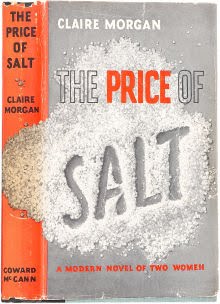
FFB 1952: Marijane Meaker (as Vin Packer): SPRING FIRE (Fawcett Gold Medal); Patricia Highsmith (as Claire Morgan): THE PRICE OF SALT (Coward, McCann)


The first startling thing about these two novels, pioneering lesbian Bildungsromans, first published in the same year, under pseudonyms, by two writers who would go on to have a two-year affair seven years later, is how even more similar they are than this would suggest.

Quite amusingly, both novels feature analogs of their authors as their protagonists; the backgrounds and physical descriptions of Salt's 19-year-old Therese and Fire's 17yo Mitch are not too terribly far from those of their authors, particularly at those ages; the cover painting of Mitch (with her paramour Leda) also rather resembles the young Meaker, on staff at Gold Medal when she submitted her first novel (which this was, though it was quickly followed by her second, Dark Intruder [1952]; Salt was Highsmith's second, after Strangers on a Train [1950]). Further, both protagonists fall into mutual love at first sight, or at least something more than simply mutually lustful intrigue, with an older, more high-status woman in the midst of stressful coping with a new, ridiculously artificial environment--Mitch is matriculating at a university and being pledged to a sorority, Therese as a harassed new toy-department clerk at a massive and stuffy department store of the type common in the era. (Of course, this sort of encounter strokes the intended reader in at least two ways--the romance-fiction trope of the immediately-recognized soulmate, and the gaydar click--though different terms would've been used in 1952, such as mutual recognition--of being either two of the only or the only two "deviants" in the social milieu they find themselves in, and the stirring of previously unfulfilled need particularly in our heroines.) Now, we learn this much in the space of the first few pages of both novels; I will now warn you that next paragraph will be filled with "spoiler" citations. After that paragraph, things will get more vague and sweeping, or at least less keyed to the novels' events, again.


There's a bit of a dance, as Therese gingerly pursues department-store customer Carol, after Carol makes at least some kind of interest clear, and Mitch seeks ways to get to know Leda, who in her turn is quite happy to have Mitch room with her in the sorority house; both the older women consistently condescend to their new acquaintances, noting how little of the world they seem to know. Therese has a fiance, Richard, a somewhat spoiled man-boy who is very proud of how patient he's been with Therese, only having had three or so sexual encounters with her, all of them unpleasant for her; Mitch soon attracts the attentions of spoiled frat-boy Bud, who alternately sullenly and unctuously plies her with alcohol, and gropingly molests her on their first date, and rapes her on the second, yet is traumatized himself by her contempt for him after the rape, which he apparently saw as seduction. The older women, Carol being about thirty, Leda being a senior to Mitch's frosh, have steady men in their lives, about whom they have mixed feelings at best--Carol's husband Harge, rather a petty dictator who hopes to control Carol, but can't quite, and Leda's steady, Jake, a somewhat less insane character than Bud, but one who is quite content with a rather blatant sex-buddies relation rather than romance with Leda. Both our protagonists meet initial "other" men who seem at least more helpful at first, but who prove unworthy of friendship; then they both meet relatively sensitive, more romantic men with whom they don't mind the mildest sort of making out (and both these Good Guys are relatively short, stocky, strong, unflashy and self-deprecating men--clearly the kind lesbians like). Both Carol and Leda prove to be difficult and weak, even if their weaknesses can be understood, given that Carol has a daughter with Harge who will become the object of a custody battle as Carol and Harge divorce, and Leda's life at college depends in large part on maintaining a delicate balancing act between the sorority she secretly disdains, the campus status and housing it provides, and her relation with her immature and sexually competitive mother (a bit of an inversion between the two stories). Nonetheless, the young protagonists are stalwart and faithful, though vexed by the dithering and excessive capriciousness of their lovers, even as they are usually ecstatic when engaging them sexually...only usually, since both couples also have somewhat jarring sexual encounters, wherein the self-doubt and uncertainty of the older women leaves the younger partners a bit hurt, put off. Therese and Carol take a roadtrip together, from NYC to the western states, in a journey that in some ways prefigures not only Lolita, as at least one critic has famously noted, but also On the Road, written at about the same time though published years later. Mitch and Leda also contemplate making a long road trip, but ultimately discard that as impractical (perhaps in part because they're already in the Midwest, and the exoticism of further west is less immediately apparent). In another mirror-image inversion rather than congruence, much is made of Carol's car, she being the wealthier of the two in Salt, and likewise Mitch's in Fire, where she comes from money which Leda can't match. Therese and Mitch write rhapsodic love letters to their women, which are eventually used against both couples; Carol and Therese are pursued by an efficient private detective, who gathers recordings of their conversations, while Mitch and Leda are burst in upon by sorority sisters while in flagrante delicto (so passionately so that they almost replicate a passage from J. Sheridan Le Fanu's lesbian vampire classic "Carmilla"). The upshot of the gathering of such evidence against them is the abandonment of the younger woman by the older in both cases; the more brittle Leda attempts to shift all blame for their tryst onto Mitch, while the more morose Carol simply hides from Therese and dithers as to whether Therese should contact her. In the end of Salt, Therese, while toying with the notion of having a fling with a lesbian actress she meets, decides that after all she really wants the resigned Carol, who has been allowed only the most limited access to her daughter, even if Carol did dare to value her daughter over her new lover...this is interpreted by some as a happy ending, although it does suggest a certain lack of freeflowing empathy between the women. Gold Medal editor Richard Carroll warned Meaker that any paperback novel, which would depend on the USPS censors' approval for at least some of its distribution (Gold Medal offered subscriptions to a GM Book Club in those years), would have to not allow the lesbian affair to continue nor end happily, so Leda, in shock after a car accident, reveals directly that she was at least as passionate as Mitch about their affair, and is placed under well-meaning but utterly oppressive psychiatric care, and forced to confront her mother while so hospitalized...and when she reacts with hostility toward her mother, is bound for an asylum. After a tense but gentle confrontation with Leda, in which the hospitalized woman admits how she tried to shift all the onus onto Mitch, Mitch decides she never actually loved Leda. Mitch then cheerfully contemplates an outing with her new roomie, Robin, to whom she is also sexually attracted, and with Robin's boyfriend Tom and Mitch's stocky, goofy male buddy, nicknamed Lucifer. Many choose to see this as an ending which repudiates lesbianism, though I can only see it as a very elegant way to have the potential of a future womanfriend and possibly to eventually eat her, too...Mitch, as noted, was always playfully, never seriously, attracted to "Lucifer," a fitting companion for a practitioner of Mitchcraft. Mitch might also prefer womenfriends in the future who are not willing to flit between utter backstabbing and total emotional collapse--behavior clearly meant to be attributable to Leda's parents' irresponsibility toward her rather than to her lesbianism per se. Meanwhile, the "sensitive" psychiatrist on Leda's case is all too ready to pack his charge off to a sanatorium for Leda's resentment of attempts to remake her into the kind of woman she has pretended to be...while he's tut-tutting about these empathy-free kids these days. A foreshadowing of One Flew Over the Cuckoo's Nest, perhaps, in some small way, only much more subversively so.

(Spoilers End)

While casting their analogs as rather more heroic than their (rather sympathetically portrayed as somewhat beaten-down) paramours, both novels are very well-written, often witty and incisive, and even a bit tricky: Highsmith loves to delay mention of a precipitating event until a paragraph or so into the description of the aftermath, or at least she does several times in the novel; Meaker is contantly shifting point of view between characters, sometimes within one paragraph, but she handles this rather deftly if at times too quickly...Highsmith in her turn remains relentlessly within the psyche of her avatar, albeit Therese is usually not extraordinarily unkind. (Both novels include rather mixed portraits of surrogate-mother dowagers, but mostly pitying where not positive...the actual mothers of key characters in each novel do not come off so well at all.) Having read these two novels in the last week, I am now even more interested in reading the Big Highsmith biography, and in digging out my copy of Meaker's memoir of their life together, both during their affair and in their brief period together as ex-lovers and friends near the end of Highsmith's life, when her irascibility had risen alarmingly. Meaker, who was a guest of the Rara-Avis discussion list some years ago, was utterly gracious, and despite her college friendship with Richard Matheson and rather unconnected career as staffer at and contributor to the same Gold Medal line publishing him, had no more directly intended to be primarily a crime-fiction writer than Highsmith did...and yet the Packer novels (and not a few of Meaker's YA novels as M. E. Kerr) at least touch heavily on CF themes, and Highsmith is mostly remembered for her criminous novels and somewhat more outre short fiction. (Meaker is quoted as noting that Anthony Boucher, under that name in the New York Times and as H. H. Holmes in the New York Herald-Tribune, was the only major-paper reviewer to consistently review paperback originals, so it made sense to write what was in his purview to review; as I remember the account in Highsmith, one of the sources of friction between Meaker and Highsmith was the latter's irritation at Meaker's comparitive wealth as a Gold Medal novelist, versus the relatively small royalties, if "higher prestige," Highsmith earned as a writer primarily for Knopf. Highsmith apparently had earned a considerable part of her income in the latter 1940s writing scripts for comics, including for Fawcett (their stable was toplined by Captain Marvel, the Billy Batson-crying-"Shazam" character sued out of existence and later revived by DC), and hated the work intensely by all accounts, and I wonder if that, along for the hunger to be taken seriously, didn't stop her from placing at least a few manuscripts at her womanfriend's house.

Patti Abbott is on Nixon-by-the-Shore vacation, and Kerrie Smith is this week's host for Friday's "Forgotten" Books links...next week, I'll be hosting the links here, and the week after that, George Kelley will to the honors, and then back to Patti again.

Thursday, January 27, 2011

"Forgotten" Music: Lambert, Hendricks & Ross (or Bavan)


The problem with doing an entry on Lambert, Hendricks and Ross, the vocal trio which formed in 1957 while Dave Lambert and Jon Hendricks were attempting to record a choral jazz record of Count Basie charts, only to discover that only one singer among those they'd contracted for the date, the Briton Annie Ross, was fully competent as a singer in jazz idiom...the problem is that they were so immediately a hit that they did a lot of tv, for a jazz group (particularly a vocal group), and so there's a lot of raw (sometimes in the uploaded state very raw, or rather chewed over) video footage one can cite for them. It does augur that they are Not forgotten, but as their era's great popularizers of jazz "vocalizing" in the sense of singing instrumental lines, either note for note or in the same sort of improvisational lines, I have been surprised by how many people have yet to hear of them, even if they have heard them or covers of their songs (such as Annie Ross's "Twisted," which she first recorded for a solo album split with King Pleasure, another singer working in the same mode, he best remembered for his vocalized cover of James Moody's improvisation on "I'm in the Mood for Love," "Moody's Mood for Love"). (And, boy, what a plethora of impressionistic amateur animation there is for some of the videos for the trio, up on YouTube particularly.)

Annie Ross showcase: "Twisted"

Twisted--Lambert, Hendricks, & Ross from Laura Cash on Vimeo.


So, after recording the Basie charts album here by themselves with overdubbing and multitracking like crazy, they did some touring and an album with the Basie Orchestra, such as "Every Day I Have the Blues":


Dave Lambert showcase: "Bijou"


Jon Hendricks showcase: "Moanin'"


LH&R as backing singers, for Louis Armstrong: "They Say I Look Like God" (from Iola and Dave Brubeck's suite The Real Ambassadors)


Sadly, in 1962, Annie Ross had to drop out of the trio, due to illness and personal problems...a Canadian, Anne Moss, briefly filled in, then the Sri Lankan Yolande Bavan became the permanent third partner for the next two years:

Lambert, Hendricks & Bavan: "Cousin Mary"


In poorer fidelity (both audio, but particularly video--the initial crackle disippates), but a nice reading of "Come On Home," recorded on their third and last headlining CBS ablum by L, H & R--you might note that Bavan flubs her solo's opening, but still pulls it off (if not quite as brilliantly as Ross did); Jon Hendricks chose to leave the trio in 1964, and so the other two decided to call it a day. Sadly, Lambert was killed in a car crash in '66, while the other three continued as performers and inspirations to, most famously and obviously, the Manhattan Transfer but also to many others:


For a nice range of folk, blues, rock and soundtrack music selections, see Scott Parker's blog for the other entries this month (and feel better, Scott).

Tuesday, January 25, 2011

25 Jan 2011: Tuesday's Overlooked Films (and/or Other A/V) (2nd Round)

The following bloggers have or probably have their entries up and awaiting your persusal for this week, or will soon (more refined links to occur when possible):
Bill Crider: Cutthroat Island
Brian Arnold: Mischief
Eric Peterson: The Outfit
Evan Lewis: The Adventures of Sir Lancelot
James Reasoner: Hellfire
Jerry House: The Atomic Man aka Timeslip
K.A. Laity: The Knack...and How to Get It
Patti Abbott: Local Hero
Paul D. Brazill: Charlie Bubbles
Pearce Duncan: The Fountain of Youth
Randy Johnson: Man of the West
Scott Cupp: Dark Intruder
Scott Parker: They Were Expendable
Todd Mason: The Great American Dream Machine; Fanfare for a Death Scene; The Firesign Theatre Radio Hour

And posts of related interest:
Cullen Gallagher: Hickey & Boggs
David L. Vineyard (among others, courtesy Steve Lewis's Mystery*File): My Name is Modesty
Paul Bishop: Johnny Staccato
Scoleri and Enfantino's We Are Controlling Transmission...
Vince Keenan: Fuzz
Comedy Film Nerds

...and thanks to all who participate, reviewers and readers alike.

The Great American Dream Machine might not've been indicative of all PBS was meant to be, but it was nonetheless a pretty good start in the form of a relatively free-form, largely satirical magazine series, 90 minutes in its first short season, down to sixty for its second and final in 1971-1972, which included a mixture of animation, sketch comedy (often featuring Marshall Efron, Chevy Chase, Albert Brooks, Ken Shapiro and others, including pre-codger Andy Rooney), reportage, interview segments (including the link above to an extended Studs Terkel discussion), and generally did what it could to push boundaries for US television for its time. Reportedly, at least some of the material in the show was reshot for Shapiro and Chase's film The Groove Tube; more importantly, the series was a guiding light and launching point for such other series as Marshall Efron's Illustrated, Simplified and Painless Sunday School, and, of course, NBC's Saturday Night and its "hip" every-fourth-week slot companion, the newsmagazine Weekend. Here's a bit of Albert Brooks's "School for Comedians" film for TGADM, unfortunately as "sweetened" with a laugh track and cut short for some latter-day clip show. While no legit home video of the original series has been offered, in June, the syndicator Executive Program Services has just announced, a pledge special gathering diverse elements from the series will be offered to public television stations, and perhaps you might be lucky enough to see it in a non-pledge slot.

Television films exist in a gray area...are they really simply teleplays (many of them serve as pilots for series, perhaps more often in the past than they do now), or are they actually more like cinematic releases...since no few US television movies have been given cinematic release, abroad when not also domestically. The most famous examples of the latter include the 1964 remake of The Killers, with the famous footage of Ronald Reagan's thug character slapping Angie Dickinson's around, deemed to be too violent for broadcast in the months after the John Kennedy assassination, and several films co-financed in the 1980s and 1990s by PBS under the American Playhouse rubric, beginning with Testament. (And a number of films made in a similar funding arrangement with the likes of the UK's Channel 4, such as My Beautiful Laundrette, also saw theatrical release in the US and elsewhere). Television films have had a tendency to be bland, even when promising to revel in salacious material (hitting all the stops in notoriety from The War Game through Born Innocent to Mother May I Sleep with Danger? and Little Ladies of the Night), and shallow; only occasionally do we encounter the truly lunatic film-for-television, but some can stand proudly in this "alternative" (in the sense that Bill Pronzini applies this adjective to Harry Stephen Keeler's fiction, and others') field...and one such item is Fanfare for a Death Scene, co-written and directed by The Outer Limits creator Leslie Stevens, and one of the most joyously ridiculous crime/espionage dramas one can hope to encounter, straight out of the same well of creativity that led Stevens to also produce the only feature-length horror film in Esperanto, Incubus. Somehow, Stevens managed to get a script approved for the Kraft Suspense Theater which involves a disinterested Richard Egan seeking out a defecting scientist amidst a swirl that includes a drugged and crazed Burgess Meredith mistaking himself for Al Hirt, with the rest of the cast filled in by such stalwarts as Ed Asner, Tina Louise, Telly Savalas, Khigh Dhiegh (born Kenneth Dickerson, in the years before The Manchurian Candidate and Hawaii Five-0) and Viveca Lindfors. The climax is hilarious; the entirety of the episode/telefilm, as the only commenter on IMDb notes correctly, is surreal. It's genuinely fascinating in the way that a Stevens production gone wrong, as with several Outer Limits episodes and Incubus, can be...and you probably won't be wishing you were watching something else while it plays...and I'm happy to report that I've just discovered that Netflix is streaming this alternative classic, so that gray-market discs don't have to be relied upon. I shall have to reacquaint myself.

And my set of links to various comedy podcasts and webbed radio shows from a few months back needs updating and expansion; I'd like to draw particular attention to the slightly revised address for the Firesign Theatre Radio Hour archives, a pulling-together of some of the "lost" material from free-form, at times Very free-form, live radio series the Firesigns did for Pacifica Radio and "underground" commercial FM radio stations in California (and national syndication, before their Nick Danger series) around the turn of the 1970s...not usually up to the best of their work on LP, you can still hear inspired bits and much of the material on the Dear Friends double-LP set is here in context. Perhaps more useful for someone who is already a fan, who's heard Waiting for the Electrician or Someone Like Him, or Don't Crush That Dwarf, Hand Me the Pliers, or The Giant Rat of Sumatra, or even the late, underrated Eat or Be Eaten...but here's more from where that all came from.

Monday, January 24, 2011

Calling for blog-posts: Tuesday's Overlooked Films (and/or Other A/V) tomorrow

All are welcome, of course...please let me know that you're In, via comment here or email at FoxBrick@Gmail.com, if I seem to be missing you. Thanks!

Double-features for the day:

*Hippie parents meaning well and being more on the ball than first appears (the later one more Boomer-stroking than the earlier):
Valley Girl (1982/3)
Pump Up the Volume (1990)

*Earnestly ridiculous Evil high-school students/Evil PTA:
The Blackboard Jungle (1955)
The Explosive Generation (1961)

*best/worst fake punk-rockers on North American tv series:
Best: SCTV, the Queen-Haters, "I Hate the Bloody Queen"
Worst: hard to gauge, but Quincy has the sentimental vote