Showing posts sorted by relevance for query damon knight. Sort by date Show all posts

Friday, February 3, 2017

FFB: BETTER THAN ONE by Kate Wilhelm and Damon Knight (MCFI/NESFA Press 1980); BLACK COCKTAIL by Jonathan Carroll (Legend/Century 1990)

"...And you know two heads are better than one..." 
--Annie Ross
Better Than One was the only officially collaborative book that Damon Knight and Kate Wilhelm published during his life and their long marriage; she was one of the most frequent as well as most important of the contributors to Knight's anthology series Orbit, and they are presences in each other's anthologies and nonfiction books, but they never formally collaborated on fiction; Knight refers to one abortive attempt early on, in the prefatory matter in this collection, which was published as a convention commemorative volume for the WorldCon, NorEasCon II in 1980 in Boston, where the couple were the Guests of Honor. (As with the books from Advent: Publishers, only with an even more obvious throughline, the book is now available from the subsequent publishing project NESFA Press.) ISFDB credits D. Christine Benders as editor, though the credit she takes is designer in the volume itself; it does seem likely that Knight and Wilhelm decided what went into the book. There are two introductions, one from each, which serve as brief memoirs of their lives together as partners and artists, followed by three poems by Knight, a prefatory note and the short story "Semper Fi" by Knight, a prefatory note and the short story "Baby, You Were Great" by Wilhelm, and four poems by Wilhelm. The stories deserve to be collected together inasmuch as Knight's story, originally published with some editorial fiddles as "Satisfaction" in Analog for August 1964, inspired Wilhelm to write hers, originally in the second Orbit anthology of original fiction in 1967. Both stories deal with virtual reality in a sense, with Knight's about the opportunities for people to create their own masturbatory playgrounds via a sort of interactive VR drawing on one's own imagination; Wilhelm, rather convinced that the technology that Knight described would probably be put to more social-controlling ends, posits instead a sort of remote experience of the lives of eventually unwilling stars of "reality" VR. Turns out they were both right, to the extent we've achieved a limited form of virtual reality and interactive programming. 

The two stories are not nearly the best single works by either writer, but are both good examples of what they can do, and the introductory matter is insightful and informative, and telling...particularly to the degree to which Knight's comments are more reserved, if clear in his gratitude for the life he has had with Wilhelm and illuminative of his artistic process (as Algis Budrys has noted about other Knight nonfiction, few could tell you more clearly how they go about the actual craft of writing than Knight), while Wilhelm's is more emotionally naked, providing a bit more of the sense of how their partnership worked and how it felt to live together and work separately; they are pretty obviously each other's biggest fans, though no more uncritically than you would expect two artists of their caliber to be.  Wilhelm's poetry gains a bit in comparison by her relative lack of reserve, feeling a bit less like exercises in the form (apparently, one of hers had been published elsewhere previously, though where is not cited; the balance of hers and all of his were apparently first published in the book), though both display their wit and grace.  Wilhelm continues to contribute notably to both fantastic and crime fiction; Knight is not as well-remembered as he should be but even last night, as I write, he was referenced blind on the topical comedy series @Midnight, in a game called "It's a Cookbook" where comedians were encouraged to mock silly or awful  examples of actual cookbooks...a reference to Knight's story "To Serve Man," also not his best but easily his most famous, and a fine more-than-a-joke story, slipped into the cultural surround in part by the adaptation on The Twilight Zone and reference to that episode by The Simpsons, those staples of proto-VR pop culture. 

US edition of the first collection with BC
While it's been collected twice since with short fiction by Jonathan Carroll, Black Cocktail was first published in both the UK and (in 1991) the US on its own, and is (surprisingly to me, considering how long I've had his books in my virtual TBR piles) the first longer fiction I've read by him.  I've had my copy of the St. Martin's Press hardcover of this one for a quarter-century, in fact, almost all of that time in a storage box, and that was my mistake...it's a good read, and I'm even more likely to pick up one of his novels soon. This one begins feeling a bit like Harlan Ellison's "Jeffty is Five"...only with a more sinister, not at all nostalgic mood...and ends with a sense of the same sort of Gestalt personality exploration that fascinated Theodore Sturgeon so fruitfully, and while the story, even given its excellent detail and grace and wit (and good choices of models to draw on...along with F. Scott Fitzgerald, Fritz Leiber, Shirley Jackson and a few other writers working similar territory over the the years) doesn't quite convince, finally, it's a more than game try, and you won't be likely to want to read something else while you're reading this one. The protagonist, mourning the loss of his life-partner, meets up with an enigmatic new man who turns out to have even more enigmatic friends...and an odd connection to people from the protagonist's past as well... Even more than the short stories I've read by Carroll over the years, this reminds me also of William Kotzwinkle's work, and that, too, is high praise. The jacket by Dave McKean is pretty brilliant; the interior illustrations, in black and white, are less effective, if appropriately moody.

The utterly spartan jacket for the first edition.
Peripheral facts: both these books have "officially" 76pp. of formal text (though as the index above notes that leaves out the overall introductions by Wilhelm and Knight); Knight's story appeared in the Analog for my birth-month; Wilhelm had essentially two "first" stories for professional publication--John W. Campbell had purchased Wilhelm's sf story "The Mile Long Spaceship" for Astounding Science Fiction (later known, as of 1960,  as Analog) before assistant editor Cele Goldsmith picked out KW's fantasy "The Pint-Sized Genie" for publication in Fantastic...but Fantastic published its story first...and Wilhelm was also soon selling crime fiction short stories and her first novel, More Bitter than Death, was cf...Knight's first professional publication had been a decade and half earlier, in Fantastic's elder stablemate Amazing, a cartoon (as Knight was initially as much visual as literary artist, but soon determined he was better at the latter...actually, he was better at the former than he gave himself credit for, if still a better writer)...one of the few reasons I was a bit sad to leave New Hampshire behind in 1979 for Hawaii, not quite as acute as leaving my few good friends and some other good people (though also not a few jerks) was that I really wouldn't've minded attending the 1980 WorldCon in Boston. As it was, I didn't get to one till 2001, the one just before 9/11. 

For more of today's books, please see Patti Abbott's blog.

Lucky Cluadia got hers signed...but had to or chose to sell it, or someone did for her...

Wednesday, July 22, 2015

US newsstand fantasy and sf magazines at the time of the debut of GALAXY: part 2

Part 1
Part 3
Part 4
Part 5/conclusion
Cover by George Salter, genius at Mercury Press
and elsewhere (notably did the two original covers
 for Kafka's The Trial for both German and
 English publication, among much else).
Mercury Press/Fantasy House; 
Anthony Boucher and
J. Francis McComas, editors

F&SF's fourth quarterly issue arrived at about the same time as Galaxy's first (monthly) issue; as one can tell, Edizioni Mondiali/World Editions was both more flush and more brash than the publishers of American Mercury. The latter had been subsidizing their politics and culture magazine in part with the rather cultured but also more successful Ellery Queen's Mystery Magazine and its books in digest-sized-magazine-format lines Mercury Mystery, Bestseller Mystery and Jonathan Press Mystery. (The Mercury had been co-founded by H. L. Mencken and George Jean Nathan, veterans of the legendary magazine The Smart Set, which had been supported by a magazine they founded as a potential cash cow, Black Mask. Thus the duo, no great lovers of crime fiction, had helped spawn the two most important crime-fiction magazines so far--though others have come close).  Discussions at Mercury Press as to possibly launching a fantasy magazine that would, like EQMM, mix literate new fiction and reprints from a wide variety of sources, began in 1946, but perhaps an excess of caution led to the first issue not being published till 1949. Since magazines tagged as fantasy magazines hadn't sold, on balance, as well as magazines tagged sf (in part because the fantasy audience was less aware they were a fantasy audience, something that would continue till the Tolkien and some extent Robert Howard, et al., explosion in the 1970s), the first issue was to be the only one to be known as The Magazine of Fantasy...that first issue included Theodore Sturgeon's notable sf story, "The Hurkle is a Happy Beast"; F&SF was also budgeted cautiously, so that throughout the 1950s (and later) it never paid as well as the highest-paying markets in the fields. But the acumen, graciousness and connections of the founding editors Boucher and McComas helped overcome that, as did their openness to women writers, literary sophistication (within certain limits; Boucher, the first to translate and publish Jorge Luis Borges in English--in EQMM, often referred to fantasy fiction that might be too subtle for his magazine's general audience, rather a self-defeating sort of crotchet), and relative lack (compared to John W. Campbell, Jr. at Astounding Science Fiction and H. L. Gold at Galaxy) of editorial taboos and somewhat narrow notions of what they were interested in seeing from contributors. F&SF would go bimonthly, then monthly, over the next several years.
Contents:


Bok-esque cover by Paul Callé
Hillman Periodicals: 
Damon Knight, editor
If Mercury Press was perhaps overly cautious in their launch of F&SF, Hillman was perhaps pessimistic to a fault. Damon Knight had been working as an editorial assistant  at Popular Publications for several years when he was able to convince Hillman to let him edit a new fiction magazine for them, which they launched alongside publishing Jack Vance's The Dying Earth in their paperback line (stories from that linked collection would appear in each issue of the magazine). At his fellow ex-Futurian Frederik Pohl's advice, he asked for a budget that would allow payment of 3c/word for fiction, which Pohl notes he was able to take around to both Gold and Campbell to get them to push for an increase in budget to allow for 3c/word as their magazines' base rate, as well. And that was the last measure of support given the magazine by its publisher...when sales figures came in for the rather impressive first issue, as the second issue was out on the stands, the magazine was folded, effective after the third/last issue was published. 
Contents

Cover by a young Jack Gaughan, for "Scanners"
Fantasy Publishing Co., Inc. (FCPI): "Garret Ford", editor(s)
If August Derleth and Donald Wandrei's Atkham House has been the most important small press to devote itself to fantasy, horror and to some extent sf and crime-fiction publishing in the 1940s (among some less durable contenders), there was no one more dogged in his attempts to make a go of small-press publishing than William Crawford, who produced two of the first semi-professional or little magazines in the newsstand speculative fiction tradition, Marvel Tales and Uncanny Tales, and would later publish two runs of the minor Spaceway Science Fiction magazine...but whose book publishing line FPCI and particularly his late '40s/early '50s magazine Fantasy Book (which he edited as "Ford" with wife Margaret Crawford) will probably be his most important legacy...particularly with the first issue from 1950, which featured the most impressive lineup the magazine would produce (as essentially a last-stop salvage market for most of its contributors), and publish what is easily its most important piece of fiction, the "first" story by Paul Linebarger which the espionage and psychological warfare expert would publish under his "Cordwainer Smith" pseudonym. I've just realized that "Ford"'s mildly famous anthology for FPCI, Science and Sorcery, is essentially a Best of Fantasy Book, with additionally a few new stories (probably originally purchased for Fantasy Book) and a couple of pulp reprints (one a Ray Bradbury story from Thrilling Wonder Stories in 1948). Frederik Pohl having a story in this issue (a collaboration with fellow ex-Futurian Isaac Asimov) probably was most of the reason Pohl saw the "Smith" story and became one of CS's great editorial champions.
Contents

Cover by Bill Stone, who shot both covers for
Fantasy and the first cover for F&SF (pre &SF).
Magabook, Inc.: 
Curtis Mitchell, editor
If Hillman was rather hasty in canceling Worlds Beyond, Magabook clearly didn't know what they were doing with the two issues they published of their fantasy and sf magazine, of which this is the second (the first was titled Fantasy Magazine, not to be confused with the several other magazines of that title over the years). The first issue's cover was a bit less awkward (no blabbing, no vaguely mummy-like creature); the contents, at least the reprints of Robert Arthur and Irvin Cobb stories (and Arthur, Cornell Woolrich, and possibly the Richard Sale and Max Brand stories in the first issue) are not the worst ever presented...but clearly this was not a project embarked upon with confidence nor a good sense of artistic or commercial potential.
Contents
--And, in fairness, I could be said to be "cheating" in citing the latter three issues, as they might barely have overlapped with Galaxy's first issue on newsstands, though they all three probably did on at least a few. Certainly, the first issue of Worlds Beyond is important in relation to Galaxy as noted, and the other two are simply the more interesting cases of the two issues browsers might've seen in late September into late October of 1950....

More to come...
Indices and cover images courtesy of ISFDB and Galactic Central.

Wednesday, July 9, 2025

SSW: "Plenitude" by Will "Worthington"/Mohler, THE MAGAZINE OF FANTASY AND SCIENCE FICTION, November 1959, edited by Robert P. Mills


This issue can be read at the Internet Archive here.

Heinlein and Fast as the cover draws. John Collier's story was a reprint. Starship Soldier was, as editor/critic John Boston has noted in email, a truncated form of  Starship Troopers, which was published in book form about the same time the second and final installment in the next month's F&SF was on the stands.

From the FictionMags Index and ISFDB:

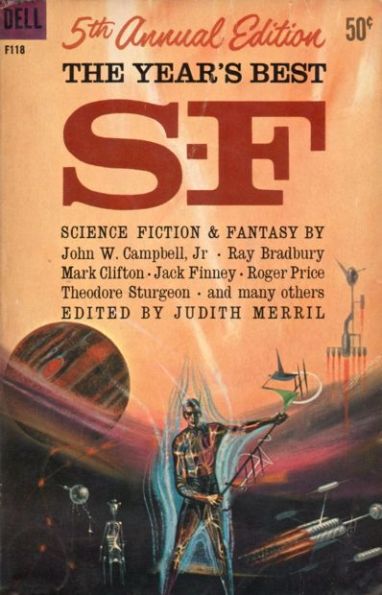
I first read the story in this volume of Judith Merril's annual:
(note the early Lawrence Block story collected below; a good volume even for Merril...)


Can't imagine why ("Snirsk!" says Ninja the cat as she walks by), but post-crisis fiction and drama is at least as common (and perhaps popular) as ever, though one of the more memorable post-crisis stories that has stuck with me through the decades (I would've read it perhaps forty years ago, and it wasn't so very new then) was by Will Mohler, who apparently published all his fiction in a five-year span from 1958-63, almost all of it signed "Will Worthington", and that was that, despite a receptive audience for it in the field.  

"Plenitude" is an interesting mixture of outsider resentment of conformity culture--through that conformity seeking a kind of community and security which can be all too poisonous (hello, current crises, particularly when the current power structure is, more than usual, in the hands of particularly self-regarding irresponsible, ignorant fools), and how one might attempt to imagine a better, truer existence through turning away from all that. It's not a brilliant story, but it does rather cleverly outline what seems at first to be a post-apocalypse scenario which turns out to be something rather different, a latter-day refinement of H. G. Wells's Eloi and Morlock dynamic, if less systematically brutal. Mohler's a better polemicist than he is a fashioner of fully human characters (the adult women characters are puzzling wonders to the [not quite fully] adult viewpoint character, and this is something he brushes off improbably, given their situation...such obliviousness might make more sense in a story set in a 1960s US reasonably affluent suburb). It's a relatively short story, and it mostly surprised me back then in its critique...Mohler mockingly uses Hegelian terms to chide its upper middle-class conformist survivors, and one will find it more difficult in a quick search for the term "Parmenidean" than it should be, as our bots of today are made to be certain we must mean to search for "Pomeranian"...I believe I first read this story in the back volume of the Merril annual rather than the back issue of F&SF, which with even a glance at the contents marks it as a typically star-studded one...editor Robert Mills, like his predecessors "Anthony Boucher" and J. Francis McComas, being as much at home in crime fiction as fantastica.

I suppose I should make a study of  Mohler's work in toto, as far as we know of it, with three stories in Fantastic, one each in If and the British Science Fantasy, and six in total in F&SF, the last one, along with a single story in Galaxy, as Mohler:
***For more of today's story reviews, please see Patti Abbott's blogpost here.