Friday, April 17, 2015

FFB/S: "Super Whost" by Margaret St. Clair and why it matters...

Margaret St. Clair, despite admirers much better-known than myself including Ramsey Campbell and Martin H. Greenberg, remains stubbornly underappreciated.  I've finally read one of the gently satirical stories in her early series about a suburban married couple of the future, Oona and Jick, the second, "Super Whost," from the July 1947 issue of Startling Stories. As with most of the series, it's not yet been reprinted, despite being charming and funny and a cross between the kind of "comic inferno" writing that would be associated with Galaxy magazine a few years later, and the kind of surprisingly sharp domestic farce that Jean Kerr and Shirley Jackson would also be writing not long after, and echoed more popularly and broadly by I Love Lucy and eventually Erma Bombeck. (In a quotation from St. Clair in her rather good Wikipedia entry, she notes that the reader response to her stories in this never-collected series was less than warm, but one suspects the motivated writers were the same sort of fanboys who so usefully drive a lot of online conversation today.) The story is a deft account of Oona's attempt to win a vacation on Mars through a short essay/blurb contest requiring proofs of purchase from the packaging of a glutinous wheat product,  Super Whost, and the result of having entirely too much of the stuff in the house as a result of the extra expenditure, along with various further agglomeration of Super Whost as others' attempts to rid themselves of the product, after also gathering proofs of purchase for prizes, lead to Oona and Jick both "winning" even more of it. Unlike as in some of the "comic inferno" writing as Galaxy started to get lazy in the mid 1950s (where characters might've simply stuffed themselves sick with some similar product), it occurs to both Oona and her husband to simply throw the stuff away, but it's just expensive and useful enough to make that less easy to contemplate than attempting to palatably use it up, and it's in the little details of commercial exploitation (the contest) and social interaction (a friend, having made her own SW treats for what amounts to a bridge or mah jongg party, remarks a bit pointedly about Oona apparently not being too pleased with the dessert...Oona deflects this with a mention of needing to get in shape for the upcoming season with her new frontless bathing suit). Having been exposed to network radio advertising from the 1940s, its descendants through today but particularly those of the decades past from, say, Kraft and Jell-O, and generally aware of the long shadow of Depression and
July 1947...typical SS cover for 1947.
wartime privation 
over even the relatively comfortable middle class I was raised in, and the Feminine Mystique that Friedan was able to delineate, for those who hadn't quite let it set in, fifteen years later...it all resonates.

Looking at St. Clair's ISFDB citations, one sees that she, like her slightly later-arriving peers such as Algis Budrys and Robert Sheckley (or Ursula Le Guin and Michael Shaara...Kate Wilhelm and Richard McKenna...Philip K. Dick and...), generated a torrent of work from the latter 1940s through the end of the 1950s, when she slowed a bit...and, like those other (shall we call them "post-Futurian"?) writers, she was the product of a broad, rigorous college education in literature and writing, in a way that most of the auto-didacts who had been Futurians or associated with the Futurian magazines such as Astonishing Stories or Science Fiction were not, even if their interests and approaches (and educations) were similar--and those folks would be much of the core of writers who helped make Galaxy what it was, and so influential on sf and other literature which followed. While St. Clair was publishing these stories in Samuel Merwin's issues of Startling Stories, the odd (but influential and well-remembered) story such as William Tenn's "Child's Play" or T. L. Sherred's "E for Effort" was popping up in John Campbell's Astounding Science Fiction...even if Campbell eventually regretted publishing a few of them since he had some trouble with their perspective when it set in with him. Certainly, Judith Merril and Evelyn E. Smith and Kit Reed, as well as Theodore Sturgeon, Kurt Vonnegut, Ray Bradbury and certainly Fritz Leiber, might've found themselves nudged in certain directions in their writing by that of St. Clair, who would do more forceful work than "Super Whost" while retaining this story's charm and wit...perhaps such other underappreciated geniuses as Wilma Shore were influenced as well.

Please see Patti Abbott's blog for more of today's books and/or stories...and a reminder of why the late Ron Scheer matters...

Tuesday, April 14, 2015

Tuesday's Overlooked Films and/or Other A/V: the links

Devoted this week to the memory of Ron Scheer. 
Read the Book from Ron Scheer on Vimeo.

Anne Billson: Guilty Pleasures?

Bill Crider: Cellular [trailer] (Vince Keenan on Cellular)

BV Lawson: Media Murder

Comedy Film Nerds: Chris Gore

Ed Lynskey: The Boogie Man Will Get You

Elizabeth Foxwell: Murder is News; Stan Freberg

Evan Lewis: Satan Met a Lady

Gerge Kelley: Batman vs. Robin
Respire

How Did This Get Made?: Tango & Cash

Iba Dawson: Respire (aka Breathe)

Ivan G. Shreve, Jr.: Bulldog Drummond on US radio and in film

Jack Seabrook: The Alfred Hitchcock Hour: "Starring the Defense" (by Henry Slesar)

Jackie Kashian: M. Dickson

Jacqueline T. Lynch: The Helen Morgan Story

Jake Hinkson: Helen Holmes and early action heroines

James Reasoner: The Dovekeepers

Jerry Entract: The Drum
Q Planes

Jerry House: Dark Fantasy: "The Sea Phantom"

John Grant: Plump FIctionQ Planes

Jonathan Lewis: Four Flies on Grey Velvet (aka...); Iron Man (1951 film)

Juri Nummelin: Fear Over the City (aka...)

Kate Laity: It Came from Schenectady...

Kliph Nesteroff: Interview with Dick Cavett

Laura: Jeopardy (1953 film); Witness to Murder

Lucy Brown: An Inspector Calls

Martin Edwards: Arthur and George

Marty McKee: Scorpion (1986 film)

Mystery Dave: Poultrygeist

Patrick Murtha: Cambio de suerte (aka  Lucky Bastards--literally "Change of luck")

Cleo from 5 to 7
Patti Abbott: Cleo from Five to Seven

Prashant Trikannad: libraries in Southern India

Randy Johnson: Three Men from Texas; Stop the Slayings (aka....)

Rick: Joe 90; Jean Renoir

Rod Lott: The Naked Witch

Ron Scheer: The Sons of Katie Elder

Sergio Angelini: Slayground

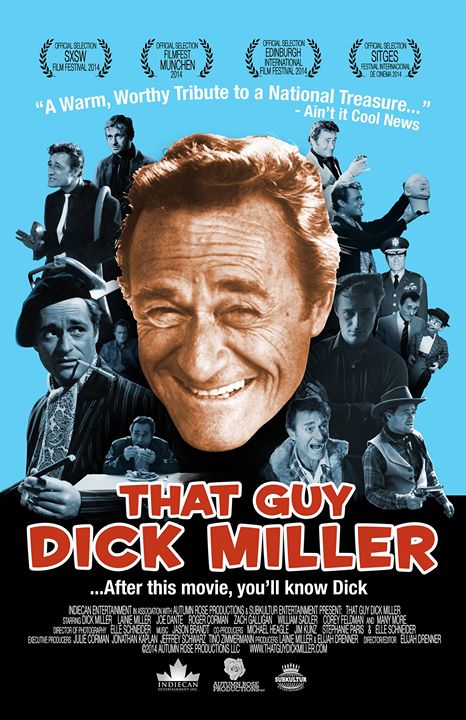
Stacia Jones: That Guy Dick Miller

Stephen Bowie: Mannix

Steve Lewis: The Skull (by Robert Bloch)

Vince Keenan: Charles Brackett

Saturday, April 11, 2015

Saturday Music Club: some trumpet and flugelhorn jazz

The Frankie Trumbauer Orchestra featuring Bix Beiderbecke: "Singin' the Blues"


Louis Armstrong and the Mills Bros.: "My Walking Stick"


The Duke Ellington Orchestra featuring Cat Anderson, Shorty Baker, Ray Nance and Clark Terry: "El Gato"


The Dizzy Gillespie Orchestra: "Birks Works"


The Art Farmer/Jim Hall Quartet: "Sometime Ago"


Lee Morgan:  "Midtown Blues"


Carmell Jones: "I'm Gonna Go Fishin'"


Blue Note stars featuring Freddie Hubbard: "Cantaloupe Island"


Friday, April 10, 2015

FFB: SF HORIZONS, edited by Brian Aldiss and Harry Harrison (1964 and 1965 issues; facsimile reprint in boards 1975, Arno Press)

 Here's Brian Aldiss in 1964:

I avoid the usual term "mainstream" which erroneously suggests two things: a) that all sf writers are equal in aim, attitude and ability, and b) that all other writers are equal in aim, attitude and ability, and that all their works are homogenous.

That this line appears in a footnote to an essay about the literary difficulties in writing good sf, using an early novel by Jack Williamson as a jumping off point (while making copious note of the similarities of too much of the work still being written and published in the early-mid 1960s), leaves open the question of how formative reading that in 1979 might've been for the 15yo me, or even more likely, how much I would've found it utterly apropos, an excellent and all but thrown-away statement of a point most people (as it turns out) won't even argue with, so ingrained in their worldview that there's an Us and a Them and the demarcations are clear (except when they aren't). (Romance-fiction fans and writers these days might be the most disturbing example of accepting a ghetto mentality, as Judith Merril might've been the first to put it in re: fantasy and sf, inasmuch as so many of them buy into the writer's guideline commercial notion that it Isn't Really a Romance if it doesn't have a Happily Ever After, or potentially HEA, ending. Romeo and Juliet ain't no romance, you fool...just look at that ending.)

This was an excellent project that probably didn't sustain itself financially, while its editor/publishers were trying to make a living from writing...Damon Knight and Lester Del Rey similarly, in the late 1950s, produced two issues of a Science Fiction Forum that calls out for reprint or posting online, but hasn't seen any yet, as far as I know, even though Knight revived the title for one of the publications of the Science Fiction Writers of America when he co-founded it in the mid '60s. Before SF Horizons, there was PITFCS and Xero; since, we've certainly had Monad and SF Eye, and others that have had a similar ambitious remit (a few, such as Richard Geis's Science Fiction Review/The Alien Critic, Andrew Porter's Algol/Starship, and Douglas Fratz's Thrust/Quantum, which have occasionally approached the same adventurous feel). Maybe Inside SF/Riverside Quarterly as well...if your magazine lasts any length of time, it has to change names (SF Eye began as Science Fiction Eye). 

If you pick up the facsimile volume, or the original issues, today, you'll have access to some of  James Blish's criticism (collected since in volumes from Advent: Publishers), but in its natural environment, cheek by jowl with an excellent interview with C. S. Lewis and Kingsley Amis conducted by Brian Aldiss, and a good one with William Burroughs conducted anonymously (but by someone, I'm told possibly James Blish, who met Burroughs at a meeting of the New York City-based Hydra Club, a periodical gathering of writers and fans that flourished in the 1950s into the '60s); Burroughs is quick to note how much he admires the work of Theodore Sturgeon, Eric Frank Russell (rather unsurprisingly) and (perhaps more surprisingly) C. S. Lewis, in whose work Burroughs sees a strong kinship with his own. I'm not sure the Aldiss essays here (as by him and by "C. C. Shackleton," a regular pseudonym of his often for more satirical writing) have all been collected elsewhere, but one hopes so (the long take on three contemporary UK writers--Lan Wright, Donald Malcolm and J. G. Ballard--is utterly engaging); the editorial in the second issue, attributed to both Harrison and Aldiss, is a particularly acute brief analysis of the great appeal of what has come to be known as the technothriller, albeit ranging as far as Advise and Consent in the then-current crop, and tracing their roots through John Buchan's espionage novels as well as Ian Fleming's incidentally tech-obsessed entries. Harrison's close reading of an F. L. Wallace novel, and issue-taking with Blish's criticism of Aldiss's "Hothouse" stories in the first issue, seems unlikely to have been reprinted elsewhere so far, and that's a pity. Okuno Takeo and Francesco Biamonti's short surveys of sf in Japan and Italy are useful snapshots (Biamonte notes that Umberto Eco had devoted a chapter in a then recent book to how he felt Italian sf should be developed), the kind of coverage that Charles Brown was later keen to continue in Locus magazine, in dealing with international sf and fantasy worldwide. 

For those who seek out the Arno Press reprint: be aware that the text pages are on acid-free paper, but for some reason the endpapers are not. That atop not reprinting the magazine covers in the book, for no obvious reason, and slapping on what I suspect is a slightly expensively embossed and cutesy cover, perhaps one used on all the Arno SF line at the time; their books were clearly meant for the library trade, and before recently purchasing this copy, I'd first read a copy I borrowed and reasonably promptly returned to the Hawaii State Library's central branch, all those years ago.

Images and indices courtesy ISFDB:
Title: SF Horizons 
Authors: Harry Harrison and Brian W. Aldiss 
Year: 1975 
Publisher: Arno Press
Notes: Photographic reprint of the two issues of the British journal/fanzine, originally published in 1964 and 1965.
Library binding on acid-free paper, less than five hundred copies printed.
No price or pub month in book.
Book cover artist not credited.


Please see a recollection of the first set of FFB links, and the rest of this week's ttiles, on this celebration of the first seven years of Friday Books at Patti Abbott's blog.

Tuesday, April 7, 2015

Tuesday's Overlooked Films and/or Other A/V; the links

The MiddleMan
This week's selection of (mostly) recommendations of (and a few warnings about) insufficiently-appreciated or simply obscure film, television, radio, audio recordings, and more...thanks, as always, to all the contributors and to you readers; Patrick Murtha joins us for the first time, this week, and welcome!

Dedicated this week to the memory of Stan Freberg.

Anne Billson: The Three Musketeers in film and television

Bill Crider: Nadine [trailer]; The EQMM Podcast: "The Adventure of the 'Two-Headed Dog'"

Brian Arnold: Redux Deluxe
Mystery in Swing

Brian Greene: Black Rainbow

BV Lawson: Media Murder

Comedy Film Nerds: Matt Mira

"Crime HQ": Videogames: Training for Psychopaths...and Saints?

David Cramner: Ron Scheer: My West: The Sandhills of Nebraska

Ed Lynskey: Framed

Elizabeth Foxwell: Mystery in Swing; National Archives declassification hearings

Evan Lewis: The Big Trail

Francis M. Nevins: Danger and Suspense the tv series and John Dickson Carr

George Kelley: The MiddleMan

Mistress America
How Did This Get Made?: Lake Placid

Iba Dawson: Eden; Mistress America

Ivan G. Shreve, Jr.: The Sin of Nora Moran; TCM fare: The Sorcerers, et al.; Nero Wolfe on radio

Jack Seabrook: Alfred Hitchcock Presents: "Poison" (by Roald Dahl)

Jackie Kashian: Mike Olsen and Andy Ashcraft on game design...and children's television

Jacqueline T. Lynch: Dead Reckoning

A Girl Walks Home Alone at Night
Jake Hinkson: A Girl Walks Home Alone at Night

James Reasoner: I'll Believe You

Jeff Flugel: The Girl Hunters

Jeff Gemmill: Pretty Little Liars

Jerry House: Stoopnagle and BuddThe Killer Shrews; TED Talks: "Amanda Palmer: The Art of Asking"; Nude on the Moon

John Grant: Penny and the Pownall Case; A Passport to Hell

Jonathan Lewis: Race with the Devil

Juri Nummelin: The Killing of America; The Last Starfighter

Kate Laity: PCA 2015 and New Orleans; The Screaming Mimi

Kliph Nesteroff: Dick Gautier (Part 2)

Laura: The Hidden Room (1949 film); College Coach

The Hidden Room:


Lucy Brown: Lesbians coming to bad ends in UK tv drama (some series finale "spoilers" here)

Martin Edwards: Funeral in Berlin

Marty McKee: Doctor of Doom

Mystery Dave: The Opposite Sex and How to Live With Them

Romance de fieras (unfortunately, without English subtitles)


It Follows
Patrick Murtha: Romance de fieras

Patti Abbott: The Apartment as The 1960s film

Randy Johnson: Introspection IV (short fiction by Fredric Brown on LP reissued); The Dirty Fifteen (aka...)

Rick: The Girl in Black Stockings

Rod Lott: The Ghastly Ones; It Follows

Sergio Angelini: The Vicious Circle

Stacia Jones: The Barber

"St. George and the Dragonet" animated: