Showing posts sorted by date for query WHISPERS. Sort by relevance Show all posts

Wednesday, September 17, 2025

Short Story Wednesday: THE YEAR'S BEST HORROR STORIES: SERIES VII (1979), edited by Gerald W. Page


I was moving around stacks of books in one of the various rooms of the house festooned with such stacks, and that's how I turned up my copy of The Eyes Still Have It the other week (see George Kelley's late review of the book, in today's list of Short Story reviews...I read it when it was newish, damned near 30 years ago, and the next book in that pile was today's subject, my copy, from 1979, of Gerald W. Page's fourth volume in The Year's Best Horror Stories, and the seventh to be published (the first three were reprints of a British annual, and Karl Edward Wagner would edit the annual for the next two decades). My first volume of the annual had been the fifth, which I discovered as a reasonably new book in '77, and it was one of the spurs that pointed me toward picking up new issues of the fiction magazines I could find on the newsstands, or even via mail order....

This was the first volume to gather fiction first published in 1978, though the only story included I had read previous to picking up this volume was the Charles Grant story, as many of his series of stories set in Oxrun Station, his haunted New England town creation, first appeared in The Magazine of Fantasy and Science Fiction, in the first new issue I'd bought and read, March 1978. Page, unlike Wagner, would also sprinkle a few first-publication stories into his volumes, such as the Wellman and Schweitzer stories as the only examples here...but I had been reading Wellman in anthologies since I was eight years old, and was always ready for more.

I could recommend all the volumes in this DAW Books annual series, which ended, sadly, with the even sadder death of Wagner, but this one is among my very favorites. 

Among the most powerful stories, for me, was the lead-off story by Dennis Etchison, "The Pitch", which ISFDB somewhat clumsily tags as "non-genre", by which they mean it's not actually fantasy, sf, nor horror...which it isn't, but it is the kind of suspense fiction which deals with psychopathic behavior, of a sort Etchison seemed to be able to publish in the horror press more readily than in crime-fiction magazines or anthologies, perhaps because of its intensity. I think such fiction might not have as much trouble finding a cf market today. Likewise, Michael Bishop's closing story, involving a two-headed (but one body) sort of conjoined twins, runs all along the edge of the fantastic without planting a flag firmly on either side...a rather unsettling and brilliant story, particularly upon first reading.

Likewise among the better works in an impressive set, the Janet Fox story, "Intimately, with Rain"; first published in the now-obscure Collage, a West Coast university little magazine for November 1978; this below might be an earlier issue:


The weakest story in the volume was (for me, unsurprisingly) Stephen King's "The Night of the Tiger", from the F&SF issue before the first new one I bought. But even that one is better than such contemporary items as his "The Cat from Hell", which I read in Terry Carr's first volume of Year's Finest Fantasy the year before, or the Gunslinger stories, which first saw publication in F&SF beginning with the October 1978 "All-Star" anniversary issue.

Page was also not unwilling to include no little sword and sorcery/horror crossover fiction in his volumes, something that (perhaps surprisingly) Wagner was less wont to do (though horror published as horror was finding ever more markets in the decades Wagner was editing the series.

Please see Patti Abbott's blog for more of today's Short Story reviews entries, and, I am somewhat disappointed this long-out-of-print volume is available in the Archive.org facsimile text at the link above if one has difficulties with standard print. I shall post links to other online texts, if time permits.

An index to the entire run of The Years's Best Horror Stories, volumes from all three editors the series had.

Wednesday, July 3, 2024

Short Story Wednesday: WEIRD TALES, March 1943, edited by Dorothy McIlwraith: 20th Anniversary issue, featuring stories by Robert Arthur, Robert Bloch and Ray Bradbury

A while back, I did a quick survey of the two U. S. newsstand fantasy fiction magazines, F&SF and Fantastic, that had produced 20th Anniversary issues in 1969 and 1972, respectively.  Both magazines made a bit of a fuss, as well they might, for as I realized as I thought about it that only one other primarily fantasy newsstand magazine in English, Weird Tales, had managed to get that far along...not even such notable colleagues as Famous Fantastic Mysteries, nor the little magazine Weirdbook, nor the UK's Science Fantasy had lasted two decades (one could suggest that Fantastic Adventures, which had been folded into its sibling Fantastic in 1954, after a couple of years of simultaneous publication, could count, but only by stretching the point).

The cover painting for this issue is definitely not among WT's best.

This issue can be read here.

The ISFDB index:

Cover art supplied by Galactic Central

Contents 

Weird Tales has few rivals in its influence among fantasy-fiction magazines. and those cited above might be most of that crew, if we add reference to Unknown Fantasy Fiction, Whispers and Famous Fantastic Mysteries and perhaps Beyond, Twilight Zone, Realms of Fantasy and Cemetery Dance, among a very few others.  And the periodical book series, such as Shadows...Gerald W. Page's volumes of the DAW Books annual The Year's Best Horror Stories were also notable for publishing some first-publication fiction of note.

But editor Dorothy McIwraith, and the publishers of WT, did nothing to commemorate the 20th anniversary, at least not in an advertised, formal way. But they did feature fiction, as in many issues, from several of the most popular of their regular contributors, among them here Robert Bloch, Ray Bradbury and Robert Arthur (among others, but I've just read or reread their contributions to the issue), and none of them are the regulars' best work for the magazine...even given that Bradbury's story, "The Wind", is one of his better-known works of the era. However, as urgently as the story tries to get across the cosmic uncanniness of a seemingly malevolent spirit of Wind pursuing the protagonist, the haunting is a bit more clumsily over the top than persuasive, as presented. Likewise, Bloch's "A Bottle of Gin" (where the bottle in question actually contains a djinn, or "genie") is more frantic than genuinely witty, striving too hard for comic effect and the effort distracts. Arthur's "The Book and the Beast" is a bit more sure-footed than his colleagues' contributions, but is also straining for effect, and slight...I seem to remember from reading it elsewhere that the Henry Kuttner novelet, at least, is a slightly better showing, but I'll check back in about that...Bloch, Bradbury and Arthur at their best are brilliant. They are close to their worst with these stories, thus still readable but uncompelling, despite the reputation "The Wind" had at one point (Arthur even included it in one of his Alfred Hitchcock Presents: anthologies in the '60s, where I first read it decades back).

For more of today's short fiction, please see Patti Abbott's blog.


Wednesday, January 10, 2024

SSW: MIDNIGHT GRAFFITI edited by Jessica Horsting and James Van Hise (Warner Books 1992); THE WAYS WE LIVE NOW: CONTEMPORARY SHORT FICTION FROM THE ONTARIO REVIEW edited by Raymond J. Smith (Ontario Review Press 1986): Short Story Wednesday


Executive summary:

Anthologies from two of the more notable little magazines of their era; OR having lasted a third of a century, and this, the only anthology from it so far, drawing on its first dozen years, the magazine ending with the death of its editor and co-publisher Raymond Smith, as cofounder and widow Joyce Carol Oates chose not to continue it. MG having been more of a mayfly in the horror small press, but having gathered an impressive roster of contributors, with the editors and publisher continuing their writing careers afterward, if perhaps not robustly (not sure if their romantic/domestic partnership continues, another parallel); the book apparently includes reprints from the magazine and fiction perhaps 
still in inventory after the last issue of the initial run was published in 1992, or solicited for the book--with one story already a reprint when published in the magazine, and another possibly resold to Pulphouse after MG's long delays in publishing (two more issues, one a 1994 "special" and the 1997 other one apparently mostly nonfiction, sporadically followed the book's publication); for i
ts part, the OR book includes a Margaret Drabble story (and not a hundred-word vignette) published two years before in the UK edition of Cosmopolitan, but not previously in North America. Both books rather neglected, even at time of release, with only two editions each...hardcover and apparently trade paperback editions of the Smith volume released by OR Press, and a mass market paperback original release from Warner Books and a Doubleday Book Clubs edition in hardcover for the MG volume. In their introductions, Raymond J. Smith and Jessica Horsting go out of their way to note how very much concerned with the world of today the fiction in their magazines has tended to be, perhaps even more so than that of most comparable magazines in the eclectic literary magazine and the horror and suspense fields (both magazines with dollops of satirical and other sorts of fantasy included), with these selections perhaps highlighting that tendency, which might even be why they seemed a good pair for an essay about just that (Raymond Smith even revising Trollope's novel's title to fit his anthology's tendencies); it's not as if, say, Conjunctions nor Whispers was oblivious to such concerns, but perhaps not quite as intent on being attuned to them. Also notable is the degree to which talented writers, from those who never need worry where their next meal was coming from to rather new and usually promising professionals, would place work with the magazines which presumably paid modestly if at a reasonable going rate. Smith is relatively restrained in presentation, running the stories alphabetically by author, and offering only brief contributor notes in the last pages, including the datum that Oates "helps edit" OR; Horsting is more intent on curation, breaking stories into themed batches, each with a brief introduction by her; each story also has an uncredited headnote, where perhaps an invisible hand of Van Hise is felt. Also notable is how starkly textual how both books feel, compared to the imagery, illustration, photography or otherwise, their magazines featured in each issue.

Both magazines leaned toward shorter fiction, rather than novellas or serialized or even excerpted novels; when one removes the dust jackets from both the hardcover volumes, one finds that the OR volume is red with black lettering on the spine, the MG black with red lettering, making for a sort of visual harkening to Stendhal jointly and severally. Unsurprisingly, Ways is a better-built volume, sewn in cloth-covered boards on better paper but with slightly less easy-to-read typesetting;  the book club edition of the other has a then-typical D-day glue binding on less sturdy boards containing slightly cheaper paper, but also depends on the more thoroughly professional typeface choices in play at Warner Books, and with fewer words per page, probably has about as much content as the thinner volume.

Neither book was too thoroughly reviewed, as far as I can tell, at time of release...the OR volume seems not to have been reviewed in such a way that I've found indexes for those reviews at all, while MG received a number of mostly unimpressive Goodreads responses and not too much more, though Will Errickson's womanfriend Ashley Louise did guest-review it for his blog in 2010.


Midnight Graffiti

edited by Raymond J. Smith (Ontario Review Press, 1986; 0-86538-054-6, x+301pp, hc; 978-0865380554 tp)
        Details supplied by Dennis Lien, augmented by TM.
    • ix · Preface · Raymond J. Smith
    • 1 · Molly’s Dog · Alice Adams · ss The Ontario Review 21, Fall 1984/Winter 1985
    • 12 · The Man from Mars · Margaret Atwood · ss The Ontario Review 6, Spring/Summer 1977
    • 29 · Saving the Boat People · Joe David Bellamy · ss The Ontario Review 21, Fall 1984/Winter 1985
    • 45 · Town Smokes · Pinckney Benedict · ss The Ontario Review 25, Fall 1986/Winter 1987
    • 58 · My Life as a West African Gray Parrot · Leigh Buchanan Bienen · ss The Ontario Review 15, Fall 1981/Winter 1982
    • 69 · At the Krungthep Plaza · Paul Bowles · ss The Ontario Review 13, Fall 1980/Winter 1981
    • 74 · The Black Queen · Barry Callaghan · ss The Ontario Review 13, Fall 1980/Winter 1981
    • 77 · Homework · Margaret Drabble · ss Cosmopolitan (UK) November 1975; The Ontario Review 7, Fall 1977/Winter 1978
    • 84 · Death’s Midwives · Margareta Ekström · ss; translated by Linda Schenck, The Ontario Review 20, Spring/Summer 1984
    • 93 · Fruit of the Month · Abby Frucht · ss The Ontario Review 20, Spring/Summer 1984
    • 102 · A Pure Soul · Carlos Fuentes · ss; translated by Margaret S. Peden, The Ontario Review 12, Spring/Summer 1980 
    • 116 · The Harvest · Tess Gallagher · ss The Ontario Review 19, Fall 1983/Winter 1984
    • 129 · Some Gifts · Reginald Gibbons · ss The Ontario Review 5, Fall 1976
    • 137 · Black Cotton · William Goyen · ss The Ontario Review 17, Fall 1982/Winter 1983
    • 144 · Any Sport · William Heyen · ss The Ontario Review 24, Spring/Summer 1986
    • 152 · The Mango Community · Josephine Jacobsen · ss The Ontario Review 20, Spring/Summer 1984
    • 168 · A Metamorphosis · Greg Johnson · ss The Ontario Review 8, Spring/Summer 1978
    • 178 · On This Short Day of Frost and Sun · Maxine Kumin · ss The Ontario Review 5, 1976
    • 185 · Baby · Joyce Carol Oates · ss The Ontario Review 23, Fall 1986/Winter 1987
    • 199 · Confessions of a Bad Girl · Bette Pesetsky · ss The Ontario Review 23, Spring/Summer 1985
    • 209 · Tea Party · Sarah Rossiter · ss The Ontario Review 15, Fall 1981/Winter 1982
    • 221 · Shadow Bands · Jeanne Schinto · ss The Ontario Review 23, Fall 1985/Winter 1986
    • 235 · Rough Strife · Lynne Sharon Schwartz · ss The Ontario Review 7, Fall 1977/Winter 1978
    • 252 · The Girl Who Loved Horses · Elizabeth Spencer · ss The Ontario Review 10, Spring/Summer 1979
    • 267 · The Interpretation of Dreams by Sigmund Freud: A Story · Daniel Stern · ss The Ontario Review 24, Spring/Summer 1986
    • 273 · Mourning · Robert Taylor, Jr. · ss The Ontario Review 14, Spring/Summer 1981
    • 281 · Interviews with Insufficiently Famous Americans · John Updike · vi series 
    •     281 · The Counselor · vi The Ontario Review 12,  Spring/ Summer 1980
    •     283 · The Widow · vi The Ontario Review 16, Spring/Summer 1982
    •     285 · The Undertaker · vi The Ontario Review 15, Fall 1981/ Winter 1982
    • 287 · A Lesson in the Classics · Gloria Whelan · ss The Ontario Review 18, Spring/Summer 1983
    • 299 · Contributors · Anon · bi

  • The stories: as too often, life has been less cooperative than I'd like in rereading the stories in either volume over the last week, but among those I refreshed my memory of, it's amusing to compare the fantasy stories "My Life as a West African Gray Parrot" by Leigh Buchanan Bienen and "Bob the Dinosaur Goes to Disneyland" by Joe Lansdale (the book never gives him his middle initial); the Buchanan Bienen, by a writer who had been and remains primarily a lawyer (particularly involved with women's rights cases, which informs the story), professor and author of legal volumes, as well as contributor of short fiction and critical essays to little magazines, involves said parrot, being as many non-human animals in the story a karmic? reincarnation of a human, recounting her less that joyous life with a human married couple who looked upon their purchased bird as  more conversation piece and investment than pet; all the reincarnated animals in the story, such as her keepers' tomcat, can converse with each other (somehow), but apparently another non-human animal she interacts with has not been blessed with reincarnation from human form nor a common language. While the Lansdale involves a present of a wife to a husband of an inflatable T. rex toy, which upon inflation begins to act like a young child, not altogether like Pinocchio, but unsurprising in this to its new "parents"...the plastic dinosaur quickly becomes obsessed with the prospect of going to the original Disney theme park and meeting the cartoon characters and the like, an excursion Bob's parents enable with perhaps surprising results. Animal/toy fantasy, a bird with an old soul awaiting its next incarnation and an artificial youngster recapitulating human childhood and adolescence. The Lansdale is funnier, if slighter, and has been reprinted more often; the Buchanan Bienen was included in the O. Henry Prize Stories volume for 1983, and both are a bit eccentric even for their first publication sites. 

Both books have a triptych of short fictions, the OR example by John Updike (arguably the "biggest name" in the Smith volume--though Oates, Margaret Atwood and Carlos Fuentes are among the many potential challengers there, particularly in 2024) and the MG being three of four stories by R. V. Branham, not quite a "discovery" of the horror/dark fantasy magazine (he'd gone through the Writers of the Future program and had sold several stories to Gardner Dozois's editorship of Asimov's Science Fiction), but the only fiction contributor to have two distinct entries in the Horsting/Van Hise volume. Not even Neil Gaiman, much less at time of the anthology's publication Lansdale, was as close as they are now to being nearly as prominent as Stephen King among the MG volume's contributors, which does have a rather lopsided representation of male to female contributors, vs. that of the OR.

  • Jessica Horsting


James Van Hise


Raymond Smith and Joyce Carol Oates


To read some individual issues and contents of those issues, please see
and

For more of today's Short Story reviews, please see Patti Abbott's blog.


Wednesday, December 27, 2023

SSW: Jeff Segal and Todd Mason on David Drake, 24 September 1945-10 December 2023


Todd Mason:

As readers of this blog might've seen before, the fifth volume of The Year's Best Horror Stories: Series V edited by Gerald W. Page, was a kind of revelation to me...evidence that such favorite writers of mine already as Robert Bloch, Fritz Leiber, Manly Wade Wellman, Harlan Ellison and Joseph Payne Brennan were still actively writing new work...and look at all their similarly-active peers, whose work I would read in this volume for the first time (hell, Tanith Lee, Arthur Byron Cover, H. Warner Munn and Charles Grant had new, previously unpublished stories in the book). And one of the writers new to me, with an elegant dark historical fantasy (reprinted from F&SF), was David Drake...and I would come to welcome his short stories in this mode and related ones over the next decade as I found and read them, in YBHS, in the First World Fantasy Awards volume edited by Gahan Wilson, in Whispers anthologies (and, eventually, in issues of the magazine the anthologies were mostly drawn from--which Drake helped put together), and in Fantastic and Ramsey Campbell's anthology Superhorror, in Kirby McCauley's anthology Frights...and the only non-fantasy/horror story in the materials I had at hand was a "Hammer's Slammers" story in an issue of Destinies, a paperback magazine edited by James Baen for Ace Books, which was the last sf magazine my father would buy for himself, into early 1979. It didn't make as much of an impression on me. Eventually, I had a secondhand copy of the first Hammer's Slammers anthology, but only read some of it, without getting caught up in it--Jeff Segal had a much more engaged (and sensible) response.

David Drake continued to do interesting work in likely and unlikely places over the next several decades, until recent ill-health kept him from writing fiction any longer, but I had lost track of his work, while being aware of it being in the marketplace. I should still pick up some of his anthologies along with some of his novels and certainly his collections I let slip by. (I was a bit late on the scene to buy most of his and Karl Wagner's Carcosa collections of Manly Wade Wellman's work and others when they were new.)

Unsurprisingly, he has been remembered as a gracious friend and acquaintance by many, even those who might never, say, take part in, nor read, his collaboration on one book with Newt Gingrich and Marianne Ginther (at the time, still married to Gingrich). And among his fans who got to know him rather better than I did is my old friend Jeff Segal:


Jeff Segal:

An especially important author, and sometimes-editor, in my reading evolution, along with his late friends and associates Karl Edward Wagner and Manly Wade Wellman (though my appreciation of Wellman really kicked-in later, as I matured enough to appreciate the authentically Appalachian settings of a lot of his horror and fantasy fiction).

The first Drakes that ripped into my awareness were: one of his I-was-there Vietnam War-set horrors, the vignette "Best of Luck"; and the historical axe & sorcery (or is it sorcery?) chiller "The Barrow Troll", a tale with one of Drake's bitterly ironic finales.

Drake was a vocal advocate for fantastic fiction, especially pulp magazine-era stories, and both his short fiction and novels often served as tributes to neglected books. Publishers Tor and Baen Books have repackaged his short fiction in many combinations, but also encouraged him to promote and harken back to worthy novels and stories by other hands, which too often had been half-forgotten over the decades. For example, his dark tale "The Automatic Rifleman" was inspired by Fritz Leiber's "The Automatic Pistol", which he also heartily recommended to his readers, and I would finally track it down some years afterward (Leiber's classic Weird Tales story opts for a supernatural premise, rather than the apocalyptic-sf direction Drake employed). 


I wrote to him, and eventually we corresponded about failed military missions; he steered me toward a classic, The March Up Country: A Translation of Xenophon's Anabasis, a primary-source historical and inspirational work (which the multi-lingual Drake likely read in its original Greek), and I dipped into it recently when studying the evolution of Walter Hill's movie The Warriors (1979) (Anabasis inspired both the Sol Yurick source-novel and the film).
My first exposure to the "Hammer's Slammers" mercenary yarns which made Drake famous...or notorious...was in a secondhand copy of the 1979 Ace paperback collection with that title. The stories, reinforced with contextual essays, displayed the universe from the POV of a far-future frontline warfighter. One of them, "Cultural Conflict", reads like a critique of the film Aliens, except it was published half a decade before that movie dominated the 1986 summer boxoffice (I saw it three times in theaters). I read the collection too swiftly and the effect of its concentrated violence was somewhat sickening at first, until I broke down how Drake achieved his effects on a literary level. The Slammers stories, and eventually novels and role-playing games, hammered Drake's name into the world of science fiction, though I'd argue that his finest military-oriented sf novel was the standalone Redliners (1996), which he admitted was a cathartic experience to write, allowing him to expel the toxins of war he hadn't known he still carried. It is also a magnificent achievement in creating, to borrow Harry Harrison's term, a "deathworld".

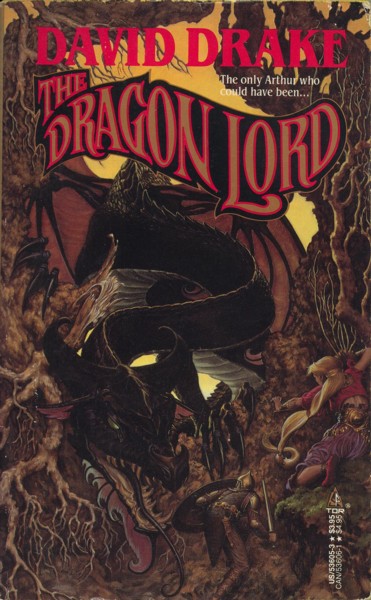
Drake's writing style, distinctly lean and ruthlessly efficient, and his raptor's eye for detail, plus his obsessions and quirks, would often stretch creative muscle over simple or awkward plotting. A case in point is The Dragon Lord, one of my favorite novels of his, a savage take on historical myth with the Camelot crowd, warts and all, serving as supporting players--its wonky back-and-forth traveling plot-structure was more than balanced by the quality of the writing, the research and some engaging characters (traveling and quests are often a part of Drake's longer works regardless of genre; for instance, his Lord of Isles cycle, an epic set almost a 1000 years after a fantasy world's apocalypse, is charmingly told, for all its ambition, in the kind of simple structure that Edgar Rice Burroughs built a successful career around--scatter your protagonists and send them off on separate adventures, while having them attempt to find one another). And The Dragon Lord demonstrated another of the author's talents: the ability to craft credibly menacing creatures with genuine impact and weight; the epic's maturing wyvern, conjured into the world by the scraggly Merlin at the behest of a typically cynical and Drake-esque King Arthur, intended to be employed as a WMD against those pesky Saxons, is used sparingly throughout the book...but it comes across as one helluva intimidating threat by the climax of the story.
Drake was adept in writing horror (primarily in short stories), fantasy (often based in realistically-rendered historical backdrops, though some of his work thus was set in newly-created worlds), and science fiction, the last in harsh military-sf or similarly rugged space opera. He had no qualms about mixing genres. The first and stronger of his two Tom Kelly espionage novels, Skyripper, is as devotedly a Cold War pursuit-thriller as any of its early-Reagan-era ilk, the McGuffin involving a cracked, ingenious Soviet scientist who wants to defect to the US in order to share his conceptual space-warfare plans with Uncle Sam to ward off "an alien invasion" he claims will occur...but there are hints that something is "off" during the brutal multi-threat spy hunt, which results in a hell of an ending, in the tradition of "Just because you're paranoid doesn't mean THEY aren't after you.”
Drake had many interests I share, which would continuously come roaring into his fiction (paleozoology, for instance). History, myth and classical-era literature were integral to much of his bibliography, rather like a bloodthirsty Roger Zelazny (Zelazny's 1969 novel Damnation Alley offered a proto-Drake hardman in a killer vehicle on a nightmare-filled deathworld road-trip). Drake also demonstrated some fascinating contradictions, such as delight in battle-glory action-filled sword & sorcery stories by Robert Howard, and Fritz Leiber (whose Fafhrd and The Gray Mouser bromance tales were repeatedly a big influence on Drake's own characters, fantasy and otherwise) but...Drake's own haunted Vietnam War service acquainted him with the effects of genuine brutality, where there is little glory. [And Leiber, who leaned toward pacifism, was very aware of this in a way that Howard was not. --tm]

Karl Edward Wagner and Drake cowrote a short story that was published in the 1974 first issue of the "little"/"semi-pro" fantasy-fiction magazine Midnight Sun. The tale predated the cult films Without Warning (1980) and Predator (1987) but anticipated something of the alien hunter/predator-on-Earth scenario, though set in ancient Rome. In the '80s, Drake and Wagner nursed the tale into a full-length novel, Killer, which I enjoyed, despite Drake's bad experience with this particular project. The Roman Empire and its frontiers provided a backdrop for his cycle of short bromance historical fantasies featuring the lethal Centurion, Vettius, and his cunning two-fisted merchant pal Dama, as they confront menaces both human and unnatural. Rome also was the setting or inspiration for some of his other short and long fiction. He may have gained a larger audience with the short tale "Ranks of Bronze", which, along with Orson Scott Card's "Ender's Game", I first encountered in the initial volume of Jerry Pournelle's anthology There Will Be War. "Bronze" was expanded into a well-received Bildungsroman novel, which inspired some follow-up books (I first learned about Bildungsromane on his website, an invaluable resource for his fans and scholars).

Not all of Drake's work "popped" for me. For instance, the first and only novel in his proposed "Crystal Walls" series, The Sea Hag, displayed some lively imagination but fell short of the Jack Vance-ian heights he was aiming for. And the follow up to Skyripper seemed to be set in an alternate universe where the conundrum the first book had been building up to was erased. However, a lot of his odd experiments rocked. I warmed up to his "RCN" space-opera series, based, sometimes literally, on Patrick O'Brian's historical Aubrey/Maturin novels. His expansion of Jim Kjelgaard's 1951 paleolithic novel Fire Hunter, The Hunter Returns, enthralled me as much as the original had. His two novels based on Henry Kuttner and C. L. Moore's "Clash By Night", The Jungle and Surface Action, were crammed full of terra-formed Venusian future-naval dreadnaught engagements and horror-choked jungles and seas, another striking deathworld. His take on the Cthulhu Mythos, by way of Joseph Conrad, "Than Curse the Darkness",
was a uniquely feral entry into the pantheon and provided a frightening and absolutely inhuman interpretation of Nyarlathotep, the Dweller in Darkness itself; no chatty Dark Man avatar for this version of the Crawling Chaos (unlike the walking dudes of Robert Bloch's early "The Shadow from the Steeple" and Stephen King's much later The Stand)--Drake's Nyarlathotep was an other-dimensional alien cancer attempting to metastasize throughout our world, summoned to the Congo by those who had been maimed by the Colonials. After humanity has been granted a breather to continue existing, the survivors reflect upon the situation; an American gunslinger, retained as a bodyguard, realizes that he and the singularly unempathic party he is with are the "good guys" and has himself a good laugh. A patented David Drake approach to their victory. That yarn scarred me quite deeply as did a lot of Drake's other efforts.
Finally, he could be quite prescient. His three "Jed Lacey" stories, involving a diagnosed sociopath who is subjected to a behavior-modifying aversion/Ludovico Technique due to his crimes, but who is subsequently "repurposed" as an investigator because he's useful to his AI-governed society, is set in a "Nation without Walls," a near-future United States riddled with omnipresent surveillance technology...a reality accepted by much of the population. When these stories began appearing in the 1970's, a Nation without Walls must have seemed comfortably like fanciful speculative fiction to most readers... 
David Drake and his contributions won't be forgotten by me.

--Jeff Segal

For more of today's short-story posts, please see Patti Abbott's blog.